
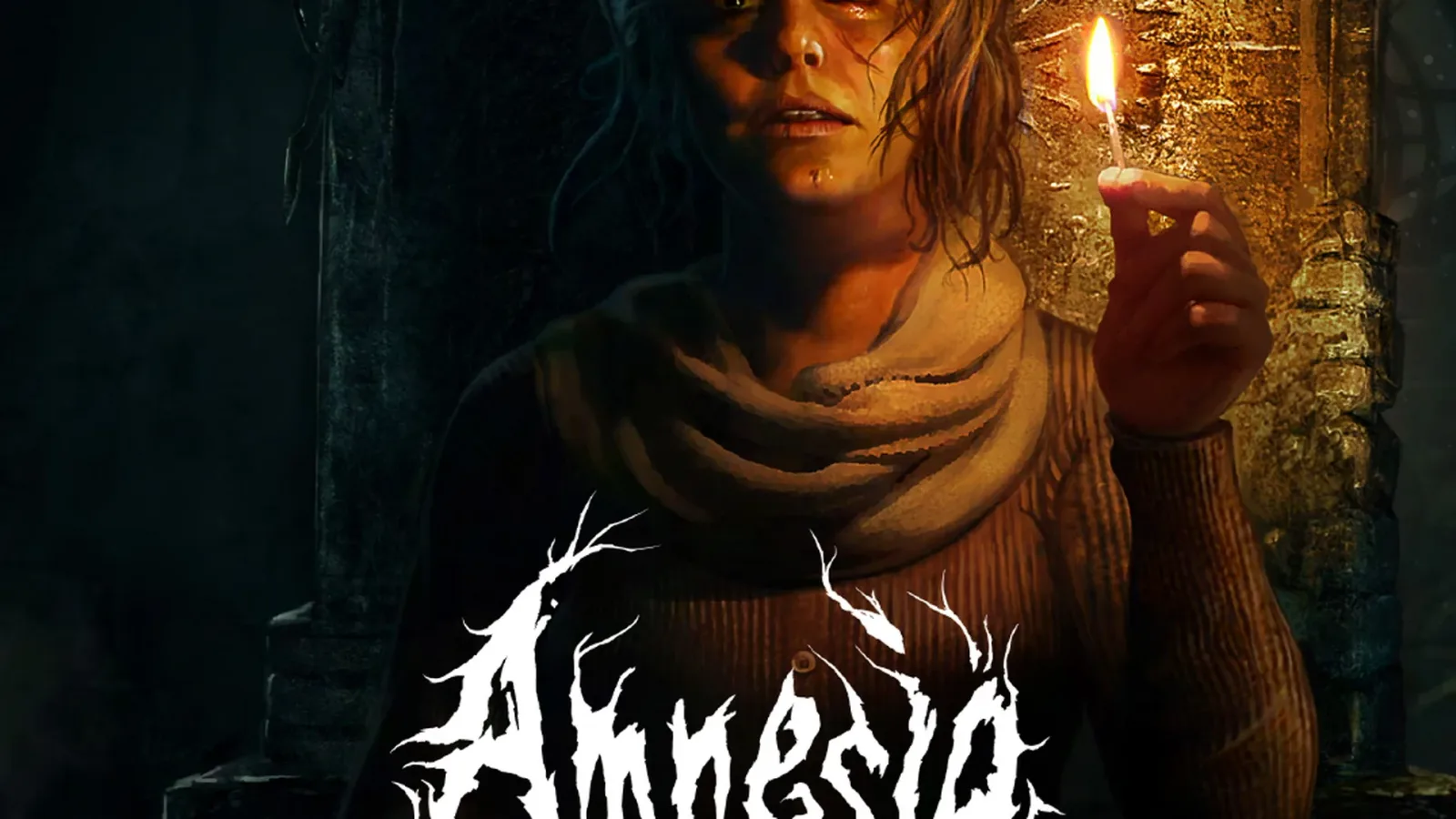
Amnesia: Rebirth
First published in GRIND IV, pages 182–189.
"THE GAME I ABSOLUTELY MUST
TELL YOU ABOUT..."
MARIUS GHINEA
"A PANG
OF THE HEART..."
Very often, when I take a screenshot in a game I mean to review, I'm faced with a dilemma. On the one hand, I feel the need to show you everything interesting and/or beautiful that the game in question has to offer. On the other, if I did that I'd be robbing you of the priceless joy of discovery, of novelty, of the surprise felt by whoever is doing the exploring. What's more, it would be as if I forcibly substituted my eye for yours, when yours may be after a different perspective, opening up to the longing for other horizons, blinking at the gleam of other lights, other colours. I should also confess that I'm a sub-mediocre photographer, and that I have the urges of a mannerist oaf whenever I slap down a screenshot.
If you look at my screenshots, the way they've appeared throughout my career as a 'games' journalist, you'll notice that every angle is the same, every frame taken from the same reference points, devoid of any inspiration – in practice, I ought to ban myself from defiling with screenshots any title that has far more to say than I'm capable of showing.
The only thing keeping me on my feet, able to get out of bed every morning and carry on propelling myself perpendicularly through the day's sections, is the illusion that I'm a nobody only when it comes to visual composition. A fragile prop – and achievements to match.
What's certain is that I get a pang of the heart every time I take a screenshot.
And then again every time I choose from among the many screenshots I collect while playing a game. I feel my own weakness, the fear of showing you too much of the game's substance, but also the fear of hemming in your freedom, conditioning you through the miserable axis of my pupil, that extension of a pitiful would-be mouse-wielder's flailing.
In Amnesia: Rebirth, more than ever, I shied away from the over-revealing screenshot. I think this title has a great deal to offer through the surprise it springs on whoever works through it, through its unexpected diversity, through its references to so many other things you have to find out about during the game and not from photos. And I also think that the way you look at a World is particular and personal, specific to each of us – I didn't want you to see it first through my eye, but through your own.
And what I believe about screenshots in Amnesia: Rebirth holds just as firm when it comes to the game itself, to everything that makes it up. Back in the days of Nivelul 2 magazine, I remember one reader saying they were amazed at how I'd written eight pages about Soma without giving away a single concrete, spoilery thing about the game itself. Now, about the new Amnesia, I want to give away even less, even though my heart is leaping out of my chest with the urge to tell you so much more.
So I'll hold back. I won't go into detail; I'll talk by closing my eye to the game and opening it towards that part of me where Amnesia: Rebirth has left deep marks.
"TENDERLY ANASTASIA AWOKE"
Amnesia: Rebirth, the way I received it, is a game made of two parts. In the first of these, the main character is under the sign of an almost complete forgetting of her own past.
Of course, this is a good opportunity for the game's creators to deploy the already familiar narrative techniques by which, through the heroine's eye, we gradually learn everything about her past and about how she came to be where she now is – in a desert region of north-western Sudan, where France seems to have established a centre of colonial power.
At the start, though, all we know is that Anastasia Trianon wakes from a state of unconsciousness, her memory almost entirely wiped, in the wreckage of the plane with which the mining prospecting expedition she was part of had reached the vicinity of the mine that was its objective. Around her – no one. A radio message, though, received from a member of the team who seems to have reached a safe place, gives Anastasia the push to get up and make the effort to reach that safe place herself, where she could find water, food and shelter, without which she would certainly have died in the middle of the rocky desert she was in at that moment.
Working through stretches of surface scorched by the sun, alternating with passages down in the mine galleries, the heroine finds various documents, fragments of journal, notes, photographs, objects that stir her memories, that tease out something of the tragedy that took place in her recent past, after which the entire expedition she was part of seemed to have vanished – but the important details of that catastrophe are not yet to be found in Anastasia's memory.
The opening of the game is slow in the unfolding of events, a gradual introduction to the gameplay elements, all of them specific to the Amnesia series. Objects are largely manipulable, there are physical puzzles, doors can be opened and closed, and some of them can be bolted shut. The heroine can run and hide, and when she walks slowly, crouching perhaps, she makes no noise.
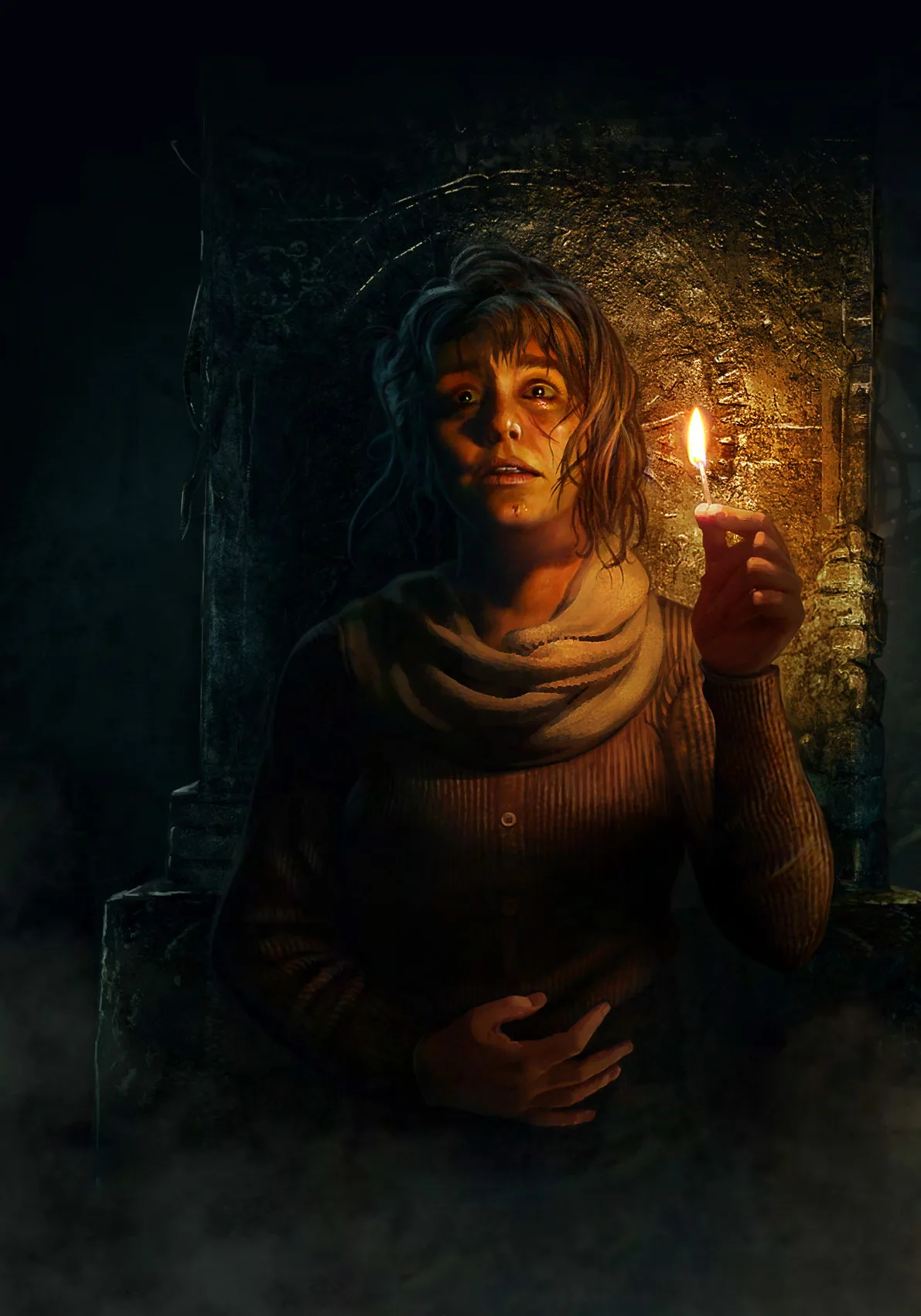
Anastasia is afraid of the dark, and prolonged exposure to it grows her fear, which accumulates gradually and at some point brings on a state of paroxysmal aggression in which the main character loses all control over her own being, has terrifying visions and does things of which she is only partly aware. The game doesn't tell us exactly what, but we're warned that at some point too many such states will have a terrible effect on Anastasia, so it's best to make use of the matches and the oil lamp we have to hand, and of which we find supplies here and there in the game, in such a way as to prevent terror from building up inside the heroine. We also discover that Anastasia is terrified by the sight of the monsters that roam certain places, and by the horrible traces of their passage, among which are numerous decomposing corpses, plus skeletons, bones, faecal matter.
"ON THE SCOPE OF SUBTLETY"
I've noticed from online reviews that quite a few players were 'deflated' by this first part of the game, some even giving up on pushing any further through the wasteland of Amnesia: Rebirth. It's clear to me that expectations were high; plenty of people were still carrying the memory of the intense terror the first Amnesia in the series stirred in them, probably from back when they were kids and PewDiePie was winning his immense popularity on YouTube with Let's Plays of Amnesia:
The Dark Descent, in which he squealed and shrieked histrionically at the game's scares. Frictional Games didn't have a great deal of choice either, and they dug themselves a small hole they can't climb out of with the game's announcement trailer, which pushed the idea of dread, of horror in the fine Amnesia tradition.
The trouble is, the Amnesia players of 2010 aren't the same people any more; they've changed. Ten years on, they've been exposed to so many horror games, some of them inspired by Amnesia, that the classic recipe no longer delights them, their senses are already blunted, and to get their nervous systems back to a state where a new Amnesia can excite them one way or another you'd have to cut off a hand or a leg too, or at least a finger, IRL, so that the majority of users can happily report they shat themselves with fear playing Amnesia: Rebirth.
And yet the new title in the series is the result of a significant evolution on the part of the people at Frictional Games, reflected in the way they conceive horror. Yes, as a gameplay recipe things don't look much changed; the resemblance to The Dark Descent is striking. But the details – which don't make themselves strongly felt in the first part of the game, yet are essential for the player with discernment, feeling and a spirit of observation – the details come to fill, in that player's soul, precisely the space in which the ordinary user would expect to find reasons for fear and jumpscares.
Because in this first half of Rebirth it's the apparently collateral elements of the game that genuinely sustain the player's sensations, and horror isn't the prima donna here, but rather the augmentation, through detail, of a reality that gradually develops unexpected dark corners, in which each of us can find fear and joy at once, according to their soul and their knowledge.
And the scope of Frictional Games' subtlety is by no means small: they stash crates at random, crates carrying the name of a (probably) shipping company – Exupéry. Elsewhere, an inscription mentions Arab alchemists. In another text you find explanations about the monsters and spirits of the desert, come out of the pagan past of the inhabitants of the Sahara's dunes and of the Arabian Peninsula.
And here, suddenly, it wasn't terror itself, pure dread, that found a place in me as a player, but an entire subterranean complex of feelings and sensations woken by everything that such things have meant in my past. One of the strongest memories of my childhood is a story from "One Thousand and One Nights" featuring two ifrits. But I had another intense experience reading Antoine de Saint-Exupéry too, and I'm not talking only about "The Little Prince" here. And the Arab occultists, real or invented, are at the root of some of the Lovecraftian quests, in the role of weavers of esoteric mirages who drive tragic heroes towards suffering, knowledge and death.
And then there are the signs of life in the Foreign Legion – photographs, texts, posters, personal effects, weapons – which send you straight off towards so many writings and films. Somewhere, the impression has taken hold that a game's developers have to do all the work themselves if they're to impress you, the player. Somewhere, the impression has become general that you merely have to lie back and spread your legs, fly undone, and the game has to perform with velvety lips over your primary organ of sense, delivering all the sensations promised in the wooden language of the marketing departments and in cunningly cut trailers designed to condition you to await their product with bated breath and your bank card peeking out from the folds of your wallet. Somewhere, there was the impression that Amnesia:
Rebirth was supposed to be a horror game that would hand over every sensation from that unwritten but assumed sales contract which powers an entire entertainment industry.
But it turns out that isn't the case. Rebirth is a far more evolved game, one that requires you too, the player. What counts in this game isn't so much the raw horror, the elements meant to trigger your fear directly and immediately, but the environment, the context in which that fear appears, generating a whole internal mise-en-scène in the player's mind, a subjective mirror of the one in the game. Because this isn't a stage where the actors of horror perform, with armchairs set in front of it where spectator-players sit munching popcorn and drinking cola: it's a stage in front of a stage. On one, Amnesia: Rebirth is playing; on the other, you, the player, are the lead actor, in a complete spectacle of the World that needs all of us – you, me, him, her, them, Frictional Games, all of us who want to squeeze into a horror game just to catch a scrap of sensation, a spark of experience, and who can get nothing at all without building the stage on this subject. An entire series of colonial-culture elements opens perspectives onto other histories, other lives. But the architecture of the buildings and vestiges, and the little pagan monuments out in the desert and in the depths, join in opening new horizons of feeling and understanding too, enormously enriching what can no longer be merely a game of dread and terror like The Dark Descent. Rebirth is the work of people who have far more to express, and who now know how to do it.
"RESONANCES"
from within us, without bringing our own script, our own set, our own spirit and our own acting talent for our own memories, experiences, knowledge and attempts at life.
For it isn't the horror itself that counts in this first half of the game, but its expression – through context, setting and detail.
Things from my memory, from my stock of knowledge and feeling, brought the insignificant details of Rebirth to life, filling the place where for some there is nothing but a void, a frustration, an apparent lack of substance. Lovecraft's mad Arabs, Exupéry's Little Prince, the ifrits of "One Thousand and One Nights", films and books about Colonial France, the architecture peculiar to the peoples of the North African desert, and the cults of the ancient mysteries – all of these sustain and widen the spectrum of feeling in which horror too finds its place, though not alone, not dominant, without masking the expression of the game's creators, reaching out towards so many other horizons.
What better example of that than the decommissioned armoured vehicle you come across in the first part of the game? Do you remember the articles in Level that I signed as "Ștefan aPIIIG", ar- ticles about games set during the Second World War? They were written together with Radu, a very good friend of mine, who is more than a bipedal encyclopaedia on the subject. Of course I called Radu and told him about that armoured vehicle, described it to him, and what followed was an hour and a bit of the history of French armour of the era the game is set in – context, origins, versions, and details of how the turrets were traversed and the gun fired – fascinating, exactly as it happens in Amnesia: Rebirth, a sign that the developers of this title did an exemplary job, down to the smallest functional and visual detail.
And just like that, in the courtyard of that Foreign Legion fort, one more source of meaning, of feeling, of knowledge and recognition turned up, alongside the others I had already had my eye on.
But all of this required me, required us: it wasn't just a stroll through the "Tunnel of Horror" where we pay at the gate and then sit in a row waiting for sensations of horror and dread to be poured, thick and generous, into the empty vessels of our beings.
"LIFE AS PREY"
What the makers of Amnesia: Rebirth pulled off extraordinarily well is the gradation of the game's horror component. It takes shape gradually, first through a long opening half in which the monsters' contribution to the overall horror only creeps in little by little. And even after that, the actual appearance of the monsters is strictly controlled, with a genre master's hand, modulating your states without overdoing it, without gratuitously flinging hordes of monsters at you, but bringing them on exactly when, how and how many units of monster per kilocorp are needed to avoid overdosing you – while still, without fail, engineering those moments of paroxysm that make Rebirth a true Amnesia title.
I was impressed by the flawless logic of the monsters' appearances: as the game turns from interrogation into revelation, they stop being accidental, random arrivals. Behind every encounter with the "enemies" there is a reason, an aggravating circumstance, a story thread that justifies the monsters' existence – sometimes through their very names and what they add to this game's epic.
As in every Amnesia title, you can't kill the monsters; you can only steer clear of them, hide, run from them, try to outwit them. And that's not easy at all – escaping a monster is very hard, and they found me many times over. Monsters aren't dangerous only in themselves, but because they force you to hide in secluded, dark places – and that's where fear grows in you, the fear that accumulates gradually in your soul and triggers those strange fits of losing control of yourself, of aggression, of terrifying visions.
Those are the fits after which something in you is ever more changed, something drags you ever closer to an ending you suspect is appalling, without your knowing what exactly will happen if you give yourself over more and more to the fits of madness that fear sets off.
And in fact this is where Frictional Games' master's hand makes itself felt once again where the horror genre is concerned: you are permanently prey, always under threat of danger. You know you have to keep away from the monsters, but that means hiding, often in dark places that grow your inner terror. So you stand between the fear of what's outside and the fear gnawing deeper and deeper inside, in your being, in your mind. And you don't even know what could happen to you if fear transforms you completely, you don't know what you will become, you don't know what that will mean for you in the context of the game. Because, well, you do take care to keep out of their way, and though you can see yourself changing bit by bit after each fit, you haven't yet reached the end of your mind's strength, you still feel able to carry on, the game isn't over yet. But the tension of the transformation presses on relentlessly, while the fear of the monsters strikes hard and short, well graded and timed by its directors.
I have to admit that at one point I stopped playing, took off my headphones, held my head in my hands and just sat there, mute with admiration, thinking in wonder and delight about the skill of the people who had pulled off such a beautiful piece of horror craft. It was a moment of catharsis, of enthusiasm, brought on by an intense awareness of the game's mechanics and the finesse with which their parameters had been tuned.
What's more, I was profoundly impressed by the handful of sequences in which you flee a direct threat. Everything plays out brutally, every sense is assaulted, time seems to dilate because the brain dumps danger chemicals into your blood, breathing quickens, your pulse climbs, frames follow one another cinematically, colours start to smear, perspective narrows, the sounds behind you seem to scorch your neck, you see junctions where you can go two or three ways, you pick one at random, you wonder whether it was the right one, you cross another intersection, pick at random again, you wonder what's on the path you didn't take, "what's going to happen now?", you jump, you throw yourself down, you sneak feverishly, you run again, you tumble into a chasm yawning beneath your feet, you've landed on the flagstones of a corridor, it looks very old, you can barely make out a door in front of you in the dark, you surge up off the floor to its bolt, you open it, you slam it shut behind you, you throw the latch, you breathe out, an immense weight off your shoulders, you've got away. You've got away once again. You can go on.
“FORGETTING
A NEW BEGINNING”
Gradually, as I approached the halfway point of the game, a change took place inside me, subtle at first, then more and more marked. You see, in its first half the game makes you fear for yourself, makes you look at yourself alone as a possible victim.
It's just you, among those still alive, whom you know could be attacked by something at any moment, or could be suffering from something. You know nothing about these somethings, you understand almost nothing of everything that seems to have happened, or is about to happen. Ignorance strands you alone in your dread.
As the heroine presses on, though, she discovers more and more, reads, sees, remembers. And gradually she begins to understand. Gradually you begin to understand. Gradually your perspective widens, more and more, until it begins to take in a whole World. And what started as fear for yourself begins to turn into a fear on a scale that a single soul can barely bear, if it ever comes to understand it and feel it in full.
From fear for yourself, through a process of painful transfiguration, the heroine – you – can arrive at fear for your neighbour: the dread born of empathy and compassion, the terror in the face of the suffering of the other, of the others, of all the others. Consciousness wakes under the whip of knowledge, opening you to ethical dilemmas that cannot be solved, only drowned in the tears of a heart that bleeds at the sight of villainy and wickedness victorious over worlds.
The gradual transformation of the dread, the fear, the horror, the terror felt by the heroine is like the passage from fear of the baton of an SS guard to the complete and direct awareness of the mass murder carried out by the whole
CA
Nazi concentration camp system, and then of every concentration camp system that has been, is, and will be.
The game puts you in the middle of a veritable allegory of human existence in the World: of the instincts that drive it, of the sacrifices and the baseness it is capable of, of the ignorance that blinds it to the suffering of its neighbour, of the knowledge that opens it to empathy and to the sharing of that suffering.
And Amnesia: Rebirth does this masterfully, devastatingly – it touches precisely those inner strings that help you identify with the heroine and become, in your turn, a participant body and soul in what has every hallmark of an exemplary drama, eternal and universal, a cycle born of forgetting and taken up again without respite by the thirst to know, once and again, and again, until there is no more time.
And then I feel the need to ask, exactly as I did when I wrote about A Machine for Pigs: what greater horror could there be? What soul can withstand the pressure of such a revelation? Are we still talking about a horror game here, one from which we should be demanding scares to jolt our numbed senses?
When the stakes are so high, the creators of Amnesia: Rebirth can play no other card than that of our empathy and humanity, in the hope that we will feel in full everything they want to convey to us, and that it will change us, exactly as Anastasia, the heroine, may perhaps change too.
What's at stake in this game is no longer instilling the fear of a scare in us, no longer the design of the perfect “jump scare”, but the very purity and warmth of your heart. Your soul is the child you bring up for a lifetime inside your body, without knowing what will become of it when you let it go from the arms of your being, driving it out with your last breath. The stake of the whole game is that child.
From fear for yourself to consciousness and empathy. Amnesia: Rebirth builds the scaffolding of a stage on which you get the chance to become – through ignorance and knowledge, through forgetting and remembering, through joy and suffering, through solitude and communion. Becoming through fear and courage can mean everything, far more than satisfying the appetite of a user waiting to be scared by a bunch of game developers.
“AMNESIA: DEADLY SHADOWS”
For the graphics, Frictional Games used version 3.5 of their in-house engine, called HPL (yes, it comes from H.
P. Lovecraft). This time there is global illumination with shadows for the exterior scenes. Another improvement is level streaming, which does away with having to break up the passage from one level to the next with loading screens. These are all important things, but on top of them comes the talent of the people who put the HPL 3.5 engine to use, and thanks to whom the game looks spectacular. What struck me from the very start was the wide view over the dunes of wind-whipped sand, the bare rocks scorched by the sun – the desert is vibrant, menacing, mysterious.
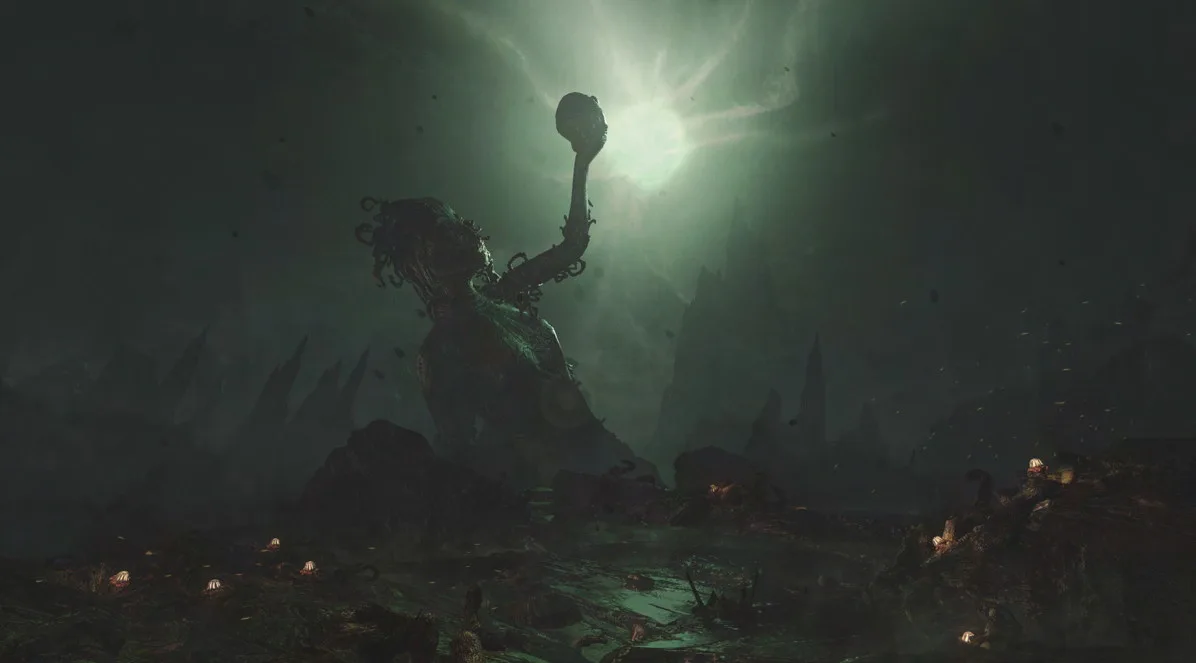
The buildings, the ruins, the underground spaces of Africa evoke history and histories, and their variety comes as a surprise. Precisely to justify the architectural variety, there is a credible historical background to the place, one that starts with the cult of Mithras in the Roman era, passes through the Arab conquest of the time of the jihad, and arrives at the local pagan population and the French colonial occupation. And among all this there is something else, points of connection to another World, portals that Anastasia can detect and use with the help of a peculiar compass that she wakes up wearing as a bracelet. These portals look a certain, distinctive way, but they are nothing next to the other World you end up in. There everything is different, everything is strange, dark, the colour palette is unusual, and the architecture has something superhuman about it – as you might expect in a place where alchemy is not laughed at, but works in full as a science effective enough to master not just one World, but all of them.
In Amnesia: Rebirth I was stunned by the way light is rendered, often creating indoors the chiaroscuro I loved so much in Thief: Deadly Shadows.
I also have to tell you how well the sound is done in this game – it is organic, well balanced, realistic, perfectly integrated into the scenes. The music steps in with great discretion, exactly as much as is needed, and the leitmotif of a simple lullaby seems to push the whole game along, in crescendo, towards the inexorable. But it does so, again, discreetly, almost subliminally.
This time the voices are very important in Amnesia; they are not merely narrators, but active participants in a story that isn't only read in the messages and documents left here and there, but is in full flow. The heroine's voice especially struck me – I tell you honestly that if there were an Oscar for voice acting in a
Yes, and here too the shadow is deadly, and the graphics render this continuous tension brought by darkness, but also the vibration, life-giving and full of hope, born of the constant, fine oscillation between dark and lit, brought by the flickering flame of a candle, or of a torch.
Out in the African open, the sun burns, you can almost feel it physically. But it also brings limpidity, clarity, giving the eye the chance to look into the distance, towards a possible deliverance. As it happens, this very feeling, evoked by various elements in the game – a distant light, the static hiss of a radio transceiver, the whimper of a child, running water, the outline of houses on the horizon – this very feeling of a possible escape reminded me very powerfully of a story by Villiers de LʼIsle-Adam called “The Torture of Hope”, from the volume “Cruel Tales and Unusual Stories”, published in 1883, and published over here in several editions too (I own this one). Yes, alongside the continuous tension induced by the heroine's gradual transformation into something you know nothing about but fear, there is also the torture of hope, the hope evoked by Anastasia's warm voice, which you hear when she talks to her silent companion, the one she carries with her.
“VOX HUMANA”
game, I'd give the Nobel Prize to the woman who plays Anastasia Trianon. It strikes me as one of the most memorable vocal performances ever; it reaches right down into the depths of your being, it makes you resonate, it keeps you at Anastasia's side until, in moments of dramatic paroxysm, you yourself become Anastasia.
It is a nuanced voice, full of feeling, passing so easily from past to present, building so humanly the future in which, perhaps, there is still one more day, and then one more. It is a voice capable of despair and hope, of strength and fragility. It is a voice that carries, a beautiful voice.
It is the voice that suddenly opened my eyes, handing me a revelation I badly needed, without my having known it. For
The game's “action” scenes also play to the eye: they have a very pronounced cinematic character, playing with your mind through effects that distort shapes and colours, with dynamic filters, with rapid successions of frames that could each, on its own, be a drawing by Goya. Oh yes, Goya, Frictional Games owe you a whole lifetime of laying flowers at your grave, as part of an annual private ceremony – so much inspiration they seem to have drawn from your visions.
I was pleased that Amnesia: Rebirth doesn't eat up much in the way of CPU and GPU resources, for a title that came out this year. My computer – an AMD FX-8370 with a Radeon R9 285 graphics card and 2 GB of video memory – is a relic by any current gamer's standards, yet it ran Amnesia: Rebirth impeccably. The game is extremely well optimised, without ever giving the impression that it cuts corners on today's visual quality standards. From that angle, I found it astonishing how the game's developers manage to evoke vast spaces and grand architecture, constantly serving up consistent graphical detail in every direction and at any distance you look – and so credibly creating the illusion of an entire world, still functioning in its immense, monstrous machinery. For many years, ever since I played the Penumbra series, I've felt something distinct, something special in the horror games of the people at Frictional Games. The same thing drew me to the first Amnesia, and to A Machine for Pigs, where Frictional Games' contribution is palpable. And in Soma I felt that something specific to Frictional Games' horror even more intensely.
Well, as Anastasia's voice spoke to me, I finally understood what draws me to Frictional Games' games: delicacy. The people at Frictional Games are delicate in the way they build their characters – whom they regard as real people, with a right to respect, dignity and compassion. Their characters aren't used inhumanely as instruments for creating and amplifying horror; they are, like you and me, poor human beings caught between the wheels of the machinery that dictates our existence. If they turn into monsters, there's a logic behind the transformation, there's an epic thread you can sense, and there is always what I read as a concern for that character, however low they may have sunk.
Although they had the chance to shock, to assault our senses with graphical detail intended for a mature audience, although they could have overplayed the novelty elements in horror, and in a game's realism too, the people at Frictional Games chose to be delicate, almost to the point where we can talk about modesty itself – but in the best possible sense: respect for human dignity, a natural decency welling up from the warm souls of decent people.
And maybe that's what struck me as all the more contrasting in Amnesia: Rebirth – everyone was expecting a horror, something terrifying that would fling their nervous systems back into the loop of the much-coveted jump scare.
But we were given something else, we were given far more, by a development team that has evolved enormously since Penumbra, each game bringing more and more to the surface the treasure buried deep in the hearts of the Frictional Games people: delicacy as a way of expressing love, compassion, understanding.
I'm profoundly grateful to the creators of this game for what they gave me when they put me inside the being of Anastasia Trianon.
I was given a lesson, I was taken through an experience that, as a man, I could never have had, and which I will never forget never, because it changed me for good. My soul was opened by a story whose power lies in setting the plane of personal, intimate experience against the allegory of the World and the dreadful way it works. I understood with astonishment that Exupéry doesn't turn up on some boxes in the game for nothing, because a being like the Little Prince fulfils his destiny in the heroine's soul, in parallel with and in opposition to what would be horror, if it weren't the real truth, and just a fabrication sold to minds eager to squeeze the maximum sensation out of the spectacle they'd paid for.
Because I believe the game doesn't talk to us about indescribable horrors, but, far more sensitively and delicately, puts us face to face with the indescribable in our own humanity.
If I were to tell you what kind of game Amnesia: Rebirth is, I couldn't call it horror. If you ask me what genre Amnesia: Rebirth belongs to, my answer would be simple. Genre: human.
P.S. After I'd finished writing this article, I realised I'd forgotten to tell you a few things. First of all, you should know that the game has some interesting puzzles that set you observing and thinking. There aren't many; there are exactly as many as there need to be for the game not to be pointlessly broken out of its natural flow, out of its rhythm so carefully tuned to your heartbeat.
And since I've arrived at immersion, I have to confess that I couldn't play Amnesia: Rebirth during the day, in the light. Every day I waited with bated breath for midnight to come, only then starting my 3-4-hour session, at the hour when everything grows quiet, leaving room for the spawning of phantoms born out of shadows and silence.
A good-quality audio system and headphones chosen with real care helped a great deal – I'll be writing about them soon in the “audio” column.
Hmm, now I realise the next Thief should be made by Frictional Games…
I'd have something else to add here, in the postscript, but I hesitate – honestly, I do hesitate.
Anyway, it's a small oddity, maybe a minor coincidence, I've no idea, but it's something that left me a bit unsettled, even though I'm not the religious sort and don't usually pay attention to such things, but… well… After I'd finished this article I found out, completely by chance, that the date I started writing it, namely 22 December, is the feast day of Saint Anastasia the Martyr.
Touched by this coincidence, I read about her life – well, in a text that limps badly in the way it regards non-Christians with hatred, heaping every villainy imaginable on them, while Christians are God's little ornaments. But once you scrape away the callous dross the Church has poured into the telling of her life, poor Anastasia remains herself, in the fullness of her love for people and the responsibility she shows towards those in need.
I don't know which of the three endings you got in Amnesia: Rebirth, but my Anastasia will always remain a martyr in my calendar.
For what other kind of person would be worthier of bearing the name of the Resurrection?
LEFTCLICKGHINEA.ro