
DOOM Guy: Life in First Person

First published in GRIND III, pages 180–181.
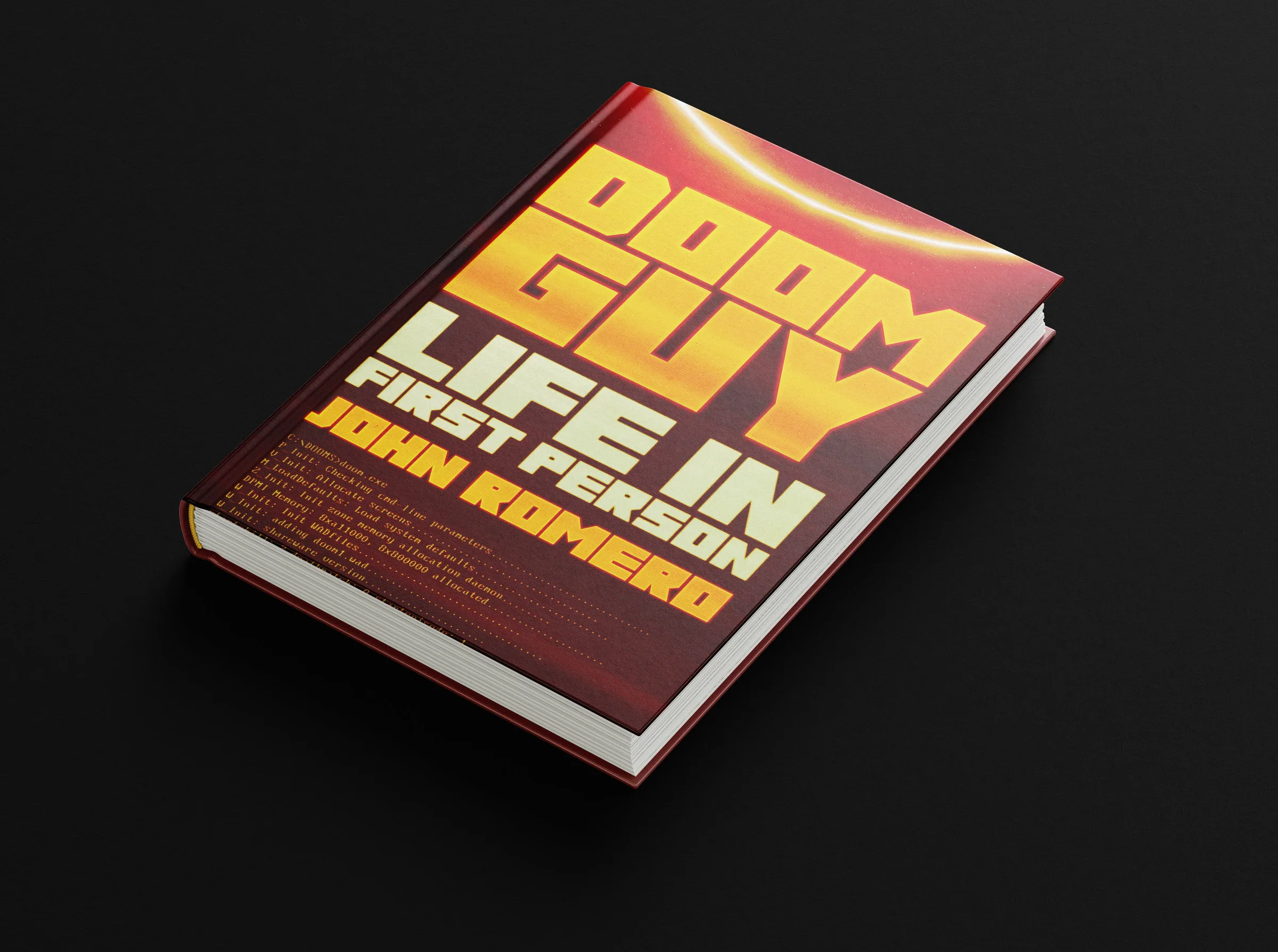

AUTHOR JOHN ROMERO
LANGUAGE ENGLISH
PAGES 384
“DOOM made gaming cool and transformed game developers from enthusiasts into true rock stars, and John Romero’s bold public persona defined that era.”
DOOM Guy: Life in First Person has become my new pre-bedtime habit and, at the same time, the main reason my mornings start a little slower, because I read until the small hours. After reading Masters of Doom last year, I thought I’d had my fill of id Software, Doom, Wolfenstein 3-D and everything that made up the birth of FPSs in the ’90s. Oh, but how wrong I was!
John Romero’s autobiography landed, as the poet says, “like a punch in the eye”!
At first I meant to order it in physical format and, once read, put it in a place of honour beside my copy of David Kushner’s Masters of Doom and Jason
Schreier’s Blood, Sweat, and Pixels... but I ran out of patience and got the digital ebook version from Amazon. I don’t know whether you lot are autobiography fans or not, but I can tell you DOOM Guy isn’t that kind of boring book. John Romero has talked at plenty of conferences and interviews about his time working at id Software, but less about his childhood and his early years.
You’d say he did the right thing; family stories are boooring anyway, we want to know how he programmed Wolfenstein 3-D, Doom, Quake, Hexen and other bad ass games!
Tim Sweeney, CEO of Epic Games. Ok, fair enough, and I was curious too. But without giving you any spoilers, our man didn’t have the happiest childhood, and that shaped his career and the games he programmed enormously.
I don’t want to write you an essay about the book, nor necessarily a review, just to recommend that you read it. DOOM Guy isn’t necessarily an autobiography. Take out the first chapters about John’s childhood and the rest of the book is a history textbook of modern gaming, with the emphasis on the first-person shooters that defined the genre and changed the industry for good. What’s interesting to take away from the first pages of the book is that Romero has a special condition that lets him recall moments from his past in lavish detail. That gives his autobiography extraordinary accuracy and makes it rich in
J ohn Romero, John Carmack and Tom Hall are the three “magnificent” men who revolutionised the gaming industry, founding id Software in 1991, the studio that gave us floppy disks with Wolfenstein 3-D, Commander Keen, DOOM 1&2, Quake and many other games that today hold legendary status. The revolution began when John Carmack and Tom Hall created Dangerous Dave in Copyright Infringement, a demo that reproduced the first level of Super Mario Bros 3, except that in place of Mario the main character was Romero’s Dangerous Dave. It was the first time a PC could generate fast side-scrolling, something possible only on consoles until then.
John Romero, the Icon of Sin technical details that add value and create nostalgia for some of us. Don’t panic, it isn’t a programming book; by technical details I mean the hardware he was using at the start to develop his first games, and how an Apple II bought by his stepfather changed his life and cemented his passion for programming and games.
The book paints a very good picture of what the gaming industry looked like in the ’80s and what the challenges were back then. How hard or easy it was to land a job as a game programmer, and how games were distributed through monthly subscriptions to certain publications (e.g. Softdisk) or later through the now-famous shareware. At the moment I’ve only got as far as chapter XII, where Romero tells the story of how development began on the most famous FPS in history – DOOM. I said at the beginning that for me this is an evening read and I try to savour it as much as I can. It’s as if Romero were telling me a bedtime story. More than once I minimise the Kindle app and go into Google to look up certain references from the book, whether it’s some piece of hardware, a game cover, or other interesting things Romero mentions that I knew nothing about until that moment.
As a retro-gaming enthusiast, I love discovering new information about the games that came out back then and how the first big gaming studios, among them Apogee and Raven Studios, came into being.
I also recommend the books below:
Masters of Doom – details the fascinating story of John Carmack and John Romero, the two legendary programmers who created Wolfenstein, Doom and Quake. The book reveals the intrigues, innovations and conflicts that sculpted the path of the modern gaming industry. Together with DOOM Guy: Life in First Person, the two books offer perhaps the best picture of the history of the first FPS games, and especially of the legendary id Software studio.
Blood, Sweat, and Pixels – explores the challenges, sacrifices and passion involved in creating famous titles such as Diablo III, Destiny or Star Wars 1313. Each chapter focuses on a unique development story, revealing the inherent obstacles, from indie games to AAA titles. Schreier recounts the efforts of the development team, giving readers a deep understanding of the true creative process.
DOOM Guy runs to 384 pages in the physical version and somewhere around 8 hours of reading in the digital version. It’s divided into 4 big sections, suggestively called “episodes” (an easter egg from Wolfenstein or Doom), and each episode carries the name of the development stages that make up the game creation process: Prototyping, Development, Launch and Post-Launch. For audiobook fans, the book is also available in audio format, narrated by Romero himself.
I can only wholeheartedly recommend DOOM Guy: Life in First Person, a must-read book for any gamer!
Leo Luția