
Foundation – Review

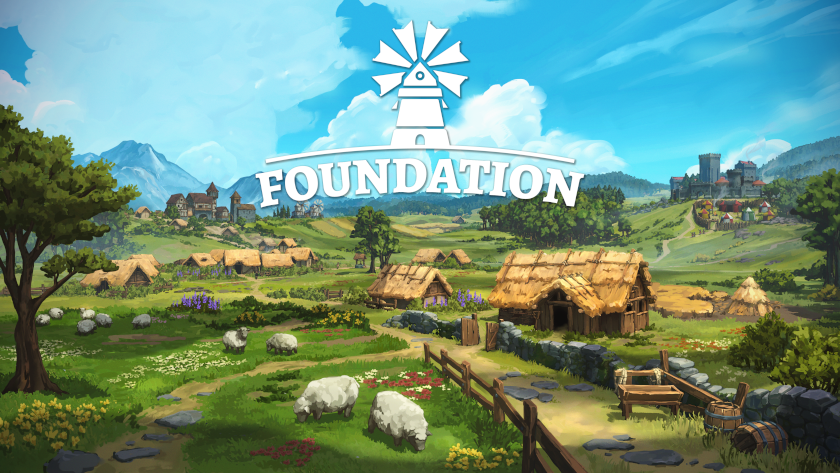
There's life beyond the grid!
This time, I've chosen to tell you a bit about Foundation, one of the most ambitious medieval city-builders launched in recent years, created by Canadian studio Polymorph Games and officially released in January 2025, after a very long period in early access. In a market dominated by games that adhere to classic strategy and construction recipes, Foundation offers something different: urban management without the rigid grid system, with an organic, fluid design and creative freedom.
Unlike legendary titles in the genre, such as Frostpunk, in Foundation the pressure doesn't come from extreme survival, but from the desire to create something beautiful, functional, and durable. It's a game that doesn't pressure you with constant catastrophes, but tests your patience, aesthetic sense, and ability to think long-term. It doesn't overwhelm you from the first minutes with a wave of information or endless tutorials. Instead, the learning process is progressive and intuitive. You'll start by building the simplest structures: a wooden hut, a logging camp, a small warehouse, and then expand your own city! This is why every choice becomes a piece in a larger puzzle.
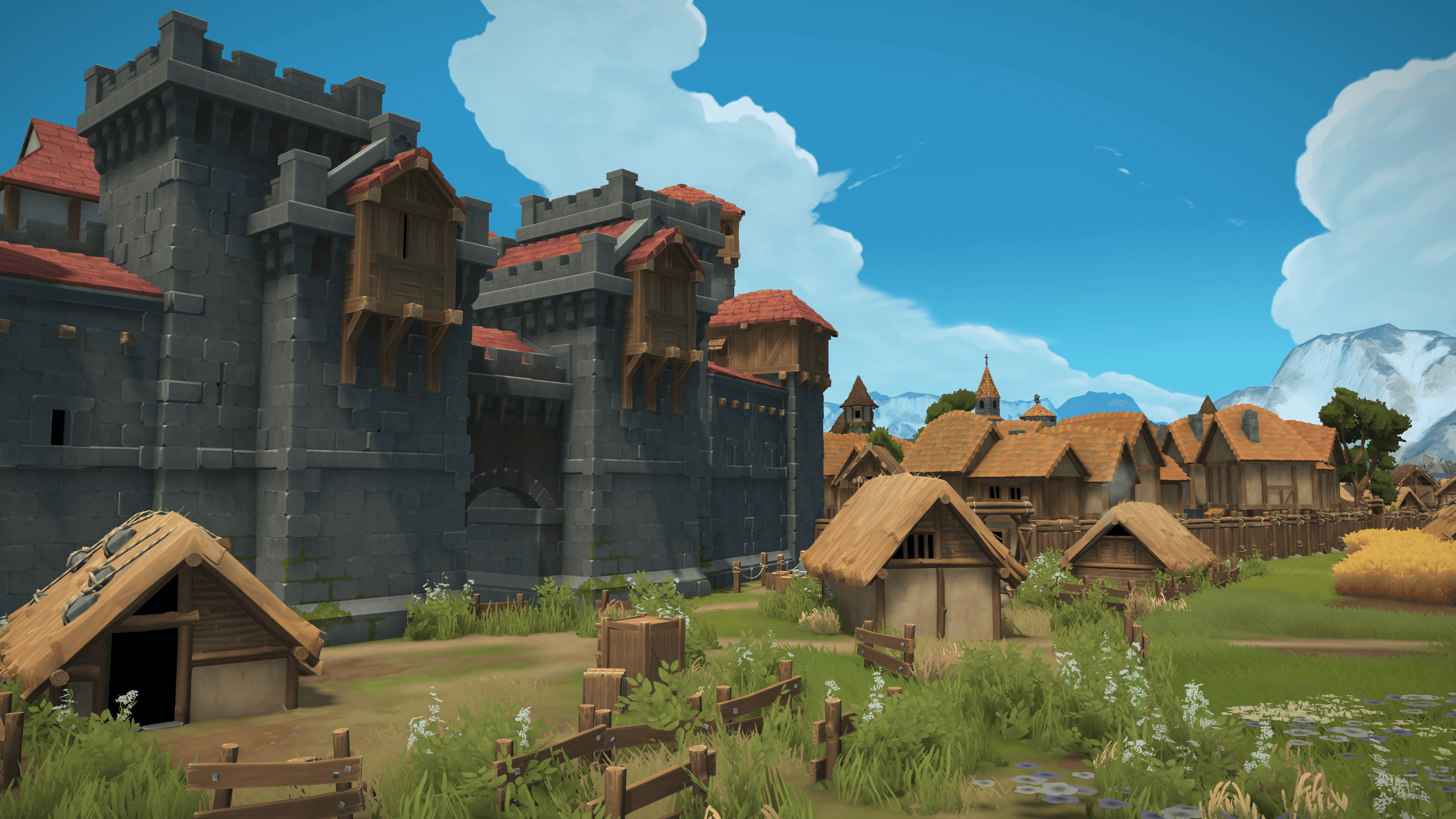
Compared to classic games like The Settlers or Anno, Foundation initially seems simple. But, as you progress, you realise it's much deeper, thanks to the way its different systems interact. It doesn't offer you ten different types of resources, but a few, which interact intelligently and logically. This is where the pace comes from, suitable for those who don't want constant pressure, but rather a calm building experience that allows you to construct your magnum opus.
Foundation doesn't have a traditional story, with cinematic sequences or elaborate characters. The game prefers to give you the freedom to write your own story, step by step, through the way you build and develop your medieval settlement. Foundation puts you in the shoes of a leader tasked with raising a new city on an empty plot of land, surrounded by forests, fields, and natural resources. This is where your journey begins: a small group of colonists follow your decisions and await your instructions, for you to build them homes, provide them with jobs, and ensure they have food. There isn't a classic "campaign", but a sandbox experience, with different scenarios and maps, where the main objective is to create a prosperous society.
The developer chose to maintain narrative minimalism precisely to emphasise the player's creative freedom. As such, each city becomes unique, and the satisfaction comes from the fact that your city truly looks different from others, because it is shaped organically, not forced by an invisible grid.
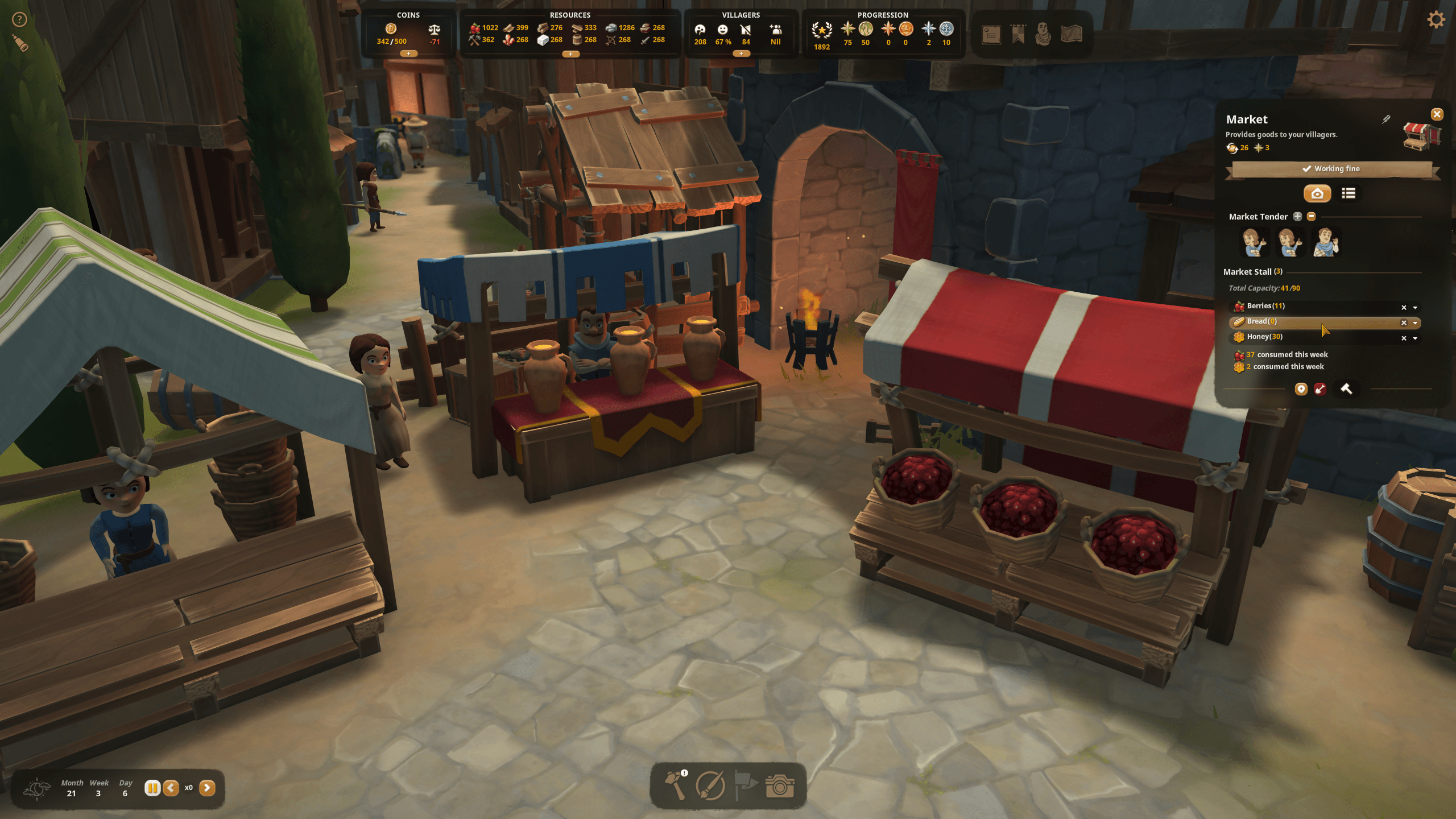
The big innovation is, as I mentioned, the gridless system. Unlike other city-builders, there are no squares here to dictate where you place buildings. You can place them freely, depending on the terrain, resources, and your personal taste. And speaking of planning and infrastructure, roads aren't even manually drawn: inhabitants "tread" paths according to their daily routes, and these paths become natural roads. The result? Cities that look authentically medieval, not like mathematical models. This minor detail completely changes the experience and gives you the feeling that you're not just a cold and detached manager, but a kind of visionary architect shaping the daily lives of the colonists.
Another unique element is the way you construct large buildings, such as monasteries, cathedrals, or castles. Foundation introduces a modular system: you don't erect a fixed building, but compose it from pieces, choosing towers, bell towers, wings, and inner courtyards. The final result is not just a functional structure, but also a personalised work that reflects your style. It's one of those features that makes each session different and unique.
Medieval society in Foundation is symbolically divided into three branches: Labour (serfs), Clergy (the clergy), and Kingdom (the nobility). The progress of your city depends on the balance between these forces.
- If you choose to favour Labour, you will develop the economic infrastructure.
- If you support the Clergy, you will build abbeys and gain access to various monastic-themed buildings, bonuses, and products.
- If you support the Kingdom, you will construct fortifications and have gameplay focused on the army, raids, and other elements from that domain.
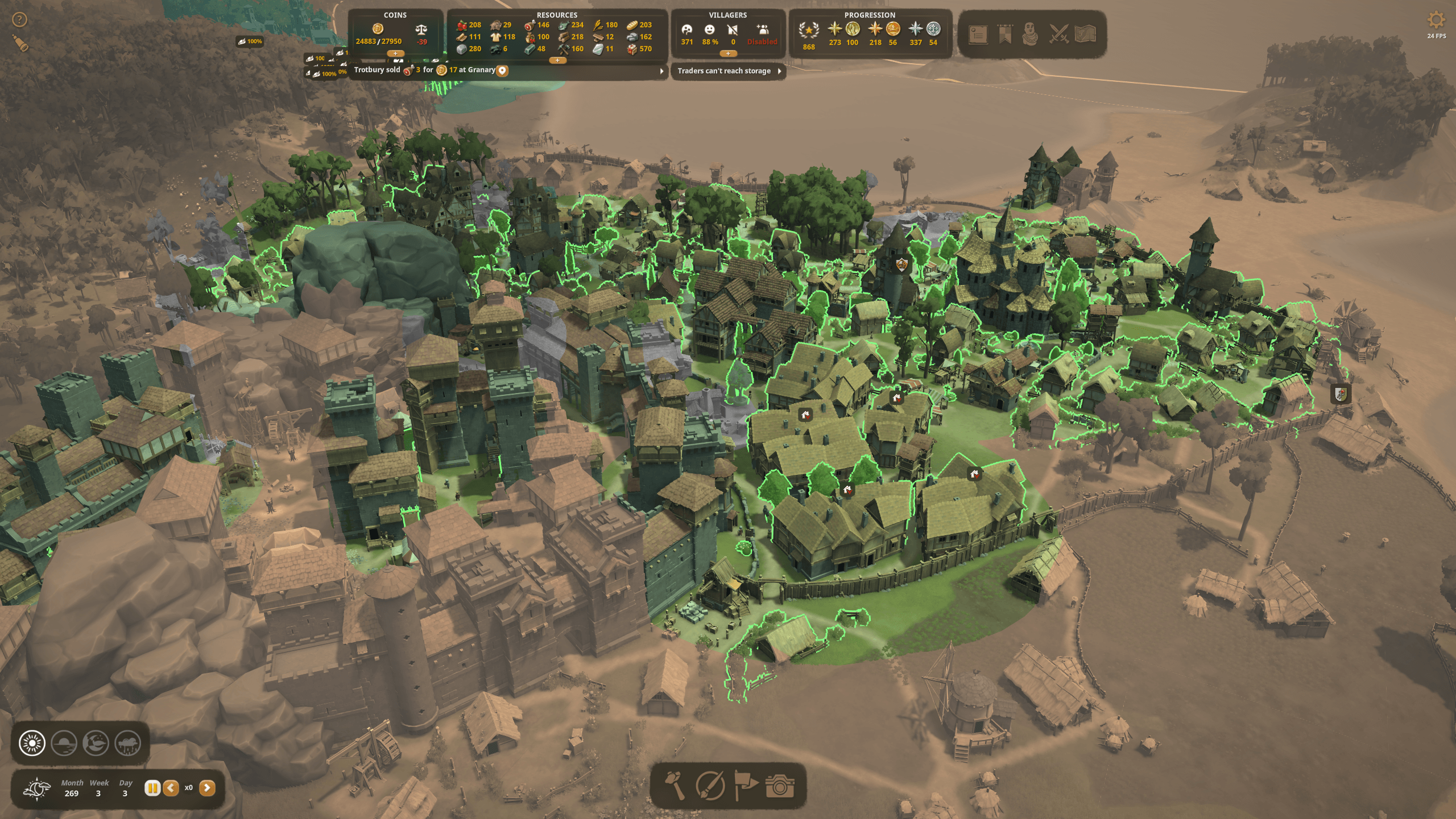
Another distinct mechanism is the terrain painting system. Instead of manually building every road or house, you draw zones: here people live, here they cut down the forest, here they cultivate the land, and so on. The inhabitants adapt and live their lives according to the established zones. The result is a more unique experience due to the antithesis, as it is both relaxing and strategic: you don't control everything down to the millimetre, but merely direct the city's evolution. The game manages, in its own way, to transform you into a kind of Magnus Carlsen of city-builders. An interesting detail is that dwellings are not built directly by the player, but appear according to the zones you designate and the attractiveness level of the neighbourhood. This makes the city grow naturally: people decide where to build their homes, and you are more of a guide than an urbanistic dictator. As a result, you might encounter different situations you didn't expect! Perhaps you want the mine workers to live close to their workplace, but they choose to build a house closer to the church or the market. The result is a more vibrant city, but also a constant challenge for logistical planning.
The last point worth mentioning is the modularity of constructions. This feature adds an artistic dimension rarely seen in the genre. You don't just erect a church or an abbey; you compose an architectural piece to your liking. Each city thus becomes a unique experiment, and the ability to combine towers, wings, bell towers, and decorative details creates an authentic sense of authorship. In few strategy games do you feel you have such a visible personal signature.
The developer has encouraged modding from the start, and the community has created not only new buildings and ornaments that can be used in the game, but also alternative scenarios and economic systems. The community helped Foundation build a solid foundation, which serves as the basis for a varied modding scene and a small but unique community. Many have been drawn to the meditative atmosphere of the title: you place your first buildings, watch the colonists make their roads, listen to the quiet of the forest, the subtle music, and see your small community grow.
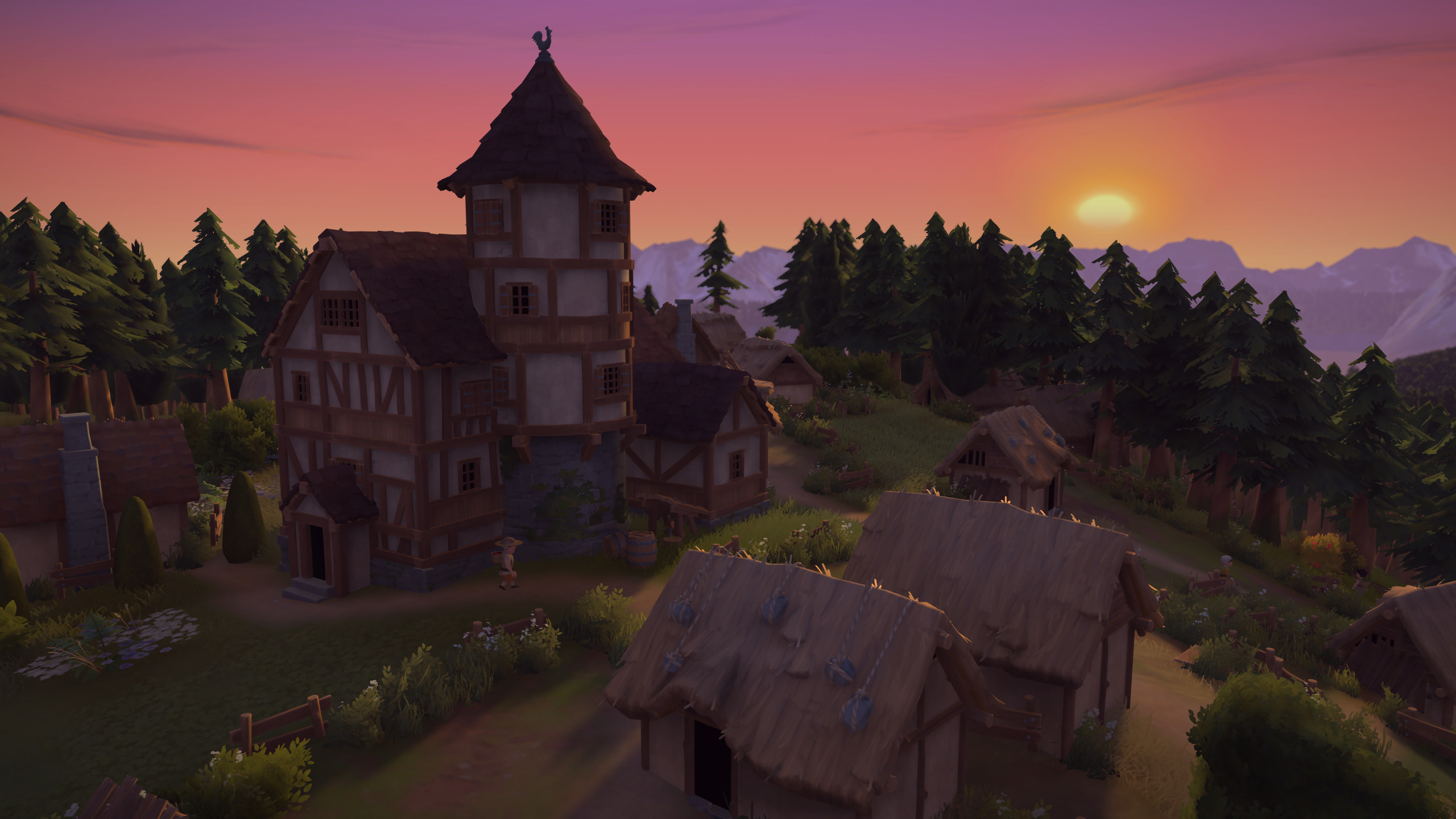
As the city expands and evolves, unpleasant situations also arise: you don't have enough food, people complain they don't have housing, and resources become harder to procure. There are no apocalyptic disasters, but there are economic crises that test your patience. It's a slow burn experience: at first it relaxes you, then it asks you to think strategically, make compromises, and adapt. It doesn't force you to choose between morality and survival, like Frostpunk, but it asks you a different kind of question: do you want a functional city or a beautiful one? Do you want to maximise efficiency or create spectacular monuments? Many times I looked at my city not as a map or an Excel spreadsheet, but as a pet I was taking care of.
On the audio side, the music is subtle and relaxing, without monopolising attention. It's more of a background that lets you get into the rhythm of the game, accompanied by ambient sounds of the small medieval settlement.
What Foundation manages to do, especially compared to other games in the same category, is to emphasise the process. It doesn't obsessively ask if you're efficient, but if you like what you're building. Your cities are not just collections of buildings that generate resources, but living entities that develop and take shape according to organic rules. The absence of grids is a design philosophy: here you don't build a mechanical puzzle, but a credible medieval settlement, with irregular roads, neighbourhoods arranged according to resources, and a landscape that naturally takes shape.
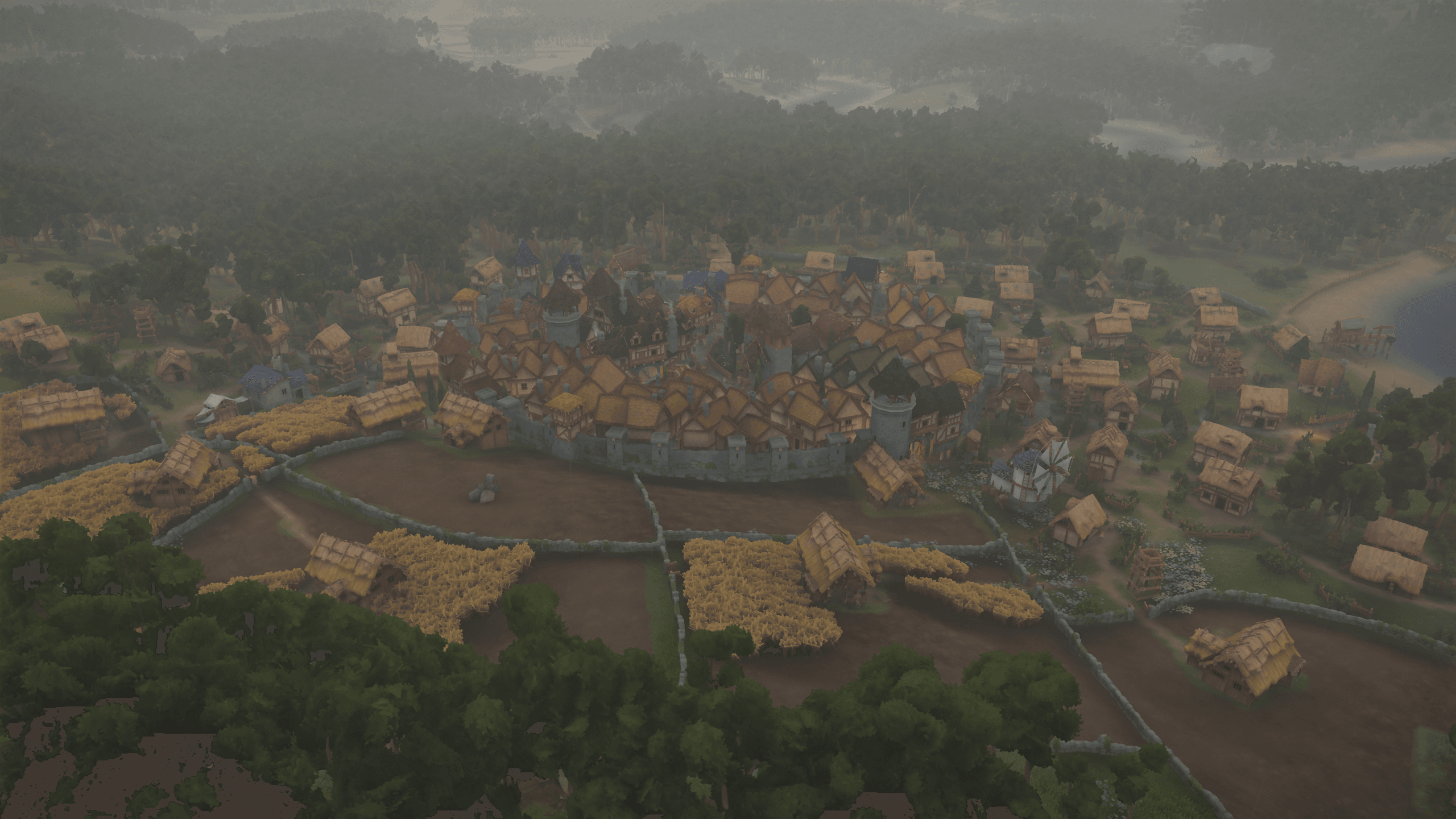
While in titles like Anno you feel like an engineer optimising precise networks, in this title you are more of an architect, thinking about the overall beauty. Even if sometimes its systems seem less mathematical or less rigorous, the aesthetic satisfaction it offers more than compensates. Your city looks good not because you aligned it to the centimetre, but because it grew naturally.
Of course, Foundation also has weaknesses. Optimisation in large cities remains a challenge, and the lack of clear long-term objectives can cause some sessions to lose intensity. But, instead of viewing these aspects as major flaws, you can see them as a philosophy of the game: it doesn't want to constantly push you, but to give you the freedom to set your own goals. Beyond mechanics and technicalities, however, the title is about the pleasure of building. It's about that moment when you look at your city and see people going to work, roads forming themselves, or fields slowly coming to life.
Honestly, it's not a title for those who seek only maximum efficiency or tough challenges, but for those who want a meditative building experience, with an emphasis on creativity. It's a game that demands patience and rewards you with a special satisfaction. And, perhaps most importantly, Foundation is a title that demonstrates that even in the digital world there is room for organic constructions, with all their imperfections that make them perfect.
Plus
- Total freedom in city construction, no grids
- Excellent modular system for monumental buildings
- Calm, relaxing atmosphere, perfect for long sessions
Minus
- Poor optimisation in large cities
- Lack of clear long-term objectives
- Slow pace, which may bore some players
0 votes
Scroll down here and stay on the page for at least 30 seconds to vote.
Pick a score from 0 to 10 (halves are allowed).