
Gothic
First published in GRIND IV, pages 198–203.
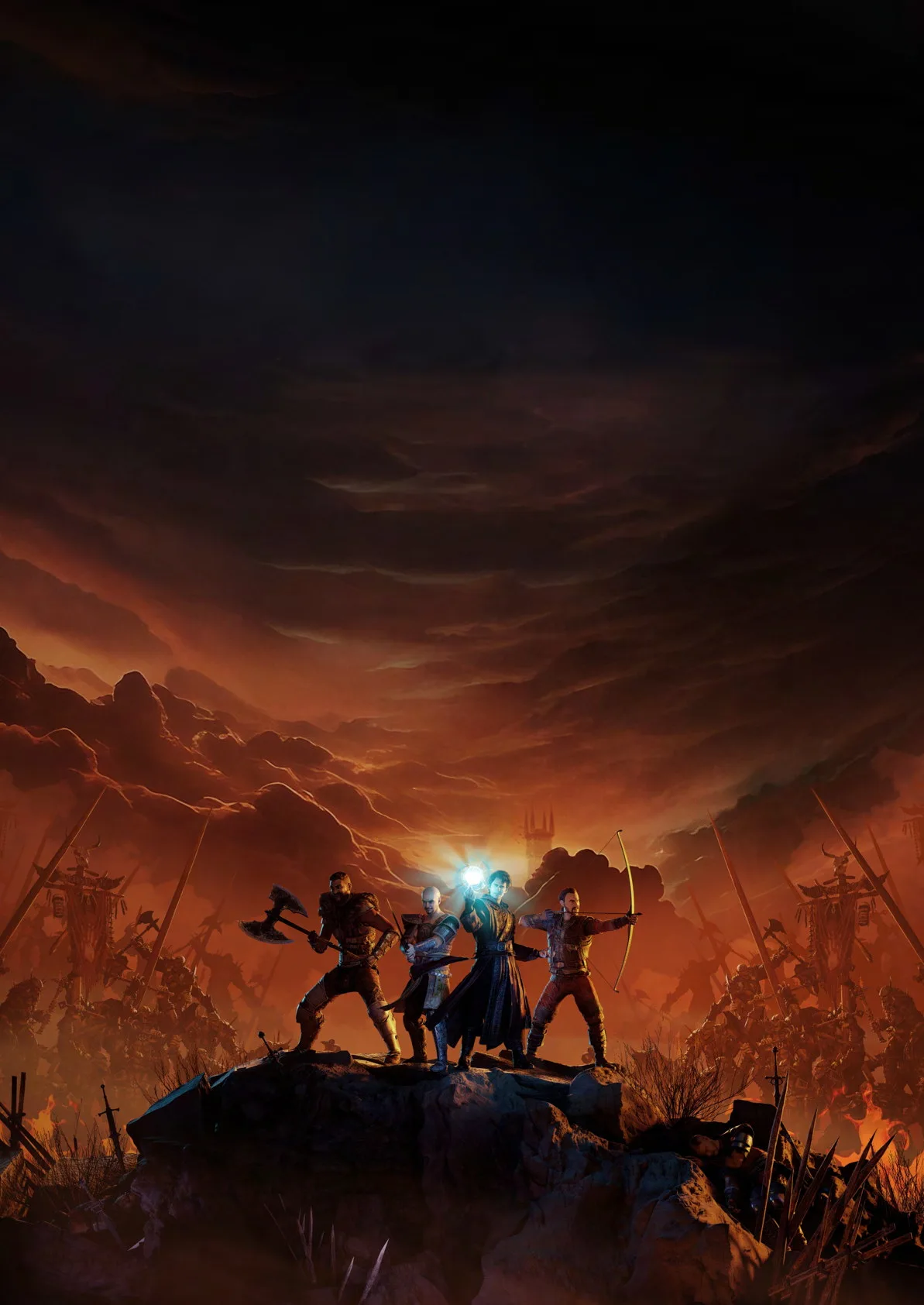
It catches me off guard and my pupils dilate. My sphincter clenches and my heart pounds. I frantically read the announcement: “Gothic Remake by THQ Nordic”. No way. A wave of sweat, chills, joy, fear and hope slams into me. Memories scream: the absolute legend of European RPGs. The Alpha and Omega of what an epic game means, one that puts us in the shoes of the sarcastic protagonist Nameless, with his hair tied back in a roguish ponytail, who goes from the most vulnerable little snowdrop to a true “Apex Predator” in the penal colony he was thrown into, thanks to my efforts, sweated out over fierce, endless hours of gameplay. With trembling hands, I open my laptop and ask grandad Google to show me the brainchild of Alkimia Interactive, the game’s developer. What does the reimagined adventure that marked my early adolescence look like?
CLICK. PLAY VIDEO. BUFFERING. AND?... DISASTER...
Nameless babbles to himself (?!) like an idiot, the combat looks lifted from a mobile game that costs 25 lei and that you never touch again... and, of course, bloom, bloom everywhere. The cloudy weather we’d got used to has gone on holiday and refuses to come back, the oppressive, melancholic atmosphere has been swapped for the look of a budget medieval action film, and the elegance of Diego’s slender, dangerous silhouette is lost in favour of a personality-free caricature, almost a failed sketch of Sean Connery in Highlander, minus the character’s originality and authenticity (Gothic 3 PTSD much?). A total, unforgivable fail, almost grating.
Fast forward a few months after the disaster I witnessed and a new shock hits me. The demo I’d seen in early 2022 was only a test THQ had devised to gauge the market’s reaction before letting the beast off the leash, with fan feedback to be worked in. And it arrived, inevitably: darker, harder, nastier.
The next two trailers, released in 2023, revealed a game far more faithful to the 2001 original than the previous year’s failed iteration. Mind you, we’re only talking about trailers with a strongly cinematic feel, which may not reflect what follows once you hit play. But on the surface, at least, the developers are on the right track, thanks to the noble attempt to find out what the community thinks and take it on board. So, chapeau, THQ Nordic & Alkimia! I sincerely hope it turns out well.
FINE, FINE, BUT ISN’T THIS THE SECOND GAME?
If a remake of the first part of the legendary trilogy that makes up the Gothic saga is in the works (Arcania is NOT Gothic), then why are you reading about a remake for the second part, especially with an expansion on top? Because in Gothic 2 Piranha Bytes tried to take the original formula of the first game, polish it and put out a new beast: original, better, stronger and yet familiar, without being merely a tribute to its predecessor. Namely, exactly what Alkimia Interactive wants to do, from deep inside its Barcelona studio. And 2002 brought a second part of the trilogy that came out a bit weaker, with a fauna seemingly not as threatening as what the original Colony had accustomed us to, and a single epic thread that left us unsatisfied. Then, after the unforgiving, harsh touch of the Germans, the formula was perfected, again thanks to the feedback of a community thirsty for the unique experience of the RPG’s first incarnation. History seems to be repeating itself, and the blueprint for perfecting the initial formula already exists; it’s there, and it just needs to be picked up by people in love with the magic of the Gothic games.
VATER, STOP WHIPPING MY BACK
From here on, I’ll be talking exclusively about Gothic with the Night of the Raven expansion, also known as the German gift of PAIN. Why? The expansion is simply better, adding a new story that takes about 10 hours of your life (at least double on the first attempt) and tripling the combat difficulty. That can be decently tamed once the player learns the control scheme for Nameless’s weapons, an achievement that comes with an undeniable sense of satisfaction and hardcore-gamer pride. But still, how did Piranha Bytes perfect the first game?
After the notorious adventure in the Colony, we explore the rest of the island of Khorinis. The obscene amount of mastery with weapons and magic has evaporated after the days Nameless spent under a heap of rubble, an embarrassing predicament he landed in thanks to the ending of the first game. Here’s a first aspect Alkimia must capture: the feeling of inadequacy the player should experience when they come snout to snout with the merciless beasts that populate Khorinis. They kill Nameless at the mere memory of the shadow of an idea of a fart let off half-heartedly by a mad Bloodfly, which swiftly puts in his place some cocky weakling who very wrongly thinks he’ll beat the wildlife with a jab of a stick found by the fireplace of Xardas, who pulled us, like it or not, out from under the aforementioned pile of rocks.
The hallmark of the Gothic experience is a pronounced helplessness in the game’s first steps, a letter in few, simple words: “you mean nothing, you are somewhere far, far below the last creature in the food chain”. The perspective the game offers is almost Bukowskian: you have to die a few times before you can really live.
Only by taking a monumental, constant beating at the start of the road will you feel a sense of accomplishment as the levels pile up under Nameless’s belt, along with Learning Points (hard-won at each level, and spent on one-handed, two-handed, bow, crossbow, magic or other, less noble skills...). With those, you finally, and with great effort, begin to slowly, slowly dominate the creatures that savagely killed you at the start of the path leading out of Xardas’ terrifying tower, where you woke up helpless and weak.
As for the butchery, the game has often been criticised for its difficulty, more precisely for its “clunky” control scheme. In reality, from my point of view, it was designed precisely like a car. First you press the clutch, that is, left click, then the accelerator, that is, W, A, D, S for the direction in which you swing your sword (for the first three buttons) and parry for the last one. That’s it. From here begins a dance of learning the attack patterns of animals, humans and orcs, so you can strike when they aren’t parrying or just before they attack, and anticipate when to parry or step back to dodge the blow. Although the combat scheme is difficult, even unforgiving on first contact, once mastered it becomes one of the most satisfying medieval combat systems I’ve ever got my hands on.
For masochism taken to the extreme, playing as a mage is recommended, since the few, precious Learning Points will no longer go into weapon skills but into mana capacity and into learning the six circles of spells that give you new ways of pulverising enemies. The flip side is that for at least half the game, until you get access to some more serious spells, you’ll be more vulnerable to the beasts’ warm caresses, which will flatten you much faster than a character who poured everything into Strength. Here lies the second vital element Alkimia must capture: the combat scheme should reflect the original formula, not copy the entrenched system that brings nothing new – short click for a fast attack, long click for a strong one. It’s thoroughly overused, and although rivals, or rather relatives, like The Witcher have managed to make the simpler formula work, it really isn’t Gothic’s, and its absence will be felt, because it’s an essential part of the game that can’t go missing without sacrificing originality.
Which brings us to the min-maxing, not exactly everyone’s cup of tea. As we discussed, with every level won through the toil and foul-smelling sweat of Nameless (or lavender-scented for Mages, who with a bit of luck won’t end up stained with goblin guts on their robes), the God of Gothic, namely Amy Lee from Evanescence, grants 10 Learning Points. But I digress. These points go on acquiring a variety of thief skills, learning trades and occult arts, and improving classic attributes like Strength, Dexterity or Mana, and then on improving combat through 1-handed weapon skill, 2-handed weapon skill, magic circles and so on. The problem is that if you don’t pick a path from the start of the game and cling to it with your teeth, whether as a wielder of assorted sharp bits of iron, a bow, a crossbow or spells, and instead make the profoundly uninspired choice of becoming a sort of hybrid tamer of the invading fauna, you are in for a bad time, because the chances of finishing the game before being driven mad by frustration at your own weakness have just shot up obscenely. For example, the game’s higher-level two-handed weapons won’t be available to you unless you’ve put almost all your points into Strength, along with a few potions with the same effect. Obviously, you won’t get to pick them up off the ground if you’ve spent points for a few levels on Dexterity (which lets you wield higher-damage bows) and bow-wielding skill (which improves the chance of hitting with the bow’s maximum damage value) to go hunting with that incredible bow stolen from the hunter Bosper...
The last 3 of the 6 acts into which the Gothic legend is divided are more or less out of reach for a character who has gone down the hybrid route, a one-handed warrior paired with a bow. That can be frustrating enough on a first playthrough if you aren't familiar with the sadistic scheme of the old heavyweights at Piranha Bytes. Luckily, the game is about twenty years old and the information is easy to find now, compared to 2002. This is a third aspect the developers will somehow have to take care of: namely, making sure it stays difficult enough to leave behind at least as many corpses as, say, a Dark Souls does. Then again, given today's developers' fear of upsetting the audience and, with it, the game's commercial success, the chances of being blessed with a game faithful to the original formula where difficulty is concerned don't look great. But it would be far from the first time something like that has happened, and so far there aren't enough clues pointing to such a turn of events. For now.
NEIGHBOUR? GOT A CUP OF SUGAR?
Why does the game evoke at least two elements of nostalgia and familiarity? For one, it has a typically Balkan atmosphere, stirring the same feelings as S.T.A.L.K.E.R. I could cite, as an example, foul, overcast weather like a molested outhouse, which we watch among ruined buildings and hastily thrown-up shelters in the Valley of Mines, the second area we'll wander through, which is actually the map of the first game. But somehow all of it also recalls the post-December Romanian landscape: factories, building sites cobbled together by local wheeler-dealers who ran out of money to finish them, semi-rusted kiosks ruled by the prying eyes of vendors, or by unshaven guards who watch over them. They stirred in me roughly the same fear as the crafty merchant Canthar, or, more precisely, of what he might do to me if he managed to trick me into putting behind bars a lady who (I think?) had done nothing at first glance, but who had trodden on his toes. Or maybe she had...? And that brings us to the second element, moral ambiguity, a close relative of what The Sopranos painted in our memory with its inwardly conflicted tubby lead. Growing up in this Romanian environment of the 90s and early noughties, nearly all of us got a bit of extra change at the greengrocer's, which we graciously kept, or perhaps watched a classmate/friend/stranger nick an apple in a far too crowded market. Or maybe we saw a cigarette lifted from a sleeping father's pack, then told a lie at school for the first time, to get a friend out of trouble, a friend who might, just might, do the same for us one day.
Well, there you go: that's exactly where this masterpiece of a game takes us and brings us back from, its anchor planted firmly in reality. Do you rat out the swampweed dealer so he gets it good and proper, or do you keep your mouth shut and split the profit? Do you pass on that Peck is amusing himself in the port with a working girl, a creature of the night, for reputation and brownie points higher up, or do you cover for him and perhaps get from him a sword a fresh recruit would never lay hands on? You can't say hand on heart which decision is the right one in the examples above, just like in life, especially in childhood and early or late adolescence, when most of us stumbled over this game, and over this kind of choice. Good and evil are subjective notions, to which we give meaning through a single detail: choice. Choice, and above all its consequences, in the second instalment of Gothic is what provides authenticity and a firm footing in reality. The moral ambiguity, in rabid shades of grey, of the situations we find ourselves in generates a profound realism conjured up by some talented lads who painted with pixels from their fingertips.
Here we should also mention the day-night cycle of the game's characters. They start their mornings in the most natural way, namely cursing and then going to work, which consists of assorted tasks, each more exhausting than the last, from guarding farms against beasts to selling freshly caught fish in the market of the port city of Khorinis. Then, as evening comes, we watch the characters escape the labour market, quietly retreating to various taverns or, for the poorest, to a campfire, to savour a beer and gossip with other citizens about the few events that spiced up their day, about fears, about vendettas. Overall, the scene evokes exactly what you'd have seen outside a block of flats around 9 pm in the early 2000s in Rahova, with working folk gathered for a chat before bed. All of this gives the feeling of a dynamic community and a living world, which has rarely been replicated since and which is one of the emblems of Gothic 2: you don't feel like you're in a game, you feel dropped into a medieval setting that breathes, lives and carries on around you, indifferent to your presence, until you break some social norm. A normality truly sister to reality. How do we experience this illusion of a living world? Well, depending on the choices I mentioned, you can take one of 3 roads, or, more precisely, communities. The first, familiar to Nameless from the first game, is that of the mercenaries, who are in fact his old friends and cellmates from the Valley of Mines. Thanks to their fighting skills, they have found work as guards for various local mobsters who need them to rise up against the forces of order of the king of Myrtana because, you guessed it, of exorbitant taxes. You'll feel at home with them if you feel like making nastier, more self-centred choices throughout the game, alongside sarcastic lines that put your immediate physical and financial well-being above, well, everything else.
If, though, you'd rather play the story, boiled down to hunting artefacts and (for) dragons, from a knight-on-a-white-horse perspective, but one unfamiliar to Nameless, the game offers you the militia and, later, the order of the King's knights and paladins. Naturally, the choices you make along the way will reflect the shine of the armour you get access to, and you'll often find yourself saving or protecting the working folk from assorted dangers. The mage's path is somewhat more neutral: although mages are formally affiliated with the aforementioned order, they put more stock in knowledge, reason and clearing up the mystery that seriously shrouds the nooks and crannies of the island of Khorinis. Obviously, as far as lore goes, it's the most satisfying choice.
The story won't differ profoundly as a result of your choice, but the way you approach it will change depending on the road you take, something Alkimia can doubtless improve on in the new Gothic iteration.
DAS ENDE
After a quick run through the essentials of the Gothic experience, which peaked in the Night of the Raven expansion, all that's left is to hope that the brave Spanish alchemists of Barcelona won't ignore them, but will bear them in mind while developing the latest iteration of a game loved on several continents. It would also be a pity to rush and push unfinished work onto the market, especially as we're talking about a game that indirectly influenced the atmosphere and gameplay of titanic titles like The Witcher: Wild Hunt or Ghost of Tsushima. Bit by bit, with passion, with attention to the multitude of non-combat quests that shape the story through choice, with a soft spot for creating the illusion of a living community that breathes down your neck, plus a proper almighty scrap, a dash of updated graphics and crafting systems, and, honestly, I think we could stumble upon a gem of a game, just as most of us were lucky enough to at the turn of the millennium with Gothic 2: Night of the Raven.