
Rodarkone's NEO•GEO Game Collection
First published in GRIND III, pages 164–169.
THE COLLECTOR'S CORNER Rodarkone's Game Collection
I managed to get a photo of the NEO•GEO AES collection.
The complete set for the NEO•GEO Advanced Entertainment System runs to 118 games in total, and I own just over half of them. There are no exclusive titles, and the catalogue was later expanded by third-party developers who bought NEO•GEO game licences and released a handful of lost and forgotten gems (see Part Three).
The NEO•GEO AES console came with an arcade-style controller (fighting controller) of exceptional quality: the people at SNK used components of qu-
PART ONE
ality similar to those in arcade cabinets. At launch, in April 1990, the console cost $649 (adjusted for the inflation rate of the last 33 years, today's price would be roughly $1,517).
This was one of the factors that hit sales: in total the console sold approximately 1.18 million units worldwide. Initially the NEO•GEO AES was conceived to be offered for rental, probably — and very possibly — because of its exorbitant price. At the time this gem was 3 times more expensive than the SNES or the Sega Mega Drive/Genesis.
An AES game also cost around $300 at launch, which was enormous for the era (that would be somewhere around $700 in 2023).
PART TWO
1. Conversions Basically, the original EPROMs from an MVS cartridge are used. These get transplanted onto an AES PCB. In theory everything is original: the EPROMs, the PCBs — though not the label, the manual or the cover. From my point of view this kind of modding is harmful to collectors. 2. Premium-grade fakes In France there's a user called Atomikwave (co-founder of the company NCI, whose legal status I'm not even sure of) who produces custom PCBs and reproductions of original games. These reproductions are extremely high quality. For more detail I recommend a short 2016 interview with Atomikwave: (https://www.culturaneogeo.com/imagenes/entrevistas/ncieng).
METAL SLUG, BABY!
Some of the NEO•GEO AES games
Fake Games, Including 3 Kinds of Cartridge, Plus a Bonus...
There's a whole story to tell here, but I'll try to give more detail in Part Three, which I've devoted to the “new” games released under licence... or, in other words, official ones.
P.S. At one point NCI held a distribution licence for NEO•GEO games, effectively putting reproductions on the market. Again, I'd say the initiative was toxic, or harmful, to collectors.
These days, though, NCI games get sold in private groups (because they have no licence), but I can tell you from experience that the quality is EXTRAORDINARY! I put a copy next to an original and it's impossible to tell the difference. 3. Multicarts These are fakes made in China, with a collection of several games on a single cart. In my case 161 in 1, which is roughly 80% of the entire collection available on the console.
They're probably the easiest way to play on official hardware, if you ignore the carts you can load games onto yourself — and here I mean the NeoSD Pro, a pricier alternative that turned up more recently. 4. SD card cartridges These work by adding games in “ROM” format to ordinary SD memory cards. What's great about this approach is that you can run the games natively. These covers are absolutely delicious
PART THREE
Licensed Games and Homebrews
1. Old licensed games As I said in Part Two, there's a company in France called NCI (Atomikwave) which produced “licensed” games for VISCO — one of the publishers on the NEO•GEO platform. Then something very interesting happened: the company “Pixel Heart” bought absolutely ALL the VISCO game licences and released an extremely interesting selection of titles (you can see some of them in the photo above).
Some of the games Pixel Heart released were never available on the NEO•GEO AES console, only on NEO•GEO MVS. We're talking: Breakers Revenge, Captain Tomaday and Ganryu. In total, only 8 newly released Pixel Heart games came out on AES. 2. New games released on NEO•GEO AES Here we have quite a few companies that produced games, the best known being: NGDEV in Germany (with Gunlord, Kraut Buster, Razion and Last Hope) and Bitmap Bureau in the UK (with XenoCrisis and, soon, Final Vendetta).
But there are plenty of enthusiasts who have released games independently, such as Neotris: a sort of Tetris for
NEO•GEO.
PART FOUR
The NEO•GEO CD Collection
Besides the NEO•GEO AES console, which reads cartridges, SNK also put two optical-media systems on the market. We're talking about the NEO•GEO CD (2 versions, the so-called top loader and the “tray” model) and the NEO•GEO CDZ.
In total the NEO•GEO CD collection runs to 99 titles, 8 of which are CD exclusives. I'm very close to having them all!
Just as on NEO•GEO AES, there are games released later (after 2005, when SNK/Playmore ceased to exist), under licence from Pixel Heart (the VISCO licence), and a great many “repro” games (read: pirated) produced by NCI. A lot of “homebrew” titles have come out too.
The NEO•GEO CD consoles came with a different controller, much closer to a design you'd find on modern systems, while still keeping compatibility with the NEO•GEO AES controller. In the same period a fighting stick smaller than the NEO•GEO AE: one was also released — the so-called “bean” controller, a nickname it earned from its bean-like shape.
22, 23... I've lost count
PART FIVE
The NEO•GEO MVS Collection
Some of you will probably scold me for not opening with the MVS games... but I reckon MVS games for NEO•GEO aren't really “console” games, since they were made for arcade cabinets. SNK released the NEO•GEO Multi Video System cabinet, which, as the name says, supports several games at once.
These were gold for anyone running an arcade, but especially for the owners of little corner shops that sell a bit of everything, or petrol stations. SNK's ingenuity was essentially the ability to run several games in the same cabinet, swapping a cartridge inside without having to buy a system with 2, 4 or even 6 slots for the owner to add different games to. Obviously the strategy was a roaring success and pushed other manufacturers to adopt similar approaches (Capcom and Taito followed suit).
PART SIX
Still, you might wonder why I'm bringing up this platform that isn't a “console” — and you'd be right. But keen gamers made it so that anyone could enjoy MVS at home. At first there were the so-called “super guns” — essentially an integrated circuit that converts the video and audio signal. On top of that, controller ports for the MVS PCBs and matching power supplies get added for home play.
Which is how you get to CMVS (Consolized MVS), proper consoles that use original MVS PCBs, set into extremely professionally made injection-moulded plastic shells. What's more, a CMVS includes new auxiliary circuits offering RGB signal, custom BIOSes, extended memory cards and other features. Some systems, for instance, also included S-video compatibility or hardwood cases.
The best-known CMVS models are: Analogue (who debuted with NEO•GEO CMVS systems delivered in DARKY, JUST SO YOU KNOW, WE'D LIKE A SPARE COPY TOO, PLS! hardwood cases for both the console and the controller), Omega (a company that uses injection-moulded plastic to create an incredibly good mould) and ORTHROS (known for their range of high-quality cases, which do however require assembly and are aimed more at enthusiasts
DIY).
One thing that hit SNK and their MVS business model enormously was piracy — unfortunately, as the years went by, game cartridges started being pirated on a large scale. Because the memory chips used for storing textures and music in NEO•GEO games got cheaper, today these clones are EXTREMELY widespread on the market.
The MVS collection is by far the most extensive of those mentioned so far (AES or CD) and runs to 148 titles, 27 of which are exclusives (in recent years a few of them have turned up on AES and CD... though not from SNK or SNK/Playmore).
NEO•GEO Pocket/Color Collection
In the handheld market, which Nintendo dominated utterly until the late '90s, SNK decided to turn up with a contender for the throne – the NEO•GEO Pocket.
The pocket system packed a 16-bit processor and served up the action on a black-and-white screen. Very shortly afterwards, in 1999, the NEO•GEO Pocket Color arrived on the market too. Practically the same configuration, but it could put up to 146 colours on screen from a palette of 4096. The kicker is that the black-and-white version could run most of the games released for the Pocket Color, while the colour system was 100% compatible with the NEO•GEO Pocket titles. Just how many fit in a pocket?
Sadly, SNK was in very serious financial trouble... and 2000 was a banner year for the company. Both consoles (NGP/NGPC) launched globally, though not every game was available in every region. It continues with “31 games appeared in the US, 44 releases can be identified in Europe and Australia, and Japan got 83 titles. In the Japanese market, the company that acquired SNK carried on releasing games until late 2001. An exclusive edition, which the community dubbed the “new slim”, turned up later in Japan... without bringing any hardware improvements, however.”
In 2001, SNK closed its doors for good...
PART SEVEN
But what's this? Didn't I just say it had closed?! Well, the company Aruze (known for pachinko-style mechanical games, about which I could write a future article covering arcade history) bought some of SNK's assets.
The creators of NEO•GEO left the market in 2001, but founder Eickichi Kawasaki brought Playmore to life that same year to buy up all of SNK's intellectual property. So the lads carried on releasing games for AES, MVS and CD. Some of these titles even made it to SEGA, PlayStation, Nintendo and Xbox. They were ported to mobile phones, of all things! Later, Playmore changed its name to SNK Playmore Corporation and, in 2016, reverted to the old name of SNK Corporation.
But what happened on the hardware side? Did SNK (SNK Playmore) manage to release new consoles? Well, the answer is a categorical NO... even if some would claim otherwise.
The NEO•GEO Collection Continues...
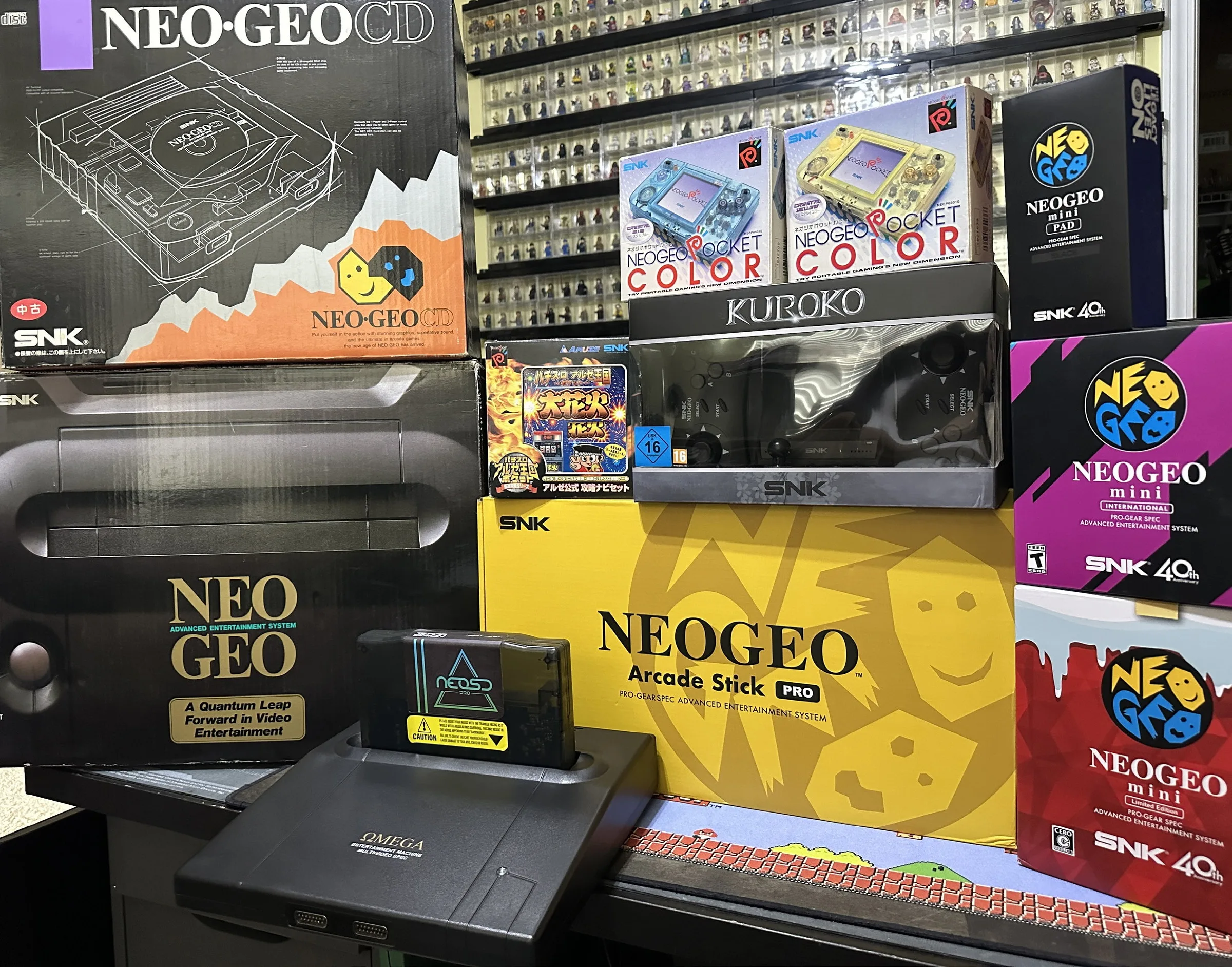
In 2012, SNK Playmore worked with Tommo (known as Blaze in Europe) to bring out a handheld console called the NEO•GEO X, priced at $129.99. The new system can also be hooked up to a TV through a docking station that looks very much like a NEO•GEO AES. Even the controller has a similar look! The console shipped with a suite of 36 classic games built into its internal memory, but it can also read external cartridges resembling SD cards. One such card was added as a bonus for those who bought the NEO•GEO X Gold version, and it later turned up in the NEO•GEO X Classics compilation (delivered in a case similar to the NEO•GEO AES “clam shell”).
Unfortunately, though everything looked really cool on paper, in reality the console had its flaws: it ran in an unsuitable 16:9 format instead of the original 4:3, and every game was played through an emulator. The console was not well received at all, and thanks to legal disagreements between SNK Playmore and Tommo (which largely concerned the poor quality of the NEO•GEO X system), fans consider this project a major failure – as did the press of the time.
But the story didn't end there: in 2018, 40 years after SNK was founded, the NEO•GEO Mini launched: a console with a cute design, delivered in classic colours inspired by the modern NEO•GEO MVS cabinets in Japan. It sold for $140 and offers TV connectivity, plus the ability to plug in one or two USB gamepads (similar in appearance to the NEO•GEO CD models). The console has 40 games built in and promised a great deal: not least because of the option to switch between the original 4:3 aspect ratio and a stretched 16:9.
The included titles cover most of the important NEO•GEO AES releases. On the hardware side, the console was produced by SNK Corporation itself... so, unlike its younger sibling the NEO•GEO X, it benefited from much more careful quality control. To cut a long story short, the NEO•GEO Mini was a real success, and that led SNK to launch several variants containing a slightly different games list. The aim is to keep the community (and collectors in particular) buying these consoles. All told, 8 different variants were released: the original, the international edition, the Christmas Edition (red), Mini x A.C.E. (black and gold, which only appeared in China) and a set called Mini Samurai Shodown featuring different characters from the series (Haohmaru – white, Nakoruru – red, Ukyo Tachibana – blue, Kuroko – black). The NEO•GEO Mini is still in production today and can sometimes be found for sale on Amazon for under $70.
Thanks to the success of the NEO•GEO Mini, in 2019 SNK Corporation launched a new budget console called the NEO•GEO Arcade Stick Pro – essentially an arcade stick that connects to a TV over HDMI and lets you run classic NEO•GEO games on modern TVs, for just $100. The new system comes with 20 games included in its internal memory, though it later allowed another 20 titles to be unlocked. The device was received enthusiastically by fans, but drew critical notices from the specialist press, which compared it to the NEO•GEO Mini (which also shipped with 20 games at first). One positive for the Stick Pro is its controller compatibility with the NEO•GEO Mini – giving you the chance to play two-player. That local multiplayer is always welcome, given that most NEO•GEO games are fighters. The Stick Pro is still in production today and can often be found on Amazon for under $90. Thanks to the active community, there are also firmware mods that extend the number of supported games – which is why the Stick Pro is popular even outside the hardcore fans of
NEO•GEO/SNK.
But the story continues to the next level: in 2020, North American players got the launch of the MVS X cabinet. The system is a collaboration between SNK and Unico (Gstone Group) and came in at a starting price of $449 (for $50 more, you could also get an extra stand). The MVS X is a tabletop cabinet that can reach the dimensions of a mini cabinet with the aforementioned stand. It has a 17'' LCD screen in 4:3 format, and comes equipped with a joystick and buttons for two players. It's a mini clone of the celebrated red Neo Geo MVS which, beyond borrowing the original's look and branding, even includes a simulated coin slot (again, a feature you get with the extra stand). The cabinet ships with a collection of 50 classic Neo Geo MVS games stored in its internal memory. Some of them are exclusive to the MVS X, meaning they don't appear on the NEO•GEO X, NEO•GEO Mini or Arcade Stick Pro.
This cabinet also saw limited success, thanks to its prohibitive price and the limited collection of available games. Although the operating system menu hints at the release of new titles (some categories are labelled Volume 1), any new additions are still awaited. The MVS X accepts firmware updates over USB – an encouraging fact, which suggests new games will arrive in future. If they don't come from official sources, the community of enthusiasts will set things right.
The system is still available today and can be bought from the official site www.snkmvsx.com