
Star Wars Jedi: Survivor
First published in GRIND IV, pages 8–13.
S/X, PC
AFTER FIVE
L A FORMATION
OF
When George Lucas sold Star Wars to the white slave traders (his words, not mine) at Disney, the latter decided that the expanded universe, made up of comics, video games and books, should be dropped from canon to make way for new characters and new stories and to accommodate the continuity of the new film trilogy. Financially speaking, it was a stroke of genius on Kathleen Kennedy's part – she recouped the four-billion-dollar investment almost threefold, a mountain of money that overshadows even the Marvel universe.
Ironically, the new blockbuster trilogy thrashed about between creatively bankrupt self-cannibalism (The Force Awakens), forced symbolism and a thematic divorce from any pre-established foundation (The Last Jedi)
YEARS OF
THE CREW
ON THE MANTIS...
and corporate damage control on PCP (The Rise of Skywalker), while the products that actually managed to deliver something more substantial turned out to be the new “expanded universe”:
Rogue One, Andor and, to some extent, The Mandalorian and Star Wars Rebels.
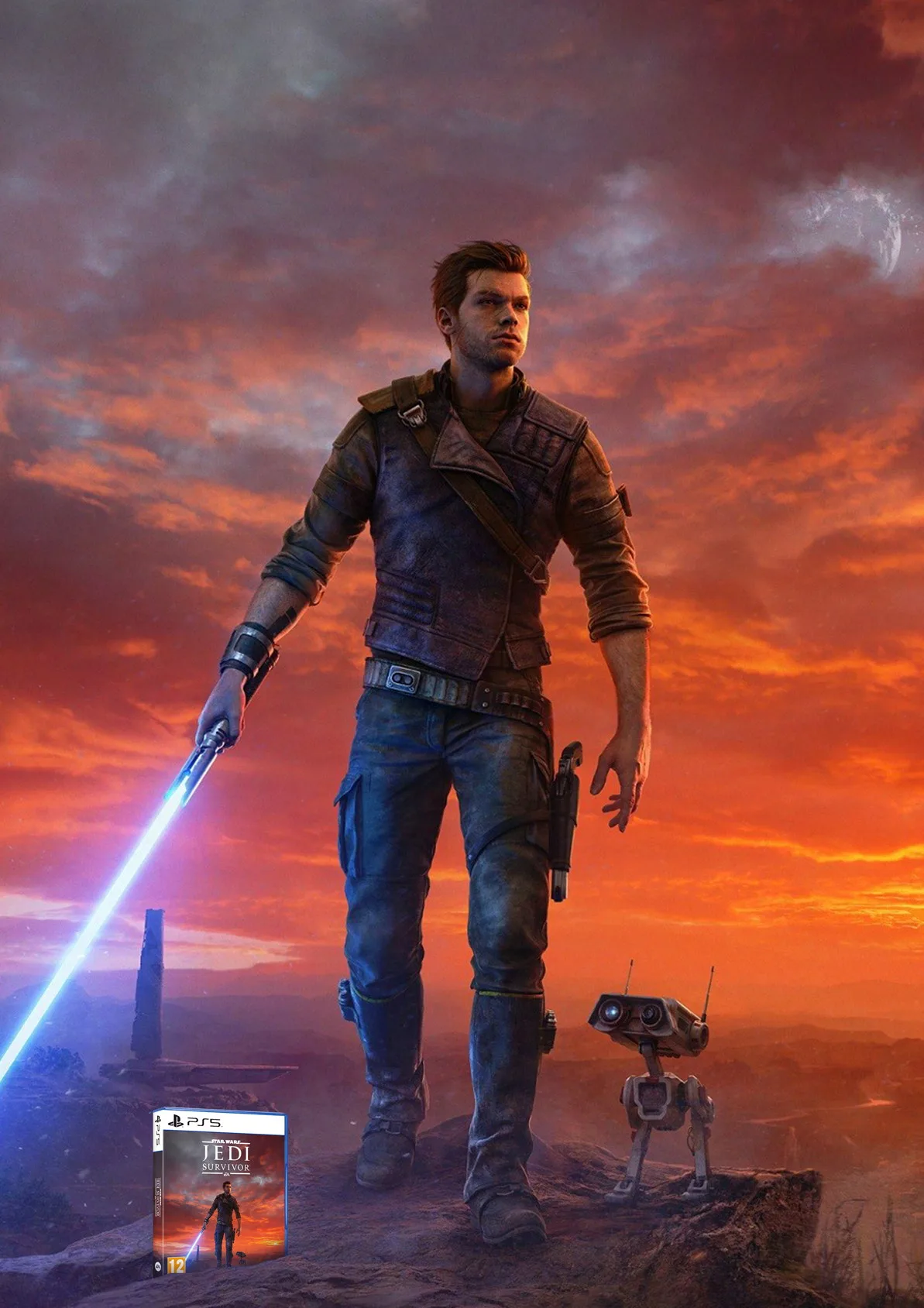
Aesthetically inspired by some of these, and mechanically by the sheer wave of popularity behind Dark Souls' game design, Star Wars Jedi: Fallen Order arrives in 2019 and gives us Cal Kestis's story five years after Executive Order 66 (and, implicitly, the eradication of most of the Jedi Order from the galaxy). An adventure that wears everything a AAA title of its time could deliver, and a soulslike more approachable and friendlier than most, Fallen Order drew enough interest and sales to pave the way for a sequel – Survivor.
“ TRUST NO ONE,
TRUST ONLY IN THE FORCE”
Cal Kestis
STAR WAR
GOOD AND
TO CHOOSE
Five years have passed since the crew on the Mantis formed, and its members have split up and gone their separate ways. Cal, accompanied, naturally, by BD-1, runs sabotage operations under Saw Gerrera's command, Greez has opened a ship workshop on Koboh, and Merrin, Cere and Eno Cordova are working to rebuild the Jedi archives on Jedha. I felt a particular satisfaction at the care taken over continuity and the way the connections between the characters have matured: the reunion between Cal and his old crew really does feel like a get-together loaded with emotion and subtext, and the organic way each of them has evolved over five years works as ideal pretexts for exploring the game's narrative themes.
After an introductory mission on Coruscant whose twists and explosions foreshadow most of the narrative arc, we gradually start gathering the crew back together (with a few new additions) and exploring the legend of a hidden planet, Tanalorr. Most of the activities we
IS ABOUT THE FIGHT
BAD AND EXPLORE
THE PATH OF LEAST
will get up to take place on Jedha, Koboh or one of the latter's moons, and as we recruit, rescue and chat to the various NPCs we come across, we turn a tavern on Koboh (Pyloon's Saloon) into a motley hub of minigames, lore and quests.
Shortly after the game begins, we have access to almost all the abilities from the previous title and, as expected, we'll pick up new powers and gadgets over the course of the adventure that unlock level sections otherwise out of reach for your average climber. If wall-hopping, wall-running and the double jump are already firmly lodged in the memory of anyone who finished Fallen Order, Survivor's platforming sections introduce us to a grappling hook and an air dash. Nothing revolutionary, but when you string them all together and traverse sections that alternate between old and new mechanics (possibly with a planetary bombardment in the background to sharpen the sense of danger), you'll be treated to some of the most specta-
AMONG
THE TEMPTATION
RESISTANCE
cular set pieces in the franchise.
A little more subtle is the integration of story elements from several Star Wars eras. In the increasingly insurmountable fight against the Empire, Cal also meets other characters trying to reach Tanalorr, weighed down by motivations rather less idealistic than his own. While most of the events we take part in wear the Empire's aesthetic, we're presented in parallel with a frame story from the High Republic era. It's a literary device I've come across before: the same desperation and struggle for survival that produces heroes, larger-than-life characters capable of self-sacrifice, can equally catalyse selfishness, hatred and cowardice, a demonstration that holds true whatever era the action unfolds in.
In the end, the subject hasn't changed: Star Wars is about the struggle between good and evil, and explores, on that absolutist foundation, the temptation to choose the path of least resistance.
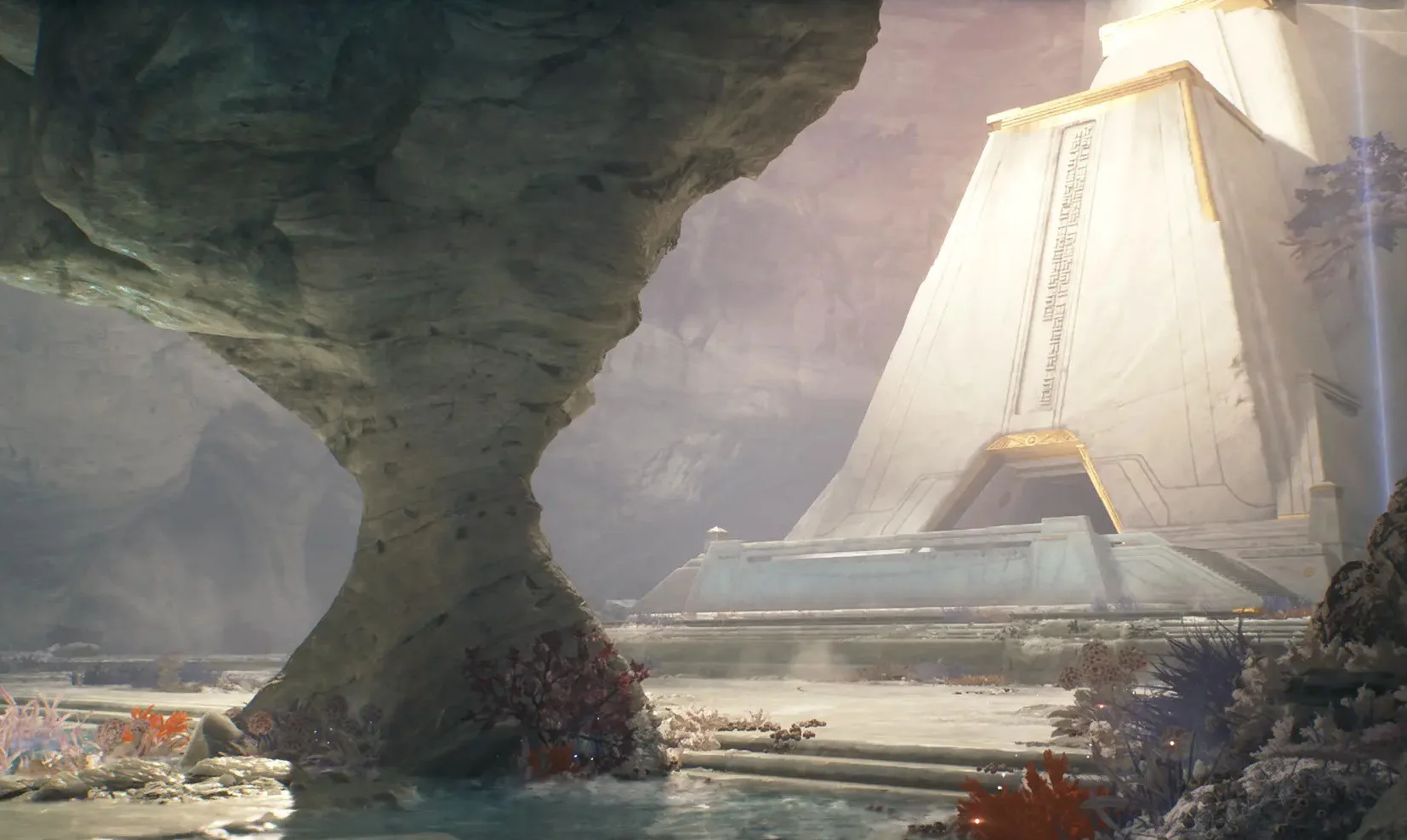
Although on paper there are six planets to explore, as I mentioned above, we'll spend most of our time on only about three of them, and the colour palette, the lighting and the overall aesthetic are more concentrated in a spectrum of warm colours, rock, canyons and sand, at least compared with the diversity of environments and vegetation in the previous game. What's more, Tanalorr, though perhaps the most interesting planet in terms of colour and design, hosts only a linear and disappointingly short segment at the end of the journey.
At the same time, the bigger hubs, such as Koboh, are built modularly, and coming back to old sections with new abilities is integrated more intuitively than in Fallen Order (where the routes often forced you to re-traverse fairly long, tunnelled sections to reach collectibles, secrets or upgrades). It's easy to see that the developers learned from their mistakes and significantly improved large swathes of the level design. From the prologue to the last chapter of the story, you can stop the main mission at any time to go and explore optional content, and the minimap conveniently marks every unexplored route and every door you can interact with. Navigation and traversal across the open-map sections is sped up by huge beasts you can ride, and once you use the Force to tame them, you use various flying creatures as gliders to float easily over canyons that are normally impassable.
The puzzles are no more than roadblocks where difficulty is concerned, but, following the Metroidvania format, they make use of BD-1's new abilities to open up new routes: a pump that sprays a flammable material and a projectile that trips electrical circuits.
Progression is intuitive and won't hold you up for more than a few minutes in the game's main thread, but the Jedi Chambers and the optional puzzles hidden off the beaten track are somewhat harder (and more satisfying to work through). What's certain is you can't get lost – the same hologram minimap from Fallen Order is clearer than ever, and all the genre's navigation tropes are baked into the world design – beige paint on the climbing ledges, bends in the road that follow the most intuitive route possible, objects susceptible to Force manipulation marked with a bluish aura. Survivor largely succeeds in putting you in the beige pyjamas of a Jedi Knight, including the excess of zeal and the infusion of power that comes with a slide towards the Dark Side: one of the most powerful abilities is unlocked at a moment when Cal gives in to a thirst for revenge and underlines, both mechanically and thematically, the risks and the rewards of a Sith mentality.
Almost every NPC you interact with has a problem that needs solving or a friend lost in a cave. Once you sort out their troubles, you'll find them in Pyloon's Saloon, where you have access to a few minigames: games of holotactics in which you have to pick configurations of soldiers and monsters from the game's roster to take on increasingly skilled players, or a garden where you can plant seeds collected during your wanderings on various planets.
The merchants you meet offer upgrades and cosmetic items in exchange for one of several series of collectibles, and the surprisingly complex system of caves and hard-to-reach areas houses terrifying beasts. Those of you skilled or patient enough to have survived the real boss of the first game (I'm talking, of course, about Oggdo Bogdo) will be pleased to hear that Survivor has plenty of these optional bosses (some even evocative of a certain scene from Return of the Jedi).
On top of that, the vast majority of the rewards for side missions and exploration are cosmetic. Apart from hairstyles, shirts, jackets and trousers, you're collecting materials for your lightsaber hilt or for BD-1's components, in a system that's a touch more complex than the palette of ponchos in Fallen Order.
Besides the fauna and the Empire, mercenaries and bounty hunters of all shapes and sizes have also got it in for Cal, often accompanied by a memberberry from the prequel trilogy: B1 battle droids, which you most likely know better as Roger, roger, along with a few other robot models — implying that the Trade Federation from Episode 1 does its shopping in the same place as various galactic underworld factions from the Imperial Era, and offering an acceptable excuse to round up characters and designs from several chapters of the franchise under one umbrella.
Combat has had a series of improvements too. First of all, the number of stances has gone up from two to five, and the way they're conceived gives you far more freedom of expression. Each of them has a specific set of moves and abilities (and a talent tree to match), they unlock gradually as you advance through the main story or sink skill points into abilities, and you can have any two of them active each time you reach a meditation point.
Single is the most balanced and versatile stance, and the one series fans are probably most used to (having used it for most of Fallen Order).
Double-bladed — the format Darth Maul popularised in The Phantom Menace — is geared towards crowd control and defence and consequently sacrifices damage, but gives you abilities optimised for efficiently destroying groups of enemies.
Dual Wield is, predictably, the most aggressive style, giving you speed and damage at the cost of compromised defence. The fact that you can cancel animations and switch from a combo into a parry at any moment makes it objectively the most powerful style as well — particularly for those used to that approach from series like Street Fighter or Smash Bros.
Crossguard is essentially the Star Wars version of Dark Souls' claymore, a heavier weapon you carry with both hands, which makes up for its reduced speed with absolutely devastating blows.
Blaster, perhaps the most exotic stance, almost summons up the image of a pirate: with a pistol in one hand and a fencer's posture, it gives you the advantage of ranged fire, and the ammo recharges by using your lightsaber in close-quarters combat. Although it isn't generally as effective as Dual Wield or Crossguard, the numerous flying enemies (especially towards the end of the game) make it a viable option for the later stretches of the story.
Survivor's main handicap is optimisation: a worrying trend, incidentally, that seems to afflict almost every PC port of a AAA action-adventure released in the last half-decade. In short, if you've got almost anything under the bonnet below a latest-gen i7, chances are you'll be treated to stuttering sessions and waves of heat that invite you to get a barbecue going on your roasting case.
In my case, having finished Survivor twice on the same hardware (a 2080 Ti and an i9-9900KF), the experience varied: at launch I ran into short bursts of stuttering every few dozen minutes and acceptable temperatures, whereas the second playthrough, 11 months after launch, held a stable framerate for the whole adventure but pushed the temperature inside the unit higher than any other game I've ever had running.
Technical shortcomings aside, though, it's a successful title whose writing and plot stay consistent and progressive across most of the story, only slightly undermined by an abrupt and somewhat anticlimactic ending. Past the story, though, there's more content to explore than in the previous game in the series, every mechanic has been improved, and the vistas (the gigantic structures towering over the impressive landscapes), the Imperial bases suspended in the sky and the dizzying geometries tell you everything about what Survivor essentially is: a by-the-numbers game, but one of the most current, best-looking and most immersive titles of its kind.
0 votes
Scroll down here and stay on the page for at least 30 seconds to vote.
Pick a score from 0 to 10 (halves are allowed).