
System Shock
First published in GRIND III, pages 26–28.
System Shock is an essential piece of video game history. If you weren't born when the original came out, but video games have always been your thing, an older gamer has surely told you about it at some point. In its day it was a singular game, positively precocious in design terms. I reckon that somewhere Warren Spector is still teaching game design lessons with nods to the 1994 game.
The remake isn't just a pixel-for-pixel reproduction of the original: it takes care to recreate the experience while also slipping a few surprises up the malevolent AI's sleeve. The opening sequence is something else, like the genuine start of a cyberpunk film. Instead of the original's narration (which had its own charm too), the plot is now mostly told from the perspective of the protagonist, the hacker, in a style that's dynamic, short and to the point, backed by an electronic soundtrack that can get its hooks into you.
REMAKE VS. ORIGINAL
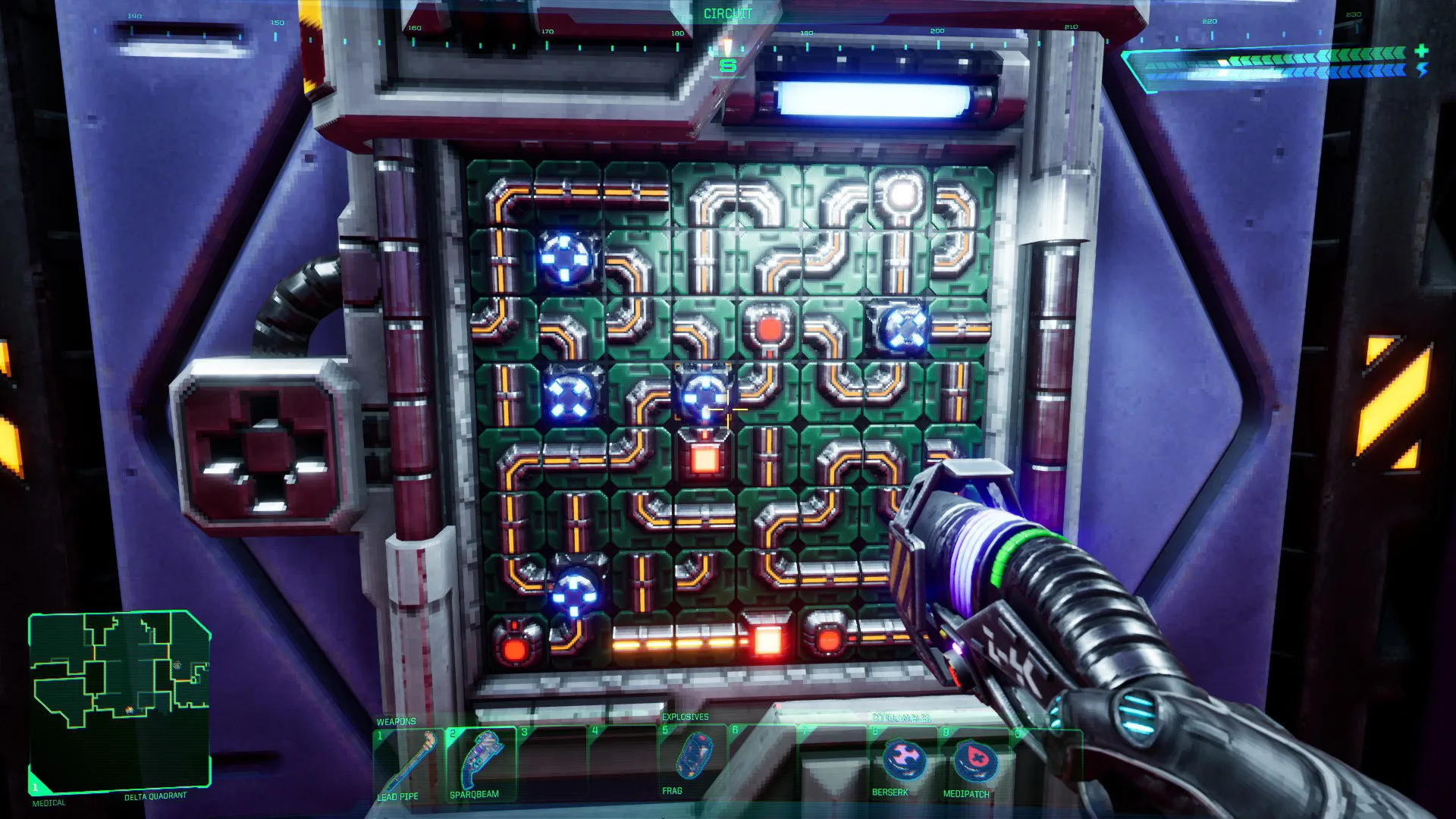
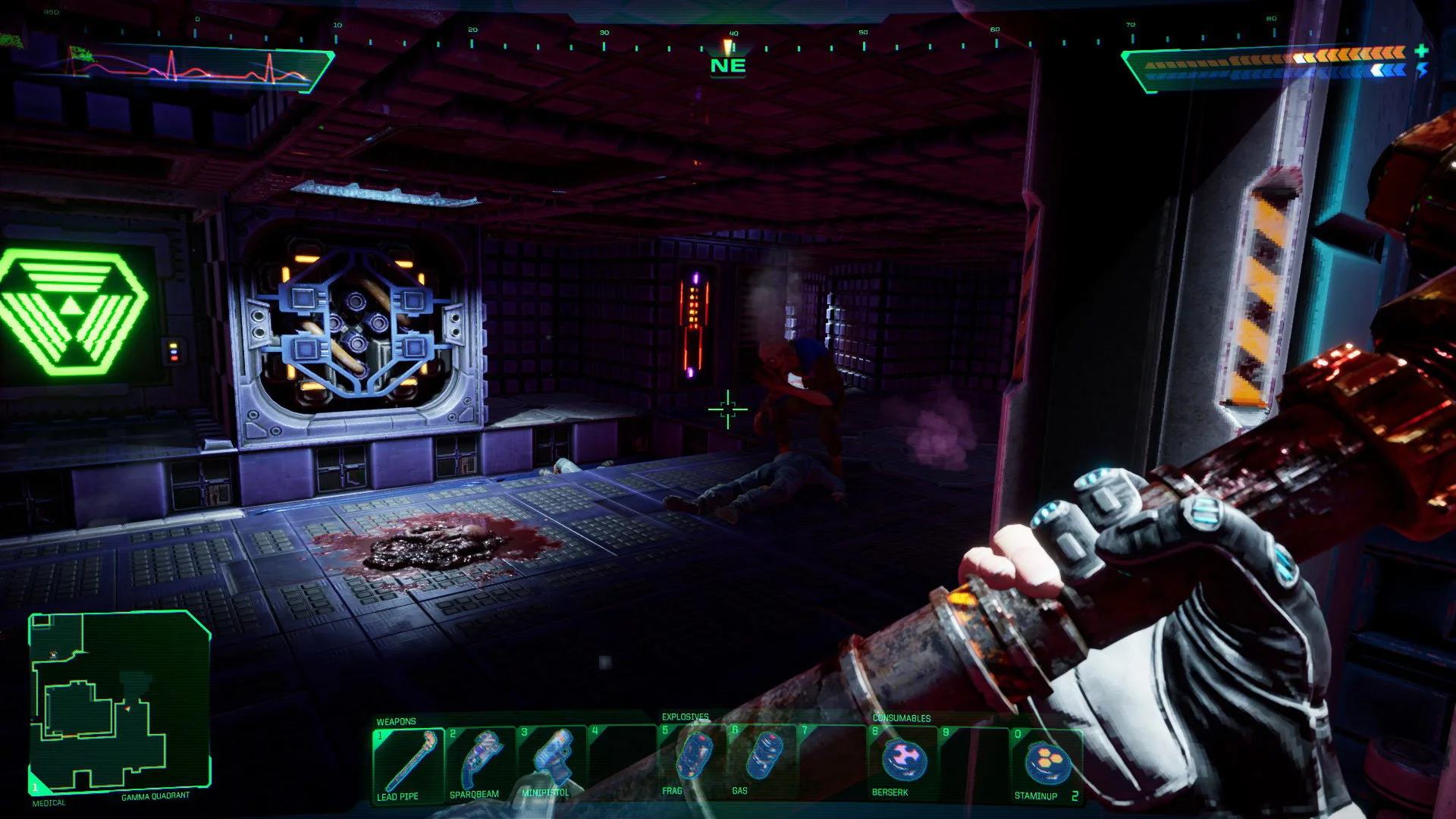
The graphics are produced without capricious visual effects. The game environment is clear thanks to an approach that favours functionality over spectacle. The textures are slightly pixelated in a pleasing way that tickles the nostalgia gland. A game like System Shock might not even lend itself to costly ray-tracing effects, but it would be interesting to see that some day.
In that sense it follows that the versatility of Unreal Engine also makes for a textbook optimisation. The new System Shock won't shock anyone with its system requirements and runs great on humbler machines. Mind you, you'd think that with graphics this economical the stated requirements would be even lower still. Those who need more than 60FPS may trip over a few technical obstacles that get sorted by switching between fullscreen and windowed modes. Something I reckon will be easily fixed in a patch around launch.
The models of downed enemies likely respawn in rooms I revisit and vanish once I move away, a function that's about optimisation too. Often, when I opened a door, an enemy's corpse would twitch. Given that I usually work my way through a level on edge, the ragdoll effect made me jump a little... because finding fresh enemies in rooms you've already cleared is a plausible situation: SHODAN (Sentient Hyper-Optimized Data Access Network) will send mutants and cyborgs after you, especially on floors where you haven't shut down the cameras. The ragdoll business is an amusing bug that sharpened my level of alertness.
Limited ammo and the rare chances to recharge health points make me tiptoe, ears pricked, along the space station's corridors. I use the Q and E keys constantly to peek round corners, approaching every new room with caution. Used as I am to more forgiving games, System Shock keeps me tenser than it perhaps should, but that induced state of anxiety serves a thrilling atmosphere, the likes of which I hadn't been in for a long time. While you hunt for the exit to the next level, you're also minding your inventory, gathering up every resource you need. You'll feel the urge to cart around even the rubbish you can recycle at a special machine that rewards you with credits to spend at the healing snack vending machine. Nor do the audio logs you find beside the station's victims do much to encourage you, offering a few clues about what happened while cranking up the horror atmosphere. Listing all these elements, you start to see part of the inspiration behind Dead Space, another sci-fi horror that got its cosmetic remake treatment this year too.
More hardcore gamers, even those who never played the originals, will appreciate the challenge offered by the maximum difficulty tiers, plus the optional objective of finishing the game in five hours. That doesn't mean it's a short game, or that you'll pull it off first time. The possible combinations of difficulty levels and the different ways of tackling situations invite repeated playthroughs. Do also leaf through the game's manual, titled Trioptimum New Employee Handbook, because it's written like the manuals of old: it packs in both explanations of how to play and information about its world. The text is written from the perspective that you're already part of the System Shock world. I read the manual like a guidebook from a sci-fi novel. With your attention sharpened for resources, trying to dupe SHODAN, hacking cyberspace and solving puzzles on the space station, the morning may well catch you still in System Shock.
It's a simple decision – if you liked the original back in the day, it's absolutely worth reliving the experience in new colours. If you were curious about System Shock in the past, or only now, this remake is currently the best way to try that singular cyberpunk experience. The $40 price tag is a fair one, given the work involved, the quality, and the fact that it isn't a AAA title. And if you're not sure, you can try the demo (Steam) – just like in the good old days.
0 votes
Scroll down here and stay on the page for at least 30 seconds to vote.
Pick a score from 0 to 10 (halves are allowed).