
Witchaven 1 & 2
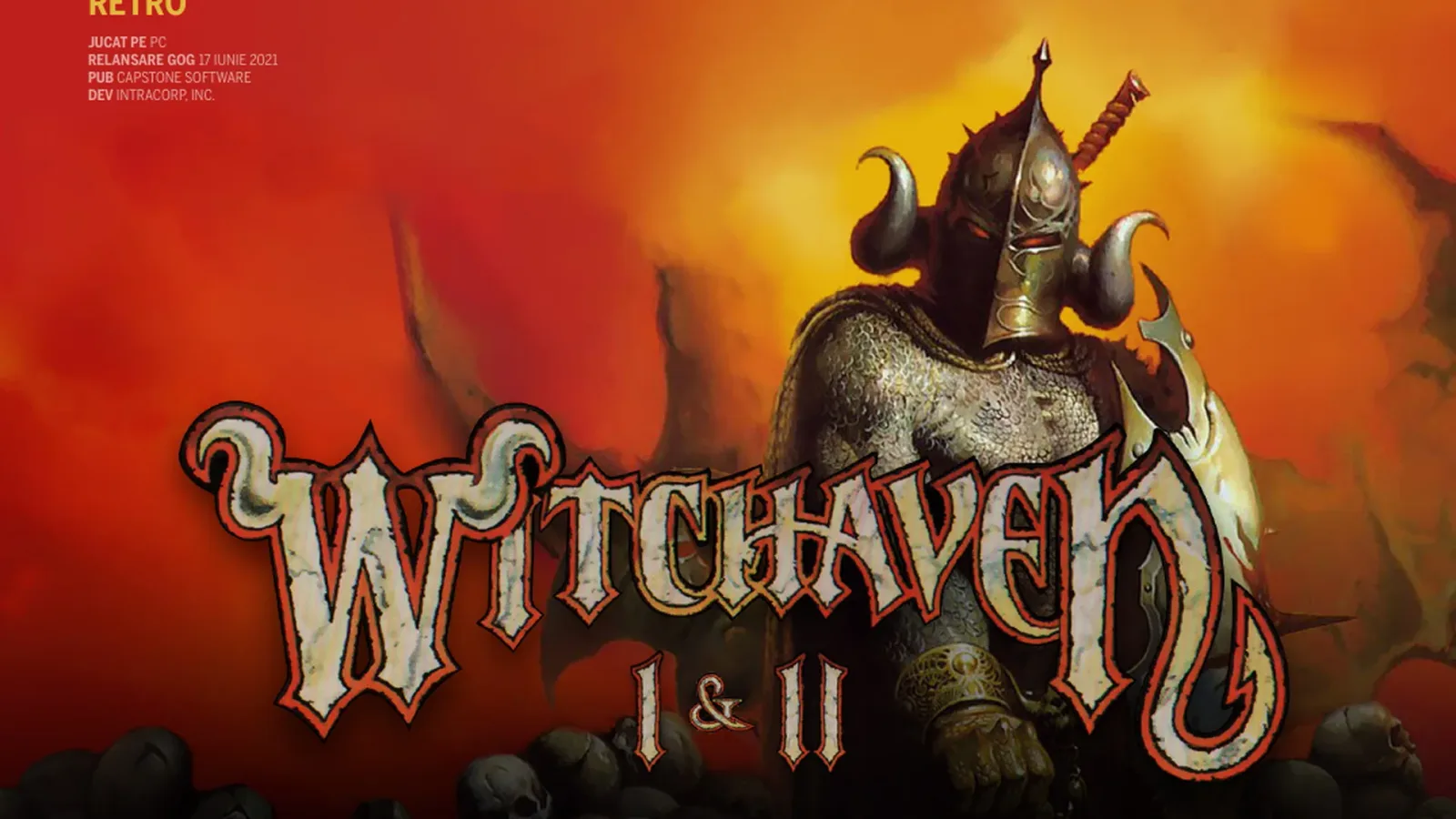
First published in GRIND III, pages 140–145.
GOG RE-RELEASE 17 JUNE 2021
Fortunately, almost every year, providence conspires in unison with me, generously handing me interesting retro subjects by way of various releases that land in such a difficult period...
Ever since meteorology seems to have turned into a science of records, in which every month edges past the corresponding all-time high by a little, I, for one, have come to eye the calendar with dread year after year, counting the days that separate me from the sauna season in my study – that is, the period in which the "big" computer, the one I'm supposed to run the games I write about on, turns into my number one enemy.
That's how I came up with a simple strategy: in summer I go retro, tackling games I can run on a laptop about 15 years old which, in turn, produces heat... but not as much as a unit with an AMD processor from the era of Vishera quasi-pseudoglory, with a 125-watt TDP, which also houses an AMD graphics card, equally old but prolific at producing heat, as is the way of my favourite manufacturer. Summer isn't like winter, when the same computer purrs pleasantly with warmth, which it spreads beneficently around itself.
A mother for winter, a plague for summer.
Good Old Games has brought to its online store a version playable on current operating systems of a rightly neglected series, but no less worthy of attention from the weirder nostalgics – as I'm delighted that you'd be too, alongside me. It's Witchaven and Witchaven II, produced by Capstone Software and released in 1995 and 1996 respectively.
I'll tell you honestly, when I saw the GoG announcement for the release of this old series, my heart gave a little leap in my chest. I played them right then, pirated, from floppy disks, and I must say it was a novel experience for that time – I liked them. For that reason I immediately felt the need to revisit them and write about them, especially since I suspect not many of you played through them in the 90s... and later not even that, given that you'd have had to run them using DOSBox. Anyway, now they're very easy to play in the GoG version; you don't need to rack your brains over installing and running them – it's all done automatically, in a configuration optimised for the best possible experience.
Only it's precisely this experience that I want to talk to you about, because the subject of Witchaven is a sensitive one from several points of view, as I was to find out following some very interestingly hilarious play sessions. I don't think it's happened to me too often so far to come away with such a contradictory impression of a title, at such a distance in time between the first playthrough and the second.
WITH THE DAGGER IN THE TEETH
We'll start with the story in the first Witchaven and finish with it right away, because, in a fine late Tibetan tradition – which I've already talked about too much – the story doesn't matter a jot in the FPS genre of the first half of the 90s. The epic component is so uninteresting, so simple-minded, that I don't even think it's worth loading your memory with the evocative and somewhat pompous names of the characters. The only thing that matters is that the main hero has been sent to an island, in the caves of whose cliffs lies the realm of a very powerful witch, who intends to open a portal to The Otherworld, from which she is to draw vaguely infinite powers with which to subjugate everything that exists.
Yeah, the simple effort of writing these idiotic banalities typical of the genre and the era is, even so, smaller than the toil of reading such a thing from the position of an innocent civilian.
At least I'm in the business... but perhaps you haven't yet developed any mechanism
THE SYNDROME
Once I'd started the game, the first thing that struck me, literally, but above all figuratively, was the opponents in the first Witchaven. These are made by a process somewhat similar to "stop motion" animation: that is, clay models of the characters are made for all the poses they adopt in the game, and each such model is photographed from several angles. The images thus obtained are then turned into the sprites used at the time to give the impression of protection, to defend yourselves from such an atrocity of a story, devoid of any interesting or possibly even novel idea. I repeat, you can be grateful that I haven't also assaulted you with the names of the characters... The story in Witchaven II, though, I didn't have the courage to look at, for fear that such a quantity of epic sordidness could do in even those hardened in the swamps of gaming obscurities, that is, even me.
What we're left with in the end is the completely baffling impression I got after watching the intro movie of the first Witchaven: a sequence of images and camera drifts through a pre-rendered 3D landscape, devoid of any spark of imagination or epic sense – it's just a stroll alongside the character, from a ship to the interior of the witch's island caverns. The music is, more or less, OK, but the little film, very long for its time, seems a silly waste of money that would have fitted better in the pockets of the programmers or the graphic artists. Oh well, it wasn't to be.
The important thing is that the intro movie in question proves its uselessness in that it doesn't create the epic and logical premise for the situation that brings the hero to the point where he disembarks on the island equipped exclusively with a simple dagger, even though the man appears to be in a good state of material equipment, as we can assume from the fact that he is a Hero sent by a rich ruler on a crucial mission. For crying out loud, at least other games make an effort to show how it comes about that you're left with bugger all when you start the game, with a toothpick in your pocket as your basic weapon and the talent to spit the olive pit the toothpick was stuck in more or less on target, in place of a sniper rifle. In Witchaven there's a disturbing serenity on the part of the developer regarding this delicate question – something that set off a few alarm bells and lit a few little red lights in my cheeks.
of movement and volume among the characters.
This method of creating enemies seems to me, from a technical point of view, a very suitable one for heightening the realism of the resulting sprites. It seems, however, that there's a significant difference between what a clay model shows to the eye of the artist creating it and what its transposition into a two-dimensional sprite represents for the player. This discrepancy struck me; I have the impression that the developer didn't know how to make successful use of this kind of character creation, which leads to a "disconnection" of these characters from the mise-en-scène of textures and geometric models in which they have to move.
But that wasn't the biggest problem, in my view, as far as the opponents are concerned. The delicate question, so to speak, was something else entirely, which is why I feel the need to open up a little the front of a discussion that deserves to be explored in more depth. It's what I call "Mogoșoaia syndrome".
I haven't the slightest doubt that the overwhelming majority of Bucharesters, when they pass through Mogoșoaia or cross Podul Mogoșoaiei, don't in any way think about who this Mogoșoaia was, where on earth this name of ours comes from, what toponymic shiver ran through the population that used it for so very long without deciding to change it – for another, who knows? Mind you, I'm not trying to explain here what the story is with this Mogoșoaia; Google exists for that. I'm merely defining Mogoșoaia Syndrome, that is, the situation in which a population that uses a certain somewhat exotic name to designate an element of the local geography never thinks about the origin and legitimacy of that name, which it doesn't call into question in any way. Mogoșoaia is a given, however strange and luxuriant it sounds; no citizen puts a shoulder or a thought to shaking its cast-concrete toponymic status. What I mean is, when you pass through Mogoșoaia day after day, from when you were a small child, this name comes to be an immutable landform in the personal imaginary geography of so many, many people – there are no more doubts, misgivings or discussions where it's concerned.
Where am I going with this Mogoșoaia? Simple: I believe most of us players suffer from Mogoșoaia Syndrome in relation to a certain game element. In this case, that element is opponent design. Look, for example, has any of you ever called into question the way the enemies in Doom look? Do you see what I mean? Quite simply, the way characters look in the games we started our gamer lives with seems to us a given; it doesn't cross our minds to give it a thought, to question it, to prod it with the dagger of doubt. Playing through Doom, or other titles of the genre and era, is for most of us the equivalent of crossing Mogoșoaia – we walk through places so well known, yet it never once occurs to us to ask what's the story with these opponents and their design, what's the story with this Mogoșoaia and how did it get here?
That is, until the day when, just as you're about to cross the well-known Mogoșoaia Bridge once again, playing Witchaven with characteristic innocence, in front of you appear… the mogoșoi, Mogoșoaia's dimmer, uglier in-laws, stinking of cheap booze and garlic, cracking seeds with no concern for the cleanliness of the public space they fill with shells, all the while conversing in guffaws and insulting passers-by of both sexes, without discrimination.
Those are the opponents in Witchaven – mogoșoi, so pathetic and so ridiculous in design that they start to set you thinking – here, what if I never really looked closely at Mogoșoaia either, what if she too is manifesting shortcomings in the education of her designers? And you arrive at the unthinkable stage – you start doubting her, you start calling her into question: look here, the monsters in Doom, which of them is downright stupid in design? Hmm, then, the best example is that spherical thing with horns that floats through the air, glaringly coloured red and blue, spitting fireballs at you, I think it's called a Cacodemon. I mean, seriously? Is that sort of thing supposed to scare us?
And I really do wonder: how naive and how daft must I have been back when I played Doom and got scared of something like that? OK, I understand that this creature's attacks are the sort of thing to worry you, but shouldn't the faculty of common sense step in and ring a bell in the upper layers of your consciousness, a bell whose crystalline sound would dispel the spell and hand you back your healthy guffaw in the face of such a laughable contraption on the monitor screen?
I won't make a list here of the at least amusingly pathetic things we get as opponents in games, especially in the pixel-sprite era, but I invite you to reflect on how Mogoșoaia Syndrome has affected you and where you should be looking for these creatures – in the mogoșoi of the titles you never called into question, never placed under the shadow of a doubt.
MERRY METABOLIC BYPRODUCT
The thing is that, throughout the whole of the first Witchaven, I came across nothing but various varieties of mogoșoi. Yes, it's true that some of them are to be feared, their attacks powerful enough to make you one with the floor texture, but where I ought to be horrified and producing the adrenaline meant to speed up my metabolism and sharpen my reflexes, I gently lean back and start laughing. Sorry, but the mogoșoi have this very healthy effect on me: they make me laugh. I don't know what was going on in the heads of those who made Witchaven, but one thing is certain: they didn't realise how hilarious the creatures they dreamt up were.
And here we come to a very interesting situation, which you may well have had a share of more than a few times in the years of 256 colours in which Doom and other such titles were made – we got scared of things we should have laughed heartily at, noticing their pathetic nature, their lack of inspiration, the clichés ripped off from the comic-book genre without discernment or critical sense (I won't even mention the aesthetic sense, perhaps it doesn't apply here). Now, after the mogoșoi of Witchaven have whetted my appetite for doubt and even for iconoclasm, I think the time has come to revisit, in a comic vein, old titles that took themselves seriously. That is, not Duke Nukem 3D or Shadow Warrior, which I hold up as good examples of the FPS genre's ironic self-awareness.
To persist in error is diabolical, but in the case of those who made the Witchaven series we're talking about hilariously pathetic devils, ported into the second Witchaven together with other opponents of the same stamp, lifted from the first title. Someone, it seems, had noticed that there was a crying need for better enemy design, but someone else said it was wise not to waste the old investment and gave the order for the mogoșoi to be recycled.
At least it's something that, as far as level geometry goes, both titles hold up well, honouring the classic winding layout in which we find the nooks, traps and secrets judiciously scattered about. Unfortunately, at least in the first Witchaven, the ornamentation and architecture leave much to be desired, which is why I was left with the impression that everything is kept, as far as possible, to the bare minimum needed to have a level, without any visual impact. The second Witchaven fares much better on this front, but I must confess that the Hexen games seem superior to me in terms of visual beauty and detail, where the art direction proves vastly superior. Still, given the graphics engine the Witchaven series uses, namely an early version of the Build engine (the one Duke Nukem 3D was made in), it seems to me that this is only normal.
What I did like about the graphics, though, was the shit-brown of the Witchaven games. You see, the 256-colour era had the advantage that game makers were forced to choose between sordid, washed-out, depressing shit-brown and lively, cheerful, full-of-life shit-brown.
In Witchaven I and II the latter option was adopted, which is why the shit-brown spaces, encountered often, somehow have the gift of lifting your mood, of making you feel that when life hands you shit, at least its colour can make it easier to live with. Unfortunately, with the move from 8-bit colour to 16- or 32-bit, this lovely chance of having invigorating, optimistic shit-brown in game levels was lost, and the drift towards depression peculiar to workers in the games industry pushed us all into the trough of Schopenhauerian shit-brown, so fabulously inaugurated by the first Quake.
WHICH IS NOT GOTHIC
There's one element that sets the Witchaven series apart from the other first-person shooter titles of its time: an RPG infrastructure. Indeed, the hero accumulates points by killing enemies or by finding treasures and artefacts, which forms the basis of a very simple level-up system. As he gains levels, the hero becomes more efficient in his use of weapons and armour, also gaining access to more powerful spells. On paper, that sounds good… but in reality the problem is that you have no control over how levelling up produces its effects, because there are no classes.
On top of that, the modifiers that come into play in the character's development aren't transparent, which means you never know what effect levelling up actually has on the hero's performance and abilities. How shall I put it – we're dealing with a sort of RPG system, but one you don't feel well enough to give you satisfaction, or to guarantee an experience superior to that of classic FPS games.
Unfortunately, this superficial and uninspired implementation of an RPG infrastructure seems to be reflected in the feel of combat too. It's similar to that of a Morrowind when you're mid-level – you swing your weapon or cast your spell, but it's far from certain that you'll actually produce any effect. One of the reasons is that most weapons are melee, but you never have a clear sense of the effective range of a blow; everything is guesswork… and the confusion is added to by the fact that different weapons have different ranges. Which is normal enough, and, in the end, perhaps such an embryonic implementation of edged weapons in a first-person game is one with predictable results – let's not forget that most sword games of that time were third-person, including the impressive Die by the Sword, which appeared later, in 1998. On top of that, the character you control moves sluggishly, and you can barely dodge a blow you can see coming if the opponent is close to you – in practice, you can be sure you'll take at least the first hit.
As it happens, ranged combat isn't significantly more 'comprehensible' in classic FPS terms either. You don't have a crosshair on screen, or any sights, which is why shooting a bow or casting spells is done by guesswork – training, trial and error being your best teachers.
Again, I perfectly understand the frustration of a dyed-in-the-wool FPS player, but on the other hand I have to admit that the sense of fulfilment you get from gradually learning to shoot a bow or cast spells makes the effort required by such an exotic (for its time) implementation of ranged combat worthwhile. Speaking of spells – in number and effect, most of them are more of an adjuvant than a complete solution. The game is threadbare in the spell department; in my opinion they were put in only to tick one extra feature off the list. They look like they were made with half a heart and half a designer's mind, and the game could perfectly well have worked without them. On top of that, it's easy to miss hitting an opponent with a spell, for the reasons to do with ranged combat that I detailed earlier. Let me stress it: the implementation of spells in Witchaven strikes me as unsatisfactory, far below what a Heretic or Hexen offers as a gameplay experience in this department.
In both Witchaven titles we have potions: for health, for increased strength, for fire resistance, as an antidote to poison, for invisibility and for invincibility – pretty much all you need. But the hero's stats can also be improved by finding artefacts such as rings, amulets and helmets, which offer various significant advantages. Granted, all of these have effects limited in time, but they prove useful if you move efficiently through the level.
The use of a weapon is also limited in time, and that can get annoying at times, because weapon wear sets in very quickly, usually after a few dozen blows. I've found myself in a level with only the dagger, and then with just my fists and nothing else, saved in extremis by finding a secret that held a weapon. Somehow there is a certain balance in the level design, so that you can get your hands on a weapon even in the desperate situation described above, and that heightens the excitement of the game. All the same, I don't rule out that the far too rapid weapon wear in Witchaven may annoy some of you more than it motivates you.
Something is bound to annoy you, though: the level design overdoes it with the various mouths set into the walls that spit fire at you. The speed of the fireballs is high, as is the frequency at which they are fired, and the burn effect is significant. Using such hazards far too often struck me as a cheap trick meant to inflate the intensity of the experience artificially, with a minimum of resources spent on developing a level.
It's true that you can use potions that protect you from fire, but the fire-shooting opponents and these fire-spitting wall mouths are placed in the levels so frequently that they often drain your potion reserves and rather spoil the fun through repetition and lack of variety.
And since we've mentioned variety – to me it seems a greater number of different opponents would have helped, both in design and in behaviour. In the first Witchaven, at least, I very quickly ended up dealing with every kind of opponent, with the crescendo in this respect almost entirely absent – which strikes me as a serious design error in any game. With the second title in the series things are a little better in this regard, but not brilliant by any means.
Witchaven I Witchaven I & II Bundle Witchaven II € 6.59 € 8.19 € 6.59
HESITANTLY, I RECOMMEND
Witchaven gave me that experience, something extra to the gaming experience – everything was more astonishingly rare for me, which leaves me convinced, more fluent, more intense, the game would absorb you naturally, it pulled you forward in a way that you almost couldn't do anything else, torn between the feelings the game gave me almost 30 years ago and the impression it leaves me with today. On the one hand, until you reached the final boss. Those games had, I understand the reasons why I was enthusiastic spell and soul – or, precisely here, the Witchavens and captivated in the past... but I can't easily overlook it seems to me they are deficient. the design problems that I spot with today's eyes. In the end, if I were to boil down my dissatisfactions into one, I think it would be the game's lack of naturalness. Somehow, all the unsuccessful things from the Witchaven series betray designers and creators who have neither enough talent nor love for the game they made. I recommend that nostalgics, all the same, play the Witchaven series because it's worth it. There is plenty of the charm of the past in these two titles. What's more, the experience of a very old FPS with melee weapons seems unmissable to me, all the more so as the implementation of combat is, in my opinion, well done... even if hotly debatable. If you're not entirely convinced, please take my word for it that, at least at a GoG discount, the Witchaven series is a must-buy that will give you more than it takes. The Witchaven series seems to me to have been made by people who came to work and worked on Witchaven... and that's all. All the FPS titles of that era that have stayed in our memory were clearly created by people irredeemably in love with their work and with the games they crafted with passion and undeniable talent. And that brought MARIUS GHINEA LEFTCLICKGHINEA.ro