
X-COM: UFO Defense
First published in GRIND III, pages 152–156.

“And He shall deliver Europe from the aquatoid scourge and strike down the lobster battleship with the sonic oscillator and guide my Leviathan to the gates of T’leth. Amen!”
I’m taking advantage of XCOM 2 being around — a game I never got to enjoy properly — to sing the praises (once again) of its brave forebears, X-Com: Enemy Unknown and X-Com: Terror from the Deep.
A few years ago, like a modern David who spent night after night wrestling intergalactic Goliaths, I dedicated a psalm to it. Published on the now-defunct Level website and in the now-defunct Level magazine. I’m proud of it, but you might count it blasphemy. Or a blatant copyright infringement, if you’re one of the atheist members of the former ruling clique at Level, where I planned to work until the end of time.
Before you accuse me of blasphemy and nominate me, against my will, for Grill of the Year, let me tell you that thanks to the X-Com Brothers I rediscovered the healing powers of a well-executed sign of the cross. I think that in the first few weeks, putting in non-stop shifts out in the furrows of the NGO for combating extraterrestrial and extracurricular threats, I crossed myself more often than I do in church. Well, what do you expect — there are no Ethereals in church, and no Lobstermen wiping out half the congregation before someone manages to plant a plasma bolt right in the middle of “in the name of the Father”. I was this close to buying a left-handed mouse, just so my right hand would be free in case I saw something yellow slipping out of the shadows. Brrr, I still get nightmares about those yellowish lobsters from Terror from the Deep. That’s on the nights I’m not having nightmares about those brown-hooded aliens from the first one.
For anyone who only switched on a computer in the last four years: Firaxis’ XCOM number one is the better-looking reboot — a little poorer in spirit and feeling — of the X-Com series that the defunct MicroProse milked to exhaustion. Where by “exhaustion” I mean X-Com: Enforcer, a 3D action game that, in the shareholders’ vision, was the natural continuation of a turn-based strategy series. Well, Enforcer buried the X-Com franchise, and every attempt by the Gollopians to bring it back to life failed. Until, a decade after X-Com gave up the ghost, 2K got its hands on the intellectual property and announced a… I’ll give you five minutes to remember, some of you even played it… TACTICAL SHOOTER! Because the last shooter was so good… In the end, things settled back into their natural bed, and Firaxis managed to put out a successor.
I fell in love with X-Com at first sight. It didn’t even run on my PC; I was due to get one six months later, so I could learn C and become a programmer earning thousands of euros a month. I had two classmates who practised the ancient custom of alien hunting. One on land, the other in the depths of the ocean. Seriously, I’m not making this up. When I fancied some Enemy Unknown, the land one, I’d go round to one classmate’s. When I wanted something liquid in my X-Com too (so to speak — it would only become mine six months later), I’d go and… do my homework at the other one’s. With their permission I mashed their buttons too; I didn’t settle for just watching. Not for very long, because they had parents as well, parents who probably wouldn’t have understood that bagging a live Ethereal was probably more important than maths at that point in our lives, but long enough for me to realise I had before me the best games ever made. I hadn’t played thousands of PC games (though I had a few hundred for the HC to my name, Laser Squad among them, another masterpiece by the Gollop brothers), but X-Com is the kind of work you can crown even without knowing its competition.
In short, in the two X-Com games you’re handed command of an international organisation tasked with combating extraterrestrial threats. Classic B-movie setup. In fact, one of the series’ major inspirations was the British TV series UFO, broadcast by the BBC in the ’70s. The alien scourge needs organs. We sapiens have organs. A match made in the Cosmos. As a result, the alien scourge saddled up a UFO and set about harvesting those organs and drawing geometric shapes in the cornfields, so you’d know who left you without a colon when you were walking home all on your own from the pub. Governments did what they do best: started flinging money at armed men to sort out their uninvited-guests problem. At the head of those armed men — among whom a few people with microscopes and a few others with adjustable spanners have slipped in — is you: the Mouse Wielder, Uncle Sam’s Whip (if you set up your base on US soil), the Sectoid-eater, the Devourer of Galactic Crustaceans, etc.
X-Com Ltd.
As X-Com’s fresh-faced administrator, you’ll fight on two fronts. The economic one, because funds aren’t infinite (if you’re not thrifty you can run your little firm into the ground and goodbye humanity), and the military one, where, if you apply the tactic of “at ’em, at ’em, at the test tube that spawned ’em!”, you waste human resources and you’re back on the economic front looking for more human resources, which can lead to bankruptcy and… you get the idea.
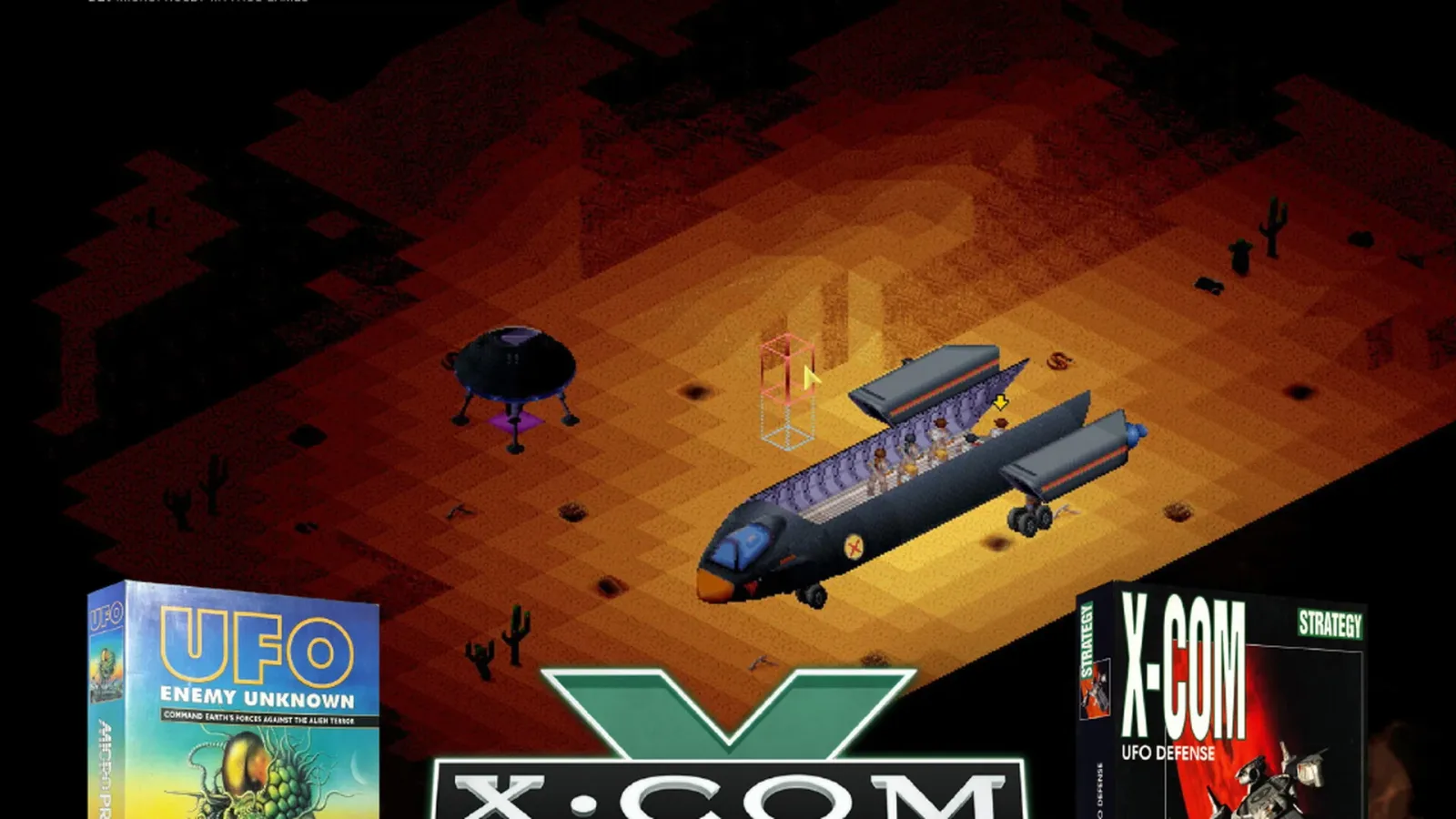
In more detail: we have two game modes at our disposal (as a point of trivia, they are two separate executables). Geoscape, where the informational, economic, scientific and industrial war is fought (plus the aerial duels with the UFOs picked up by your all-powerful radars), and Battlescape, an isometric marvel where, in the purest turn-based style, you get your hands dirty with fluids of extraterrestrial origin and load your conscience with the three decidedly mediocre recruits you sent out of the ship first to draw Sectoid fire.
We’ll take them one at a time. Geoscape actually means admin work. Base construction, research, production, a bit of trading — you’ll do the lot. On top of that, on the Geoscape you fight the invasion on a global level. Meaning UFO detection and interception. Which isn’t just clicking a little red cross to send your little yellow cross off to intercept. If you carefully study the types and flight patterns of those little crosses, you’ll be astonished to observe that the invasion isn’t a long string of random or scripted alien appearances. A piece of code (I don’t know how big it is, but I vouch for its efficiency) organises the invasion down to the smallest detail and, most importantly, actually reacts to your actions. If you rely only on the radars built in your base to detect and intercept the scourge’s UFOs, you lose half the charm of the hunt. For instance, if you notice a concentration of supply ships in a given area, there’s a good chance an alien colony is sitting there. Sure, there’s a chance that colony will be picked up by your base radars, but if you take the reins and send a few ships of your own out on patrol, you’ll discover it sooner. Likewise, if a terror ship catches your eye, brace yourself for a terror mission in the near future. That is, unless you manage to intercept it and blow it out of the sky before it lands in Buzău and terrorises the locals. I said earlier that the scourge responds to your actions. Successful interceptions don’t just bring you the respect and the funding of your international sponsors, they also bring unwanted attention from… THE INVASION… them… them. At some point, irritated by the number of UFOs the X-Com fleet has holed, the aliens will send reconnaissance ships and, sooner or later, you’ll wake up to find a whacking great battleship parked in your base. One of X-Com’s minor sins is that it never implemented a jamming system or any other method of making yourself invisible when the situation called for it. I could give you dozens more examples, but the core idea is that in X-Com the invasion is simulated by the book, in many shades of grey and intermediate states… and it’s exactly this aspect I miss most in the new XCOMs, where the approach is minimalist, black and white. UFO appearances are random, when they aren’t scripted; base attacks are scripted too; in practice the Geoscape is only there to simulate the passage of time, it isn’t the actual stage on which the invasion plays out. Never mind the limits imposed by board-game rules (you have three missions, but you’re forced to pick one!) rather than by circumstances, as used to happen in X-Com. Where in theory you could knock off a terror mission and the assault on a crashed UFO one after the other, but in practice you didn’t have enough people, and you weren’t in the mood to go barrelling into the crashed saucer when the terror mission had eaten half your squad and there was no money left for ten more recruits. A shame. XCOM 2 went some way towards fixing the problem, but even there the Geoscape just looks like a way of passing the time between two missions.
Base construction was also a very important element, ignored in the new XCOM, putting the little administrator inside you to work. It was a real pleasure (and a challenge) to pick the location of your next base by studying the invasion graphs (UFO sightings), to juggle funds so you could afford one more production base. Or detection base. Or whatever you fancied. To hire and fire scientists. To transfer them at the end of the month knowing that salaries aren’t paid if recruits/scientists/engineers aren’t in base but in transit (I admit, it was a kind of cheat, but everything goes as long as you don’t edit saves with a hex editor to put billions in your account). Practically, you had a million things to do, and never has micromanagement seemed so pleasant to me (yes, now it seems even more pleasant, given that OpenXcom, which I’ll tell you a bit about further down, has implemented some incredibly useful features). You knew that every little thing, every click made by a handful of people from the internet™, OpenXcom is a source port that removes your last excuse not to try two of the best games ever made™. Thanks to OpenXcom, a constant presence on my hard drive since version 0.9 — that’s over two years now — I’ve convinced myself once and for all that it isn’t the rose-tinted glasses of nostalgia, with a filter for crap-coloured light, that are responsible for the veneration the ancient X-Coms enjoy. I play X-Com fairly often and I can’t believe how well it holds up for a 20-year-old “geezer” (1500 in game years). The game is very solid, the mechanics are current, the only thing that has “aged” is the graphics. And I only say that half-heartedly, because I’m a sucker for pixels. And anyway, I see the “retro” look and pixel art are much in demand among indie consumers and producers.
What does OpenXcom bring? First of all, compatibility with all operating systems (there’s even an Android version) and fixes for some of the annoying bugs. There’s mod support too; some of them are absolutely insane and completely change the experience, such as Piratez or UFO Redux (now Area 51); do look them up.
I said earlier in the article that it isn’t micromanagement that kills us but, in most cases, the interface. To that end, a whole set of features has been implemented in OpenXcom that have made my life exponentially easier. A random example would be the ability to specify in the Manufacturing screen that all production is destined for sale. From that moment on, an item is sold automatically once it’s produced, sparing you a weekly trip to the Sell/Sack screen. Another example, a well-chosen one this time, would be the ability to save soldiers’ equipment so you no longer have to arm and kit them out before every mission. Anyway, the improvements are too many to mention here; go to openxcom.org yourselves and read. Then install it. Then thank me. And if something doesn’t break inside you, you’re not human and you don’t deserve your PCs.
As an interesting aside, the people who worked on OpenXcom tried to improve the AI. Because the AI was hardcoded, it had to be rewritten. The result was Satan himself. There’s an option to select it, and I only recommend it if you can finish X-Com on Superhuman (which no longer resets to Beginner when you load a game, the bug has been squashed!) with your eyes closed. Enough talk, go play! mattered in the grand scheme of things. For example, the base layout was of very great importance. I found out quite late that the access points in case of a base invasion were the hangars and the access lift. Since the base layout is the same on the tactical map (Battlescape), with an intelligent design (the access lift as a bottleneck, meaning hangars positioned in such a way that access from them to the rest of the base also went through the access lift) you could end up with a base that was very easy to defend.
A little about research and technological warfare. First of all, when you discovered PSI technology, it was Game Over. Seriously, PSI in X-Com was a kind of God mode in Quake. But I forgive it this sin because, after everything you suffered before mind control finally fell into your lap, PSI technology offered you the chance to mock Them in the most barbaric style. I have a friend whose great pleasure was to mentally control aliens, make them drop their weapons, arrange them neatly in a straight line and summarily execute them. No trial. Another would “convince” them to shoot each other. Or ritually top themselves with a grenade. In any case, revenge was sweet, and that typically human feeling that convinces you to chase enemy archers down with cavalry in Shogun 2 even though they’ve withdrawn from the battle, there’s nobody left to regroup them and they no longer pose a threat, kept you in the game even once you realised you couldn’t lose it any more.
Returning to technologies less divine than PSI, I’ll just mention that a certain technology (let’s say… LASER) wasn’t automatically invalidated by the next tier. For example, I didn’t give up laser rifles when I discovered plasma. Why? Very simple. Laser technology didn’t need ammo. And, more importantly — I think I’ve said this elsewhere too — the low Time Unit consumption (more on those below). That is, 2 (TWO) aimed shots per turn, which convinced me to keep them in my snipers’ loadout long after the rest of the grunts had switched to plasma. They were also among the most profitable products (I made billions selling laser cannons on the black market).
BATTLESCAPE
I’ve sprawled on like a leper and still haven’t got round to telling you about Battlescape, the place and time when things get personal and your $30,000 recruits get their chance to prove their usefulness. And they all will, no matter how mediocre their attributes are (because yes, the mathematical model of a soldier under your command is very complex; each of the nine attributes that define a weapon-carrying entity plays a very important role on the battlefield). The weak will be cannon fodder (they get off the plane first, draw enemy fire, etc.), cynical as that sounds, and the strong will shoot at the enemies the cannon fodder uncovers (aka Scouts, so they don’t feel bad). Speaking of cannon fodder, we’re dealing with a delicious paradox only partially captured by Firaxis’ XCOM. The maximum number of soldiers you can throw into battle is between 14 and 26 (after a technological leap). Although you’ll get attached to your soldiers named after people you know, you know that no matter how careful you are, people will die. And you try to make the process more efficient. I can just picture the difference in motivational speeches between an X-Com officer and an XCOM one. “Lads, there are fourteen of you, some of you will die, because that’s the nature of things, but you’ll die for a noble cause blah blah blah, flag, independence, stork, cabbage, foal, you, the one with Bravery 10, get to the front, take a pistol, a smoke grenade, and step out first” versus “I’ve only got you four. Avesaloame, if the devil puts it into your head to die I’m left without a level-four sniper and by all that’s holy, I’ll come after you and bring you back with the power of Saint Load”.
Perhaps the most nerve-wracking moment is the “landing”, when you know nothing about the terrain and there’s about a 50% chance the first man to set foot on the ground leaves it there. And, to protect your more advanced soldiers (because their attributes grow), you’re forced to resort to cannon fodder. To the Expendables. And of course you do it with a slightly heavy heart, because you’re not a psychopath and it’s impossible to feel nothing when soldier Koniec 1 bites the dust on his very first mission. Things will probably go differently with Koniec XII, who only died on his third mission, but you’ll always remember the first sacrifice (mine was Jools, killed in the middle of the desert by a Sectoid’s plasma; yes, he’s from Cannon Fodder, you guessed it).
I won’t go into details about the mechanics in Battlescape; X-Com is a classic TBS in which both yours and theirs move and shoot in turns, within the Time Units they were endowed with by the great Random Generator in the code. I’ll only draw attention to how those interact, with short, ugly little jabs at XCOM and its pampered sibling XCOM 2. The cover system, for example. In X-Com we don’t have a “system” of cover. We have physics, we have walls, we have projectiles. A wall’s function is to stop a projectile whose trajectory intersects it. It’s common sense that a soldier placed behind that wall will be protected at least from the first enemy shot. In our case, the wall doesn’t give you bonuses — the wall exists and, since it has no choice, it lets you hide behind it with the promise that as long as it’s a wall, the probability is 1 (one) that nothing will hit you. Nothing except explosives, of course, but nobody said it would be easy.
The inventory and the actions your soldiers can perform on the battlefield are also very important. Your people, like the enemies for that matter, can access their inventory during combat. Which means they can pick objects up off the ground, enemy weapons included. So when a grunt runs out of ammo, all you have to do is find him a weapon, pick it up and use it. There’s no need for me to tell you how much a mechanic like that adds to the atmosphere and the gameplay. Another situation: you need to throw a grenade a long distance. Given that grenades in X-Com don’t explode on impact but no earlier than the end of the turn, nothing stops you from throwing a grenade next to another recruit, who’ll pick it up and throw it even further down the human chain, until it reaches its destination. You see, then, how, by eliminating the inventory, XCOM “got rid of” half the fun of old X-Com. The reason Firaxis cited, as far as I remember, was to eliminate micromanagement. Between you and me, micromanagement isn’t a problem when it’s backed up by an interface with the features to support it. X-Com’s problem wasn’t micromanagement, it was the interface. And it wasn’t that big a problem anyway. Now that the interface has been adapted and crammed with features in OpenXcom, micromanagement has become a real pleasure.
Another of X-Com’s trump cards was destructible terrain. Implemented in the 90s. Decommissioned in 2012 by XCOM, partially reintroduced in XCOM 2 as a fantastic novelty. I don’t think I need to explain why and how the ability to “make” yourself a door in a house, when using the classic one seemed far too risky, added a whole new tactical dimension to the game. As an aside, the “destructibility” of the environment was taken to the extreme in Apocalypse, where one of the most memorable moments were the ones in which we “paid a visit” to the Sirians and demolished buildings on top of their heads.
I’ve saved the aliens’ behaviour on the tactical map for last. They’re active. They swarm. They hunt you when there are a lot of them, they run from you when there’s only one. They panic when the situation calls for it, they hide while you go frantic looking for them, the ones with Mind Control try to take your soldiers over from the shadows, and so on. Basically, they exist and go about their business even when you can’t see them. To summarise, they can hunt you from the shadows, and that’s a fantastic boost for the game’s dynamism at the gameplay level, but also for the atmosphere in general. I won’t tell you what it means in X-Com to hit End Turn when there’s not a single critter in your field of view, but you know it’s possible THEY can see you, because it never crossed your mind to bring a few flares on a night mission (when visibility is reduced and there’s a fog of war as well). In XCOM, thanks to the pod activation mechanic, the same situation has a way of calming you down instead of winding you up, and more often than not you heave a sigh of relief that you got away with it this turn too. Clearly nobody’s shooting at you.
Regrettably, I’ve already blown my allocated space by about four times over, so it’s time to draw a conclusion that’s been nagging at me since 2012. X-Com is a PC game that couldn’t exist in any form other than bits, while XCOM could just as well be a board game. That’s what I’ve tried to explain across many pages, and I hope I’ve managed to get across at least half of what I wanted to. Almost everything about XCOM (2012) can be simulated with toy soldiers, cardboard and a die, with no need for millions of operations per second. I like board games, but I prefer them physical. I like XCOM too (and the sequel, more recently), it was a very brave project on Firaxis’s part, but in my honest opinion it’s missing the genius, the beauty and the clarity of design, the harmony of mechanics and the freshness of the dear old X-Coms. Seriously, X-Com is a lesson in perfect game design that ought to be taught to every amateur, or professional, in the Industry.
P.S.: Throughout the article I’ve referred specifically to the first X-Com (Enemy Unknown or UFO Defense), but everything I’ve said holds for Terror from the Deep as well. Which is the same Mary with an underwater hat, and the major difference is that the Gollop brothers had nothing to do with it. But the mechanics are copied so faithfully that it doesn’t matter that much any more.