
Clair Obscur: Expedition 33 – Review
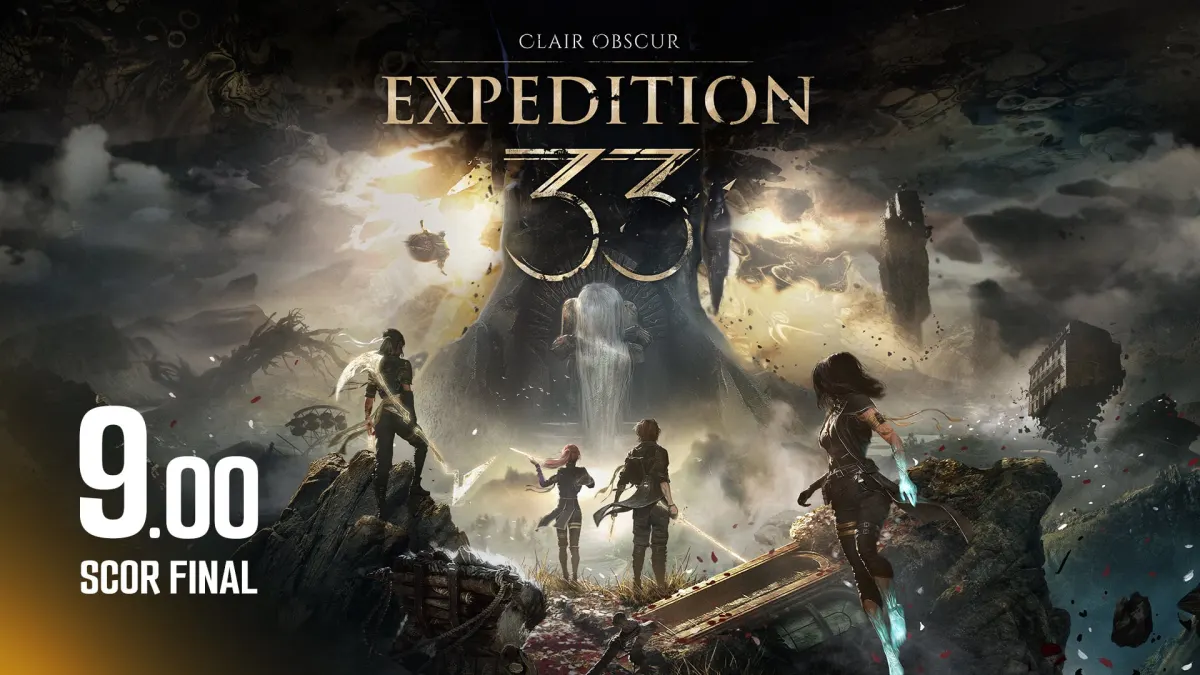
My Game of the Year favourite!
Listen up. If there’s one game I wanted to get my hands on this year to review… this is it. Before we start, I want to mention that I’m not a huge fan of turn-based games. I’m very picky when it comes to them. I even discussed in an interview with Filip Andersson, Game Director at Palindrome Interactive, that they’re all spreadsheet simulators at the end of the day. It’s how you present them to the player that makes the difference.
But I fell in love at first sight with the dynamic combat in Clair Obscur. I absolutely love parrying. Lies of P and Sekiro are my favourite games. So I was ecstatic to see how this mechanic is intelligently used in another genre of game.
Not to mention the music. I even had the pleasure of exchanging a few words with Lorien Testard, the composer. It’s going to be highway robbery if he, Alice Duport-Percier and Victor Borba don’t win a ton of awards this year.
One last thing I want to mention before we start is about optimisation. Unfortunately, because of it, I couldn’t fully enjoy the game. The optimisation issues hit me hard. Black screen after black screen. Believe me, I spent about 70 hours in the game, of which only 45 hours are recorded by the in-game clock. The remaining 25 I had to keep fighting the same bosses and watching the same cutscenes again and again due to crashes. Let’s say I spent half or less of that learning enemy patterns.
I’ll tell you more when I talk about performance and optimisation. Let’s get to hacking and slashing the other aspects first.

The story so far…
Lumière is a fictional city that embodies Belle Époque Paris. You can stare at it for hours. The architecture, the fashion style, the colours… Majestic is an understatement. But beauty doesn’t last forever. Every year, the Painter scratches a number on the Monolith. People of that age will cease to exist. The number decreases year by year, a countdown to humanity’s demise. But people haven’t stood idly by. Starting with Expedition Zero 67 years ago, they have constantly tried to break the cycle and save humanity from imminent death. Without luck. “Paving the way for those who will follow us” has become the motto of every Expedition. Everyone knew their return was a matter of “if”, not “when”.
Now it’s Gustave, Lune and Sciel’s turn to join Expedition 33 in a new attempt to take down the Painter. Gustave is a cunning and brave inventor. Lune is a calm and calculated magician. And Sciel is our optimistic magician who wields a scythe.

I haven’t said anything about Maelle, have I? Even though she appears frequently in trailers. Well, she joins the group prematurely – she’s only 16. But I assure you she has good reasons.
Monoco is another funny member who will join the group. He’s part of a race called Gestrali – living puppets who love to fight. Monoco is special because he can transform into the creatures he defeats… after cutting off their legs. Don’t ask, okay? It wasn’t my idea.
Esquie is the last to join us. You know the gigantic ball the Expedition uses in trailers to move around? That’s him. He’s probably the strongest being. If only he weren’t lazy and didn’t act only when he felt like it.
The actors’ performances bring each of them to life. The most famous of these is Andy Serkis. But he’s not the only big name. We have Daredevil himself, Charlie Cox, who plays Gustave. Behind Maelle is Jennifer English, known for Shadowheart in Baldur’s Gate III. And Verso, this mysterious character I can’t tell you much about, is played by Ben Starr. You might have heard of him for roles like Clive Rosfield in Final Fantasy XVI or Khazan in The First Berserker: Khazan.

Although I adore Serkis, Charlie Cox is the one who impressed me terribly in this game. He exceeded all my expectations for his debut in his first video game. Every inflection of his voice, every contracted muscle, every expression, every emotion… This man left his mark on me as one of the most memorable characters in video games. And that’s just after his first performance. Gustave lives and breathes because of him.
There are still a few problems in the normal scenes, not the pre-recorded ones. The lip-syncing doesn’t match at all. It’s always slower than the lines. And there’s no option to completely skip dialogues we’ve already heard.
A clever way in which the story and past events are presented is through the journals of previous expeditions. These contain audio recordings from their final moments and their message for their successors. They are the only collectible for the story, and I appreciate this simplistic approach.

The world itself gives a Metroidvania feel. Access to many regions is conditioned by new abilities you have to unlock for Esquie. You just have to find stones he lost while following the story. Some of these are typical of the JRPG genre, such as breaking rocks, swimming, or the ability to fly.
You’ll also encounter different NPCs throughout your journey. Some of them offer comical moments. Some advance the story. And some allow you to trade or upgrade your arsenal. None of them feel annoying. And each has a predetermined role. My suggestion is to rotate the active member interacting with other characters. You might witness unique interactions!
This is the best experience I’ve had with interactive media so far in terms of story. It’s been a while since a game touched my soul. Many of them impressed me with their gameplay. Very few stole my heart with such a profound and all too human experience.

When one falls, we move forward…
I knew we weren’t talking about a classic turn-based game from the moment I saw gameplay videos. The active and reactive combat won me over from the start.
The active part is about in-battle abilities. You can pre-select which three members you’ll send against enemies. Each can use normal attacks, ranged attacks, or skills. Normal attacks consume nothing. On the contrary, you’ll receive one Ability Point (AP) after them. But they will end your turn. Ranged attacks consume one AP and you can use them until you run out of these points. They are useful if you want to hit enemy weak points, as well as against flying enemies. But be careful because any action can be dodged by enemies.
Characters can be customised through skills. You’ll have to invest intelligently in the abilities you’ll actively use. And be careful, because you can equip a maximum of six. So choose wisely!
I’d say you can experiment a bit. You’ll be able to find or buy items that allow you to respec. I didn’t use them, because I had a clear idea of what I wanted from each character. But hey, you have room to manoeuvre if you need it.
Each character also comes with Gradient Attacks. You collect Gradient Charges from actions during combat. One charge allows you to use the weakest Gradient Attack. Three charges give you access to the strongest. And this type of attack can only be unlocked if you have a stronger bond between characters. So go and talk to everyone when you’re in camp.

I’ll separate skills into two categories: offensive and support. The names are quite suggestive. I went more for the offensive ones because I like a good fight. I’ll explain in detail when we get to the reactive part of battles.
Last but not least, you have to perform timed actions to unleash your abilities. You might deal less damage, stop the ability, or even hurt yourself if you don’t perform them at the right moment. And don’t worry if you’re not a fan of them. There are accessibility options that allow them to be executed automatically. I left them active because they keep you engaged.
Let’s talk about the reactive part too. Enemies won’t just stand there watching you kick their arses. They will attack you. And you can use these attacks to your advantage. They have sequences of normal attacks that you can parry or dodge. Each attack has a specific tempo and a visual, auditory, or both stimuli.
Dodges are the safer option – the window in which you can execute them is more generous. Parrying is more fun and has more benefits. If you parry all or most attacks (including the last hit), you’ll perform a counterattack. The counterattack will be performed by the entire group in the case of attacks that would have affected everyone.
Some attacks you can only jump over, which is different from the other two actions. You’ll receive a visual and auditory signal when this is the case. And a successful jump allows you to counterattack while in the air.

And that’s not all. Enemies can also perform Gradient Attacks. The response to these is a Gradient Counter. Some Gradient Attacks are single hits. Some represent the last hit in a sequence. Just pay attention. Don’t panic when the screen turns grey. And press the right button at the right time.
I cannot stress enough how well all these elements come together to provide a satisfying gameplay experience. Hitting an enemy with a counterattack after parrying all their attacks feels divine. Especially if you play on the highest difficulty, as I did. There’s not much room for error there.
I also have to insist that you get used to enemy attack patterns. Don’t rely exclusively on upgrades. You’ll gain more if you understand the flow of combat. In fact, I kept collecting items that restore HP, AP, revive fallen members, etc., but I didn’t use any of them. I’m the type who prefers to play clean. And I have a feeling you’ll have just as much fun if you use a similar approach.

But you also have other toys in your arsenal. The first upgrades you can get are Pictos. They can be found, dropped by enemies, or bought. You can only equip three per character. For example, at the beginning of the game, I equipped Lune with a combination of Pictos that allowed me to start any battle with +2 AP and an extra point for each successfully parried hit.
But this isn’t the only use for Pictos. Win four battles with a Picto equipped and it will become a Lumina. How does Lumina work? Unlike Pictos, these can be equipped on any character you want. But be careful, because each Lumina has a cost, and each character has a specific number of points for these passive bonuses. You’ll receive one Lumina Point with each level. You can also find or buy items to increase this capacity.
You can find, buy, and upgrade weapons. These dictate what kind of elemental damage normal attacks produce. Some abilities use the element associated with the equipped weapon. Enemy elemental vulnerability is important in the first part of the game. Weapons also come with a series of passive bonuses as you upgrade them. You can do this using different materials or by defeating a group of enemies located in a specific area.
Plan around weapons with passive bonuses you like if you want to think long-term. Start to slowly prioritise skills that include multiple hits. Invest in the Luck attribute for higher critical hit chances. And use Pictos and Lumina that increase your normal and Break damage. Let me explain.
First, the upper limit per hit is 9,999. So you’ll want a high level of Luck to increase the chances of consistently hitting that number. Abilities with multiple hits increase your chances of landing critical attacks.
“What’s Break Damage?” you might ask. Each enemy has a Break bar that fills up as you damage them. You’ll be able to perform an attack that incapacitates them for one turn when the bar is full. Only certain skills can do this. So keep one or two characters with such skills around.

I suggest you also pay attention to the attributes that increase weapon effectiveness. You’ll receive three points per level that you can allocate. And each character has an attribute that is found on almost all weapons used. For example, Sciel’s weapons scale well with the Luck attribute.

I’ll admit I was bothered when I heard the news that there would be no maps in the game. How am I supposed to find everything if I don’t know where I am? Fortunately, this only applies to individual game areas. There is a global map through which we can travel, and it takes the form of a zoomed-out version of the continent. This provides enough information without detracting from the joy of exploration. Areas you’ve already visited will have their names displayed. Locations are coloured white or red to denote their level of danger.
If an area is accessible, confidently enter and see what’s inside. You might be surprised to discover an item, a secret boss, or a new region to explore and unravel its secrets!
Your best friend on this continent-map is the ability to set up camp. Not just because you get to chat with the other members. But also because you can upgrade your expedition members, reset HP, and create a save point before fighting enemies.

Most enemies are Gestrali, eager for fights like Monoco. They offer normal items that you can buy. However, they also have a secret inventory that you can unlock if you defeat them in battle. Thus, these enemies become an easy way to gain experience, as they are not hard to defeat.
Speaking of experience, it applies to the entire group. Even inactive characters will level up at the end of a battle. There are also a few areas where you can GRIND if you feel the need.
The way regions are constructed is intelligent and doesn’t add dead time for the sake of it. Access to grappling hooks facilitates traversal. At most, you’ll have to revisit a few regions to take down a boss or two that were initially too powerful. You’ll also find items from time to time. And you can use them strategically. The game auto-saves every time you collect an item. So you can use them as mini-save points.
Honestly, I’d have to look veeery closely to find any gameplay quirks.

Give the artists all the awards already!
Now it’s my fanboy moment for everything visual and audio. It’s undeniably the most beautiful game I’ve played, after Dragon Age: The Veilguard surprised me with its faithful graphics and level of detail. They know how to use lights. They know how to use camera angles and special effects. And they certainly know how to make the most of motion capture technology and the actors’ performances. Whether we’re talking about campfire scenes or fierce boss battles… THE GAME DELIVERS!
I still maintain my argument that Lorien, Alice, and Victor should win a ton of awards for what they’ve done with the music. The melodies ignored my brain and went straight to my soul. And it’s not just one musical genre they used. They allowed themselves to experiment with several. You can listen to opera arias, rock, jazz, atmospheric music, and many more. You can rely on the soundtrack to capture the gravity, the sense of danger, joy, uncertainty, or any other feeling associated with the scenes.
The sound effects are visceral for attacks, parries, counterattacks, and all other special abilities. I felt every action. Every button pressed. I don’t even know how else to praise these people.

We reach the moment when the expedition fails…
It’s time to talk about optimisation… Or rather, the lack of it. First of all, you’ll need a decent system if you want to enjoy what Clair Obscur: Expedition 33 has to offer. Check the Steam requirements and you’ll understand what I mean. But even those specs won’t guarantee a problem-free experience.
My trusty setup with an RTX 3070, i7-10700 and 32 GB RAM has saved me many times in other games. But Clair Obscur wanted to be the exception to the rule. And some blood might have been spilled in the altercation.
I had to use the Medium preset to record some gameplay for you. But I quickly switched to Epic afterwards. And I had about 10 hours where I stared at the beauties created by Sandfall Interactive. But then… then things degenerated. I didn’t lose frames. I didn’t have graphical issues. But my screen would go black and I couldn’t do anything – my graphics card was giving up. This happened too many times to count.
I immediately thought of the problems Nvidia has had recently. New releases had major issues due to the penultimate driver. I even downgraded to version 566.36, which was the most stable. But the problems persisted. The latest version didn’t help, although it should have. Not even the Low graphics preset did anything.
And it’s not like I encountered this problem sporadically. It happened to me even five times consecutively after a few minutes of fighting a boss or watching a scene. Not to mention how many times I had to fight the same bosses again and again. Or how frustrating it was.

The worst part is that I encountered a softlock after more than 70 hours spent in the game. These problems tripped me up at one of the last bosses and it terribly annoys me that such a good game suffers because of this.
I also encountered a few minor issues. I was teleported to inaccessible areas on the map or some scenes would zoom inside character models for a few seconds. But these happened three times in total and let’s say I could overlook them. Even the strange teleporting could be solved by loading a previous save.
I sincerely hope for a patch to fix the situation at launch. Otherwise, I won’t risk my system’s integrity again. I advise you to be careful too. I persisted and kept trying to play because it’s the game I’ve been waiting for the most. But I won’t make the same mistake twice.

Final Verdict
Clair Obscur: Expedition 33 fully deserves the title of masterpiece… when you can actually play it. It has the most engaging and enjoyable combat system I’ve encountered in a turn-based game. The story warms your heart. The world looks incredible. The sound and music are the best I’ve heard since I first picked up video games.
Unfortunately, it’s plagued by poor optimisation on PC. I want to recommend it to all my friends and family. I really do. The creators’ soul and passion are palpable. The people at Sandfall Interactive are giving a masterclass in storytelling, gameplay, art, and music here. And yet… the technical side beat them.
I’m glad that the community has come to our aid with mods that improve performance without reducing game quality. However, it’s a red flag for more and more developers. It’s not reasonable to release a poorly optimised game and expect players to hope some modder will fix the problem.
In any case, you can now enjoy it on all platforms without serious issues. I’m giving it 9/10 and I hope to see Sandfall Interactive lift the Game of the Year Award.


Played on: PC (Steam)
Release date: 24 April 2025
Developer: Sandfall Interactive
Publisher: Kepler Interactive
0 votes
Scroll down here and stay on the page for at least 30 seconds to vote.
Pick a score from 0 to 10 (halves are allowed).