
Final Fantasy VII
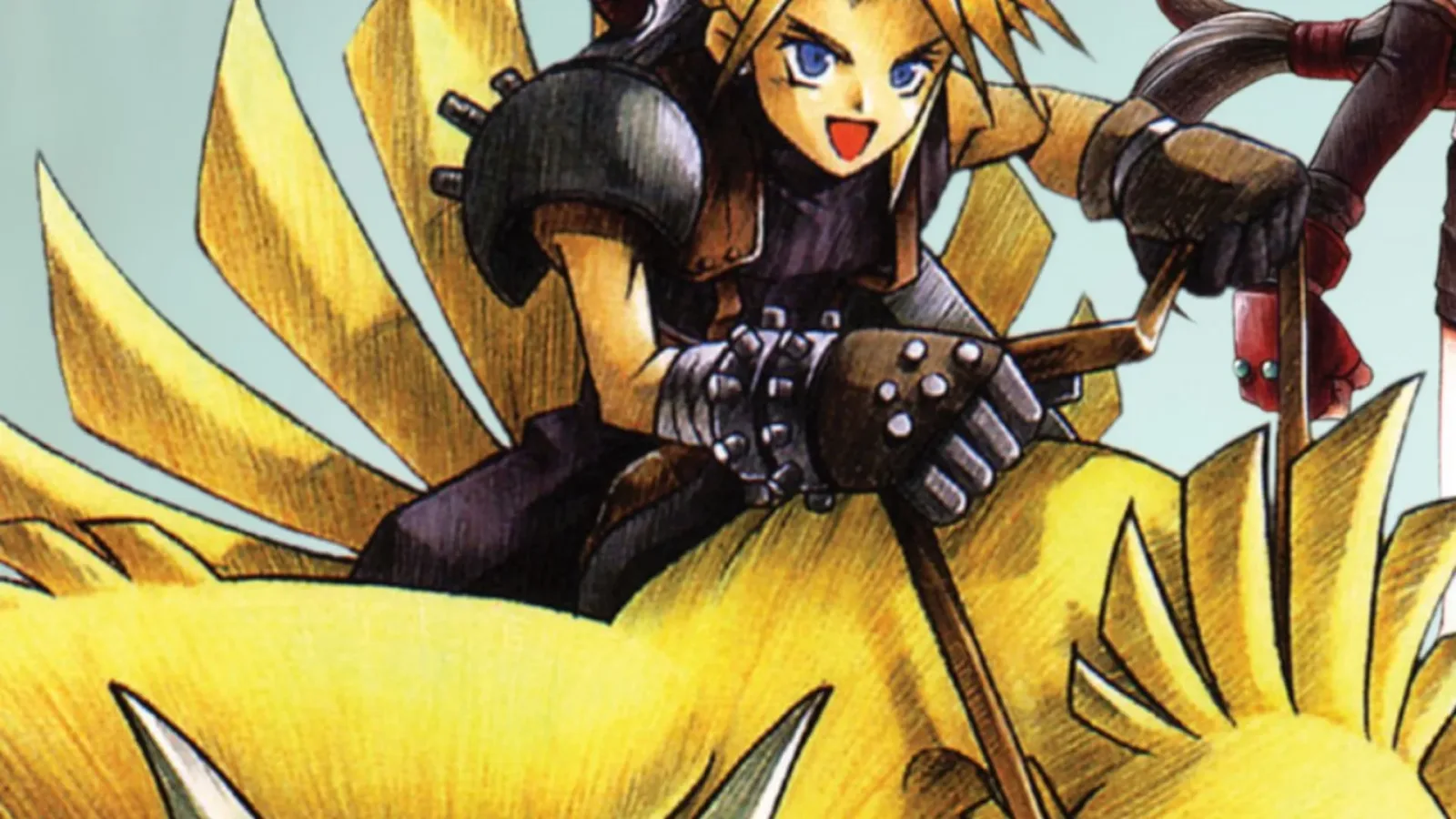
First published in GRIND I, pages 12–21.
Eight hours have passed since I started the game. I'm inside the evil Shinra Corporation building, fighting my way through robotic employees on the 65th floor. Maybe the company offers jobs and helps families pay their bills and ballet lessons, but the people in charge are morally responsible for bombing the slums and destroying the planet through megalomaniacal mining operations. What's more, some employees seem to hate their jobs and give me suspiciously accurate information about the building's next levels, as if they want to be rid of the entire management hierarchy. Something is rotten here, and the stench in the corridors isn't just mako energy or gunpowder.
Still, it's my duty to press on and put an end to this oligarchic, opaque tyranny. And what follows will avenge all the friends and partners of mine who died because of bored bureaucrats ordering destruction and executions during their tea break between 5:00 and 5:15 PM. I keep climbing the stairs... I reach the CEO's office. They arrest me, I escape, and I get one last confrontation. The battle isn't difficult, but it tests my timing and teamwork. And to escape the building after completing the mission, I use a motorcycle that looks lifted from Dennis Hopper's most beautiful hallucinations in Easy Rider.
I defeat the corporation, ride my chrome steed to the end of the elevated highway and admire the explosions behind me. Most game stories would have ended here — eight hours in, once the protagonist has beaten the enemy. But this isn't just any adventure; it's a Final Fantasy game. So the place where most games end is only the beginning for the members of the eco-terrorist organisation
AVALANCHE: Cloud, Tifa, Barret, Aerith, Red XIII (and later Vincent
Valentine, Yuffie, Cait Sith and Cid). A whole world opens up to be explored, and the battles against corporate soldiers turn into long, complex fights with all sorts of mythical creatures from the lands of Gaia.
DPI PL AD NIL
That's roughly how I'd describe Final Fantasy VII: a game that starts spectacularly and keeps you hooked for 50–60 hours without getting boring or repetitive.
An immersion in a cyberpunk world where magic and technology combine to give birth to a captivating story about good intentions and destruction.
“Woo-hoo! | gots ants in my pants wanna do a dance, gotta take a chance, and mebbe find romance!”
TO be a real ma,
Not fart arouna, everyone know, Tight or!
And the introduction above covers only a sixth of what the game has to offer. Remember PlayStation games? Yes, the ones you play from a CD. Well, Final Fantasy VII, released in 1997, takes up not one, not two, but THREE CDs. Throughout the adventure I kept trying to imagine myself in another country in the second half of the 1990s, being given the console with the most generous storage for games and ending up with an experience that invites me to swap three discs as I progress.
Even in 2004, installing two CDs to play GTA Vice City seemed enormous to me.
n you gotta
Final Fantasy VII is the most iconic title in the series for several reasons. Firstly, it's the first to be officially released in Europe and the first on PlayStation. The technological leap from the Super Nintendo is huge, with a much larger world to explore: on foot, by off-road vehicle, across the surface of the water (by boat), above cities (by aircraft), beneath the waves (by submarine) and even from outer space. Secondly, VII marks the moment when Square released the same game on every continent under the same name — Final Fantasy VI, for example, was known as Final Fantasy III in the United States precisely because releases were selective. And thirdly, it's a story of perpetual relevance, with memorable characters and gameplay tricks far more ambitious than anything I'd played since 1997.
Final Fantasy VII is the kind of game you'd get for Christmas and have enough content to keep you busy all year — because beyond the main story there's always a side mission offering significant bonuses. And the fact that Square (Square Enix since 2003) constantly received requests to make an updated remake (and recently did so for PlayStation 5) speaks volumes about the game's cultural impact. It is, quite simply, the JRPG that popularised the whole genre outside Japan.
J-Point & Click, J-Action, J-RTS, J-Snowboarding Sim, J-Flight Sim
Despite what I said above, I have serious reservations about classing Final Fantasy VII as a JRPG. True, it has all the hallmarks of the genre. Yes, it takes quite a bit of grinding to beat every enemy with flair and to unlock extra abilities or items. But the narrative elements and the exploration-driven gameplay remind me more of Point & Click adventures like Broken Sword, Sam & Max and Syberia.
The interactions with the characters, though text-box based, managed to move and amuse me in equal measure — but never to leave me
Aeris
“How about Mir
99 out with you once?”
completely indifferent. And the music is so good that I've been listening to it for a week in various YouTube playlists. Final Fantasy VII offers plenty of variety in its gameplay, so the experience never stays linear for too long. During the invasion of the Shinra building you get somewhat primitive stealth sections that surely influenced series like Hitman and Splinter Cell. After you escape the building, there's a memorable motorbike chase that blends the madness of Road Rash with tower defence mechanics.
And since I've mentioned “tower defence”, in the stronghold of Fort Condor you can play a sort of RTS and tower defence hybrid: you position your defence units on the map, then wait for the invasion and coordinate your infantry to keep the damage down as far as possible. It's a sequence that looks lifted straight from Warcraft, but adapted to the polygonal universe of Final Fantasy VII. And the surprise of discovering this bit of variety is extremely pleasant.
But once you start the action on the second CD, you hit a snowboarding section that predates the first SSX by three years and is nowhere near as rudimentary as I'd have expected. I've said it before and I'll say it again: the Japanese really do make the best games, and their attention to detail is hard to match.
And once you reach the city of Gold Saucer, you'll find a heap of fun ways to spend your money. There's an arena with fierce one-on-one fights to test the survival skills of Cloud Strife, the main character. But there's also a short FPS sequence in which you shoot objects from a rollercoaster, a primitive fighting game that reminds me of the classic Karateka, and even the chance to bet money on Chocobo races.
I think I lost a few hours straying from the main story, just trying to find everything this stretch of the game had to offer. And it wasn't hard to imagine a Square shareholders' meeting in the mid-1990s, when someone asked, “But why does it have to be just an RPG?” and the whole room applauded the idea of releasing a game “with everything”, one you buy to satisfy many other needs and curiosities. Let's not forget, though, that video games were, until recently, quite expensive and out of reach for a good part of the world's population.
And if none of the above sounds impressive enough, I should point out that the main story features a genuine “bitch slapping” sequence between two female characters: Tifa and Scarlet have a score to settle, and the slaps are coordinated by the player.
Utilitarianism, cynicism and nihilism, from several perspectives
The story of Final Fantasy VII is centred on the idea of saving the planet. And the factions involved have different interests, approaches and means of reaching the same goal. At times we'll sympathise with the protagonists and believe they are the ones doing the right thing — but towards the end of the game the decisions become ambiguous, and the question even arises: “do your good intentions justify killing a few thousand innocent people?”.
The first missions in Final Fantasy VII involve destroying mako reactors — a kind of power plant that runs on atomic energy to produce electricity, except the game steps into somewhat more mystical territory to suggest that the energy is extracted directly from the planet's spirit. The eco-terrorist organisation AVALANCHE is worried about the way the Shinra corporation has ended up with an energy monopoly over the whole land of Midgar, and conspires to reduce the scale of the exploitation, convinced that the planet is dying and that only they can save it.
7 n A everything president Shin saysis alle:
At the same time, over the course of the game you'll discover an abandoned mining town whose inhabitants complain that their work became unprofitable the moment Shinra found a more efficient way of producing electricity. And this is one of the first moments when you start to wonder whether you really are on the good side – burning coal is less efficient and more harmful to the environment, isn't it? So Shinra's plans to give the entire planet energy independence no longer seem quite so malevolent... but the corrupt means by which the corporation expands its influence will make you hold on to your sense of justice.
And that will go on until a threat appears a bigger one, and, through a corporate spy infiltrated into your team, you actually end up making common cause with the mega energy corporation. And at that very moment there'll be an exchange of dialogue that calls utilitarianism into question —
A little fear will Control the minds of t of each side:
Shinra produced technological progress and made life easier for an entire planet, but it had damaging effects on the planet; at the same time, AVALANCHE destroyed several mako energy plants and cut short the lives of innocent people. Who is right, and who is acting correctly? Are human lives the most important thing? Is the survival of the planet a more important goal than the existence and progress of humanity?
The answer to these questions is offered through two nihilistic answers. The first of them is the antagonist of the entire game himself, Sephiroth. The grey-haired swordsman is an accelerationist who wants revenge by destroying the whole planet. For him the situation is inevitable and, consequently, he prefers the quickest route to an apparently obvious ending.
ils)
The second nihilistic answer is given by the game's ending, which effectively makes you realise that our human concerns are insignificant on a planetary and cosmic level, because nature has its own means of healing itself. I don't want to give away too many story details, precisely because I want to encourage you to play through it yourselves.
But part of Final Fantasy VII's success is certainly down to this topical story.
Plenty of players certainly felt justified in bombing the mako generators. But those who had the patience to make it to the end of the game went through a whole process of exposure to the ramifications of such actions. In the end, how will humanity overcome its post-industrial challenges: through more technological progress, through a regression to a more primitive way of life, or through total destruction?
The Cloud – Tifa – Aerith love triangle
Before Geralt, Ciri and Yennefer, players were fascinated by the dynamic between Cloud, Tifa and Aerith. The characters tease each other constantly and get their share of amusing, sometimes acid exchanges. But the lads at Square did everything they could to make Aerith stand out, to the point where players fall in love with her. And here we're talking about the PlayStation era, when polygons were jagged and beauty couldn't be expressed very well through graphics.
But Aerith stands out for her personality. At the start of the game she's just a flower seller.
But once she's caught up in the action, she turns out to have exemplary strength of character. Cloud offers to walk her home after saving her — but instead of accepting her lot as a fairy-tale damsel, she wants to see the adventure through to the end in order to help the team. Aerith is unexpectedly realistic and direct when she has to face the harsh realities of the world she lives in, yet at the same time she keeps her purity and her gentleness. Although the world around her is largely hostile, she doesn't let herself be corrupted and never once falls into the extreme of resignation or cynicism.
Tifa, on the other hand, is more emotional and more sensitive. She's known Cloud since childhood, she ends up falling in love with him, but she never has the courage to say how she feels. She feels a little threatened when Aerith arrives on the scene, and she even gets a few lines that suggest jealousy. And unlike the gentle flower seller, Tifa really does have a moment where she becomes the damsel in distress who has to be rescued. But over the course of the game she grows stronger and shows balanced doses of compassion and courage. Though she's emotional and unsure of herself, the adventure she goes through unlocks her full potential. So we have a character who grows both in level and in her ability to face the world around her.
I won't tell you how this love triangle ends, but I can tell you about the scene where Tifa is kidnapped by a pimp and Aerith helps Cloud get hold of an elegant dress, so that he has the kind of disguise that gets you into the Don's mansion. Cross-dressing is a recurring theme in Japanese games, one I've come across in StarTropics (one of the temples bars men from entering, so you have to disguise yourself to get in) and The Legend of Zelda: Breath of the Wild (Gerudo Town is a town inhabited only by women, where the guards only let you in once you've got hold of a specific veil). But in Final Fantasy VII it plays a more important role than the protagonist's comic emasculation — Cloud manages to overcome his initial cynicism, showing Aerith and Tifa that he cares about the fate of the whole team and can make sacrifices for a greater purpose.
The characters and their rotation
For the best part of the game, Cloud is the main character. There are moments, though, when he becomes temporarily unavailable — either because he's going through a crisis, or in order to tell other characters' stories. And these sequences are a real delight, one that highlights the narrative complexity of the whole universe.
Because Final Fantasy VII isn't just Cloud's story, but a whole chain of phenomena and events that have brought the planet to a point of crisis.
Cloud is simply the handiest little plasticine figure for putting the most important events in the spotlight. But after some 40 hours, Barret and Tifa take over the foreground. And 2-3 hours later, Cid becomes ight be the last time ever be together...
WUS Bi: en one.
have been chosen to pe the leader of this Planet. id
AU PIE ©
the team's temporary captain, and we get to find out more about his ambitions to explore outer space aboard his own rocket.
Nor should we overlook the vampire Vincent Valentine, who holds precious information about the birth of the antagonist Sephiroth. And at a few points in the action, even the seemingly malevolent employees of the Shinra corporation are humanised, exposing their weaknesses or airing their grievances.
We also have Yuffie, a young mercenary with kleptomaniac tendencies. She attacks the party members several times over the course of the game — she never manages to win, but every time she relieves the team of money or items. If the right sequence of dialogue is chosen, Yuffie can join the party and will get a side quest that puts her centre stage.
And since I've mentioned Sephiroth, I should point out that he's a playable character during the telling of a story from the past. And I find the mechanism fascinating: a few dozen hours before you get the chance to face your ultimate enemy, you get the chance to observe his powers. You'll know what kind of fight you need to prepare for, and you'll marvel when you see the way he takes down any enemy in a single blow. The game prepares you for what's coming, but it scatters enough surprises along the way to rule out any predictability.
What amused me most was the moment when hot-headed Barret tried to take over as leader of the team... only to realise fairly quickly that he's far too impulsive and doesn't have the skills needed to coordinate the operation. It's an important bit of storytelling that reminds us that, both in life and in games, every character plays an essential role. And although many of us want to be in positions of leadership, in most cases the success of the mission matters more than the egos of the people involved.
And yes, Final Fantasy VII has plenty of characters who show their individuality at certain key moments. The game would certainly have been just as good without Red XIII, Vincent Valentine, Yuffie and Cait Sith. But beyond the small contributions they make to expanding the story, we have to consider that in 1997 kids didn't have a great deal to do.
So adding a few extra characters who can be levelled up to gain unique abilities is one of those elements that increases the number of hours you can spend in the game exploring all the content (a very popular pastime before the internet era, when $60 was a bigger chunk of your monthly income and players could spend a good few months with a single title).
The grind you need
I must admit, I'm generally not a fan of the idea of grinding. I'd always prefer something compact, something that helps you get through the whole story and puts across a message that doesn't lose its impact and emotional weight to hours spent in repetitive battles. But through a combination of gameplay and music, Final Fantasy VII got me to spend a good few hours exploring the map and throwing myself into random fights with all sorts of creatures.
I ended up finishing the game at level 72/99, an average performance for a Final Fantasy player, but one that goes well beyond my usual level of involvement in repetitive mechanics. There were times when I was grinding for relaxation, during a 10–15 minute break. The fact that the remastered version let me triple the speed of the action at the push of a single button encouraged me to get into more battles and rack up more experience points. And when I had to face Sephiroth, I was a little less nervous (though I still was, because the final battle is built to give you trouble no matter how prepared you are).
Final Fantasy VII is built on a “materia” system — the equivalent of Diablo's gems, which can be slotted into the available sockets in each character's weapon and armour.
The story behind these crystals is that they are created by exploiting Mako energy through the Shinra Corporation's power plants. So anyone who equips the materia called “Lightning” can strike with lightning, and anyone carrying the “Counter” materia will automatically launch a counter-attack against the enemy who hits them.
In other words, materia crystals unlock spells and special abilities. And the beauty of them is that they can be used by any character, regardless of how their ability points are assigned automatically. You can turn the sword-wielding warrior into a healer (for lovers of Romglish) or you can turn the wizard into a formidable deflector of attacks (a tank, for those same lovers of jargon).
There are also materia combinations and ways in which the effect of spells is transferred to artefacts: for example, combining the “Meteor” and “All” materia will help the character unleash a fiery attack on all w up in the slu mused to danger:
ave me, all right?”
enemy units; at the same time, a “Thunder” materia inserted into the socket in a sword alongside the “Element” materia will guarantee that all physical attacks are also accompanied by electric shocks. Likewise, the same “Thunder” materia inserted into armour alongside “Element” will guarantee protection against electrical attacks.
The possibilities are limited only by the player's imagination. And I say that after watching a few clips on YouTube in which some people are still discovering various combinations and adapting them to all sorts of confrontations in the game... because the beauty of the magic-jewel system is that you can pull them out and slot them back in whenever you like, in any combination. That opens up a whole host of tactical possibilities through which certain important battles can be finished far more quickly by players who understand the enemy's abilities. As Sun Tzu said in the favourite book of financial-sector corporate types, if you know yourself and you know your enemy, all that's left is to have the materia with the right element and victory is guaranteed.
Final Fantasy VII in 2021?
The question “should I still play Final Fantasy VII in 2021?” is much like the question “should I still watch Casablanca or Gone with the Wind?”. We're talking about an absolute classic and probably the most beloved JRPG ever released. If you can look past the dated graphics, a run of delightful surprises awaits you.
But if you see the graphics as an obstacle, then your best bet is to get your hands on a PlayStation 5 and enjoy the experience completely rebuilt by the lads at Square Enix. I should though, sound a warning about the stories: the remake takes certain narrative liberties that were probably introduced as surprise elements for the most ardent fans of the original. As a result, the newest version is marked by revisionism and plot twists that don't exist in the 1997 game.
All the same, I find it hard not to recommend Final Fantasy VII. Especially now, when the game is available on every imaginable platform: from consoles to PC (at the time of writing this article, the game is on Steam at €13) and mobile phones.
True enough, the graphics are dated. But if you can handle a title from the Lego Star Wars series, then you'll certainly fall for Final Fantasy VII and everything it has to offer.
Do be careful not to get emotionally attached to certain characters, though; they may well have tragic endings exactly when you least expect it. And don't cry at the end, it's only a game.
= Vlad Costea a
0 votes
Scroll down here and stay on the page for at least 30 seconds to vote.
Pick a score from 0 to 10 (halves are allowed).