
Final Fantasy VII: Rebirth
First published in GRIND IV, pages 80–93.
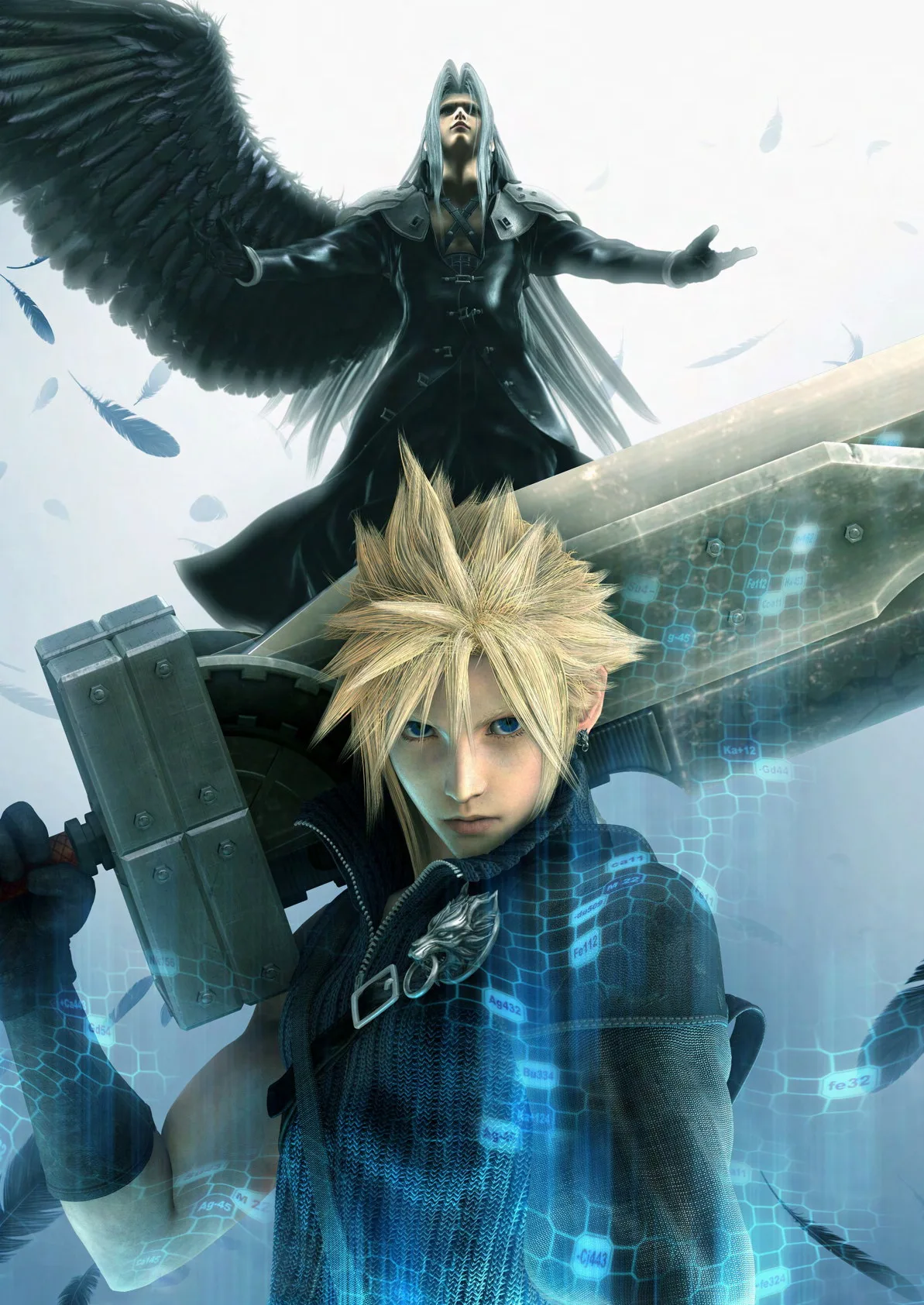
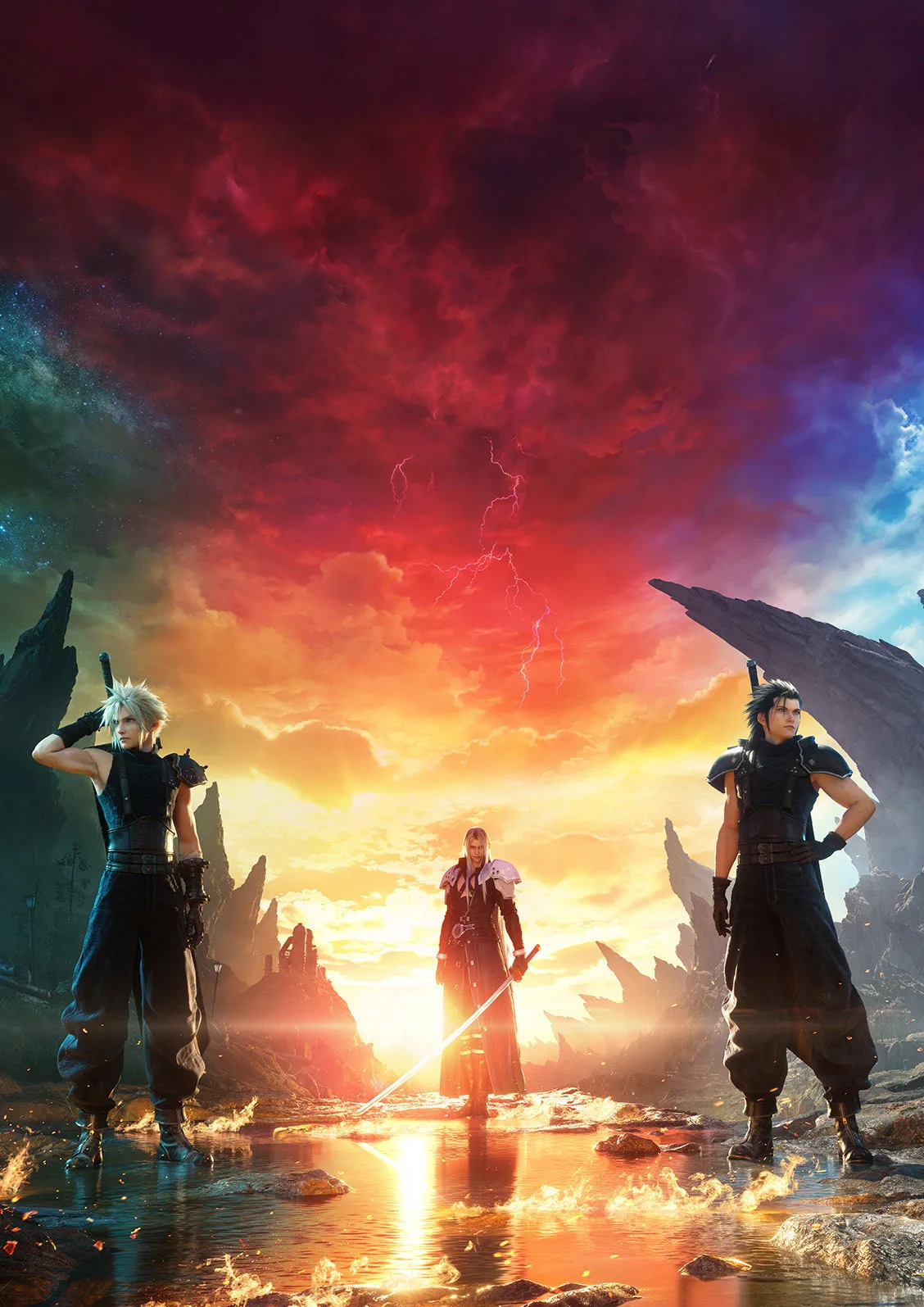
Final Fantasy VII means something more than a game from 1997 F inal Fantasy VII holds multiple meanings that grant it legendary status: for fans of 1990s Japanese RPGs, it represents a pinnacle of graphics, narrative and gameplay that few contemporary releases have managed to match.
For Square Soft (later Square Enix), it remains the best-selling game in the entire Final Fantasy series, the company's first foray into the PlayStation world, in which it "betrayed" its friendship with Nintendo, the first release to cover all the relevant regions (Japan, the US, Europe), and a huge technological leap from the previous SNES title. For Sony, FF VII was one of the reasons the original PlayStation outsold the Nintendo 64, Sega Saturn, Atari Jaguar CD and NEC PC Engine/TurboGrafx-16. And today's eco-terrorists, who block traffic, vandalise famous works of art, press for an end to nuclear energy production, glue their limbs to monuments and try to halt the oil in- dustry through sabotage, surely find justification for their actions in those childhood moments when they played the first few hours of Final Fantasy VII.
We're talking about a title released in 1997, spread over 3 CDs and offering well over 60 hours of adventure alongside Cloud, Tifa, Barret, Aerith, Red XIII, Cait Sith, Yuffie, Vincent Valentine and Cid Highwind. On their journey, these characters face opposition from the Shinra corporation (an energy mammoth that exploits the planet's lifeblood to produce electricity accessible to all), as well as the planet-destroying plans of Sephiroth (a superhuman infused with extraterrestrial DNA from the Jenova specimen). The story is a tangle of mythical elements and cyberpunk themes, an explosive immersion in a mission that starts at a local level, takes on a planetary scale and, towards the end, stretches out into outer space. If you want to find out more, I encourage you to give this fossil of angular-polygon 3D graphics a chance, one that was later ported to every major platform (including PC and mobile phones). But if you're pressed for time, I recommend reading the article I wrote in the first issue of GRIND in August 2021, later refreshed by Leo in January 2024.
Given the success described above, Final Fantasy VII means something more than a game from 1997 that has been rebuilt from the ground up in three parts, with releases in 2020, 2024… and whenever we get to see the final chapter of the story. Final Fantasy VII also means the animations "Advent Children" and "Last Order", both released in 2005. Final Fantasy VII also means the spin-off games, in which certain characters are put in situations that extend the original's story… and here we have to mention "Before Crisis", "Dirge of Cerberus", "Crisis Core", "Final Fantasy VII Snowboarding", "Final Fantasy VII G-Bike", "Final Fantasy VII Remake Intergrade", "Final Fantasy VII: The First Soldier" and "Final Fantasy VII: Ever Crisis".
And last but not least, the Final Fantasy VII universe includes both appearances by characters in series such as "Kingdom Hearts" and "Super Smash Bros", and the contributions of fans who have created new, non-canon works.
I haven't mentioned all this just to fill the page and overwhelm you with information: the second part of the project to remake the original Final Fantasy VII draws on elements from the entire extended universe and includes references that die-hard fans of the series will appreciate, while newcomers will sail right past them. In other words, Rebirth isn't just a remake: with everything it includes, it becomes true "fan service".
A flood of nods to characters and situations that you'll only recognise once you've invested time in the story. It's more an attempt to reward everyone who has imagined various dialogues and scenarios involving the heroes, but also a way of clearing up certain ambiguities generated by an original in which interactions relied on text boxes.
Over my adventure of roughly 95 hours, I explored a good part of what's on offer. I dared to complete more than half of the side missions, tried to uncover some of the secrets scattered across the map and held on to the idea of reaching 100% completion up to chapter 10 (out of 14)… when the story picked up such a brisk pace that I stopped caring about anything else that might distract my attention. Overall, apart from a few quests, mini-games, dialogues and story elements that change certain details of the narrative, Rebirth is a fairly faithful reproduction of the original's events. The emphasis is still on quantity, even when it comes at the expense of quality: because Final Fantasy VII (1997) comes from an era when games were expensive and much harder for the target audience to get hold of, it set out to offer enough content to fill an entire summer holiday… even though the main story can be finished in 50 hours. The second part of the remake tries to adapt that philosophy, with a world far vaster and fuller of activities than players in the last years of the second millennium could have imagined. The problem, though, is that today games exist in abundance and are much more accessible — so the competition for the consumer's attention and devotion is fierce. As a fan of the Final Fantasy series who enjoys the little story details he uncovers, perhaps it sounds hypocritical for me to complain about a generous amount of content. But the problem I want to describe is a different one: the 1997 original can be played to a satisfying point, revealing the whole story and delivering a conclusion, in less than half the time it takes to get through the two remake parts released so far. And those two parts, offered to players 4 years apart, only cover the action of the first disc of the PlayStation 1 title. For that reason, I feel compelled to introduce 7 problematic concepts:
Fragmentation — when you decide that work on a remake will take more than a decade, there is a risk of investing effort and capital in something that won't be a commercial success. I understand the idea perfectly, and I agree that episodic releases can generate the funds needed to see a titanic undertaking through, but I can't forgive certain uninspired decisions. For example, there is no continuity for the effort you put into the first part of the remake: if you slogged through the grind to level your characters to the maximum, you'll find that in Rebirth you have to start from scratch and are served more or less hidden tutorials.
What's more, technological changes will stand in the way of a future compilation containing the whole story:
the first part was optimised for PlayStation 4 and has a rudimentary combat system compared with what we find in the sequel… which, in turn, makes full use of the power of Sony's new-generation console. For the third part, there's talk of a move to Unreal Engine 5… a welcome upgrade that will nonetheless become a problem the moment Square Enix decides to release a complete Final Fantasy VII Remake package.
Will we get Unreal Engine 5 remasters of the first two chapters? Will the control and combat systems of the first part be refined to meet the standard set later? Given the slow pace of work, I'm inclined to think many of these problems won't be fixed any time soon. And I don't know how interested I'll still be in the Final Fantasy VII universe once I'm past 40 and some of my priorities in life change. A 1:1 remake, following only the events of the first game without trying to reinvent the wheel and without including modern elements just to tick boxes, would have demanded less effort and would have had a more significant impact on the children and teenagers of the late 1990s who are now fully grown adults and can't play for more than 200 hours to get through the story. On top of that, the programmers, designers and composers who worked on the 1997 game are also past 60… the window in which they can contribute is quite short, especially when fans are already calling for remakes of other beloved entries such as VI, IX and X.
Artificial padding for the sole sake of adding gameplay hours to justify the €70 price tag — therein lies the biggest problem with the whole project of remaking Final Fantasy VII: once you fragment it, you're left with a lack of content. If the game comes out in three parts and follows the original's chain of events exactly, then each segment will get roughly 20 hours of gameplay. Which wouldn't be bad at all if the experience were intense and gripping enough — I can think of proper blockbusters that reached their ending without ever giving the impression they were dawdling and abusing the player's patience. But there's some unwritten rule when it comes to Japanese RPGs, and the length of these titles rarely drops below the 60-hour mark. The problem I want to flag is that Final Fantasy VII's story, which carries a certain sense of imminence and haste about a potential end of the world, is diluted by ephemeral quests that not only don't contribute to the story's quality, but chip away at its gravity. The original had distractions too, in the Costa del Sol and Gold Saucer regions — but the time spent there added up to a few hours, not several tens of hours.
The tonal shifts in the original made a bit more sense, because you're passing through distinct regions, each affected to a different degree by the evil Shinra corporation. But in Rebirth, the fact that you only cover a certain portion of the original and lose a heap of time interacting with irrelevant NPCs can get irritating. Yes, the game world is bigger and more spectacular to look at. But filler content rarely improves the journey or contributes to fleshing out a main character: it's there just so you can earn money (which becomes plentiful towards the end of the game anyway) and experience points. Basically, the extra stuff stands in for classic grinding, in an attempt to introduce more variety. Except these missions rarely leave you with the impression that they matter at all. And here I want to name Chadley — the most annoying NPC in the whole game, who tricks you into doing various side missions for him and, at least in the first part of the adventure, forces you to stray from the main objective just to run through a tutorial. If there had been a way for me to tear him apart and slice him up with a giant sword (the way I did with the beasts he sent me off to slay), I wouldn't have hesitated for a second to use it. In the original there's no such character: you can explore the world as you like and grind as much as you think is necessary.
Loss of identity — if the first part of the remake is linear and manages the feat of telling in 50 hours a chunk of story the original told in 8, Rebirth commits even greater sins with its open-world approach. And we're not talking about a gripping, interactive open world like the Legend of Zelda games on Switch. No, no — what we've got here is a Ubisoft-style Assassin's Creed approach, somewhere around the Valhalla period: a constrained, lifeless world where your ability to explore is fenced in by invisible walls, while the actions available to you are disturbingly repetitive. Every town is surrounded by a patch of wilderness with near-identical missions: you capture telecom towers, you explore crystals in caves, you kill certain creatures within a set time limit, you photograph the most spectacular scenery, you capture and ride an ostrich (chocobo) with special abilities, you find the home of the cheeky little Moogles and try to herd them all back into the pen they came from, you gather various herbs and materials specific to the region, you find a polygonal tower defence game inspired by the Fort Condor region, and you get bus stops running again so they can serve as your checkpoints. After about 20 hours, these side activities turn annoying precisely because they're so predictable — you already know what you'll find in each region, you build up reflexes for ticking off the tasks, and the joy fades pretty quickly. The original Final Fantasy VII knew better how to introduce new gameplay elements and how to strike a balance between combat, exploration and mini-games. And it handled the open-world concept far more simply and efficiently, with a map you crossed by way of an oversized protagonist. There were moments in Rebirth when I wasn't sure whether I was playing Final Fantasy or some other generic open world built in Unreal Engine. At the same time, the most memorable moments played out in enclosed spaces, hemmed in by rigorous level design. Only then did I get a clearer sense of what kind of game I had in front of me, and enjoy the content more.
The difference in atmosphere — in the 1997 original, the landscapes were darker. The dialogue, though it had a humour all of its own, heightened the pressure the characters feel in the face of a potential apocalyptic end. And the atmosphere as a whole stirs up a certain nostalgia for much simpler times, when technological progress wasn't a threat. Sure, you could argue that all of this is a stylistic mark left by the limited power of the PlayStation 1. Sometimes hardware limitations encourage a kind of creativity that tries to mask the shortcomings. Because the 1997 game's graphics aren't spectacular the whole time and clearly don't match the cinematic sequences, we get a real feast in terms of music, dialogue and gameplay mechanics. On Rebirth, I read a comment on Reddit where a fan put forward the following idea: this colourful, lively world doesn't give them the impression that it needs saving. The original had a narrower colour palette, which expressed the decline of civilisation and whatever is left behind by accelerated industrialisation.
The first part of the remake managed to instil that feeling pretty well, leaning on cyberpunk architecture in which even the sky is covered by gigantic steel structures. Rebirth, though, includes a rather generic open-world section, stuffed with things that tell you nature is untouched by Shinra's exploitation or by Sephiroth's actions. Obviously, the story accounts for every aspect and explains the discrepancies. But even so, if you dropped characters from Assassin's Creed, God of War, Horizon or Dragon's Dogma on the outskirts of Rebirth's cities, you certainly wouldn't get the impression that something had got mixed up: the open-world part has no visual identity.
On the other hand, the cities are bigger and livelier than in any other game in the series — a welcome fact that also highlights a few good ideas that did end up being implemented the way they should be.
What should be added is that the music no longer plays as important a role, taking on a more ambient character most of the time.
There are a few memorable tracks too (especially "Bob Wow" and "No Promises to Keep"), but my ears weren't tickled as often as they were by the original. What's more, the dialogue is often changed, adapted and expanded to put the emphasis on the relationships between characters. Which isn't necessarily bad, but it can lead to situations where the original's subtleties are served up too blatantly.
Accessibility for newcomers — or rather, the lack of it.
Square Enix's marketing team told a whopper of a lie when they claimed Final Fantasy VII Rebirth could be played by people who hadn't played or finished the first part of the remake. If you really want to enjoy this new title, you have to invest a minimum of 60 hours: either finishing the original, or seeing the Midgar adventure released on PS4 and PS5 in 2020 through to the end. Ideally you'd play both, and then find another 15 extra hours to finish Crisis Core, which introduces an unexpectedly important character in Rebirth. And here a big problem comes in, tied to the arguments about fragmentation described earlier.
Sure, you can join battles and do side quests without having a clue about the story… but you'll miss out on exactly the best part. Stripped of its narrative elements, Rebirth is just a bog-standard RPG, with clumsily implemented open-world elements and spectacular graphics.
The best parts turn up too late — Final Fantasy VII is pretty well balanced, with dramatic sections and tense moments interwoven with good-natured humour.
Rebirth, though, leaves you feeling it's far too detached from the mission: only after the tenth chapter, at the end of a minimum of 25 hours, will you feel like you're achieving something important. The main narrative thread, as we've known it since 1997, includes two visits to the luxury resort of Costa del Sol and another two trips into the Gold Saucer amusement park. This becomes a problem because of the filler content, which makes you lose so many hours that you'll almost forget that you and your team are supposed to be saving the world. But once I reached Chapter 13, I truly found out why Final Fantasy
VII Rebirth is a triumph of technology and of the art of storytelling: it was only once the game turns completely linear that I found the drop of soul in the whole affair. Here the story gains a fresh note of coherence, you're handed more of the answers you were waiting for, you're greeted by puzzles that finally put your thinking and your spatial awareness to the test, you get battles that genuinely test your understanding of the weakness system, and every character is given a meaningful role. In short, the staging of the moment when Cloud and the team visit the ancient temple of the Cetra civilisation far outstrips the action in the original. And I'm not sure I can say the same about many of the other remade moments. But once you reach Chapter 14 and get the interdimensional battle with the extraterrestrial spawn Jenova and with Sephiroth, you'll finally find the satisfaction of taking part in a phenomenon of cosmic proportions. Only then will you realise that the open-world structure is in fact the story's greatest enemy, and you'll wish you'd spent less time ticking off irrelevant tasks in the vicinity of towns. The climax is grandiose, the fight with Sephiroth is a genuine test of reflexes and of your ability to plan, and the ending leaves room for an absolutely frenetic continuation, full of surprises. But to get to see any of it, you have to grit your teeth for at least 40 hours and try to enjoy the less inspired moments.
Optional content from the original becomes mandatory in Rebirth — which isn't necessarily a bad thing, especially given that the original's optional characters (Yuffie and Vincent Valentine) had their roles cut down so the game could ship on time. But the pleasure of discovery, of making choices that genuinely affect your run, is gone. In the 1997 game, Yuffie turns up at random while you're exploring the first continent and only joins the party if you pick the right dialogue lines to impress her. Pick wrong and she'll relieve you of a sum of money and run off. In Rebirth, though, you can't shake Yuffie off even if you choose the dialogue lines telling her to stay away because you don't need her.
Everything is "staged" so that the character has to resort to cunning to get into the party. With the vampire Vincent Valentine, who in the original could be avoided or even missed entirely during the visit to Shinra Manor, recruitment through optional dialogue is replaced by a mandatory battle you have to win. And once you've put the beast down, he joins the party passively — you can't use him in battle and you can't give him weapons or armour. He'll only turn up in certain dialogues. The situation will surely change in the next part of the remake, but that limitation didn't exist in the original.
There's also something to be said about the paradisiacal village of Gongaga, birthplace of the hero Zack Fair. In the 1997 game, visiting this settlement is entirely optional.
If you're too focused on the main quest, there's a pretty good chance you'll miss it and never discover Zack's parents' house (and Aerith's reaction — his girlfriend from before he disappeared). In Rebirth, though, the trip to Gongaga takes up the whole of Chapter 9 and serves up some of the most infuriating side quests (accompanied, admittedly, by memorable action scenes in the main story). I understand Square Enix's need to fill the game with content and expand the story's arc with more detail, but at the same time I long for the freedom of the original and the surprise of stumbling on important details about certain characters.
Unfortunately, Rebirth's side quests don't manage to fill that gap.
Before I get labelled a narrow-minded nostalgic, I should also mention that I understand why Final Fantasy VII Rebirth is the 2024 game with the highest scores on Metacritic. We're talking about a veritable feast for hardened fans of the series, a serious contender for the "Game of the Year" title and, in places, a genuine blockbuster. The improvements over the first part of the remake are plain to see: the combat system is more fluid and encourages you to involve a wider range of party members, the cinematic sequences are grander and more spectacular, and the details woven into the story will be a feast for any fan of the Final Fantasy VII universe.
So I find myself obliged to counterbalance the gloom of the preceding paragraphs with 7 reasons why Rebirth deserves praise:
The combat system is excellent — in the first part of Remake you could justly complain that your party members were filler and that you could wreak havoc with Cloud alone, rarely calling on Barret for distant targets. Rebirth revitalises the whole combat system with the introduction of "Synergy Abilities": a set of special attacks with devastating effects that you can unlock mid-battle by performing actions alongside at least two characters who have good chemistry. Cloud and Aerith, for example, can team up to overwhelm enemies with a combination of brutality and tenderness… but to trigger the specific animation on screen and then take a significant chunk out of the monsters' health bar, each of them has to complete at least 3 actions in the same battle (which can include skills, the use of items such as potions, spells). The waiting time between attacks in the original Final Fantasy VII, pompously named Active Time Battle, is replaced in Remake and Rebirth by a mechanism that pushes you to commit to the offensive in order to charge your characters' action bar. Action bar full? Then you can use abilities, spells and items. Done that three times with two different characters in your party?
Get ready for a devastating offensive! In other words, the game pushes you to use even the characters you like less, rewarding you with spectacular animations and significantly shorter battles. Once you get the hang of the system you'll dodge fewer encounters, and you'll want to spend experience points unlocking more synergistic attacks. And if you find yourself in a tight spot, with two party members down and the only soldier left standing on a disappointing number of hit points, an emergency option unlocks that lets you call for help from the teammates on the bench (your party can only have three members, but you'll always have at least two allies waiting in the wings). You get that sense of a tight-knit team, and you find extra reasons to appreciate Red XIII, Cait Sith and Yuffie — whom you'll almost certainly keep on the bench most of the time. What's more, the battles push you to watch your opponent's attacks and respond both offensively and defensively: parrying a run of attacks often brings a bigger reward than a dozen hits from frantically mashing the square button on the controller. Fans of series like Devil May Cry will be disappointed to find that Cloud's oversized sword and Barret's gun-arm are far more effective when you take a strategic approach. And the final battle with Sephiroth — an event so grand that
I could write a whole article describing its six phases in lavish detail — is the ultimate test of the lessons you've learned along the way, because judicious use of action points, parrying the enemy's attacks and exploiting the silver-haired foe's momentary weaknesses are the only way to win. In his final phase, Sephiroth has an attack in his arsenal that reduces your characters' HP to 1… leaving them vulnerable to being finished off by any touch that follows. You have to be ready at any moment to restore HP and launch a counter-offensive. It's a slow process, one that tests patience and the ability to plan more than reflexes and impulse. And the victory, which I got on my eighth or ninth attempt, was the most satisfying moment in the entire game for me. If the third part of Remake includes battles just as grand and as well staged as this one, then I'll certainly have words of praise to say… in GRIND magazine 7!!
Forced character rotation — in the original you can identify at least three characters who play a rather minor role in the story. Given the three-person limit, you'll settle on your favourites fairly quickly (in most cases Cloud — Barret — Aerith, or Cloud — Tifa — Aerith) and forget entirely that Red XIII, Cait Sith, Cid, Vincent Valentine or Yuffie exist. It's effectively enough to have the classic warrior-ranged attack-healer formula and you don't have many reasons to deviate from it. What Rebirth does instead is split your party up in certain story sequences to force you to use all of them and, along the way, discover their strengths and weaknesses. No one feels like they're there as filler any more, just to pad out a small piece of the story. You could call it fan service taken to the extreme, but Rebirth includes substantial sequences in which you see the world from the perspective of characters you'd otherwise never have put in your dynamic trio. And that's wonderful, because the story as a whole makes more sense when you understand the contribution and motivation of each participant. Cait Sith, for instance, becomes a proper database hacker who gets you into areas the Shinra corporation has sealed off.
Red XIII also features in several key moments outside his native realm of Cosmo Canyon, and Yuffie gets some delicious interactions whenever Barret is around (he often treats her in a fatherly way). In the Gongaga region and at the Temple of the Ancients, you'll enjoy action sequences in which your team is split in two — more often than not, the female characters stay together to look for alternative routes while the men fight the battles on the main flank. These moments prove delightful precisely because of the dialogue and interactions that didn't exist in the original.
All the characters get a fuller characterisation — in the 1997 game, Barret was comical to the point of seeming like a cartoon character. Red XIII's story didn't have much humour in it, being marked instead by his destiny as the descendant of Cosmo Canyon's guardian. And Aerith gave the impression of being confused, seeing her fallen ex-lover Zack in Cloud's image and gestures. Well, the situation changes radically in Rebirth: every member of your team gets an extended characterisation that highlights both their qualities and their past regrets.
For someone who never set much store by the sequence where Barret meets an old friend named Dyne, there's a scene of drama on the scale of Greek tragedy. The sequences are so good that they'll surely stay with you for a while and have you reflecting on lost friendships.
It carries a unique emotional charge and helps humanise Barret beyond the limits of his 1997 portrayal. At the same time, Aerith shows an understanding that goes beyond the childish naivety she displays in dialogue. She is one of the two characters who truly know what's going on with the interdimensional forces of the universe, and it will be a real pleasure to discover how she helps thwart Sephiroth's plan. Even Cloud, who had a rigid personality in the original, gets moments where he shows humour or seems to struggle to break free from the control of forces stronger than his will. These details matter enormously in the way the story is told, because certain muddles or ambiguities left over from the original finally get clarified. As for the antagonists' camp — Sephiroth, Rufus Shinra and the members of the Turks — it's much easier to understand their intentions and motivations. Sure, Sephiroth still gets the characterisation of a demigod who has discovered the secrets of the universe and uses paranormal powers to achieve his ends.
And Rufus is still obsessed with expanding mako energy extraction, which he defends through his subordinate special agents (the Turks). But the dialogue they take part in is often delicious, offering context and detail that previously didn't exist in the Final Fantasy VII universe. And for any fan of the 1997 original, every conversation and interaction between characters quickly becomes a real feast — sometimes it might even tempt you into finishing side quests just to unlock more scenes… though I don't recommend it: better to look the sequences up on YouTube and stick to the main narrative thread.
The two team members who were optional in the original, Yuffie and Vincent Valentine, are brought into the foreground far more often and will surely contribute more substantially to the way events unfold in the third part.
Ultimately, the war between the land of Wutai and the Shinra Corporation is a secondary narrative thread that plays a far more important role in this effort to rebuild the Final Fantasy VII universe — and Yuffie, in her capacity as a warrior of the Wutai kingdom, will surely have her share of memorable confrontations. As for the mysterious vampire Vincent Valentine, in Rebirth he only plays the part of a passive observer of the phenomena unfolding around him. It remains to be seen how far his role will be expanded in the next part… which I'll definitely be writing about in issue 7 of GRIND magazine!
The action strings together a genuine blockbuster — Final Fantasy VII on PlayStation 1 is already a spectacular game. It has motorcycle chases, aerial, underwater and even cosmic exploration of the whole world, plus cinematic perspectives from which gargantuan battles unfold. But Rebirth uses today's technology to take all of it to another level of spectacle. For example, the sequence where you obtain your first ve- hicle isn't especially memorable in the original. But in Rebirth you get a drive-by chase in which you have to use Barret's machine-gun arm to take out every enemy coming at you to stop your escape. The Temple of the Cetra civilisation, included towards the end of the first CD in the original, is just a labyrinth full of traps that ends in a memorable battle and an important revelation about Sephiroth's plan. In Rebirth, though, it gets a grandiose staging that stretches across some 6–8 hours of intense action. Even the military parade in Junon, which in the original is a short rhythm game of matching the music and the movements of NPCs, gets a chapter of its own that reveals more about the nature of a military career and how individuality can slip in to bring a ray of hope through the cracks of a unit trained to follow orders. But what surprised me most was the moment when the characters take part in a staging of the play "Loveless" — a quasi-Shakespearean production that needed 27 years to show its true face. In the past, "Loveless" was just a cultural reference meant to add depth to the game's world… and it did so through posters and lines from characters who mentioned they'd seen or read the play. Rebirth did it justice, but also added a new musical masterpiece from Nobuo Uematsu that harks back to the golden age when players would buy the soundtrack CD as well. "No Promises to Keep", a song I recommend you listen to even if you don't play Final Fantasy VII: Rebirth, stands up there in the pantheon alongside "Eyes on Me" from Final Fantasy VIII, "Melodies of Life" from Final Fantasy IX and "Suteki da ne" from Final Fantasy X. It effectively completes this Mount Rushmore of Nobuo Uematsu tunes that soothe the soul. And yes, the whole artistic moment in Rebirth took my mind to the opera scene in Final Fantasy VI. I hope one day I'll get to write about that marvel too!
Chapter 13 is a masterpiece — once I reached Chapter 13 in Rebirth, everything genuinely started to make sense. It's the point of no return, marking the start of a chain of extremely well-directed events. Your open-world exploration effectively ends the moment you disembark at the foot of the temple of the Cetra civilisation (also generically called the Temple of the Ancients). And that's exactly what turns the whole experience into something special: every moment is calculated to push you into using all the knowledge and skills you've picked up along the way. The battles are harder, but they also nudge you into discovering each enemy type's vulnerabilities so you can exploit them afterwards. And the satisfaction of moving forward goes beyond anything you've hit before. In the first part, you have to solve puzzles that test your sense of spatial orientation — rotate certain sections of the temple by 90, 180 or 270 degrees and you'll line up the sections you need to walk on. Get it wrong and you'll either stumble on small bonuses or run into formidable enemies before you can change the angle of approach. The original presented this temple as a labyrinth with little traps that triggered battles with ferocious beasts. The faster you found the right path forward, the more battles you spared yourself. But Rebirth takes every detail up a level, with a staging that shows off the chemistry between the characters far better. There's even a moment when the heroes are split into two teams and fight parallel battles that end up intersecting. And when you learn the history behind the Black Materia (an ancient object through which its bearer can call down a vast meteorite that destroys all life on the planet), you understand Sephiroth's intentions and watch the sacri- fice of Cait Sith… well, everything takes on spectacular proportions. What's more, each character visits a chamber of reflection where they confront problems and traumas from the past — and this small detail, which doesn't exist in the original, helps enormously in understanding each hero's motivations. Because Final Fantasy VII isn't just about Cloud and Tifa, and Aerith and Barret's stories are truly heartbreaking. The end of the chapter, which highlights Cloud's inner conflict and the fight he wages to choose his own fate, is far better than everything the original offered. It makes me realise what a game how good it would have been if the action had been more concentrated around significant events, instead of me being encouraged to conquer telecom towers for Chadley, pick medicinal plants and tame Chocobo ostriches.
And believe me, it's worth putting up with the vices of a mediocre open world to discover the diamond at the end!
Queen’s Blood — just like Triple Triad from Final Fantasy VIII and the slightly more polished variant called Tetra Master in Final Fantasy IX, Rebirth includes a seemingly optional card game.
Titled “Queen’s Blood”, this new challenge is the wet dream of every kid who grew up with Yu-Gi-Oh, Duel Masters, Pokémon or even Magic: The Gathering. More than that, it's an attempt to return to the habits of the golden age when Square Soft ruled the entire console RPG scene. Over the course of Rebirth's adventure you'll be given the chance to compete against NPCs eager to show off their intelligence and their ability to place certain cards strategically. Beat them and you'll receive one of the most powerful cards in their deck, and you'll be able to put together your own winning combination for future duels. “Queen’s Blood” initially seems stupid and excessive, but it ends up hooking you. Unlike other side quests, it gets a chapter of its own that forces you to win an entire tournament before you can move on. And if you manage to beat every duelist scattered across the map, you'll get some significant details about the game's origins and how its creator is connected to a certain ancient kingdom.
Overall, “Queen’s Blood” is fun, engaging and the only extra activity that I didn't mind completing. In fact, I enjoyed every chance I got to buy cards from the various shops or to compete against some oddball on the edge of the forest. True, unwinding with a card game in the middle of a story about saving the planet from seemingly imminent cosmic phenomena doesn't do much to build the tension. But then again: I loved every match, and I looked forward to discovering a new region just so I could have the next one!
Grinding isn't necessary — in every 1990s Japanese RPG, grinding is an essential element if you're to face down the primordial forces of the universe standing in your way at the end. In short, that grind means piling up money and experience points… with the aim of making your heroes so powerful that no future battle will make your palms sweat while your fingers are curled around the controller. We're talking about a repetitive activity, but a sometimes satisfying one. In some games it means taking part in a larger number of repetitive battles. In other titles, there are special regions that can be explored by those eager to take on an extra challenge. The original Final Fantasy VII has both… and Rebirth replaces them with an open-world approach in which the various side quests do the job of diversifying the hunt for resources and experience points. Fortunately, the game is balanced well enough that grinding isn't necessary. Items, experience points and the various materia (coloured orbs that grant characters different abilities or spells) are useful for faster progression, but what you find by following just the main objective on the map is enough to see the game through. Obviously, certain battles get easier if you have certain spells or your characters hit a higher level. You even have giants (summons) that you can unlock and later bring into battle for the moments when you feel overwhelmed. But if you're good enough at spotting weaknesses and countering, you'll get by on your skills as a player rather than on the bonuses that make your heroes stronger. And somehow that's ideal: grinding is an activity that's only useful for players less blessed with quick reflexes, who have to put more time into battles so that the characters on screen become immune to certain types of attack. You have to work smart, not hard — and for that same reason, I slogged through about 95 hours to get the game finished. Had I been better at parrying and dodging enemy attacks, I could easily have knocked 10 hours off that. And if I'd stuck purely to the main objective on the map, I'd probably have enjoyed the experience more by skipping some filler missions.
Final Fantasy VII: Rebirth is also the first game I played largely on the PlayStation Portal: an external monitor for the PS5 that helped me get through Cloud's adventure while lying in bed in the room that has no TV. What I can say about the Portal is that I can't recommend it under any circumstances — not in its current form, at least.
To connect to your PS5 at home it isn't enough simply to be on the same Wi-Fi network. You also have to enter your PlayStation account details, which I find absurd. It's just a way for Sony to get more data about users… because otherwise there's no logical justification for the extra authentication step. But the biggest problem isn't about personal data protection, it's about signal quality: even though I'd hooked the PS5 up to the router with a high-speed network cable and was sitting with the Portal a metre and a half from the signal source, I regularly got disconnections in the middle of battles and moments when the resolution visibly dropped.
I played the original Final Fantasy VII on the Nintendo Switch, and for me the ideal would have been to get a similar experience on a portable screen while playing through the second part of Remake. But I couldn't enjoy the adventure in all its glory until I plugged the console into a TV or monitor. Which is disappointing, because the Portal still sells for 1,100 lei in specialist shops and is nothing like a successor to the PSP and the Vita: it's a simple wireless monitor with a controller attached.
The screen has no OLED panel, the Wi-Fi chip isn't a new generation, and there's no support for HDR or Bluetooth headphones either — you get a miserable 3.5mm jack. I couldn't have recommended the Portal even if it had been given away for free… because it doesn't improve the gaming experience in any way and only breeds frustration. For the same money you could buy an excellent monitor with a fast response time, or even a 4K TV, probably assembled on a ship navigating the international waters between China and Taiwan.
I thought it would be useful, at the end of my kilometre-long monologue about yet another game in the Final Fantasy series, to include a short description of the impressions I had during the time I spent with the Portal. There are only two situations in which I recommend buying this PS5 accessory: you have money to burn and sometimes enjoy empathising with the disappointments of the average consumer, or you're a hardened PlayStation collector.
In both cases, I'd advise you to wait for the inevitable moment when a massive price cut comes along and you can get your hands on a Portal for less than 1,000 lei. For what it is and what it offers, I don't think it's worth paying more than 700-800 lei. And if you're a collector, I don't recommend ever taking the device out of its box. Leave it there next to the PS5 webcam and headset… one day you'll be able to put them in a museum illustrating what gaming was like in the 2020s.
And as for Final Fantasy VII: Rebirth: I'm glad I finished it to a satisfactory degree, I'm delighted I added the Deluxe edition to my collection, and I can't wait to see the continuation. If the specialist press gave it an average score somewhere around 9.2, then I — the ordinary mortal who tried to squeeze in almost 100 hours of playtime across 6 months of responsibilities — would generously give it an 8.5. Not necessarily because I don't recommend it enthusiastically, but because I had higher expectations after playing the original, and I'm disappointed by certain practices that stretch the story out.
But I don't think I'll ever replay Rebirth… I'd sooner replay the 1997 original, updating it graphically with community-made mods. Not because I'm nostalgic, but because a compact 60-hour adventure is more satisfying than a fragmented experience that makes you wait more than half a decade to see how the story ends.
See you in GRIND 7, Sephiroth!
0 votes
Scroll down here and stay on the page for at least 30 seconds to vote.
Pick a score from 0 to 10 (halves are allowed).