
Lies of P – Review
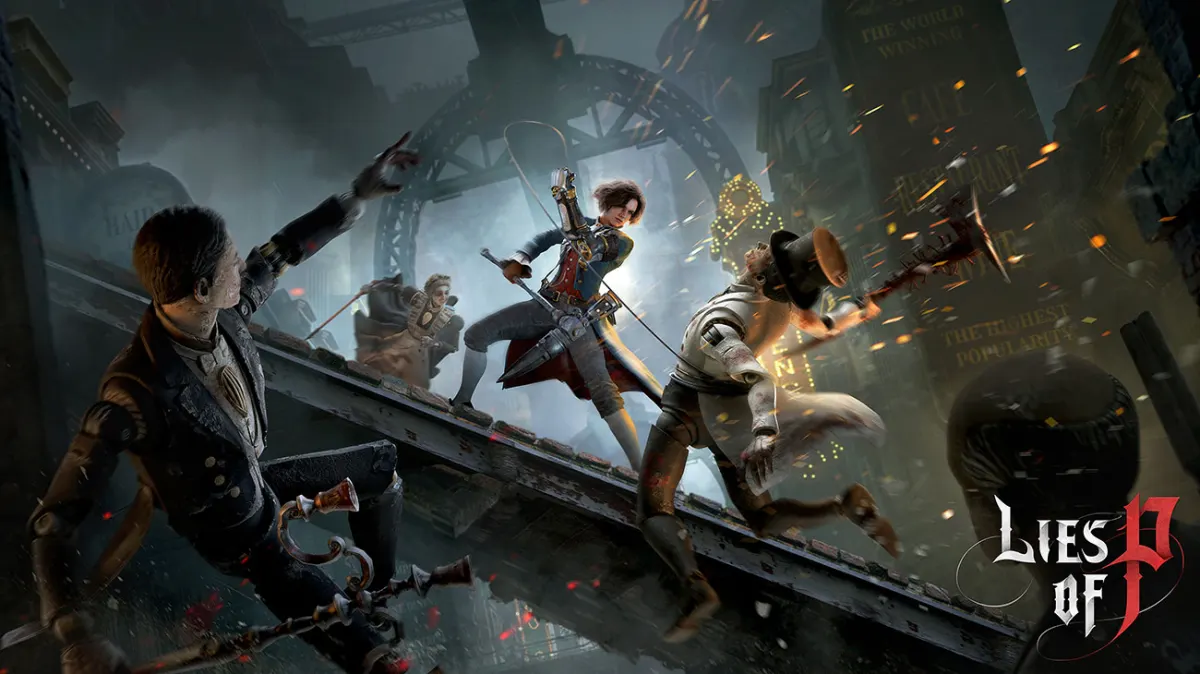
Souvenirs fanés
Today, the market is oversaturated with soulslike games. Few studios have truly understood From Software's formula, and fewer still know how to properly build a game in this style. This type of game is difficult because it aims to challenge you to become better, hence the well-known expression "Get Good" often used by gamers as both an insult and an encouragement to others. The team at South Korean studio Neowiz Games understood the formula correctly and built a game in such a way that the desire to improve arises naturally and transforms into an ambition to overcome obstacles through willpower and skill. Moreover, the team managed to interpret the formula established by From Software in a unique way and improve it with a system never before seen in soulslike games. It's important to mention that I don't usually play this genre because I no longer have the time or the skill I had 10 years ago… but Lies of P enchanted me. The story piqued my curiosity, and to see how it ended, I had to become more adept at mastering the control mechanics. As you're used to from my previous reviews, we'll start with the story.


Carlo Collodi's Le avventure di Pinocchio. Storia di un burattino (or The Adventures of Pinocchio, as we know it better) is the second most translated book in the world, after the Bible. The work is one of the most important Italian literary pieces and is a story loved by children everywhere today as much as it was when it was initially published in 1883. The story was published periodically in a magazine, chapter by chapter, from 1881 to 1882. Collodi's story has been adapted by the Neowiz team for Lies of P. The action takes place in Krat, a technological marvel of the world, a city where technological advancement has eased the lives of its inhabitants and allowed for the automation of certain daily aspects. The main character we play as is unnamed, but almost all the NPCs we meet refer to him as Geppetto's puppet.
The puppet is awakened by a turquoise fairy and is guided to leave Krat Station, where he discovers that all the other puppets (the game's term for robots) in the city have revolted against humanity and decimated almost the entire city. The initial goal is to reach Hotel Krat, where we are given the mission to find Geppetto – as he might be able to identify a solution for this rebellion and its cause. The story follows the main ideas of Collodi's work, such as: the puppet's desire to be a real boy, the guidance of the turquoise-haired fairy, the cunning of the fox and the cat, the appearance of the puppet master, the interaction with the sea monster, and so on.
The narrative elements are largely the same but are reinterpreted through the lens of soulslike games. Unlike most titles in this genre, the exposition in Lies of P is direct, and we don't have to read all the notes and participate in all the in-game conversations to understand the narrative thread. Thus, we are dealing with a gloomy world, like most soulslike titles, deteriorated and on the brink of collapse, where allies are few and friends are almost non-existent. Our companion throughout the game is a guidance system from the lamp we carry on our belt, called GEMINI (like Jiminy – the cricket from The Walt Disney Company's Pinocchio film).

Some of the story's crucial moments are present in the game in the form of battles with menacing enemies. The first powerful enemy we encounter is a gendarme, and this moment parallels Pinocchio's first outing from home in Collodi's story – where his interaction with the lawman results in Geppetto's arrest. The first menacing foe is the Puppet Master, who represents only one aspect of the character Mangiafuoco, the other being represented by the factory adversary. Other important moments from the book are different in the game, such as the search for the tree with golden coins. In the original story, the tree is a lie by the fox and the cat to steal Pinocchio's money, but in Lies of P, it is a real tree with fruits resembling golden coins that have medicinal properties.
Collodi's story is also an introspection into the question of humanity. What defines us as humans? In the digital age of artificial intelligence, we see this question revisited from multiple perspectives, from ethics to spirituality and morality. In the game, we see this question discussed from a moral perspective. One of the game's main systems is the ability to lie. The game world presents us with the 4 laws of the Grand Covenant of Krat (which in our terms would be similar to Asimov's Laws – the 3 laws of robotics):
- Puppets must obey their creator's commands.
- No puppet can harm a human.
- Puppets must protect and serve humans and the city of Krat.
- No puppet can lie.

The main character differentiates himself from the other puppets by not being bound by any of these 4 laws. He is completely free to act as we wish. And lies play a central role in the story because, unlike those in Collodi's tale, they don't exist in a binary world where there is only good and evil. All the lies we tell are positioned somewhere in a grey area. Do you tell a dying, blind mother the truth that the infant in her arms is a puppet, or do you compliment the "child" she holds tightly to her chest? Do you tell a puppet that seems to have developed a true consciousness and personality the truth that it cannot have its own feelings or thoughts, or do you lie that it can acquire these human characteristics? Or, as a final example, do you tell a lady suffering from an incurable disease that has disfigured her face that she still has that sparkle found in her youthful portrait, or do you nonchalantly remark that the fire in her eyes has disappeared?
It's clear from the situations presented what the truth is, but vocalising it can have negative effects in moments when characters need compassion, understanding, or a kind word. As Ji Won Choi, the director of Lies of P, said, lying in the game is not a bad thing. Lies are an essential part of the adventure. The first lie we tell is mandatory because we cannot advance the story without it. Upon entering Hotel Krat, we are asked by the automated doors if we are a puppet. To advance, we are forced to lie that we are human. Besides Collodi's story, we can also see inspirations in the game from the Belle Époque, the industrial revolution, other fairy tales, stories, and classical art (for example: in the fight with the penultimate menacing enemy, we can see an adaptation of Michelangelo's work from the Sistine Chapel, namely The Creation of Adam).
If I were to say more about the story woven by Neowiz, I would spoil its charm, so we'll move on to an analysis of the game's technical components. Lies of P is a soulslike that respects the formula created by From Software. The game tries and succeeds in being original both through its captivating story and the new systems it presents to us. The novelty element of the game is represented by the option to customise each weapon. These are composed of two elements: the head and the handle. The reason I say head instead of blade is because we are not only dealing with bladed weapons; we also have many blunt objects. But back to it: we can combine any head with any handle we have on us. Therefore, if we want to combine the blade of a flaming knife with the handle of a spear, we can do so. Or we can make less natural combinations, such as combining a hammerhead with a sword hilt. Of course, there are also rare weapons that we can buy from Alidoro (the vendor with the mastiff mask) with special items obtained from battles with menacing enemies. Unfortunately, we don't have a wide range of special weapons, and these cannot be disassembled. Both normal and special weapons can be upgraded. Weapon heads will be gradually upgraded to a maximum rank of +10, and handles can be modified to increase in power with one of the 3 damage attributes.


Another interesting aspect of the game is the Legion Arm, which replaces magic in Lies of P. The main character's left arm is a mechanical one that can be replaced. Our options are diverse: an arm that launches a harpoon to pull enemies towards our character or vice-versa, an arm that sprays a toxic substance, one that acts as a shield, and so on. Each arm substantially changes the way we approach battles, and the correct arm can transform a difficult confrontation into an easy one.
Like From Software's older games, everything is linear in Lies of P. The levels are not large, and as such, we cannot speak of a huge open world like in Elden Ring. However, the relatively small world is very detailed and well-constructed. It is clear that Neowiz paid great attention not only to the in-game characters but also to the environment, as each district of Krat along with the other locations in the game are distinct. We cannot confuse the arts district with the main boulevard or the cathedral with the tower. Each area, although using roughly the same colour palette, has its own defining motifs. The world is grey and riddled with murderous puppets, but at the opera, the grey contrasts with the white marble and the dark red of the velvet curtain. In the swamp, the gloomy grey complements the sickly green of the water and the toxic material dumped by factories into this area… along with the defective puppets.
Through each zone, we will follow a well-defined path, with the possibility of finding shortcuts to return to rest areas – and after a few hours, I started to predict roughly where the next shortcut would appear. At these rest areas (called Stargazers in the game), we can increase one of our character's 6 attributes:
- Vitality – character's health;
- Vigor – maximum stamina;
- Capacity – capacity to carry certain items;
- Motivity – physical strength attribute to carry heavier weapons;
- Technique – attribute representing dexterity;
- Advance – magic in the game;
The points we invest in any of these attributes will have visible results up to a certain point, after which the increase in attributes beyond an arbitrary threshold (usually 40) will have diminishing returns. If in Elden Ring these points were called Runes, and in Sekiro: Shadows Die Twice they were called Sen, in Lies of P they are called Ergo. The explanation given for Ergo is that it is a substance discovered by the alchemists of Krat, which was used as an energy source for various technological marvels and as a treatment for certain ailments.

In addition to attributes, we can customise both the hero's physical appearance and playstyle through the points we invest in P-Organs (an unfortunate name which I consider a result of the studio's language barrier, Neowiz being a South Korean studio). Unlike the attributes above, points for this system are found in limited quantities and must be sought far and wide in Lies of P. P-Organs are divided into 4 categories: offensive, defensive, abilities, and items. The effects of this system are divided into major and minor. Major P-Organ effects range from an extra inventory slot to equip another Legion Arm to the ability to perform a double dodge. Minor ones can be support abilities such as increasing the amount of Ergo obtained after defeating enemies, higher damage, or the ability to have more quickly usable items, such as cannonballs or Pulse Cells (the equivalent of the healing item in Lies of P).
The first time I finished the game, I managed to reach level 200 without too many problems. Lies of P did not require the GRIND I encountered in many titles of the genre. I mention this because I no longer have the same dexterity, skill, and reflexes I had in university. Thus, I understood that with the passage of time, some genres I can no longer play with the same dexterity as 10 years ago. They now require more time and dedication to truly enjoy them, to be able to "get good". However, with Lies of P, this was not the case. I discovered that a particular attribute (Advance), once raised to level 40, can make the adventure simple. It doesn't change its genre from soulslike to action-adventure, but it makes most battles easy, and some menacing enemy battles are on equal footing thanks to this attribute. The big problem with the attribute system is optimisation. Advance affects: the Legion Arm, abilities that apply a status to enemies (such as fire, corruption, shock, etc.), and throwable items (such as cannonballs, Molotovs, knives, etc.). Thus, most battles with enemies after the cathedral become very simple, to the point where after the confrontation with the Black Rabbit Brotherhood (the 6th mandatory boss), I didn't even try to learn the opponents' moves. This is also partly due to the fact that for every battle with a menacing enemy, we have the option to summon an AI-controlled puppet to help us, and this can draw the enemy's attention while we throw all the arsenal we have at them. This is remedied, however, with the last enemy in Lies of P, where we cannot summon this help, and the item-throwing strategy does not work. In my first playthrough of the game, I lost approximately 5 hours until I had the reflexes and knowledge necessary to defeat him and finish the title.
Lies of P has often been compared to Bloodborne due to its tone, monsters, enemies, and environment. Some have even called it the successor to From Software's title. I cannot deny that Bloodborne seems to be one of the inspirations for the game; Bloodborne's rally mechanic is present here, but it only activates after blocking an attack. After parrying a blow, we have a short period to attack the enemy to recover some of the lost health. The emphasis is on offensive gameplay, as in Bloodborne. Damage is completely negated if we manage to execute a perfect parry, and parrying several consecutive attacks in tandem with our own offense will leave the enemy in a vulnerable state where a concentrated blow will immobilise them and allow us to deal fatal damage. One of the enemies at the beginning of Lies of P will force us in the first playthrough of the title to become very good at parrying. This frustrated many players immediately after launch, and in the first patch, Neowiz reduced both the health and damage power of 3 enemies that managed to frustrate a significant portion of players.
Personally, I managed to defeat 2 of the 3 before the patch came out, and the problem seems to me to have been more related to the approach style and how each player invested their points. When I reached the last of the 3, who is also the penultimate menacing enemy (or the last depending on in-game choices), the fight seemed a bit too easy, but this is my personal opinion. This episode with the Neowiz community reminds me of Collodi's interaction with his fans. The Adventures of Pinocchio initially ended in chapter 15, after he had been hanged by the fox and cat. Fans revolted and demanded that the story continue, and Collodi resumed it after a few months' break.
I don't have much to say about the music because it was composed with great attention to detail. In most sections of Lies of P, we only have ambient sounds such as that of heavy machinery in the factory or the notes emanating from the cathedral organ. We can find vinyl records through side quests or exploration, which we can listen to at Hotel Krat. My advice to all who wish to finish Lies of P is to take a few minutes out of their game time and listen to the songs on these records.
It's rare for a game to convince me to start a new playthrough in New Game+, and until Lies of P, I had never done so for a soulslike. The second playthrough was more enjoyable than the first due to having obtained an item that changed the interaction with menacing enemies. After finishing the game for the second time, I decided to start a New Game++… and this aspect is proof of the Neowiz team's attention and meticulousness.

In conclusion, I believe that Lies of P is a worthwhile title that I heartily recommend to anyone looking to try a soulslike game. Both the game's linear design and the simplicity of the battles might be a negative aspect for hardcore fans of this genre, who would prefer a more demanding challenge. However, these two aspects make the game accessible to other people who do not have the necessary experience to complete other titles of this genre. The adaptation of Collodi's classic story is a perfect introduction to the fascinating world of soulslike games and a first step in developing the reflexes and skills needed to face Bloodborne and other much more difficult challenges.


Played on: Xbox Series X
Release date: 19 September 2023
Developer: Neowiz Games and Round8 Studio
Publisher: Neowiz Games

0 votes
Scroll down here and stay on the page for at least 30 seconds to vote.
Pick a score from 0 to 10 (halves are allowed).