
Neva – Review
One of the few games that made me cry
The people at Nómada Studio need no introduction. They already captured our hearts with GRIS, an atmospheric puzzle platformer that tackles quite sensitive emotional topics. And now they take us on another emotional journey with Neva. The game has already won the Games for Impact award at last year's The Game Awards. It recently received the Annie Award for Outstanding Achievement for Character Animation in a Video Game. And it is currently nominated for the Artistic Achievement award at the BAFTA Game Awards.
Thanks to Devolver Digital, I have the opportunity to tell you in detail why it is so impressive.
Neva means “snow”
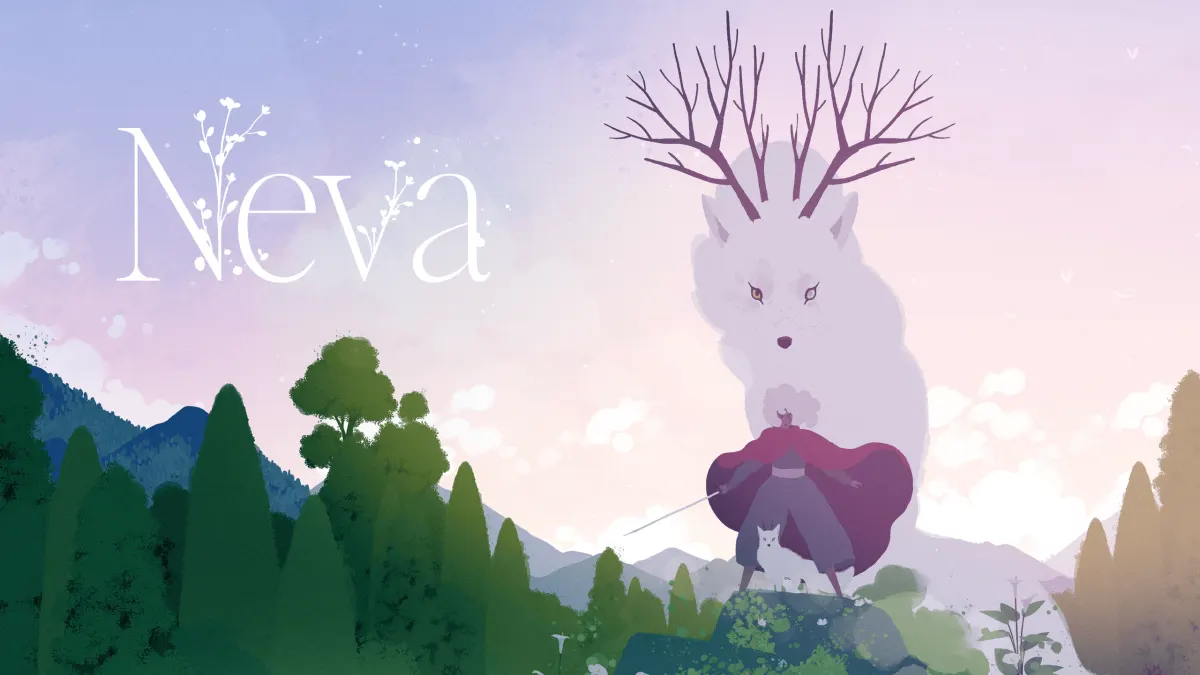
The game invites us to explore an adventure about the natural cycle of life. You'll actually start playing after being hit by an introductory scene that would melt even the cruelest barbarian's heart. You'll take on the role of Alba. And your mission is to take care of Neva, your little magical wolf cub, until she grows up. Neva's lineage has an important purpose in fighting against the darkness that corrupts the land. The team formed by the two protagonists must fight against dark and malformed creatures to reach their destination.

The game doesn't involve traditional dialogue. Instead, Alba will call out to her companion, “Neva”, when she wants her to follow, perform certain actions, or just to pet her. I greatly appreciate this simplicity in execution. Actress Cristina Peña successfully conveys feelings like warmth, unease, irritation, etc., depending on Neva's actions. I'm impressed by how much emotion she could express, considering she could only use one word.
We're talking about an initiatory journey, a coming-of-age in the true sense of the word. The world changes and evolves. The game's events begin in summer and take us through all the seasons. And Neva grows and becomes stronger with each passing season. A small, scared cub will soon become something… more. At first, you'll be her guardian: you'll feed her, help her climb, and remove obstacles from her path. But it won't be long until she becomes a reliable partner, both during and outside of combat.
I wouldn't be lying if I said that the way the game's camera is manipulated is responsible for the feelings the story evokes. Closer angles when traversing corridors and narrow spaces. Wider angles when running through vast areas to admire them. Not to mention the subtle and gradual transitions between the two. They allow us to experience the world as if we were there. I don't think I've ever seen developers use the camera with such mastery as those at Nómada.

The beauty of a game like Neva is that it doesn't linger in your soul more than it needs to. It's an adventure that comes with a baggage of emotions and action. And it manages to tell a complete story in a concise manner. It will take you somewhere around four hours to finish the story, according to HowLongToBeat.Com. Or six hours, if you hunt for all the achievements and extra content. It took me about eight hours, but I didn't rush and wanted to admire every detail.
That being said, there are portions of the game that feel empty or where you have to walk for a very long time. The developers manage to distract you from this with the help of the fairytale landscapes. But there will be moments when you feel like you're progressing very slowly.
Hunting for collectibles and trophies isn't very difficult, but I feel that sometimes it sabotages the natural flow of the game. Neva is a linear atmospheric adventure at its core, and I'm not a big fan when searching for secrets breaks immersion.
On the other hand, this aspect won't bother you if you just want to play for the sake of the story. Collectibles and secrets don't impact the game's events; they just unlock or don't unlock trophies on the platform you're playing on.
Are you somewhere between “I HAVE TO COLLECT EVERYTHING!”, like me, and “Let's just have fun”? Then you can play through the game naturally for the sake of the story. Then you can return to each area to find what you missed. The items you collect will remain collected and you don't have to restart levels from scratch. It also helps that there are save points where you can save and resume the game within each chapter/season.
At the end of the day, Neva will be a deeply emotional experience. I can't guarantee you won't cry, because I did at the end of the game.
A healthy balance between action, exploration and puzzles

The first question many friends asked me when I recommended Neva was: “Does it include combat?”. I perfectly understand what they mean. If I were to rephrase, what those people asked me was: “Will this game captivate me?”. The answer to both is affirmative.
The combat mechanics start very simply. Alba has access to a sword and three health points, as well as normal jumps and dodges. The attack sequence consists of three fluid and satisfying sword strikes. On top of that, you recover vitality when attacks connect. Each health point is represented by a flower with six petals. Each successful sword strike recovers one petal. If you are hit, you lose an entire flower and the petals from an incomplete one. For example, let's say you have two flowers and three petals from the third. You will lose one flower and three petals if you are hit at this moment. Enemies also have contact damage, so I don't advise hugging them when you're near them.
But this is just how you'll fight in the first chapter, at the beginning. As I mentioned, Neva will grow as time passes. This will give her new abilities that will allow her to fight alongside you. Not to mention that these new abilities will be used to solve puzzles. If we put everything together, you'll have a fresh experience when facing enemies in each chapter.

Enemies follow a similar trend. The first ones you'll face are simple and predictable. Then they become more creative in terms of design and behaviour. You'll also encounter a few bosses who are more like walking puzzles. The key is to recognise their patterns and act accordingly. They won't be extremely difficult to defeat, that is, unless you rush in without any plan.
Given the game's duration, there are enough enemies and abilities to keep you captivated. The short time it takes to finish the game is also why I'm more secretive about abilities and enemies. It's better to experience them on your own.
However, the details I've discussed so far apply to Adventure Mode. You can just as easily opt for Story Mode to enjoy the narrative. This mode eliminates the ability to die and simplifies puzzles. The game is single-player after all. Enjoy it in the way you prefer.

You'll also encounter ingeniously crafted puzzles. Some will require a bit of mental gymnastics. Others will have a hidden trick. Without giving you spoilers, my favourite mechanic involves the reflective surfaces during winter. There's a mini-section in this chapter where enemies and platforms are seemingly invisible. But there are terrains or walls where you can see them. It was a fun coordination exercise.
You can just as easily eliminate these puzzles in Story Mode if you don't like them.
It's not the end of the world if you get hit during combat or when solving a puzzle. There are enough points where you can reset your HP and save your progress throughout the levels.
I mentioned collectibles and secrets when talking about the story. You'll find most of them naturally and unlock the associated trophies. But there are also some that are a bit more obscure. However, there's a record of each for chapters in the menu where you select them. And people on YouTube already have guides for those you can't find on your own.

A series of accessibility options were also implemented two months after the game's launch. The first of these reduces transparency and increases text visibility for tutorials. Others include:
- a visual indicator when Neva barks for people with hearing impairments;
- the option to make Alba visible even when foreground objects cover her;
- the option to make platforming puzzles easier.
If we put all the details together, Neva's gameplay is living proof that simplicity isn't boring. It's more important to use easy-to-understand mechanics to create an enjoyable experience for players.
Van Gogh took a journey into minimalism, and Bach took it for a walk down atmospheric alley

The artistic direction in Neva demonstrates that less is more. Characters and environments are drawn using a precise number of details and colours. The balance in contrast makes each element easy to distinguish. And the rest of the magic comes from the clever use of lights, fog, and other special effects. More importantly, this aesthetic is easy on the eye. You can rest assured if you are a person with high photosensitivity like me.
But all these graphical elements would mean nothing without the proper use of the camera. I've said it before. I'll say it again. These people didn't just create an extraordinary game world. They also knew how to present it in the best possible way. A close-up shot here, a wide shot there. Even the subtle zoom-in effect during combat has its purpose – to involve you as a player.
The music knows how to draw you in while you explore or solve puzzles. But it also knows how to push you into action when you have to face your enemies. It's atmospheric. It's encouraging. And it sends shivers down your spine with every piano key pressed… every violin bow stroke…
But it shouldn't be a surprise. The band Berlinist is responsible for the game's music. They are the same people who worked on their first game, GRIS. And the same people who worked on Worldless, another successful RPG from Spain.
The combination of visuals and music will make an adult cry like a child. I can proudly say that from my own experience. I'm listening to the soundtrack as I write this review, and I can't help but be overcome with emotion.
Final Verdict

I would underestimate Neva if I said it was merely impressive, considering the work of Nómada Studio. They managed to write and tell an emotional story using a single word from the main character. They created balanced gameplay sequences of exploration, action, and puzzles. They came up with an artistic direction that says so much using so few elements. And the composers and artists gave me goosebumps with their performances. Only a few details stop the game from being perfect: the need to search for secrets and collectibles, which sabotages immersion; and the few moments where you feel like you're wandering more than you should.
I'm conflicted whether to give it a 9.5 or a 9. So I'll make the wise choice of giving it 9.25/10. It's a masterpiece that I heartily recommend, and it's worth every golden penny you invest.
You can pick up the game for $19.99 on all major platforms like Steam, PlayStation, Xbox, and Switch. And you can often find it discounted to $15.99 during weekly or seasonal sales on Steam. It's one of those games that makes you experience in a few hours what some games fail to do after dozens of hours. That's why I'd say both prices are equally valid.
That's all from me for today. Thanks for reading. And see you in the Next Level!

Played on: PC
Release date: 15 October 2024
Developer: Nómada Studio
Publisher: Devolver Digital

0 votes
Scroll down here and stay on the page for at least 30 seconds to vote.
Pick a score from 0 to 10 (halves are allowed).
Comments (1)
Comments are shown in their original language.
Good article 🙂
New comments will open again soon.