
Princess Peach: Showtime! – Review
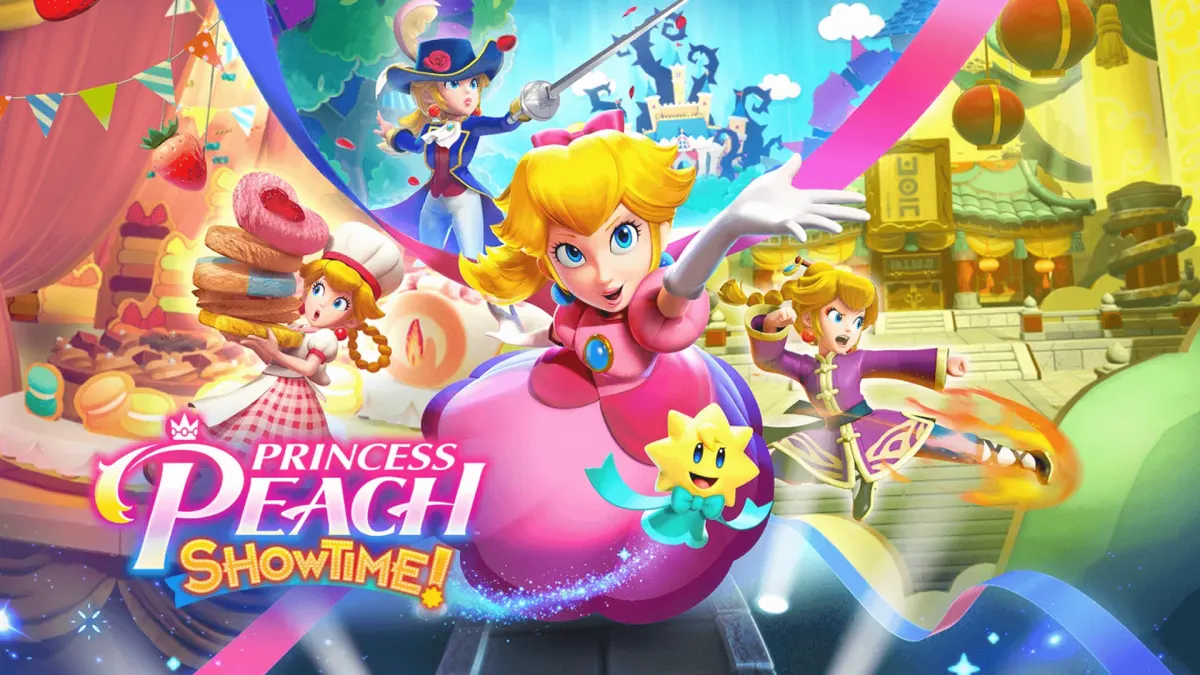
Peach has earned her place alongside other renowned female characters in interactive entertainment
Each of Mario's allies, along with at least one antagonist, has had their own games that defined their personality. The famous plumber's brother has the Luigi’s Mansion series, Wario makes a living through his adventures in WarioWare: Move it!, Yoshi has become Nintendo's mascot's babysitter through various titles, and Toad searches for treasure in Captain Toad: Treasure Tracker. But what about the other two famous characters, Bowser and the princess of the Mushroom Kingdom?

While it may seem hard to believe, Princess Peach wasn't the first damsel in distress in the jumping Italian's franchise. That "honour" belongs to Pauline, Mario's first girlfriend, whom he rescued from Donkey Kong in the eponymous 1981 game. This title also had the misfortune of being caught in one of the most important lawsuits in Nintendo's history, which resulted in the gorilla's identity being preserved and the famous pink ball (with the power of a black hole) being named after the lawyer who defended the Japanese company's interests: Kirby. But let's get back to the matter at hand: Princess Peach was created by the legendary Shigeru Miyamoto, father of the Mario and The Legend of Zelda franchises, in 1985, and for almost 40 years she has been the main ruler of the Mushroom Kingdom. Initially, she held the title of Princess Toadstool (a poisonous mushroom), and from the 80s until today she has played the role of a secondary character and damsel in distress in the various adventures of the most famous protagonist in video games.
Peach has been playable, as a secondary character, in several creations adjacent to the main franchise, such as Super Mario RPG, Super Mario 3D World, Mario Kart, Mario Party, Paper Mario or even Super Smash Bros. She has also had 2 games where she was the protagonist: Super Princess Peach, a platformer similar to Super Mario Bros., and Princess Toadstool’s Castle Run, a Game & Watch game based on Super Mario Bros. 2 which was offered as a toy in Japanese Happy Meals.

Over the years, Peach has earned her place alongside other renowned female characters in interactive entertainment, and recently she also appeared in "The Super Mario Bros. Movie" (2023) as a deuteragonist (second main character). She was played by Anya-Taylor Joy and was presented in a modern way, not as a damsel in distress who needs to be rescued by the plumber brothers, but as a capable monarch who takes the initiative to solve her own problems. This interpretation from the film continues in Good-Feel's game, where Peach brilliantly takes on the role of the main character and manages to defeat the fearsome witch Madam Grape and her Sour Bunch.
The game's story is relatively simple: the princess goes with some of her advisors to the Sparkle Theater to see a play. After Toad buys the tickets, the game's antagonist appears, takes over the venue, and cuts off access to the outside. Peach doesn't give up and looks for a solution to her predicament, and she's lucky enough to meet Stella – the theatre's guardian. Stella joins the ruler and grants her the power to change different elements of the plays. Together with the little star, who transforms into a hair ribbon, the protagonist sets off to save the show. The game's story is not complicated, and I believe this aspect is a result of how the game was planned. It's not a game for experienced players, but rather one for youngsters, which needs to be accessible in terms of story and the mechanisms present in the title.

Since the story takes place in a theatre, each mission consists of a play divided into 3 acts. Due to the way the missions are constructed, I can say that the game is a side-scroller, similar to the early Super Mario Bros. games. Peach will always move from left to right and will have to face different enemies or obstacles that come her way. The idea that each mission is a play manages to give life and personality to the game. Princess Peach starts each show with the basic powers offered by her assistant Stella, but soon she ends up helping the actors and taking on the main role while the star of the play is missing. The princess changes drastically for each mission and has access to different costumes and powers, like a true actress. The 10 roles she takes on are: Swordfighter, Detective, Patissiere, Figure Skater, Dashing Thief, Mermaid, Mighty, Cowgirl, Ninja, and Kung Fu Fighter. Each is well-defined and comes with its own mechanics, which are not found in the other shows. The only one I didn't like out of the ten was the detective role, because I found the system of searching for clues with a magnifying glass and deducing which witnesses/suspects were lying to be repetitive. I have friends who really liked this section because it managed to bring to life a simplified version of Sherlock Holmes. I also have friends who didn't like the sections where Peach plays the little mermaid at all because they didn't get along with the rhythm-based musical mechanism or found the way of manipulating fish strange, but I liked it because of the nostalgic feelings it evoked in me for Walt Disney's famous 1989 animation. I even had a moment where I expected either Sebastian, Triton's advisor and the composer of the underwater kingdom, to conduct the underwater orchestra, or the film's antagonist to appear, but my wish to meet them was not fulfilled.
Through the level design, Good-Feel studio managed to produce a game that offers youngsters a complex gaming experience. Princess Peach: Showtime! is not limited to a single playstyle. Although it is a side-scroller, each play is practically an opportunity to experience a different genre of gameplay. We can experience the spectacular moments from soulsborne games through the Swordfighter level, where we have to "perfectly" parry enemy attacks, or we can learn the basics of stealth games through the ninja missions, or experience the intensity of arcade simulators like Overcooked with the help of the patisserie sections.


Probably because I've played many Asian games lately, the missions where Peach takes on the roles of Ninja, Kung Fu Fighter, and Super Sentai stuck with me. As a Shinobi, the princess must infiltrate castles and avoid samurai patrolling the area. In this role, the princess has access to "powers" that allow her to camouflage herself and perform acrobatics that have become synonymous with this caste of Japanese spies. As a Kung Fu Fighter, she lives a Wuxia fantasy in picturesque peaks and Shaolin temples, where she must save the grandmaster and defeat the fallen student who has come to take revenge on the entire martial arts school. As a Super Sentai, she will help a team of researchers fight an alien invasion and will rescue people from under rubble or protect them from surrounding flames. Even more so than the Avengers, Peach will face aliens on her own planet in a mission full of suspense and moments worthy of the big screen. None of the levels are difficult and take a maximum of 10 minutes, and in addition to the main objective of reaching the end of the play, we must collect coins, ribbons, and Sparkle Gems to advance to the next level. Coins are easy to find in each show, as they come from various actions we undertake. I consider the ribbons the hardest to obtain, as they are hidden behind puzzles that can be complicated for beginner players. Sparkle Gems are not as abundant as coins, and are often hidden behind challenges, but simply completing the level is enough to obtain at least 80% of them. These precious stones are the main resource we will use to advance the game and access the various confrontations with the witch's subordinates.
As I mentioned earlier, the target audience for the game is youngsters, and this is evident in the battles with the creatures that Madam Grape puts in our way to stop our advance to the top floor of the theatre. In total, the game has 5 major battles, including the final one with the fearsome witch, and each is more of a puzzle than a confrontation. If the missions took the form of plays, these "battles" take the form of backstage preparations. Each boss is based on a technical aspect of the shows: we have an enemy who controls the decorations, one who is a spotlight, and so on. Each battle has a solution and sequence that must be followed, and once discovered, victory is guaranteed. These battles are grandiose but not as memorable as the interactions with the Sour Bunch. Its members are more reminiscent of the infamous duo that Ash Ketchum "confronts" in the famous Pokémon series, namely – Team Rocket. Each little purple person is an adorable dummy who narrates their plans like Jessie and James, and every time we defeat them, I expected to hear them declare that "the Sour Bunch is blasting off againnnn...!".


Graphically, the game looks superb. Considering that Nintendo's little console is already 7 years old at the moment, I didn't expect it to easily render the details of the characters and the scenes where the plays take place. However, the Kyoto company's creation manages this feat, but not brilliantly. The game has moments where it struggles with all its might to maintain a stable 30 frames per second. There were a few instances where this number was not reached, and although they are not abundant, they are enough to bother some more demanding players. The loading times for some levels are absolutely shocking, and we can wait up to 1 minute for a mission to load! I attribute these negative aspects to the console's age, and it's a shame that Princess Peach: Showtime! suffers from these technological impediments.
Although the game is good and manages to establish a new identity for Peach (similar to the one in the 2023 animation), it lacks an important element: the desire to complete it 100%. After finishing the approximately 8-hour game, we have the option to replay all missions to find the items we didn't collect the first time and to find 3 ninjas hidden in each level. Unfortunately, this was the first game from the Kyoto company that I didn't want to continue after seeing the first end credits. This is not the result of a game mechanic, a design element, or even the story, but rather the lack of that magical element that exists in all Nintendo games so far. For example, every Pokémon title has had a well-thought-out post-game that gives us access to mythical monsters we can catch, Kirby and the Forgotten Land remixes missions and enemies, and the Xenoblade Chronicles franchise continues the story with an epilogue that resolves any narrative threads that were not fully addressed in the main game. It is very likely that the lack of desire to complete the game 100% is the result of a game identity crisis that tries too many genres, but I cannot say for certain.


In conclusion, Princess Peach: Showtime! is not a bad game; it's a good entry point for youngsters, successfully placing the famous princess in a new light and showing us that she doesn't need a knight in shining armour to come and rescue her. I sincerely hope that Nintendo continues the princess's adventures and creates a new franchise, as I would love to see a Skater Peach in the coming years.
Princess Peach: Showtime! is available from 22 March 2024 and can only be played on Nintendo Switch. Thanks to our friends at CD Media for providing us with a review code so we could share our thoughts on this charming game.

Played on: Nintendo Switch
Release date: 22 March 2024
Developer: Good-Feel
Publisher: Nintendo

0 votes
Scroll down here and stay on the page for at least 30 seconds to vote.
Pick a score from 0 to 10 (halves are allowed).