
ReSetna – Review
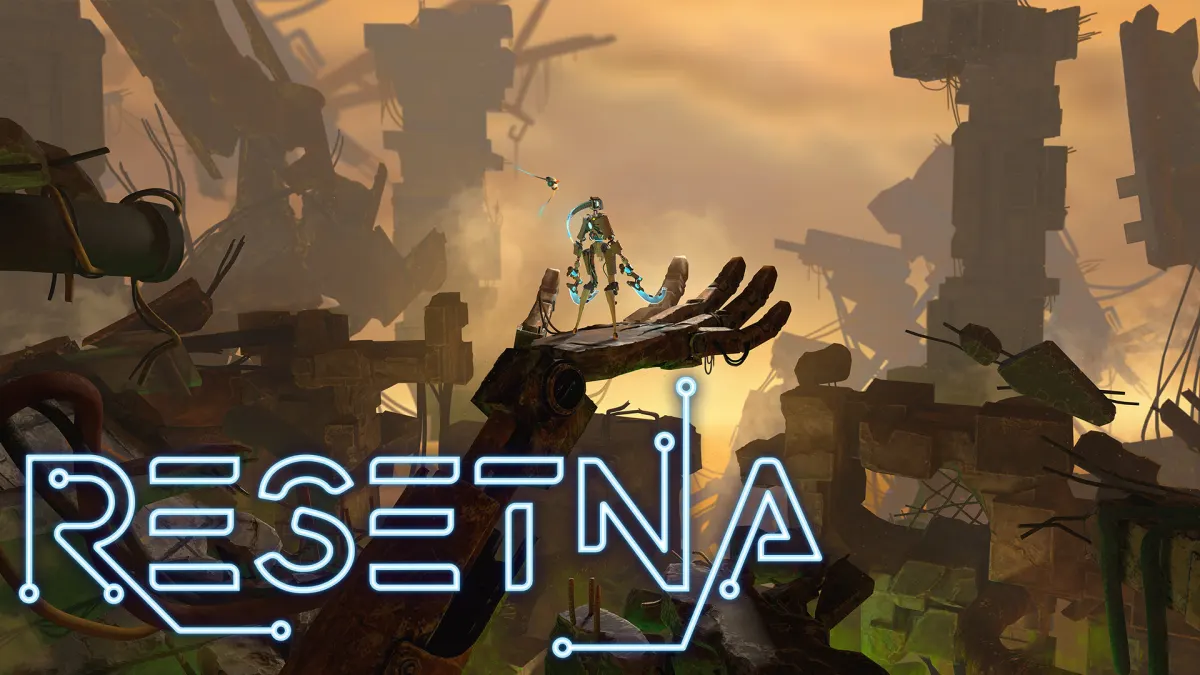
Skynet is coming for us, folks!
Here’s the deal: I saw ReSetna at an indie showcase. It looked like an interesting action platformer. I spoke with the folks at Today’s Games Studio – a new indie developer from Croatia. And they were nice, friendly, and offered me a review copy for their first game. So I’m going to proceed like any respectable critic and pick their game apart.
The people who worked on this project have games like Serious Sam, Talos Principle, and League of Legends under their belts. Now let’s see what resulted from the team formed by these talents.
Story 417
Don’t know what 417 refers to? You can check here for a list of HTTP codes to understand. I’ll refer to them throughout each subtitle. We’re talking about a game that includes robots and programming, after all. I had to use them.

In ReSetna, you take on the role of… obviously, ReSetna. She is an intelligent robot built to eliminate a virus that affects most of the robot population, making them hostile. You will venture through seven regions. You’ll meet some interesting characters. And that’s all I can tell you about the story without giving you spoilers.
In fact, that’s all you’ll understand if you play through the game without reading the codex. There you’ll find all the context you need. From there, you’ll understand what’s really going on. And the other characters you meet offer very little story information. Somewhere close to none.
If you ask me, I don’t see a problem with using text and a codex to tell the story. Except for the fact that here we don’t have a visual novel or text-based adventure game. We’re mostly talking about an action-adventure platformer. My minimum expectation is to understand the big picture after interacting with the characters. And the rest of the information should add more to an already established context.
I’d say none of the robots I met left any impression on me. They mostly play the role of merchants or give you quests. They occasionally offer a crumb of story. I didn’t feel their presence or relevance most of the time.
ReSetna is a fairly concise experience. The developers mentioned that the game was built for around 20+ hours of gameplay. I finished it in ten. That’s with finding every collectible and completing every mission. But I won’t lie, I asked the developers for a map to find the last two collectibles that were bugging me. But we’ll talk about that later.

Main and side missions are easy to complete. And their objectives are marked on the map in 99% of cases. Only two side missions don’t meet this criterion. But it makes sense, as their purpose is exploration.
In the latest update, they also added rewards at the end of missions. I’ll talk more about this in the gameplay section.
In short, ReSetna tells an interesting story… if you have the patience to read the entire codex and piece the information together. I can’t say you’ll understand much if you explore and interact with the other robots. Not to mention they’ll be very invisible and irrelevant.
Gameplay 200
What can you expect from the gameplay? First of all, weapons. You’ll have access to three types:
- Axes – fast weapons that help you manoeuvre the battlefield with ease;
- Swords – balanced weapons in terms of damage and attack speed;
- Naginata – a slower weapon than swords, but one that deals more serious damage.
You’ll receive the axes from the start. You’ll be able to buy the other two as you progress and find the necessary resources to purchase them. You can freely switch between them using the left and right buttons on the D-pad. I always prefer to use a single weapon. So I stuck with each weapon the moment I unlocked it.

Each weapon comes with a special attack you can execute by pressing the attack button while moving downwards. But you won’t be able to spam it infinitely. You’ll have to wait a period for it to charge. You’ll also execute an attack that launches ReSetna forward if you hold the attack button for a period. You don’t have to wait for this one to recharge. But it will be more difficult to use, as you’ll be vulnerable while preparing it. And if you attack in the air and move in the direction of enemies, you’ll perform a pirouette with your weapons.
I tried all the weapons before and after the most recent patch, which added significant improvements to the game. One of these is more fluid movement during combat. Weapons used to induce slow and robotic (pun intended) movements before. But their movement set has been greatly improved. Now it ensures better response times and more natural movements.
Another offensive tool in your arsenal are hacks. These can immobilise enemies for a period, explode a single enemy, or create an explosion that spreads to every nearby enemy like a virus. I opted for the viral explosion as soon as I unlocked it. But you can choose any hack that suits your playstyle.

You’ll also encounter Metroidvania-like elements, such as traversal abilities to unlock new areas. You’ve probably realised I said “Metroidvania-like elements”. But I didn’t say ReSetna is a Metroidvania. The way you play through the game is mostly linear. You enter an area. You naturally find a new ability. You move to the next area. Backtracking is minimal, and you’ll have very few reasons to revisit already discovered regions.
The game map also expands as the story progresses. You’ll find five access cards after a series of important events. These will allow you to enter some previously inaccessible areas and rooms.
The abilities that will make your life easier are:
- Dash and parry, available from the start. I rarely parried attacks due to the speed of combat. Instead, I chained dash after dash while dishing out death to enemies like sweets.
- The classic double jump for higher platforms.
- The ability to dash while in the air. A single such dash takes you far in this game.
- The ability to climb certain walls, scale them, or descend them, as well as the option to launch yourself off them.
- The ability to latch onto certain energy points to launch yourself and cross chasms.

What’s interesting about weapons, hacks, and abilities? The fact that you can alter their behaviour using the Chip system. These are upgrades you can insert into a Tetris-style grid to improve ReSetna. This grid will be small at first, and you’ll have to choose wisely what you want to equip. But you’ll be able to expand it and add more Chips in the future. You can also create five different presets. The disadvantage is that you can only equip each Chip in one preset. Let’s say you want a Chip that gives you bonus HP in two presets – that’s not possible.
The image you see above is from the current patch, with an improved visual interface. Now you can see a bronze, silver, or gold triangle in the corner of each Chip. This indicates its efficiency. Bronze or a single star indicates the weakest effect. Gold or three stars indicates the strongest effect. It all depends on how many Chips of the same colour surround it.
However, navigating this menu isn't always fun. Each Chip will be automatically placed in the grid, without you being able to choose its position manually. Then the cursor will be sent back to the inventory area to select another one. I recommend moving them within the grid using the D-pad, not the left stick, if you're using a controller. This will visibly ease navigation. Not to mention that the left stick will frequently glitch in this menu. In short, the D-pad is your friend.

Enemies should be quite varied in theory: 29 different types of robots. And that’s without the six bosses. In practice, I often encountered the same four recycled enemies frequently, even in new regions.
They’re not very difficult to defeat. You can take them down quickly using a sequence of special attack, charged attack, and your hack. Their behaviour became a bit more interesting after the latest patch. But it wasn’t anything out of the ordinary.
To be honest, I fought them a lot at the beginning and at the end of the game. At the beginning, because I wanted to gather a lot of resources early on. But it seems the game is so generous that it wasn’t necessary. We can find many chests with resources placed throughout the game.
So why did I fight a lot at the end? Because it wasn’t necessary to face enemies for most of the game. If it wasn’t an obligatory arena that blocked my progress, I didn’t touch them. I could very simply dodge, jump, or use the other abilities to collect what I needed from the rooms. And I wasn’t excited about the idea of destroying the same enemies again and again. I cleared all regions after I unlocked all abilities and that was about it. In short, you can turn the game into a walking simulator if you want.

The only difficulty bosses can generate is if you want to get a trophy. Specifically, the trophy for defeating a boss without taking damage. My advice is to do this with the first one you encounter, as it has the most predictable behaviour. Other than that, bosses are HP sponges waiting for you to beat them until they stop moving. I always try this approach in games. It allows me to check if they offer a challenge. Or if they’re just there as ornaments. And for ReSetna, it seems I didn’t have to learn any attack patterns. I’ll also mention that the fight against the last one is an explosion of visual effects, enemies, and music at maximum volume. This is the only thing that made it difficult.
The pace at which you progress in the game seems inconsistent. You’ll have access to most upgrades by the time you face the second boss. And this not only oversimplifies that fight but also trivialises the rest of the game. If I may offer some advice, I would change this approach to one that places boss fights as skill checks. For example, facing a boss that tests your ability to use air dash after you’ve unlocked it. Metroidvania-type games are a good example to follow in this regard.
But this would only solve one of the problems. The Chips offer an enormous advantage and carry you through the game. I would adjust them to diminish this advantage. I’m not saying it’s not good to be OP. What I mean is that you should feel like you’ve earned that level of power.
You also receive three injections that repair the main character. These replenish at each checkpoint. You can have a maximum of six such injections.
Shall I tell you about map pins? Go on, I’ll tell you! My dear pins are also present in this game. You have twenty at your disposal and they are called Custom Tags – you can place them wherever you want. There are ten more that you can place at ReSetna’s current position. These are called Shards and are more special. You’ll see a picture of the area where you placed them if you select them. These are two interesting choices. But they feel outdated and limiting. Why not have access to an infinite number of pins that allow us to see what’s happening in that area? I’ve seen this approach in other games. And I think it would have its place here too.
I also encountered bugs where I could only place Custom Tags in the room I was in. I had to restart a few times when this happened. This aspect, and the fact that we have a limited number of pins, encouraged me not to use them. Instead, I decided to advance until I hit a roadblock. And then go back to each region to collect what I missed. It seems this approach was the correct one.

Another improvement for the map would be to be able to see the name of the region where the cursor is located. Yes, they are coloured differently. But I wouldn’t mind knowing their names in case I have missions there. Fortunately, most mission objectives are marked on the map.
We have a decent distribution of teleportation points. We can also use them to save, as well as to recover missing HP and injections. Plus, you’ll find one before each boss.
In ReSetna, you’ll have access to one main resource and many other secondary resources that you’ll need to collect to buy items and upgrades. The second category doesn’t drop from certain types of enemies. Instead, it’s tied to the regions where you defeat them to obtain a specific type of material. But you don’t have to worry too much. You’ll find enough materials. I myself finished the game with a considerable surplus.
There’s only one penalty when you die – you’re spawned at the last Teleporter where you saved the game. Otherwise, you’ll keep everything you collected in your inventory. Which makes me ask: Why can’t we freely teleport to these checkpoints? There were times when I let enemies destroy ReSetna precisely for this purpose. What can I say? Why travel a lot when you can be respawned faster this way?

Here are my final comments regarding gameplay:
- There aren't many accessibility options. You can adjust the size of the mini-map. You can uncheck the Screen Shake option. And there are sound cues when you enter a room with a Teleporter. These should be useful for people with visual impairments.
- Enemies start to glow in a specific way when they're preparing to counterattack. This helps if you want to parry. And in the latest update, they introduced a visual cue to help you synchronise better. But again, the parry option is hardly necessary. You can get away with being aggressive with dodges.
- I frequently encountered completely black screens when moving from one room to another. Sometimes I could hear the sounds of enemies attacking me. But I couldn't respond until the game finished loading the area.
- Similarly, there were moments when enemies spawned right next to me when I entered a room. I took a few cheap shots from them because of this.
- Flying enemies used to be extremely annoying. They would fly higher and higher while shooting at you and were very difficult to hit. They eventually fixed this behaviour. You can also use ranged attacks against them.
- You might also encounter situations where there are too many enemies in a very confined space.
- Platforming puzzles are very well executed. They are at that ideal point of challenge that you want to overcome to get rewards. But they are balanced enough that you won't tear your hair out if you don't succeed on the first try. They are simply fair and won't frustrate you.
- Even though they added rewards for main and side missions… I don't really see the point. I can confirm that I had more than enough resources by the time I finished the game. And I didn't feel like I was missing anything.
- The new update also introduced enemies attached to walls along vertical corridors. These were empty before. And now you're encouraged to interact with something and not just walk around.
- Speaking of “attached to walls”, there were a few moments when my character got stuck after jumping into a wall. Or situations where they remained stuck in the air. A restart solves these problems.
Graphics and Sound 218

The artistic direction in ReSetna is visibly skewed towards sci-fi. Think of everything you’d dream of finding in a high-tech alien ship – that’s pretty much the atmosphere. But there are also regions that add organic elements like acid. Or regions where you encounter minerals. Not everything looks clean and immaculate. There are signs of rust, decay, and a world slowly dying. You can also observe little robots going about their business in the background or foreground. Even if some textures look a bit blurry or unpolished, the graphics manage to convey the desired message.
One aspect I really liked is how well the 2.5D models are executed. I mention this because I’ve encountered many 2.5D games where the textures and design looked like they were AI-generated or just very bad – especially for enemies. ReSetna wins in this regard.
The music leans towards sci-fi, atmospheric, and eerie sounds. The sound effects during combat, exploration, and when using abilities are good. ReSetna used to make irritating mechanical sounds with every step. But this aspect was later resolved.
However, there’s a problem with the music during boss fights. The volume goes from a normal level to “Slipknot Concert” in a few seconds. I even had complaints from people when I was streaming because they couldn’t hear me over the music. It’s sad, considering the Master Volume is quite decent and doesn’t need to be reduced too much – an aspect you don’t find in most games.
Final Verdict

ReSetna offers a positive experience in terms of combat fluidity. Even though the number of weapons is limited, the Chip system adds flexibility and the option to customise your playstyle. The Chip system itself is a fairly unique approach to modifying your character. The abundance of resources you can gather just by playing and opening chests is another positive aspect. This eliminates the need for grinding. The puzzles are very well constructed and won’t frustrate you. And the environments and characters are polished and fit the game’s theme.
Unfortunately, there are shortcomings in other areas. The story and characters are insignificant. The main and side missions boil down to “go there, collect that, come back,” without many interesting events. Even though combat feels nice and fluid, the lack of enemy variety reduces the fun. You can avoid most fights without being penalised for resources. Bosses are HP sponges. The map could benefit from improvements. And I would appreciate it if they introduced a late-game mechanic that allows us to collect the remaining collectibles we missed. There are many ways they could do this: colour the outline of rooms where we’ve discovered everything, have an audible signal when we approach a secret, etc. Additionally, you’ll frequently encounter glitches. Or you’ll have to experience dark screens until the game finishes loading areas.
If we put it all together, I think ReSetna would have been a very good action platformer with Metroidvania elements for the 2000-2010 era. Unfortunately, the market has already set high expectations for this genre of game. And the current game feels like that person who arrived at the party after most of the main guests had left.
I wanted to give it a rating somewhere between 5 and 6/10 when I finished the game. But the recent gameplay update convinced me it deserves a solid 6/10.
You can buy it on all major platforms for €19.50. But I’d say a fairer price for the experience offered is €10. Luckily, it now costs €9.75 for this Steam Spring Sale.
I also want to applaud the developers’ effort and their desire to improve the game based on community feedback. I believe what they’ve learned from the ReSetna experience is very valuable if they decide to create a similar game. I hope they do and I’m rooting for them.
Anyway, that’s all from me. Take care. And I’ll see you in the next review.

Played on: PC
Release date: 30 September 2024
Developer: Today`s Games
Publisher: Module16

Plus
- Fluid combat
- Unique Chip system for customisation
- Abundant resources, no grinding needed
- Well-designed platforming puzzles
- Polished sci-fi environments and characters
Minus
- Insignificant story and characters
- Repetitive main and side missions
- Lack of enemy variety
- Bosses are HP sponges
- Map could be improved
- Frequent glitches and dark loading screens
- Inconsistent pacing of upgrades
- Boss music volume spikes
0 votes
Scroll down here and stay on the page for at least 30 seconds to vote.
Pick a score from 0 to 10 (halves are allowed).