
Robobeat – Review
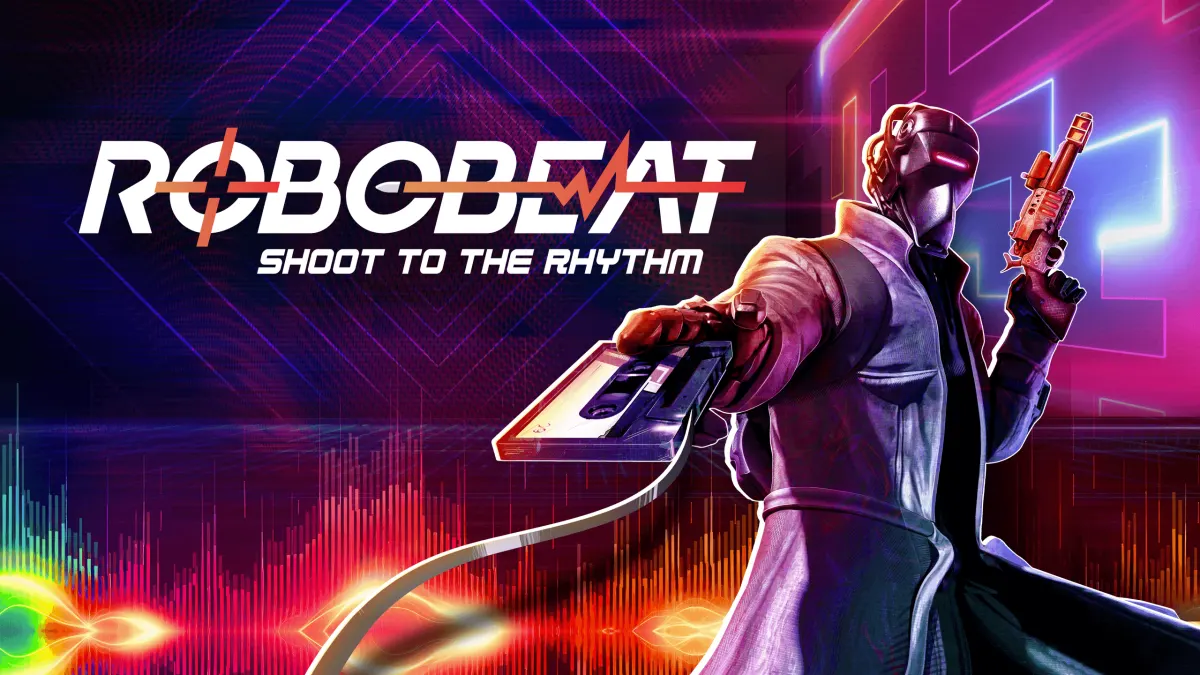
I went pew pew in my first rhythm shooter
To be clear from the start, this is my first rhythm shooter… as in, the first one I’ve ever played. And if you’ve been following me for a while, you’ll know I’m not a big fan of the FPS genre in general. That’s why I was a bit sceptical when the people at Kwalee put ROBOBEAT in my hands, but I felt it had that something, that je ne sais quoi, that va-va-voom – well, that and the fact that I’m mad about roguelikes. My interest grew exponentially when I found out the game was developed by a single person, Simon Fredholm. Let’s just say I spent about 35 hours achieving everything there was to achieve in the game and discovering everything there was to discover. The question is: Is it worth spending so many hours with the game? I’ll let you decide after you take a look at the review.
Can you include a decent story in this kind of game?
In short, the answer I’m happy to give is: Yes, you can. Of course, it’s not going to be the core of the game and the reason you play necessarily, but it’s always appreciated when developers create a narrative thread for their games and give you a reason for doing what you do. In ROBOBEAT’s case, the main character is an agent of Erasure Solutions, a company that provides mercenaries to clients to solve their problems. There’s a catch though: the company prides itself on these mercenaries being the best in the business because it wipes their memory after each mission, so they can always focus on the current mission.
You’re sent from the start of the game to settle a client’s score and eliminate Frazer, the antagonist of this game. You arrive at his block, take the lift like a polite boy, find him and think your mission is over. Obviously, that’s not the case – Frazer pushes you off the building and you have to climb back up to him, but this time going through each area of the block. I liked how they used the cinematic sequence where you’re thrown to the bottom to quickly showcase what the levels you’ll have to go through will look like – I thought it was an interesting teaser.
Once you return to the first level, you’ll have to complete four levels one after another to reach Frazer again and complete your mission. Each will be unlocked the moment you reach the end of the previous one. However, the word “level” seems more or less an exaggeration. Why? Because in essence, each level just adds a new area to those you’ve already conquered before and a few new enemy types here and there. I’ll tell you a bit more about this when we discuss gameplay.

Even if each room where you have to confront enemies looks similar to the previous ones, they tried to make things interesting by scattering many, many secrets through them. These secrets are mainly cassette tapes that let you play various songs throughout your runs. Once you find a secret, you’ll also get a clue to guide you to the next one – you just have to keep an eye out for anything suspicious in these rooms. Also, in these secret sections, you can find story fragments that will help you better understand what’s going on. And if the secret hunt gives you trouble, the people at Kwalee have created some guides on their YouTube channel to help you – even if it’s not something included in the game itself, I appreciate it when a publisher supports its titles and developers like this.
Another story element included is the existence of cinema-like rooms after you wipe the floor with each boss – here you’ll receive recorded messages from Frazer himself. After each of these projections ends, you’ll also experience flashbacks that seem from another world than your own. How are they related to the story? Let’s just say you’ll get your answers and experience a series of surprises after you finish the game. Even if the story elements are few and scattered, they offer enough to intrigue you and make you think about what’s happening – there’s more to it than meets the eye.
Alright, alright. But how’s the gameplay?

As I mentioned, you’ll have to go through four levels to reach the end of the game. And to traverse these levels, you’ll need a little help. More precisely, weapons – many, many weapons. The game includes 24 weapons, both for ranged and melee combat, to help you make mincemeat of the hordes of enemies. You unlock these weapons when you find schematics associated with them after clearing rooms of enemies or in the game’s secret rooms, and then you buy them with Blips – one of the game’s currencies. You can only have two weapons equipped simultaneously. At first, I found it interesting to take each of them for a spin as I unlocked them. Later, I realised that many of them just have an interesting design and that’s about it – only a few of them were truly practical. Once I found the Ping Pong paddle that deals considerable damage and explosions every third hit, I didn’t even care about the rest – it’s even more interesting when you discover that you can find higher-level weapons as you progress through the runs, and that the Ping Pong paddle deals more damage than the superior versions of some weapons. As much as I like melee weapons, they are simply too weak in this game – it’s not worth getting close to an enemy and risking being hit when you can solve the whole situation with a well-placed bullet from the other end of the room.
Also, weapons have alternative attack modes depending on the key combinations you press.
Weapons aren’t the only toys you have access to – you can also equip two power-ups to make your life easier. If I had to classify them, these come as offensive power-ups – things like a sniper rifle or a drone that fights for you for a few seconds – or utility power-ups – things like the ability to freeze your enemy, slow down time, and so on. Similar to weapons, you can find superior versions of these throughout the runs. I found that the most efficient way to use them is to have one offensive and one utility power-up equipped – the utility one incapacitates the enemy, and the offensive one will help you deal serious damage during that time. You just have to remember that these have a cooldown and you can’t spam them left and right as you please.
I played on mouse & keyboard and found it odd that one of the power-up keys is the middle mouse button. Fortunately, the game lets you change all controls as you please, and I immediately moved it to the E key, to be close to the other one, which is on the Q key.

When you discover higher-level weapons and power-ups, not only is the damage they can cause improved – they also benefit from additional effects. For example, a superior weapon can have effects such as increased damage against burning, electrocuted, frozen enemies, etc., it can cause greater damage in general or for critical hits, and the list goes on. A superior power-up can cause more damage, apply different effects to enemies, reduce the power of enemy hits, add more jumps, etc. This aspect helps you quite a lot in customising your build. However, the fact that these bonuses are more or less random creates situations where you can get an enemy freezing effect… for a power-up that already does that – not exactly ideal.

One of my biggest gripes about weapons and power-ups is that you can’t freely choose which weapons you want to start the run with, but you can self-destruct your character as many times as you want until you get the combination you like. To put things in perspective, you’ll have access to two weapons and one power-up until you finish the second level, and four weapons and two power-ups starting from the third level. If you consider what I said earlier about weapons and that some of them are simply useless, you’ll easily realise why it might become irritating. Add to that the fact that this selection is random and that you can receive a copy of the same weapon three times, as you can see in the image above.

In this game, you can charge the bullets your weapons fire to make them much more powerful. I’ll be honest, I used this feature very rarely, because I was too busy shooting to the beat and avoiding groups of enemies coming for my life. If the ability to charge bullets wasn’t that useful, parrying projectiles saved my life many times – if you press F when an enemy throws a projectile at you, you’ll throw it back to where it was and deal damage to those in that space. Considering that some enemies throw projectiles that follow you to the ends of the earth + each boss has this ability and parryable attacks, I suggest you quickly figure out how parrying works if you want to have any chance. Unfortunately, this mechanic isn’t encouraged much in the first half of the game – I almost forgot about it until the game introduced enemies that threw projectiles that followed me. There’s also the problem that you can parry some projectiles without even looking at them, while others, you can’t. The second category includes some that float and follow you to the depths of hell until you parry them.

Throughout the runs, you’ll be able to unlock rooms where you can get better equipment for free, shops where you can buy equipment with the coins you collect during the runs and which disappear at the end of them, but you can also unlock upgrades that will be valid during that run. These upgrades can be things like reducing damage taken from enemies, increasing speed, increasing damage you deal by parrying, etc. Some are useful, others are… just there. I won’t hide the fact that it took me quite a while to hit the right combination of upgrades – ones that significantly reduced damage taken and increased my weapons’ firepower – to finish the game and unlock everything that could be unlocked. I found it quite bizarre that you can’t unlock a series of permanent upgrades that you can choose before starting a run – I’m thinking here of elements similar to Hades, where you can increase the damage you deal if you hit an enemy from behind, where you get a few chances to be revived and so on. These elements made my experience in the latter part of the game quite boring and repetitive.

You’ll face both enemies that hit you up close and enemies that shoot at you from a distance, but I must confess that the variety of enemies leaves something to be desired for a game where you’ll die quite often until you learn to adjust your style and what you can use to make your life easier. The bosses don’t escape this lack of variety either – each had a maximum of three types of attacks that they used in rotation. Even if you defeated them a few times, this didn’t change their attack patterns. And the worst aspect about them? They were bullet sponges. The lack of varied attacks and the excessive HP cut into my appetite for the game.
Throughout the first three levels, you have points where you can catch your breath before fighting each boss, so you can heal your wounds and unlock weapons and power-ups related to the schematics you find. The last level doesn’t let you heal before each boss, only after. It took a while to finish the game because of this. Sure, it helped me improve my spatial awareness in the enemy rooms before the bosses, but it wasn’t a pleasant experience to keep going through the same levels that look identical.
In fact, it wasn’t the lack of healing that gave me a hard time, but the inconsistency of the parry mechanic. Sometimes I could parry projectiles the moment I was visually and audibly notified they would be launched, sometimes I could do it when the projectiles were on their way to me, sometimes I could do it when they were a millimetre away from hitting me, but sometimes it didn’t work in any of these situations. Technically speaking, you have to sync with the beat, but I was able to parry projectiles without syncing with the beat. In short, parrying in ROBOBEAT remains a mystery to me to this day 😂

The best and most spectacular aspect of the game is fighting to the rhythm of the music. It was difficult for me to get used to it on the first day of playing, as this type of game was unexplored territory for me. But starting from the second day, everything settled down and I adjusted my playstyle to have a more pleasant experience. It also helped that the game offers a target practice section where you can get used to the rhythm of the songs. Moreover, you can add your own songs to those already in the game and even create a mix with the songs you want to listen to when you play. Not to mention that you can change songs or mixes whenever you want during the game – you can choose a crazy BPM (Beats Per Minute) if you want to test how good you are, or you can choose something more relaxed if your fingers start to hurt. I played around with changing songs a bit, but I ended up practising with one or two songs a day, and that worked much better for this rhythm shooter novice.
Here are a few more gameplay details before we move on to the sound section:
- The game goes into standby every time you switch tabs. If you have a habit of accidentally pausing, this standby mode will ensure you don’t self-sabotage.
- The game includes a room where you can check your progress in terms of unlocked cassettes, weapons, and power-ups.
- Mechanics like wall-jumping and sliding on certain sections are not included in the tutorial, even though you can use them throughout the game and even unlock upgrades for them.
- Similarly, you’re not told that when you decide to ground pound, you can suspend enemies in the area in the air and they will take critical damage during that time, even though the ability is introduced in the tutorial.
- If you want to access their Discord server, it seems the dedicated button in the game doesn’t work.
- You’d better use your Blips while you have them to unlock new toys, because you’ll lose them at the end of the run.
- If you record a certain number of headshots or finish a section before a checkpoint under a certain time limit, you get access to reward rooms when you reach the safe zones between sections. Sometimes you also find shops before these points. My recommendation for level design would be to position the shops after you can check these rewards, because you could very well buy a weapon that you’ll have access to anyway because you did well before reaching these points.
- The game adds a little variety by including parkour or target practice rooms at the end of which you can get rewards if you’re quick.
- If you have the damage indicator activated, you’ll see a “Nice” next to each shot that deals 69 damage. Do with that information what you will.
- Even if enemies and rooms suffer from a lack of variety, both have been intelligently created in terms of gameplay: large rooms with enemies that quickly cover the distance between you, as well as small rooms with enemies that constantly hunt you and force you to learn which enemies to prioritise.
- Some upgrades you receive for abilities are vague. For example, they may mention that you receive a temporary damage bonus after jumping off a wall, but the exact numbers are not mentioned. There are quite a few upgrades with such vague descriptions.
- There’s a hidden room that lets you unlock an infinite play mode. I won’t spoil how to get there – just know it’s there if you’re up for a challenge.
- Even though the game counts combos, there’s no end-of-run screen that tells you how you did. It could also include some leaderboards for the highest scores or fastest times for more competitive players.
The game is literally music to my ears

I liked the variety of songs already included in the game, with slower songs for more casual players who want to get used to it, but offering veterans more alert rhythms if they’re up for a challenge. As I mentioned earlier, I decided to stick to one or two songs so I could use muscle memory when I had to wipe the floor with enemies. I used the default songs at first to get used to it, and then I moved on to importing my favourite songs. Because yes, you can add your own songs and you have access to an editor that lets you customise them: you can decide where songs start and end, you can delete sections, and you can manually adjust the BPM. I didn’t play around too much with manually adjusting the BPM, but I can say that the game is capable of identifying it itself most of the time – it doesn’t work with all songs, but it still allowed me to play to the rhythms of my favourite songs. It could do a better job of explaining how to use the music editor, as I had to figure out some controls on my own. If you’re not someone who wants to figure everything out on your own, the people at Kwalee come to people’s aid again with YouTube tutorials – again, even if it’s something outside the game, I like to see publishers who care about players’ experience.
A little tip for those who have difficulty playing normally and shooting to the rhythm: the game lets you disable this option and shoot enemies like Rambo as much as you want. It’s a nice way to offer more casual audiences the chance to enjoy the game, without people constantly being stressed about having to shoot to the rhythm. I was stubborn enough to play without this “Chill Mode” (as they call it), but that’s only because I wanted to prove to myself that I could do it and that I could get better as I played – don’t do like me if you just want to have fun haha.
Disco aesthetics

The visual direction dominated by neon lights stands out from the start. The game also adds a glitch filter, but I wasn’t a big fan of it and deactivated it to see what was happening on screen better. There’s also a Screen Shake option, but you’re already used to me deactivating it every time so I don’t get dizzy. A nice little detail is that you can activate or deactivate the option for weapons and HUD elements to move to the rhythm of the songs. A tip from me is to set the Field Of View slider to maximum, because the game likes to throw enemies at you and you’ll want to see as much of what’s happening as possible.

As I mentioned, there isn’t much variety in enemy and room design. Most enemies are generic-looking humanoids, and their bodies are made of geometric figures – their colours are slightly changed depending on the game section you encounter them in, and occasionally they may have distinct elements, but generally they look similar. The rooms look architecturally the same, with small variations in size, and sometimes they add a little verticality by including a second floor – this element adds a little variation in terms of gameplay, but not significantly. You might be drawn to the different posters scattered on the walls of the rooms, trying to create the image of a futuristic and neo-totalitarian regime where robots are enslaved and forced to work.
Even if not all weapons are equal and very few are useful, I appreciate their variety in design. I just wish I could use my beloved katana to cut through thousands and thousands of enemies without feeling every time that I have better weapon options.
The screen can become too cluttered during fights, as normal and homing projectiles, enemies hitting you from a distance and up close come for your life at the same time. It doesn’t happen very often, but if you hit such a room right before a boss fight and don’t have the option to recover your HP… it might give you some headaches.
The graphics use a mix of warm and cool colours that don’t hurt your eyes too much. I was able to play for hours without feeling my eyes getting tired or my vision being affected.
Final Verdict

Overall, I enjoyed my time in ROBOBEAT as my first roguelike rhythm shooter. The gameplay was largely optimised, I could see clear progress in my ability to shoot to the rhythm of the music, the minimal story elements and secrets kept me engaged and made me think about the bigger picture, I liked both the in-game music and the ability to add my own songs, and the visuals were gentle enough on my eyes.
The game would benefit from working on its weapons – with only a few effective weapons, you have no reason to choose the weak ones and handicap yourself, unless you just feel like doing it for fun. For example, they could work on the damage melee weapons do and the range at which they can hit to make them at least somewhat relevant.
The lack of enemy variety hurts the game, and bosses being generic bullet sponges throughout each run is not at all thrilling. They could change their attack patterns based on the number of runs you’ve completed and even let you decide what bonuses they could receive – if they do that, I hope they don’t add bonuses that increase boss HP, because they’re already quite chunky in terms of HP and fights with them would become even more boring. Maybe it’s just me, but I like enemies that are difficult because they behave intelligently, not because they have a lot of HP. At the same time, I see this as a bonus when you go through this type of game multiple times.
I’d also like them to take a look at the parry system and optimise it to be consistent throughout the game. Do you have to parry to the beat? Can you parry whenever you want? Does the projectile have to travel a certain distance? Can you parry it at any distance? I feel these are details they need to resolve and explicitly mention.
Last but not least, they could improve the way they introduce and explain new mechanics during the tutorial, and as you discover them. I’d also like to see more encouragement for players to use these mechanics from the start – things like parrying or jumping and ground pounding to launch enemies into the air – instead of introducing them abruptly. This might mean adjusting enemy behaviour and adding a wider range of enemies from the start, but I strongly believe this would benefit the game and players in the long run.
ROBOBEAT receives a solid 7 from me for now. It could easily be an 8/10 game if it didn’t suffer from aspects that hurt its replayability and made the 35 hours I spent 100% completing the game feel more like a grind. In any case, it’s a solid game for the £20 you pay for it and even better if you catch it on sale.

Played on: PC
Release date: 14 May 2024
Developer: Insanity Games, Simon Fredholm
Publisher: Kwalee

0 votes
Scroll down here and stay on the page for at least 30 seconds to vote.
Pick a score from 0 to 10 (halves are allowed).