
ScreenPlay CCG – Preview
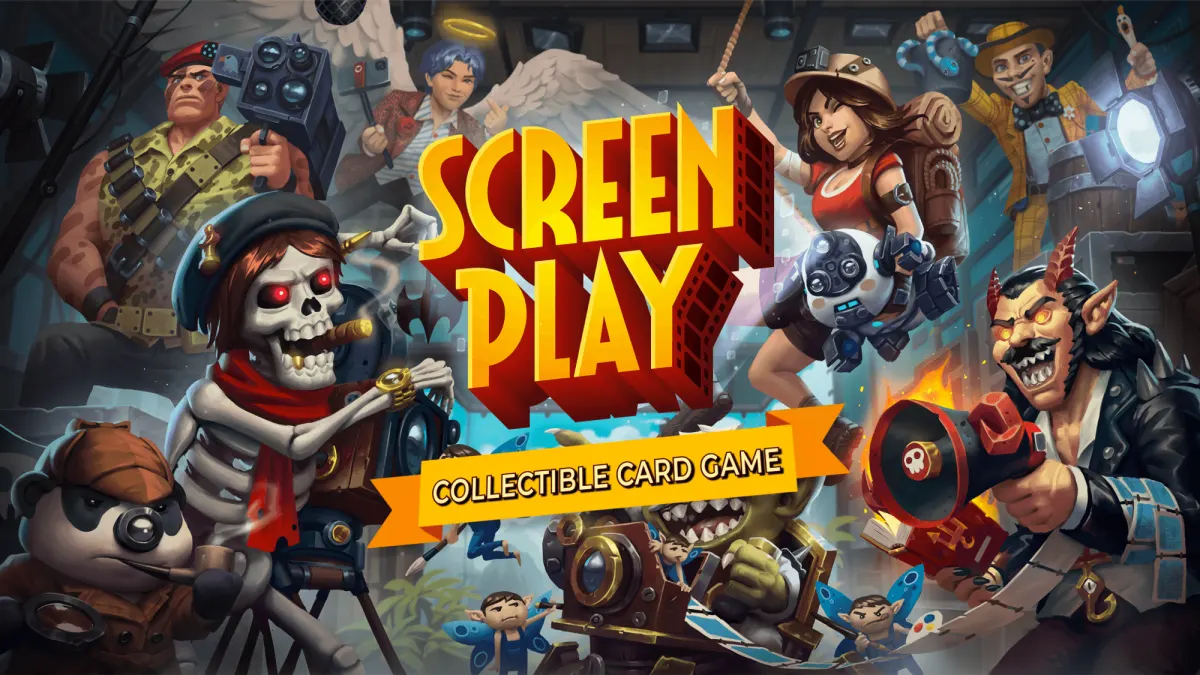
Is there still room in the market for a new CCG?
Before we begin, allow me to present my “humble” experience and career in the world of card games, so you can get an idea of why I might actually know a little bit about what I’m talking about here. Right. I’m a former Top 100 in Hearthstone and Gwent, former Top 20 in Eternal (which I reached less than a month after starting to play) and former Top 15 in Legends of Runeterra. I was a commentator for Legends of Runeterra for 3 years, during which time I interviewed top players and Worlds winners, and also wrote articles for competitive players. So yeah, you could say I’m not exactly new to CCGs.
ScreenPlay is developed and published by the German studio Comico Games. I found the idea of creating a card game based on the world of movies interesting, so I signed up for their playtest through a journalist application, tested it for a while, participated in a few tournaments, got to know the community, and now I’m here to tell you what I thought of it.

Cards and mixed opinions on gameplay
In ScreenPlay, you take on the role of a film director trying to finish their cinematic masterpiece before their opponent. What exactly does that mean? Your deck has three main actors, called Leads. Each has a quest similar to those introduced in Hearthstone a while ago – to see a certain number of characters played, a number of attacks carried out, a number of characters saying goodbye to life, and so on. Each of these actions is rewarded with Performance Points for the Lead, until their quest is completed. You finish directing the film when you meet this criterion for two of your main actors before your opponent does.
Apart from the three Leads, cards are divided into three categories:
- Characters – the units you’ll play during matches;
- Tropes – the equivalent of spells in classic card games;
- Crew – these are not units with attack and health points and do not occupy any of the slots allocated for characters. You can use their effects periodically, for a certain number of action points, at a certain turn interval.
Each of these cards is assigned a number of frames – think of frames as the cost you have to pay to play a card in other CCGs. Regardless of the number of frames assigned to each card, it must not exceed a cumulative maximum of five per turn. After one player completes a Lead’s quest, the limit will extend to six frames per turn until one of you wins. Frames are not only used as a cost for units, but also as action points – attacks usually cost two frames, with the exception of some more special characters. They also decide the priority of actions during a turn. For example, if your opponent plays a Trope to destroy one of your characters, but you decide to attack with that character (an action that costs two frames), your character will be destroyed before it can do anything.

Speaking of actions, you also have the option to Perform – you can click on your Director in the bottom left and drag to one of your characters to perform; if it survives and manages to complete the action by the end of the turn, your Lead receives a Performance Point, regardless of what kind of quest they have. This action costs you two frames and I like that it offers flexibility, as you have the chance to advance your Lead’s quest in situations where you normally couldn’t. For example, let’s say your Lead receives points if you play characters, but unfortunately you’ve reached the limit of nine characters you can play. In this case, you can command your characters to perform and you will receive Performance Points.
Going into more detail about actions, the decision-making stages and the stages where they materialise are simultaneous. You decide what you will do during the turn at the same time as your opponent during a preparation period, then you observe the results, depending on what your opponent also decided. The game also includes a series of interesting priority systems.
Firstly, we have Spotlight, which more or less represents who has priority for actions in that turn – Spotlight changes from turn to turn between players. Why does it matter? If two characters decide to attack simultaneously, the player with Spotlight’s attack will happen first, will reduce the character’s health bar by one bonus point, and will incapacitate the character for two turns (if it doesn’t remove it from play).
Secondly, there’s the Counter system, which sounds similar to what I described above. Let’s say you decide to attack a character, but your opponent anticipates this and attacks that unit a little faster. This will count as a Counter – it will still incapacitate the character and deal bonus damage.
An interesting mechanic they’ve introduced is the ability to avoid attacks… but you’ll pay a price for it. Let’s say you have a unit that your opponent wants to take out of play at all costs. You, being Nostradamus and realising they’ll use a character or a Trope to do it, want to avoid what they’re planning. If you drag and drop on your own character, it will avoid the attack. Good, good, but what’s the price, sir? If you avoid too quickly, the character will be incapacitated for two turns. If you avoid too late… you can figure out what happens.
When it comes to building decks, you can only include cards that belong to the same film genre as your three main characters. You can’t include a Comedy card when your three main characters are from the Drama, Horror, or Action genres. Additionally, you’ll need a minimum of 40 cards for a valid deck – the upper limit is 59. There doesn’t seem to be a clear limit on how many copies of the same type of card you can include – each card has a different maximum number of copies you can include. I won’t go into details about keywords, buffs, or other card-related specifics.
Now that we’ve talked about the interesting gameplay aspects, it’s time to get the skeleton out of the closet and see where things could be improved:
- The tutorial is very dense with information, and not all of it is useful. I would have liked to see the characters explain the mechanics briefly and to the point, instead of taking us on a story from Adam and Eve between them and then, after a while, remembering that “Hey, we have some things to explain here.”
- It’s not explained anywhere that when you attack a character, that character doesn’t retaliate – unless it has certain keywords. I would suggest adding this information for players.
- The only way you can check what different keywords do during the game is to play the card, then click on the unit and check. But you can’t do that while you have the card in hand. A bit strange, isn’t it? I’d like to know what a card does before I play it, not after. Just saying.
- The game would benefit from a history section where you can see what happened in previous turns. A graveyard where used or removed-from-play cards are discarded would also be useful, so you can check what has been played and plan future turns around it. There are also mechanics where you can bring characters back to life, and you might want to know what options you have among the characters removed from play and if they meet the conditions to be brought back into play. If they implement such a thing, I would suggest separating the opponent’s cards from the player’s – now this space is used in common and may limit what they can do with revival mechanics in the future.
- Remember I mentioned earlier about receiving an extra frame when a Lead’s quest is completed? They could specify that in the tutorial too.
- It’s a bit irritating that you can’t retract cards once you’ve selected them to be played – you can only press Undo to do that. So if you have any doubts about the first card played after adding the entire sequence of cards, you’ll have to press Undo a bit – or Ctrl + Z, because it works the same way.
The game could also benefit from an option to increase animation speed, as they currently take quite a long time. I’m not saying remove them entirely. Just let us choose whether we want to wait for them or not.

Building decks is hard… but not for the reasons you might think
As I mentioned, I won’t go into details about keywords, synergies, or other craziness. But I will talk about the collection interface when trying to build new decks, because it’s quite clunky.
For starters, you can only see what cards you have in your collection if you start creating a new deck. I find it confusing that we can select different types of filters in the collection menu, but we have to create or edit a deck to actually see what cards we have.
Cards are not sorted by cost, and the only way to do that is to select each cost individually, one after the other. If you like to play archetypes that rely more on minions or are very aggressive, or just want more freedom in finding the cards you need, you might encounter problems here.
Once you’ve selected the three main actors, the collection manager doesn’t filter your cards based on them, reducing them only to those you can include – you have to do this manually. As you might have guessed, I’m not a fan of extra steps.

How’s the economy doing?
Disclaimer: I received 10 packs and 100 Goldies (in-game currency) just for applying as a journalist to review. Besides that, you can get 3 more packs if you use the code READYSETACTION and another 10 packs if you’re part of their Discord server. In theory, you’d think there are enough resources to go wild, but I still felt like my collection was a bit empty – it’s a feeling quite present among the players I contacted in the community, apart from those who had been playing for a few months.
You receive a different type of currency if you play competitive ranked matches: 10 coins for victories, 4 for defeats. You have two daily missions from which you can earn an average of 50 coins/mission, and sometimes you can also get Goldies. Additionally, you can participate in daily community tournaments to get more resources for your collection – they’re not very competitive, more for fun.
In the recent update before Early Access (13 May), they added the option to buy Goldies with real money.
Card packs cost either 100 coins, which you earn by playing or completing missions, or 20 Goldies.
If you want to craft cards you don’t have in your collection, you have to spend Goldies on them. And it seems there’s a bit of unease in the player community because these crafting prices have increased. And you know what? I’m with the players on this. Firstly, you shouldn’t have to pay for cards with a resource that’s very hard to obtain. Secondly, the change happened without prior announcement – a move I don’t support.
You also have the option to buy cosmetics such as game boards, card back designs, deck covers, or even Directors that represent your in-game avatar. All of these can only be purchased with Goldies.
My feeling is that the game lacks a limited mode like Hearthstone’s Arenas or other CCGs’ Drafts. Such modes not only help players gather resources but also teach them about the different mechanics and synergies in the game. Honestly, it’s the reason I haven’t spent any resources on packs – I was expecting something like that to be implemented. I’m a capitalist kleptomaniac who keeps their resources safe until the right moment to spend them, what can I say.
All things considered, the game’s economy is not in a very rosy situation right now, and these stealth updates regarding crafting prices and the introduction of a currency purchased with real money don’t sound encouraging to me. After playing so many CCGs competitively – some more generous with resources than others – I strongly believe that monetisation should come from cosmetic elements, not from buying in-game resources. Otherwise, this type of game becomes more about who has the fatter wallet, not who is better at the game.

The art and inspiration are incredible… but sometimes on the verge of a copyright issue
The game’s art direction is cool, leaning towards a cartoon and comic book style. The developers have also included posters of imaginary films starring the characters in the Lore section, trying to create their own universe. My only concern is that someone might sue them. The references they use are sometimes very close to real-life IPs and personalities. If someone decides to sue them, it might not end well. Nobody wants a lawsuit with Ronald McDoom, do they?
But until they figure out what to do about that, they could also include the option to click on cards during the game to see their design in all its glory. When you’re bored or just waiting for the actions you’ve selected to finish, you might want to take a look at what the characters look like. They could even animate some of the cards, as this doesn’t happen now – only the moment a Lead finishes their quest is animated.
The different card back designs, different Director skins, and different game boards all give the same comic book feel, but I haven’t spent resources on them – I’ve only seen them on other players. I’m a person who cares about gameplay first – it has to convince me to invest in cosmetics. You also have the option to buy different deck covers, but I’m still in doubt about how useful this is, considering that only you can see these covers in your own collection.
The sound design is good… but it feels like music is missing
Don’t get me wrong. I’m perfectly aware that this is a playtest version and you can’t have everything your heart desires included. That’s precisely why I expect them to add more songs than just the one in the main menu and the one during gameplay.
Aside from that, the sound effects are clean, comical, bold, and a joy to listen to. Whether it’s a boxing broccoli throwing a punch, the “whoosh” sound when a character dodges an attack, or the sound of movie stars when you get a Performance point, I appreciate what they’ve done with the sound. They could also add sound effects when opening card packs.

Anything else to watch out for?
Yes, there are a few more things that could be improved, in case they haven’t already been resolved in the Early Access version released on 13 May:
- You can’t change your resolution if you’re in Full-Screen. You have to switch to Windowed mode, change it, and then switch back to Full-Screen.
- Animations, loading times, and click sensitivity are slow and leave a lot to be desired. It takes a while for menu buttons to do what they should after you click them, and opening animations trigger very sluggishly.
- The time it takes for all game resources to load when you start it up isn’t very short either. They could include some screens with characters and their stories to alleviate this problem.
The competitive system is a mystery to players and nothing is known from the developers.

Should you give it a chance?
Based on the interesting mechanics and gameplay, the artistic direction, and the sound effects, the game seems promising and you could give it a go.
Based on the optimisation issues, the problematic tutorials and menus, and the up-in-the-air economic system (and based on what they want to implement in Early Access, it seems they want to entice people to throw money at resources), I’d say don’t rush too much.
The coolest aspect of the game was the few community members I talked to and played with in the daily tournaments, but eventually, I realised it wasn’t for me. I’m not competitively excited by it, and the gameplay, while fun, didn’t feel flexible enough – it feels like it leans more towards a casual audience. I was initially happy that I could have fun without being super competitive and focused on winning every match, but that feeling eventually faded.
The game can be downloaded for free. You can try it and let me know how you feel.

Played on: PC
Release date: 13 May 2024
Developer: Comico Games
Publisher: Comico Games
