
Super Mario 64 – Review
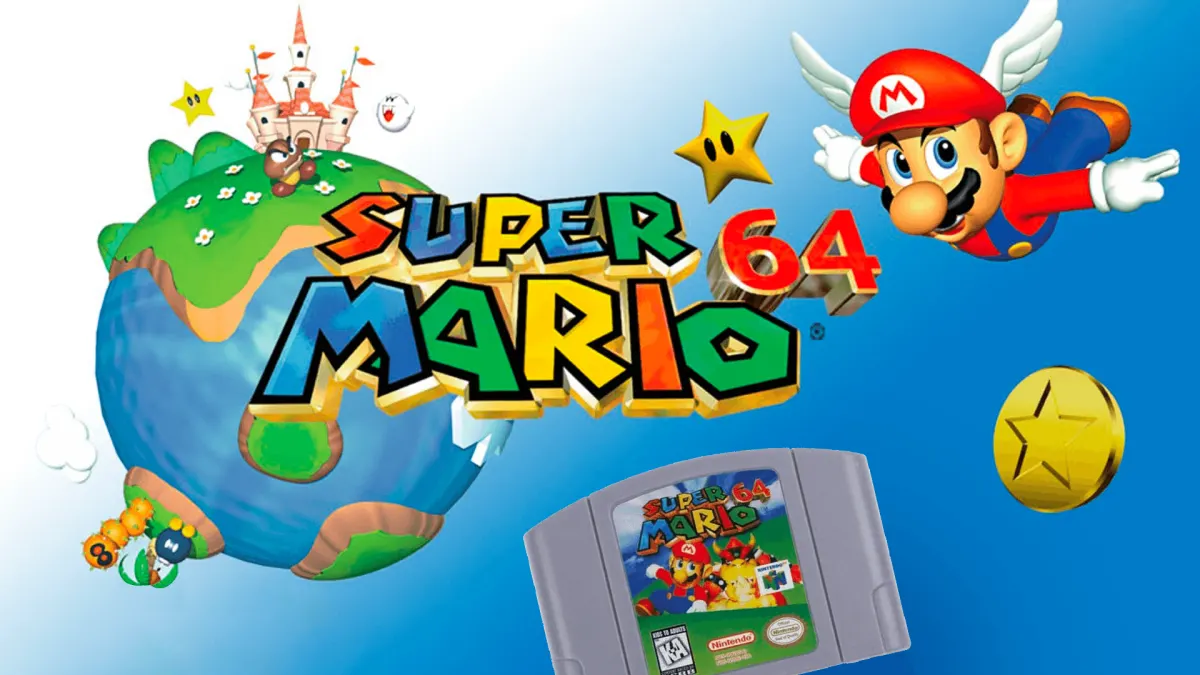
In December 1998, when I was just 6 years old, Father Christmas was to irreversibly change my destiny through Super Mario.
Unlike the toys I had touched until then, I was dealing with a vast and interactive universe, which displayed my adventure in a sublime ambiguity: on the one hand, the graphics showed me exactly how events unfolded; on the other hand, the images on the screen failed to answer the question “why?” and I had to use my imagination to give a purpose to the squishing of Goombas. Super Mario Bros, played on the omnipresent Terminator 2 or Super Design Ending-Man BS-500 AS, made me a gamer and opened my appetite for many other digital worlds.

But while I and several million other Eastern Europeans were enjoying our first contact with Mario, our mates on the other side of the defunct Warsaw Pact had already been familiar with Super Mario 64 for about two years. For them, the fact that the Italian plumber had been introduced into the third dimension to pull the evil Bowser's tail was a dream come true. For us, it was just a rumour, no different from the stories Cosmin from downstairs told about “batmen” brought from the USA, who come with a remote control and fly just like Arnold Schwarzenegger in the film “Jingle All the Way” (translated by ProTV as “Goana După Cadou” – The Gift Chase).
Sources of information were few, access to technology that could confirm or deny a rumour was just a chimera, no different from the fabrications that every kid in front of the block spread to keep others' minds occupied, and the only elements that fuelled my conviction that Mario meant more than the adventure on the Terminator were the misleading labels on the yellow floppy disks bought from the bazaar (pirates had learned to use more recent images to give the illusion that your 8-bit system could run something much more advanced).

However, I got my hands on Super Mario 64 in 2022, more than 20 years after I started imagining a more “realistic” Mario game. Although I had the chance to buy a Nintendo 64 with Super Mario 64 quite cheaply around 2010, I was afraid that the work I was about to discover was too old and might disappoint me. In many rankings that compile some of the best games of all time, Super Mario 64 holds a place of honour on the podium. But the subjectivity of the editors is quite evident, as they clearly appeal to nostalgia and end up romanticising some of the game's shortcomings.
From the perspective of a 1990s child who grew up in the United States or Western Europe, the impact caused by Super Mario 64 was huge. After all, the time interval between Super Mario World (SNES, 1991) and Super Mario 64 (1996) is only five years. The technological leap, however, is immense: the Italian plumber is not only introduced into an additional dimension, but once again has the honour of defining an entire genre and places himself at the forefront of the evolution of art and science.
From the perspective of a 1990s child who grew up in Eastern Europe, who didn't own a Nintendo 64 in its glory days and only caught up with the latest gaming standards in the second half of the following decade, Super Mario 64 might seem like a relic. An experiment from a long-gone era, when technical limitations imposed conventions that are useless today.

But I still decided to give it a chance… in 2022.
Even though I knew I would end up comparing it to Super Mario Galaxy and Super Mario Odyssey, successors that take absolutely every aspect to the next level. As soon as the Nintendo Switch Online subscription included an additional pack for N64 games, I ensured the continuity of the tradition by which the Japanese from Kyoto have almost unlimited access to my piggy bank.
What I was about to discover pleasantly surprised me. And not just because I was trying to convince myself that I hadn't wasted money by effectively renting a 26-year-old game. Super Mario 64 is a somewhat clunkier prototype for Super Mario Odyssey, offering a unique adventure in an unusual context.
If in all other Super Mario games released previously Princess Toadstool/Peach's castle was the final destination, here it becomes the starting point. Through a twist of fate, the evil Bowser kidnapped the blonde damsel right inside her own royal residence. And what Mario must do to fulfil his mission as a knight in overalls is to traverse all the rooms in the castle until he finds the dragon and can initiate the decisive battle. And to gain access to the wing of the castle where Bowser initiated the kidnapping, Mario must collect enough stars scattered throughout each level.


Par excellence, the Super Mario series defined the 2D sidescroller genre: you move from left to right, face the obstacles that come your way, and finish the level once the flag on a pole comes down. To progress, most of the time you don't need to replay the same level – Super Mario World is the only exception to the rule, but it can be completed even without needing to look for secret exits.
Super Mario 64, however, completely eliminates the “you have to get from point A to point B” rule. All the levels in the main story, with the exception of the last one, involve completing small missions that offer yellow stars as a reward. For example, if you manage to collect all the red coins placed on the map, you will receive a star and return to the lobby that connects the levels. If you explore the sunken ship in the level “Dire, Dire Docks”, you will be rewarded with another star. And if you manage to return a baby penguin to its mother at the foot of a frozen mountain in the level “Snowman’s Land”, you get another miniaturised celestial body. All these stars will help unlock new levels and facilitate progression inside Princess Peach’s castle.
What’s interesting, however, is that Super Mario 64 forces you to find a minimum of 2-3 stars in each level. Which means you will have to replay each stage to try to complete another of the suggested missions. And each time you return after a successful operation, you will see how the environment has changed: the cannon that propels you into the clouds of the “Bob-omb Battlefield” map appears after you discover at least one star; once helped, the snowman in the “Cool, Cool Mountain” level will keep his head on his shoulders; and victories obtained in races against Koopa the Quick end up changing the turtle’s location the next time you return.

Indeed, it can be said that Super Mario 64 is the first game in the series to allow a non-linear approach.
Beyond the fact that you can traverse the 15 levels in almost any order you prefer and collect the 6 stars from each realm in the succession that makes you happy, there are also small secrets waiting to be discovered inside the castle that substitutes the map from previous iterations. In fact, you can find a total of 120 luminous, eyed celestial bodies – but you need a minimum of 70 to face Bowser and rescue the princess.
It doesn't matter if you collect them all from 12 levels and ignore the others. It doesn't matter if you hunt for secrets in the castle that allow you to avoid certain challenges that appear later. As long as you accumulate the correct number of stars to unlock the next section, you are free to choose the tasks as you please.
Super Mario 64 brought two major innovations for its time: the ability to jump and stomp enemies in a 3D environment, and the action of rotating the camera. If you want to be prepared for the challenges ahead, you need to orient yourself in space to understand the nature of the dangers and to secure an optimal angle for jumping. But while today we have standardised the camera system placed behind the hero, Super Mario 64 forces you to use a favourable angle to accomplish the task with the best possible precision. Thus, the correct approach is not to rotate the camera after every movement – but to fix the camera at an angle appropriate for each scene. Once you have established the perspective, you can face all the challenges that come your way.
Although the system of fixing (instead of permanently rotating) the camera may seem rudimentary, it is not half as bad or outdated as the controls in the first three Resident Evil games on PlayStation (the so-called “tank control” can become a nightmare). Mario is much more agile and athletic than Lara Croft, can execute more manoeuvres than Crash Bandicoot, and has a less linear adventure than Spyro the Dragon.
gon. Mario's main rival from the 1990s, Sonic the Hedgehog, would have to wait another 2 years until he received the gift of the third dimension in Sonic Adventure. Again, Nintendo was at the forefront of innovation in console gaming and was dictating the trends the industry was heading towards.
Even in 2023, Nintendo is looking to streamline storage to accelerate (or entirely eliminate) loading times – The Legend of Zelda: Tears of the Kingdom fits on a 16 GB card, which allows large portions of the game to be stored in the Switch's RAM. A single update for Call of Duty: Warzone can take up 10 times more hard drive space and sometimes requires an overnight download. There's a lot to be said about the importance of software optimisation, but I'll stop before I'm accused of extreme partisanship.
Super Mario 64 is still an excellent game that can stand shoulder to shoulder with 3D platformers released today in the indie space. Subsequent releases in the series, from Sunshine to Odyssey, have refined every aspect related to control, graphics, and sound. But there is still something special to discover in the moustachioed plumber's first foray into the world of polygons. The level design is incredibly good, and all other elements have their own charm. If Nintendo decided to remake the entire Super Mario 64 experience using the graphics engine and physics from Odyssey, then it would certainly sell millions of copies and be nominated for various awards. However, I can only respect the stubbornness of the team behind the Mario games to reinvent and reimagine such a simple story.
Once you return to Super Mario Galaxy, Super Mario Odyssey, or any other 3D game in the series, you will notice that the genre has actually evolved very little from 1996 until today. Indeed, new game mechanics, new ideas, and new improvements related to optimising and streamlining gameplay have appeared. But many elements have remained unchanged in the last 27 years. With Super Mario 64, Nintendo established a multitude of conventions that were revolutionary at the time, but which we take for granted today.

If I haven't convinced you yet to buy the N64 cartridge for your collection, subscribe to Nintendo Switch Online, and/or download a 6 MB file from other sources, then I recommend listening to “Dire, Dire Docks” and “Piranha Plant’s Lullaby” from the game's soundtrack. They will help you better understand why Super Mario 64 is so beloved, why the atmosphere it offers is still hard to beat, and why a child of the 1990s who didn't grow up with 3D Mario chose to imagine a parallel reality where post-communist grey is replaced by an optimism with colourful red and blue overalls.
Mamma mia!

Played on: Nintendo 64
Release date: 23 June 1996
Developer: Nintendo
Publisher: Nintendo

0 votes
Scroll down here and stay on the page for at least 30 seconds to vote.
Pick a score from 0 to 10 (halves are allowed).