
Undaunted: Normandy
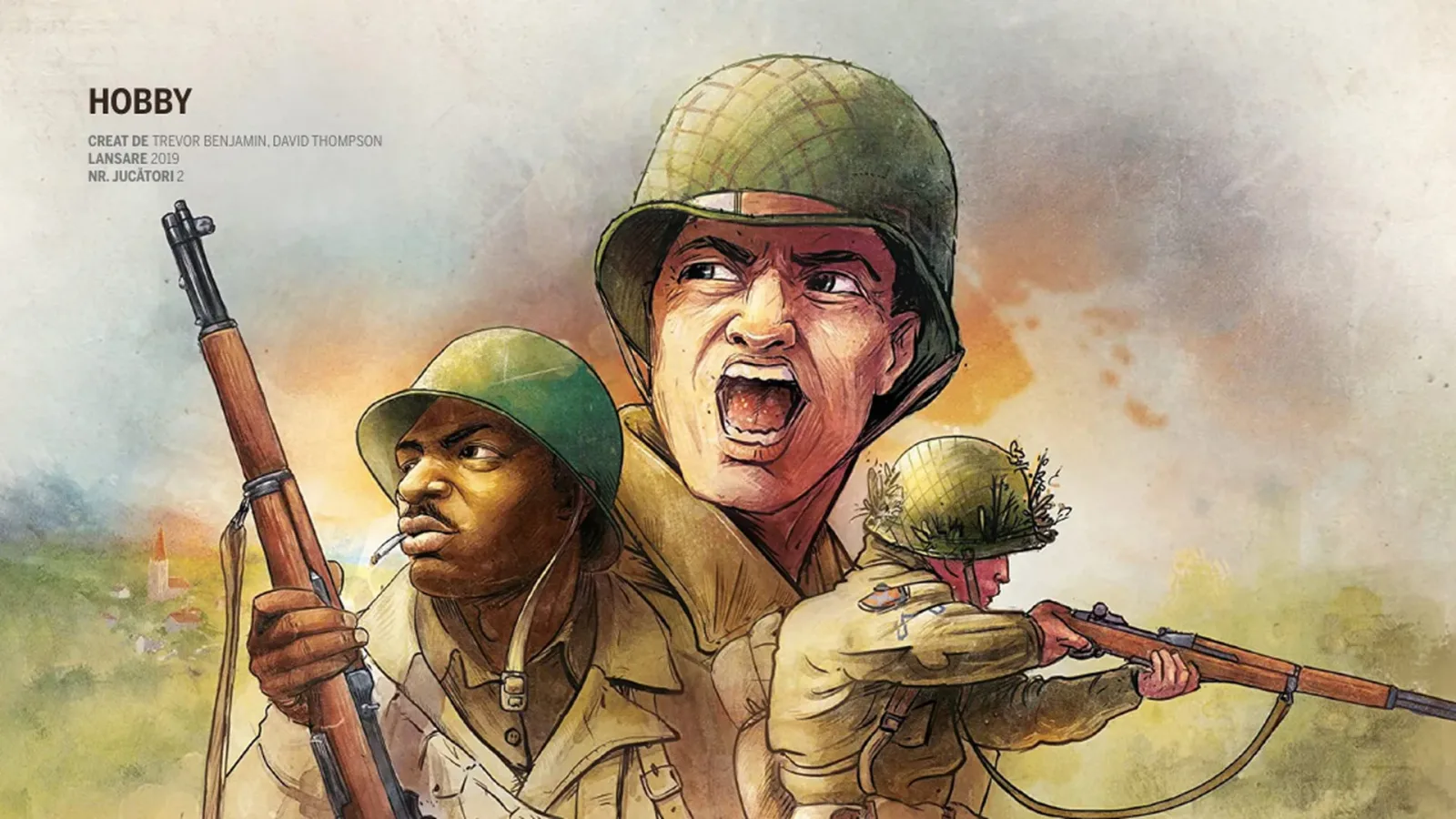
First published in GRIND III, pages 186–191.
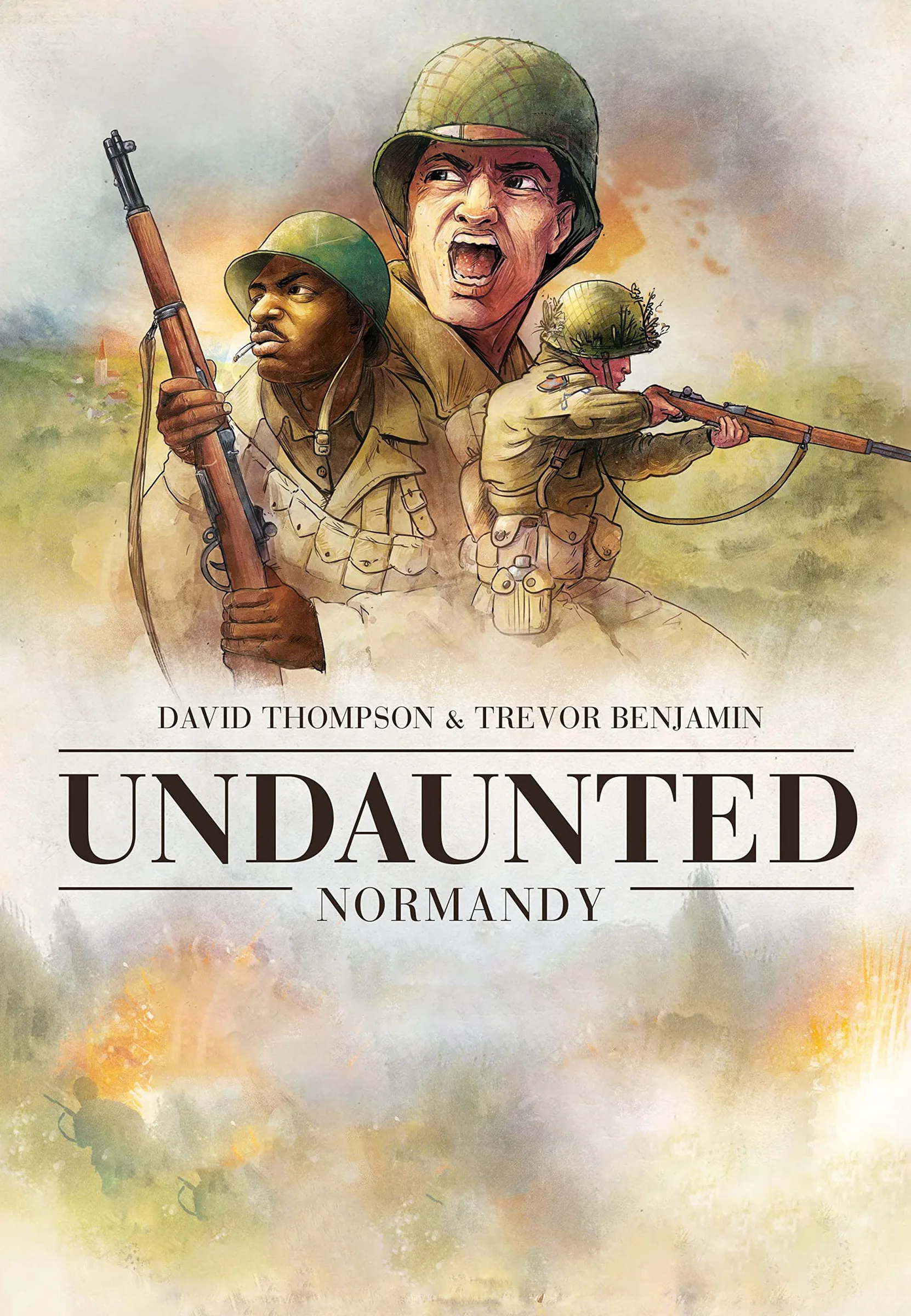
CREATED BY TREVOR BENJAMIN, DAVID THOMPSON
PLAYERS 2
CLASSIFIED
“After we had endured all the ordeals and the training in England, we felt pretty well prepared for anything, and we were very ready to fight the Germans, and we could hardly wait for the day when we could really go into battle.”
[Sergeant Bob Slaughter, 116th Infantry Regiment, 29th US Division]
War is, without a doubt, one of the most interesting subjects for the human species. Of course, we don’t like war itself, but we do like talking and reading about it. Perhaps it satisfies the primitive brain’s need for violence? Or maybe it simply satisfies a morbid curiosity while filling us with gratitude that we aren’t in the middle of those events? We especially like playing games with and about war, because, after all, what could be more suitable for satisfying certain curiosities (“what would I have done in Napoleon’s or Belisarius’s shoes?”) than games? A safe space that poses no mental or physical danger to you, but which puts you, more or less abstractly, into a specific war scenario, is exactly what’s needed. And the sheer number of games that have appeared on the market, taking humanity’s various military conflicts as their subject, can only confirm this attraction.
One of the most prolific types of media that addresses the theme of war is, without a doubt, video games (who hasn’t heard of Medal of Honor or Call of Duty?), but there’s another that far surpasses it. Board games (tabletop games, as the older folk call them) not only have an entire category dedicated to wars, called “war games”, but they date back as far as the 18th century, or even the 16th. I know you’re thinking of chess, but I’m not referring to that, but to games that explicitly implement the idea of war. Now, this category of war games is quite niche even within the realm of board games, because it generally comprises games with rather cumbersome rules, being far more concerned with the idea of simulation, of realism, to the detriment of fun. Not that they aren’t fun, but you have to be passionate to appreciate them. And yet, the game I have before me, and about which I feel obliged to speak as much as possible, is itself astonishing for being very simple compared to other war titles, and it’s very good, causing quite a stir upon its release and still being highly regarded by the public.
Undaunted: Normandy is a war game for 2 players, created in 2019 by Trevor Benjamin and David Thompson, illustrated by Roland MacDonald and published by Osprey Games, whose action takes place during the Second World War.
The game’s story centres on the battles fought by the US 30th Infantry Division (check Wikipedia, it’s very interesting) against the Germans, immediately after the Normandy Landings. This division carried out several important operations during that period, fighting intense battles for a total of 282 days until the end of the war.
Thus, one of the two players will command a platoon of soldiers from that division, trying to win battles against the Germans, battles that will span 12 scenarios. The other player will, of course, lead a platoon of German soldiers.
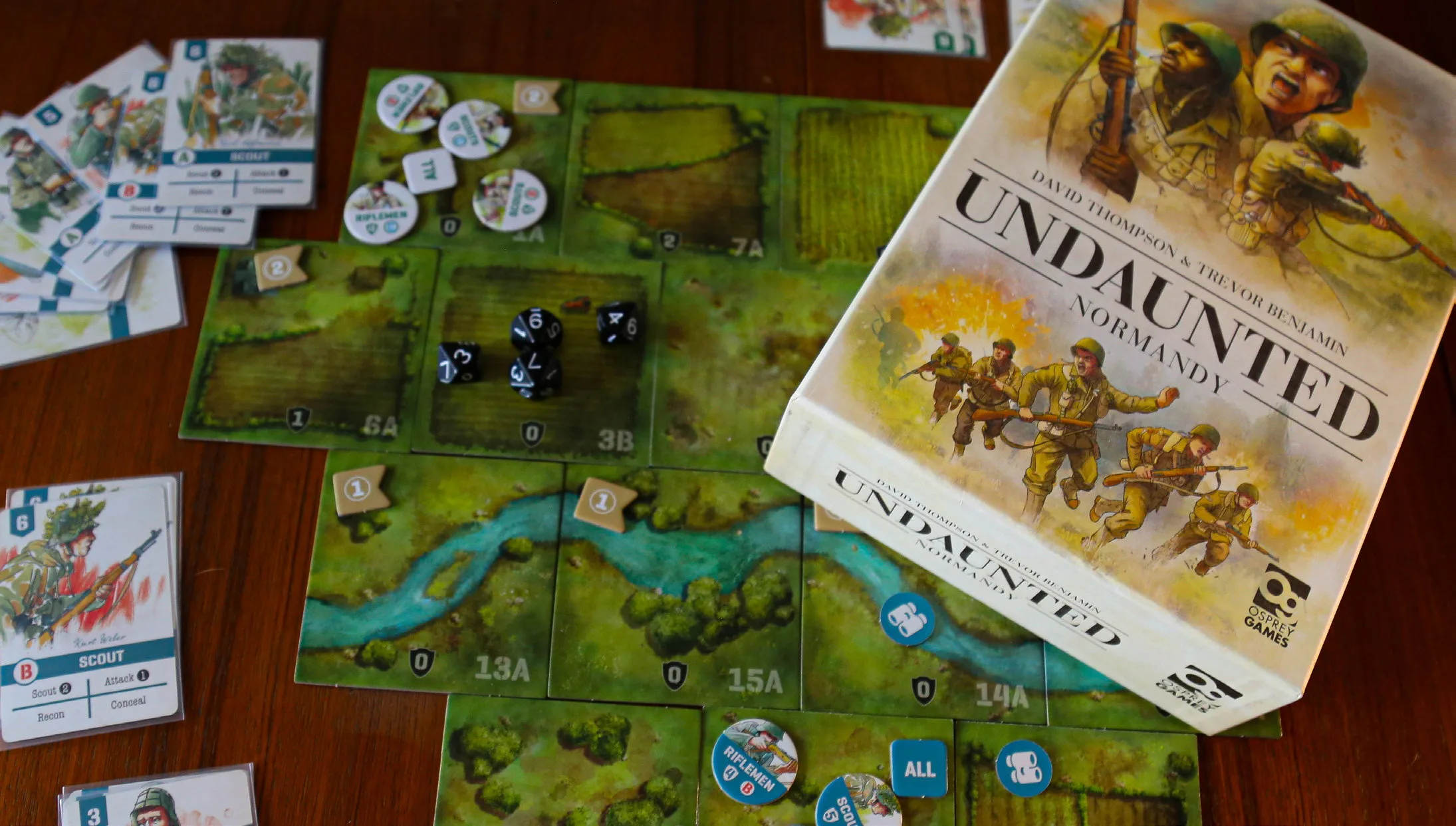
I won’t reveal too much about these scenarios, but it’s important to know that they are connected and there’s a certain continuity; thus, you can play them either stand-alone or in campaign mode, creating a narrative thread. Like any self-respecting game, the action takes place in a space, in this case, on a game board, and I must admit that every time I set Undaunted: Normandy on the table, I’m pleasantly surprised by how good it looks. Essentially, the map isn’t a big deal, being made up of 18 cardboard tiles (each with two sides, A and B) arranged as the scenario dictates. But what cardboard tiles! These are richly illustrated, with various more or less abandoned buildings, but also agricultural fields, forests, plains, rivers or other geographical spaces that all look different. Graphically speaking, each piece of the map has a pleasing appearance, and the very well-executed details give each scenario personality: I really do feel like I’m on the edge of a small village, in a rural area, planning my attack.
And the geographical features on each tile really do matter! Thus, each has a “cover bonus” that can offer you extra safety in case of an attack and invites a tactical and strategic evaluation of the situation on the battlefield. Do you send your soldiers forward into that open field that’s right in the enemy’s line of sight, or do you send them further right, where there’s a field covered by a row of bushes?
Although we’re talking about a war game, Undaunted: Normandy is one where the action takes place in a confined, close-quarters space, which also gives the feeling that “it’s personal”. If in Risk or Diplomacy or Axis & Allies you have the whole world at your disposal to manoeuvre units, here you have the back yard of a small French village. The atmosphere is much more oppressive and everything becomes much more personal: somehow you feel like you’re in a space that was once inhabited, or where other people were, day in, day out. Now it’s just you
The 30th Infantry Division was a National Guard unit in the First World War and the Second World War. It was nicknamed the “Old Hickory” division, in honour of President Andrew Jackson.
The Germans nicknamed this division “Roosevelt’s SS”. The 30th Infantry Division was regarded by a team of historians led by S.L.A. Marshall as the number one American infantry division in the European Theater of Operations (ETO), involved in 282 days of intense fighting in the period from June 1944 to April 1945. Currently, the 30th Armoured Brigade Combat Team is now part of the North Carolina National Guard, and its most recent combat deployment was in 2019. there, fighting fierce battles with your enemy. Thus, from this point of view, Undaunted: Normandy is more akin to old computer game series like Close Combat or Commandos (aha, that’s how old I am).
Of course, to stop this whole tactical excursion from becoming too boring, each map will have various tokens on it representing the units of each faction, depending on the scenario’s requirements. In Undaunted: Normandy, players have the following units: Platoon Sergeant, Platoon Guide, Squad Leader (A, B and C), Rifleman (A, B and C), Scout (A, B and C), Machine Gunner (A, B and C), Mortar and Sniper. Whether you play as the Americans or the Germans, the units are the same. The asymmetry, however, lies not in the characteristics of each unit, but in those of each scenario: where each faction starts, the units available to it, and the number of objectives it has to win.
Oh, I haven’t told you how you win yet, have I? Ultimately, on each scenario’s map there are certain zones with objective points on them that players have to control with their units. For example, in the first scenario, if the Americans control zones totalling 6 objective points, they win the game.
how do you play Is that all? Not at all. Only now do we get to the mechanism at the heart of Undaunted: Normandy, namely the game cards. You see, each player starts the scenario with a small deck of 10 cards (made up of the cards the scenario mandates). On their turn, each player draws 5 cards from their own deck, which they play either before or after their opponent has played their own cards (depending on initiative). That’s the turn, that’s the game.
What do those cards represent, and why are they so important?
They represent the units you have on the map and have each unit’s actions written on them. So only if you play, say, a Rifleman card can you perform the desired action with that unit, whether it’s attacking an enemy unit, controlling a strategic point on the map or simply moving.
Each unit’s card has 2–4 actions that set it apart from the others, from Move and Attack, to Bolster, which lets you add men to your platoon, or Command, which lets you draw 1–2 more cards from your deck so you can take more actions this turn.
Another category of cards you’ll receive over the course of the game is Fog of War, which are downright useless and can end up hurting you through their very uselessness, because they have no actions on them. So just imagine what it would be like if, out of the 5 cards drawn that turn, you had only one you could use, the other 4 being the useless cards?
Fog of War. What’s their role? Well, they’re there to convey the uncertainty and tension of wartime in the game, because you never know exactly what actions the enemy will take or what their next move is. In Undaunted: Normandy, this uncertainty is represented by its very consequences: your inability to give orders and take actions. The Fog of War concept is best known from RTS games like Age of Empires or StarCraft, only there it’s literally represented as a fog.
Of course, over the course of the game you'll get the chance to expand your deck (which means more soldiers in your platoon), so you can take more actions per turn and even shake off some of that uncertainty of war. That way you can build your deck however you like. And it was precisely this deck-building mechanism that kicked up such a fuss when Undaunted: Normandy came out: it creates a complex, tactical game that is nonetheless easy enough to grasp to be fun. Every card in your hand at the start of your turn adds a strategic layer and gives you a certain number of choices you have to weigh up. If you have two Rifleman A cards in hand, you can play one of them for the Move action and the second for the Attack action, so you close in on an enemy unit and attack it. But what if you only have one Rifleman A card and one Scout A card instead? Hmmm…
What I like about Undaunted:
Normandy is that, even though it doesn't have the special effects, the visuals or the storytelling of big Hollywood films like Saving Private Ryan or Dunkirk, it somehow still manages to keep you emotionally invested in all 12 scenarios and make you feel something for the platoon you command.
I've already mentioned that the map is a fairly small one, which forces both factions to fight almost hand to hand. Time and again you'll find yourself breathing down the enemy's neck… you draw your weapon… take aim… fire. The enemy drops flat on the ground. In those moments the rules of the game require the player who owns that unit to search their hand, their discard pile or their deck for the card that matches that unit and throw it out of the game. For the rest of the game session. For example, if do I know them from somewhere? your opponent has attacked and killed a Scout A, you have to take a Scout A card out of your hand, and so on.
At first it doesn't affect you much, beyond the fact that you have fewer and fewer cards that let you take actions with that unit. But as you throw them out, and you look more closely at one Machine Gunner A card and then at another Machine Gunner A card, you notice that they have names. The one you threw out of the game earlier was called Alexander Busch, and now it's Heinrich Schneider's turn.
And in the whole platoon you have just one more Machine Gunner A, with the name Gerhard Schuster written on it. He's the only one left in the platoon. Even their portraits on the cards are different. Because these aren't simple playing cards, they're people who, once they've fallen in the line of duty, don't come back. Whether you play the Americans or the Germans, none of them is invincible.
And so Undaunted: Normandy, with all the drawbacks that come with this sort of medium, manages to recreate an atmosphere close to the events seen in films like Saving Private Ryan: a platoon of soldiers caught between a rock and a hard place, who have to use every last scrap of their intelligence and tactical resources to come out on top. And although the names of the soldiers in this game are entirely fictional, the scenarios in Undaunted:
Normandy mirror the battles that David Thompson's own grandfather (one of the game's two designers) went through. But whether you choose to play as the Americans or the Germans, you'll end up caring about your soldiers. Every time you throw a game card into the box, discarding it for good, a shiver will run down your spine.
we shall fight Wargames are known for being very complex and complicated, sacrificing ease of learning and broad appeal for historical accuracy and realism, but Undaunted: Normandy is not that sort of game: although it's far more abstracted than others in this category, it's very easy to learn and fun. And it looks very, very good too.
To be honest, for this review I had to dig it out of mothballs, having not played it for a good few months. Within the first five minutes of the game session I exclaimed to Paul, my opponent at that moment: “Wow, this really is a good game!” I literally had to stop playing just to marvel at how much fun I was having. Because every turn you feel like you're doing something, making tactical and strategic decisions, watching your opponent's moves and reacting.
And precisely because your turns won't always go the way you'd have liked, it will force you to adopt a bit of flexibility in your thinking.
on the beaches!
And if you've decided you like it and you've played Undaunted:
Normandy, then you should know that it already has some standalone expansions, which can be played separately: Undaunted: North Africa, Undaunted: Stalingrad and Undaunted: Battle of Britain.
Each of them adds new game mechanics, with new scenarios. If you're curious, I'll leave you to look them up yourself on the big internet.
And I know you're reading this review in a magazine about computer games, I'm perfectly aware of that, but Undaunted: Normandy is an outstanding game which, if the subject interests you, deserves a go from both those who know what a modern board game is all about and those who haven't touched one since Monopoly.
Alex Doppelgänger www.alexdoppelganger.com