
Armored Core VI
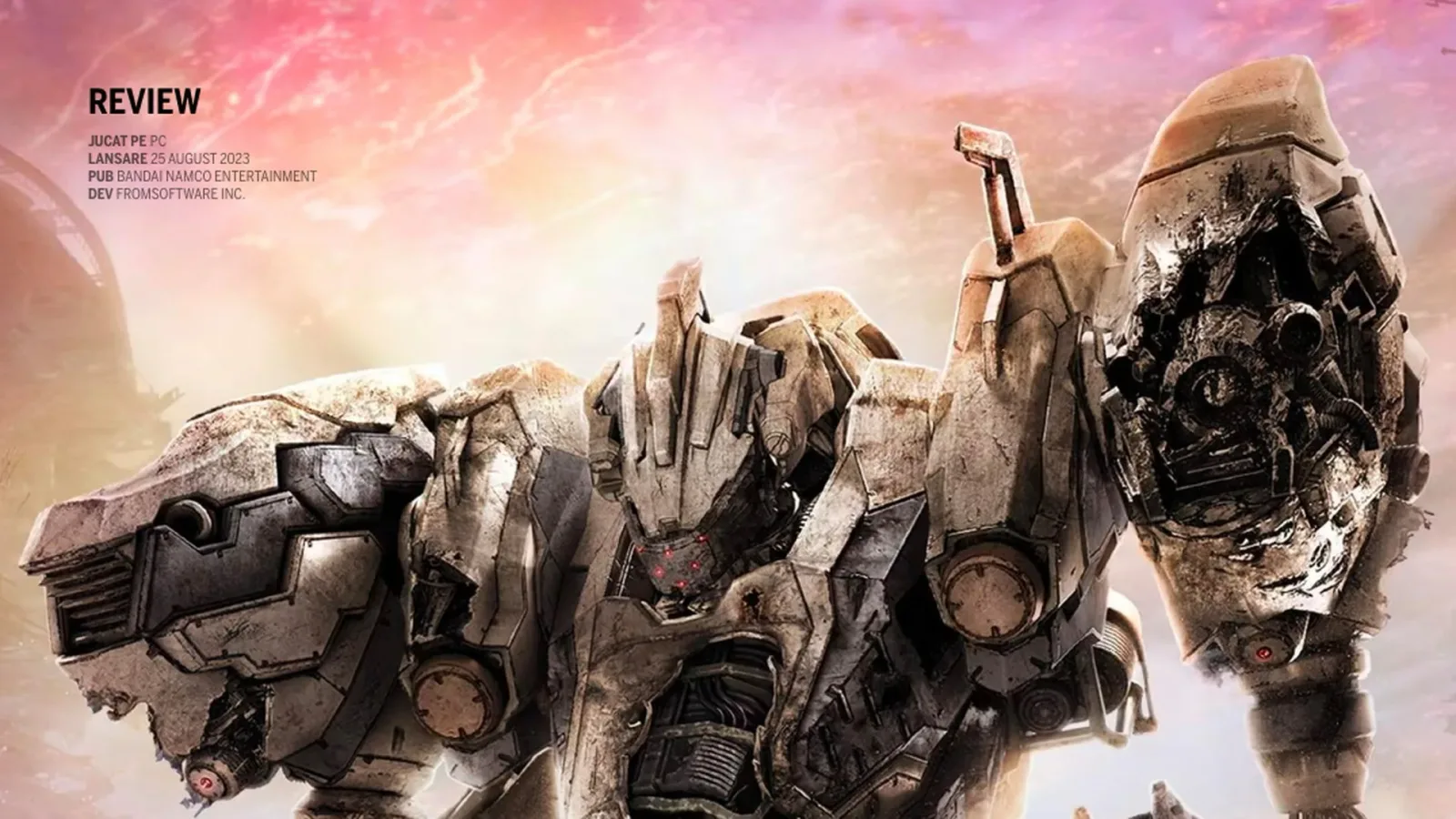
First published in GRIND III, pages 38–42.
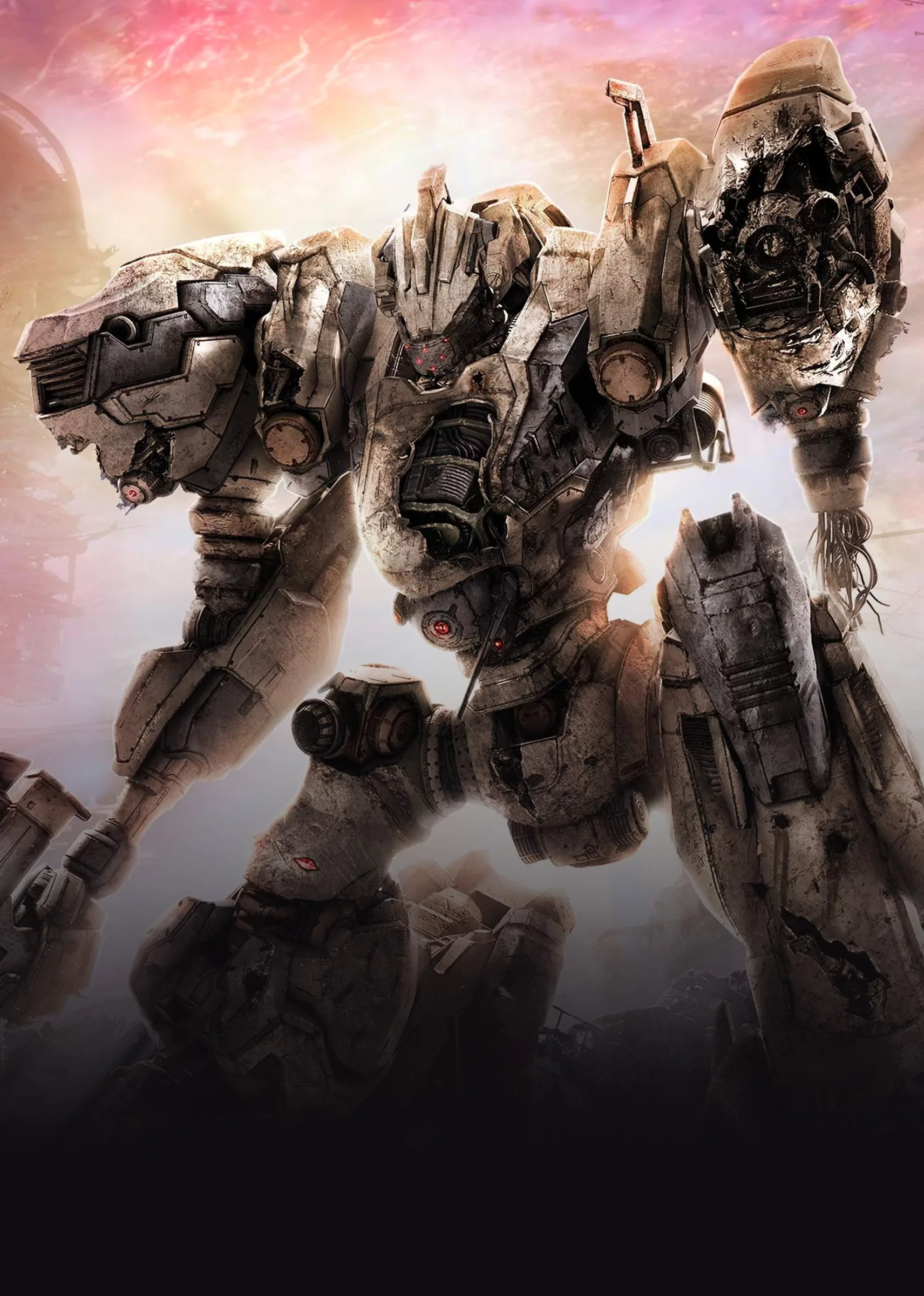
Childhood nostalgia and the discovery of a legend. I'm sure every one of us, back when time seemed to trickle by at its own lazy pace and everything felt grand, imagined ourselves as heroes of the universe.
The willow branch you snapped from the tree on the way to school turned into a formidable weapon (that's what happens when you play Castlevania from an early age), the dense forest you had to cross to reach the bright meadow seemed an undeniable enemy standing between you and happiness, and the kids you played with were trusty companions when the mission was to relieve the neighbour a few houses down of a few cherries from his tree.
Anything at all, however insignificant in the eyes of the grown-ups, could serve as a toy or for simulation exercises recreating whatever you'd seen in the films on TV.
As a child, one of the films I watched with my dad was RoboCop. Sure, by the standards of today (and not only today), it might be considered a violent film for a five- or six-year-old girl. Whenever I watched it, I was captivated by Alex Murphy's fortitude. One step away from being killed by a gang of criminals, his body is turned into a machine such as had never been seen before: a cyborg. More robot than man, with no memory of the life that was cut short, the policeman becomes a tool of the corporations, who wanted nothing more than to squeeze as much money as possible out of a city af- flicted by poverty. Even so, Murphy's spirit comes back into control and he realises that, although he has lost his life and his family, he is the only one capable of turning on these power-hungry giants. It's a tragic story, about malevolent rulers of organisational colossi who want to corrupt even the last glimmer of the human spirit's hope and will to fight.
Agent Murphy is living proof that the good in us can still rise out of the mire that threatens to overwhelm us.
In my day-to-day play, I imagined that if this man, cursed by fate, was able to stand up to such ferocious enemies, then no obstacle could seem too big for me. So I set about recreating exactly those moments that had struck me, with the help of empty cigarette packets I found at the adults' parties.
In time, this personal attraction to robots became more and more pronounced, once I came across a few Japanese animated series (anime). The concept was slightly different: not cyborgs, but pilots trained to handle giant robots. Mecha anime, as the genre is called, has a few points in common with RoboCop. A hero who manages to overcome every challenge and give hope back to the oppressed. That's because his ability to handle these immense machines becomes a superpower, one that can rival governments and even creatures from beyond Earth's space, who threaten the entire planet.
From RoboCop to Ravens' Nest
Today, the mecha genre, in anime as in other media, is no longer as popular as it was in the ’80s or ’90s. With exceptions such as Aldnoah.Zero (series, 2014), Promare (film, 2019), 86 (series, 2021) and the adaptation for the game NieR: Automata, NieR: Automata Ver1.1a (2023), not many have caught my attention recently. But I always had in mind a series of video games that people had almost forgotten about.
When you bring up FromSoftware, there's only one thing on everybody's lips: Dark Souls. After I finished Bloodborne, somewhere around 2018, curiosity pushed me to ask myself a banal question: what did the Tokyo team do before becoming one of the most respected and admired game developers on the planet? A quick search and I see that the first games they released were two series I'd never heard of.
In 1994 King's Field was released, a first-person RPG where you could explore every area of a huge dungeon, discovering keys and portals that helped you through the different levels. Enemies that crossed your path could be taken down with melee attacks and special spells. Opinions were split: the public appreciated it for its RPG elements, but the increased difficulty and unconventional structure left most players with a bitter taste. For anyone who never got on well with the pace of progression in Demon's Souls, King's Field shows you no mercy… quite the opposite. Your character moves sluggishly, while the monsters threatening you have fast moves and kill you almost instantly. Sound familiar? The next one on the list seemed to be the Japanese team's first big success, but unlike King's Field, the images gave me the impression of a game I would never have associated with FromSoftware.
Armored Core, a niche series almost nobody had heard of for close to a decade, since the last sequel launched in 2013, instantly grabbed my attention. Not only because I'd never seen anything like it before, although connoisseurs of the genre would probably point me towards Titanfall. But because of the sheer number of elements that let you customise your mech to suit your preferences, your needs and the mission you have to see through to the end.
Unfortunately, although there are 15 Armored Core games, none of them was accessible to me without buying a PlayStation 3, a PlayStation Portable or a PlayStation Vita, and many of them aren't availa- ble except as physical copies. That, or I could take the emulator route – where the quality of the gameplay suffered to such an extent that I couldn't have fully enjoyed the experience. Disappointed, I decided to settle for just reading about this obscure title, because I wanted to know what lay beyond the robot fights and explosions.
The action takes place in a grim world, where corporations are in a constant war with each other, and the humanity of that time is forced to retreat underground. After the Great Destruction, the survivors try to take refuge on the planet that was once prosperous. Throughout this time, the companies Chrome and Murakumo Millennium fought over control of the territory and resources, almost ruined after a nuclear military conflict.
Between these colossi never sated with power sits the military coalition Ravens' Nest. A neutral force, whose role is to carry out difficult or politically and strategically risky tasks for anyone willing to pay the highest price – from governments all the way to terrorist organisations. The abilities of a Raven mercenary are legendary, given that the mere presence of a single member on the battlefield guaranteed success.
The game takes its name from the mech with which Raven pilots are able to defeat their opponents. A veritable suit of armour around a cockpit, in which these soldiers spend much of the unstable existence they lead. Life and death are unknown concepts to them; their sole purpose is to see through as many orders as possible, as efficiently and as quickly as they can.
Who will win world domination in the end? The answer depends largely on whose side you decide to join.
Feed the fire. Let the last cinders burn.
The end-of-2022 debates over which title would win Game of the Year were intense. God of War Ragnarök and Elden Ring, two heavyweight releases, were on the favourites list and picked up every nomination for the big prize. Alongside them there were other successful titles that delivered quality experiences over the course of the year. But an announcement I never thought I'd get to witness left me gobsmacked.
Armored Core returns after a long hiatus, with fresh forces.
I'm convinced that many of those who re- ad these lines don't know exactly what to expect after the trailer shown at The Game Awards. And the veterans, for all their boundless enthusiasm and joy, had all sorts of questions. What will the gameplay be like?
Is it meant to be a sequel or a reboot?
What does Armored Core VI do differently from the ones before it? And more importantly, will this game be influenced by Dark Souls?
I tried not to look at Fires of Rubicon as a continuation of past titles, but rather as a completely new video game, standing on its own. I admit, the way the action unfolds and plays looks very intimidating, per- haps even more unfriendly than the Soulsborne series. But hey, when you've been through the hell of Izalith, the horrors of Nightmare of Mensis or the catacombs of Caelid, what could be worse?
It all begins on the planet Rubicon 3, where a new substance, Coral, fiery red, has been discovered. This source of pure energy is capable of carrying humanity's technological progress forward, in terms of communication. Yet what promised to bring prosperity and development turned out to be a catastrophe. Rubicon 3, together with the stars around it, is sunk in flames and destructive storms. After centuries, this disaster left the celestial body in a contaminated state, buried in ash.
Despite all that, Coral remains a tempting draw for extraterrestrial corporations, who can hardly wait to get their hands on a new power source. Which gives the inhabitants of Rubicon 3 a reason to organise and push back against these threats.
All you hear in the background is the voice of a certain Handler “Walter”. This commander, beside whom you are nothing more than a dog meant to carry out orders, activates neural control using the very substance you risk your life for. Your body is augmented so that it can handle an Armored Core as efficiently as possible. Instead of a name, you get an identification code: C4-621.
At first glance, Fires of Rubicon doesn't seem to stray far from its predecessors. The perspective is third-person; you're given a mech to pilot and customise. As you go, you'll feel the need for stronger parts, tailored to the terrain you expect or the fight ahead of you.
Progress is fairly linear and simple. You take missions, finish them, collect your money and sink it into the best robotic parts going. Your objectives vary, from killing other pilots and bringing down enormous machines to, occasionally, teaming up with others.
The world is vast, but you've no time to explore it. After all, that's not why you're here; you're just here to see the most profitable contracts through for your boss, whichever organisation you decide to serve.
Your mech gets around either on its robotic lower limbs or via a boost system that lets you weave between enemies on the ground and in the air.
Flying eats into a stamina-like bar, so it has to be calculated strategically. Overdo it and you may find yourself in the risky position of being unable to reach a safe zone.
Quick boost is similar to the dodge roll in Dark Souls, except you've no guarantee of invincibility when you try to dodge an attack. Assault boost is the more aggressive variant, where you effectively plun- ge forward at maximum speed.
The game hands you a whole arsenal of weapons to equip.
Two can be used with your mechanised hands, the other two sit on your shoulders. The melee weapon is always on the left, the automated one on the right. The shoulder-mounted ones are missiles, which can be fired in concert with the weapon in your hand — something the game encourages, so you can take out a target as promptly as possible. What I find interesting is the ability to lock on to several points, with the missiles then hitting every chosen target at once.
Apart from the stamina bar in the middle of the bottom edge, there's also the AP (Armor Points) bar, Repair and Scan. AP is the classic health bar, Repair is the kit that helps you top your AP bar back up, and Scan gives you the option of scanning an area to plan your attack strategy around the number of obstacles you have to destroy.
For those who are fans of Sekiro:
Shadows Die Twice, I have good news for you. Armored Core 6, under the direction of Masaru Yamamura, game designer on Bloodborne and Sekiro, introduces a new mechanic, stagger, similar to the posture bar. Which means you're encouraged to fight offensively.
When that stagger hits its maximum, your opponent is immobilised and can't move for a few seconds.
A window in which every hit carries a boosted damage multiplier and you can deal serious damage. If you don't make the most of that window, the stagger resets and you start again from scratch. The same goes for your mech. When you take continuous da mage, your own stagger bar fills up and you're immobilised.
The real adventure begins in the garage, where things get complicated. Every rifle, rocket type, grenade or laser sword can be judged on two important values. Attack Power, which speaks for itself, and Impact Power, tied closely to how much stagger you can build. From there follows an endless run of experiments to strike the best possible balance between the two metrics.
ARMORED CORE INFO
An Armored Core has 11 components in total, which you can combine however you please. Four of them are the weapons, then the head, the core, the arms, the legs, the energy generator, the booster and the Fire Control System. The limbs, head and core determine the robotic body's resistance, the generator is your power source, the booster improves the speed at which you move. Finally, the Fire Control System boosts your accuracy depending on the distance you launch your projectiles from.
If that whole list of figures you have to keep track of already sounds overwhelming when you want to try Fires of Rubicon, there's a simpler option. All you need to remember is not to exceed the maximum value for weight (Current Load) and energy (Current EN Load). Weight is influenced by the leg model you prefer, as well as by how you move.
There are four types of legs: biped, reverse-joint (for extra agility), tetrapod and tank treads. For energy, the generator model can range from a higher power output with a slower energy recovery rate, and vice versa.
All of it can be acquired for serious money and hard graft, literally.
The most dangerous missions are also the most lucrative, and in the end you'll be able to buy the components that will guarantee your success. Here, Armored Core 6 lends you a small hand, by letting you see other players' builds online and try them out, without the slog of building an entire mech from scratch.
I’ll give you a reason to exist.
Let’s get to work.
Armored Core VI doesn't feel like a soulslike. And that makes me happy, because it shows me the developers want to offer a completely new experience compared with the genre that made their name until now, especially for gamers who have never heard of this series. And yet that very thing can be a double-edged sword. Hardcore Dark Souls fans may well see Armored Core as a dry game, without much freedom to explore.
For me, Fires of Rubicon will stir the nostalgia of a time when my imagination carried me off towards the horizon, facing down giant robots and plotting a revolution against the bad guys. With the necessary caveats, of course. Because we don't know what the real story behind the pile of ash covering Rubicon 3 has in store for us.
Mădălina Coman
0 votes
Scroll down here and stay on the page for at least 30 seconds to vote.
Pick a score from 0 to 10 (halves are allowed).