
Elden Ring: Shadow of the Erdtree
First published in GRIND III, pages 8–15.
The Fall of Divinity and the Struggle of the Tarnished
It's Tuesday, 28 February 2023. A day like any other, filled with everyday work tasks, morning tea and scrolling through Twitter. In the stream of posts, one catches my eye.
Rise, Tarnished, and let us walk a new path together.
At that moment, I forget everything around me, turn on the console and dive into Elden Ring. And not just because, after roughly 150 hours of gameplay, I still haven't got bored or felt the need to commit to another game. It's because I've been waiting for this moment ever since I read countless articles and listened to podcasts trying to explain the mythology and story of Elden Ring, in the hope of grasping every angle on the Tarnished's role in the power-hungry massacre waged by the demigods across this vast realm.
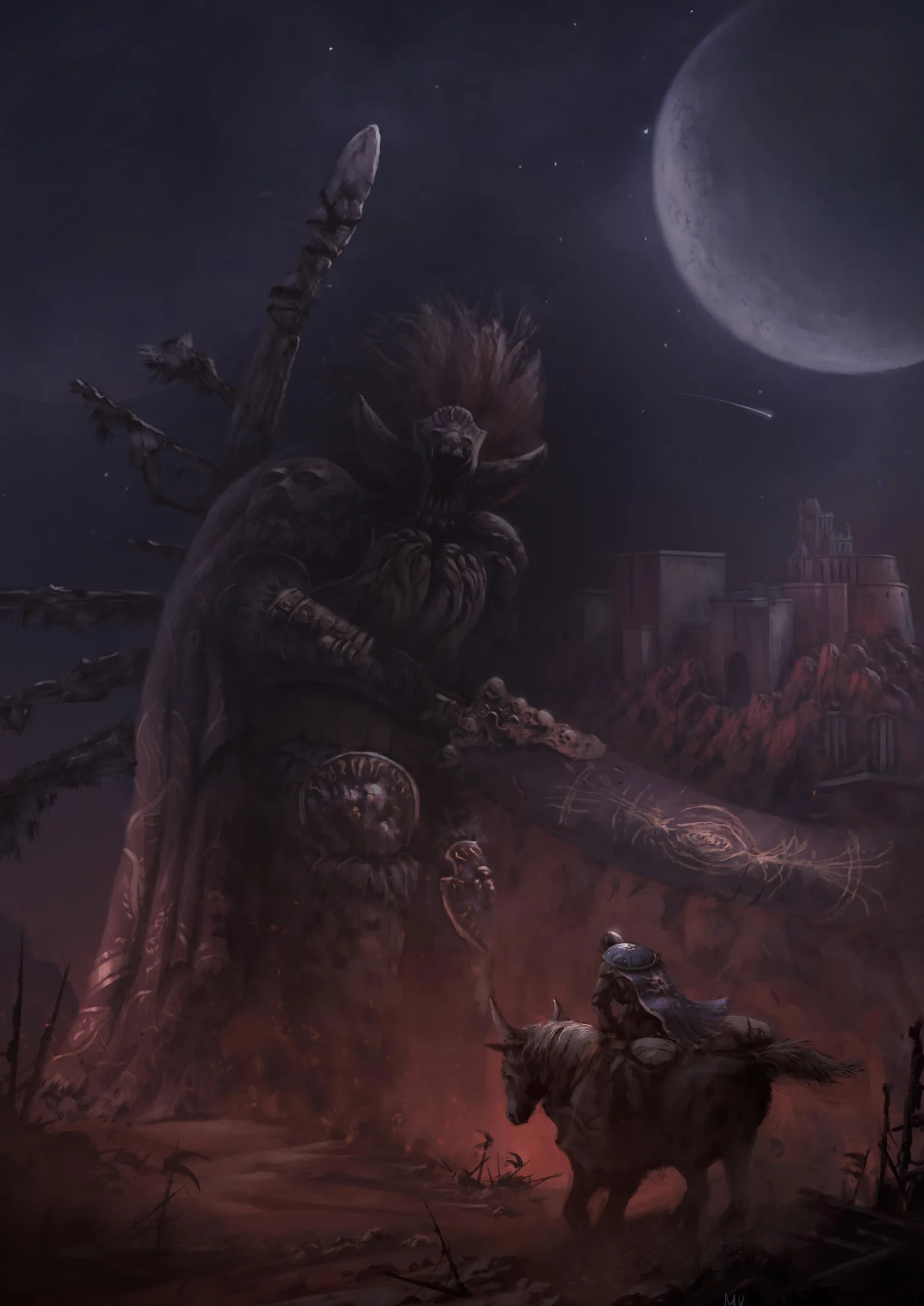
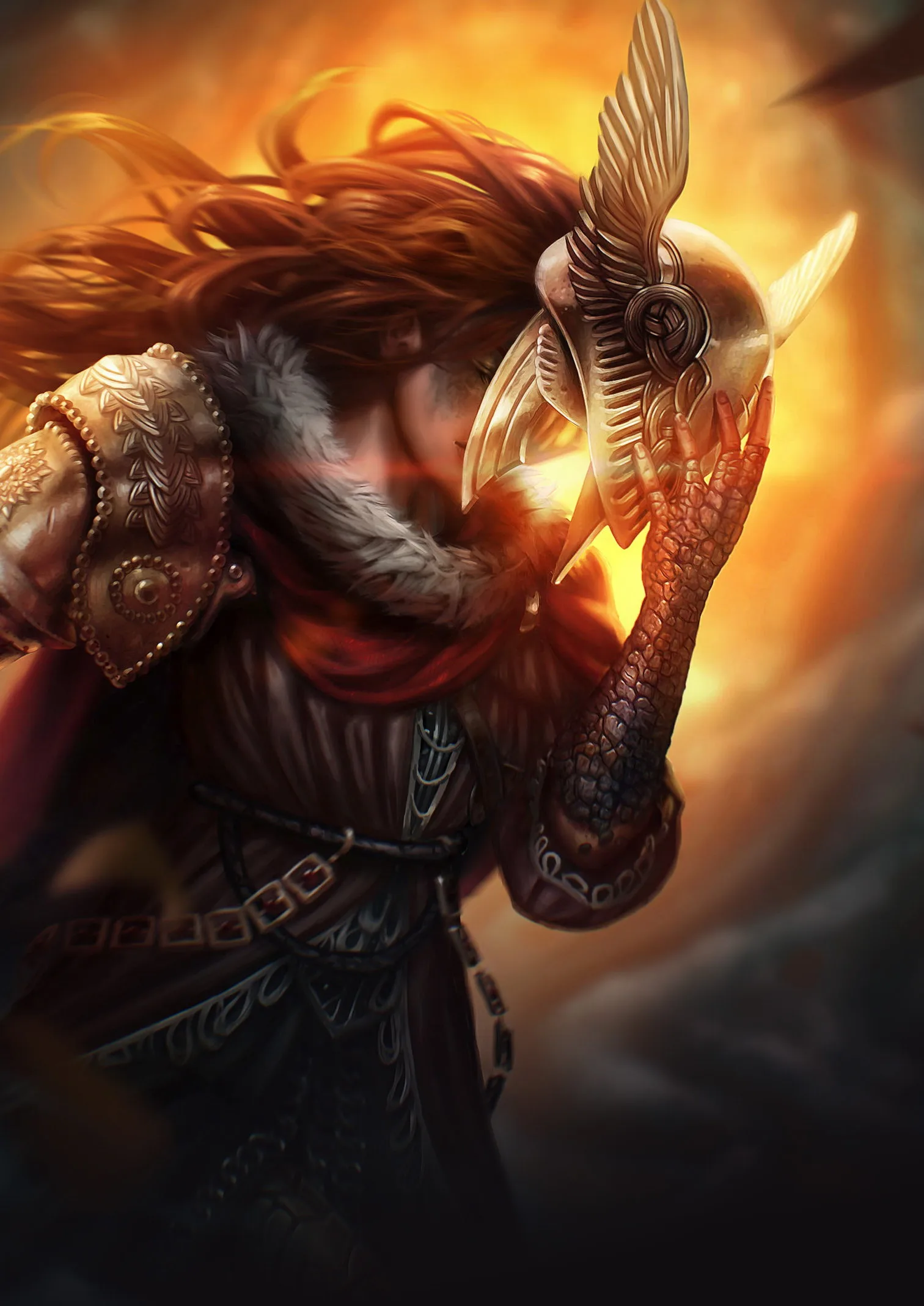
The announcement the community had waited so long for doesn't come alone, but accompanied by dedicated art with a cryptic message behind it. Who is riding Torrent in your place? Could it be Marika, the Eternal Queen who rules over the Lands Between? Or one of her children, an Empyrean born of the same god? At the same time, we see a Tree that is completely changed from the one in the opening cinematic. It looks as if it has been damaged from within, with gold gushing from its entrails like blood from a fresh corpse.
Shadow of the Erdtree is the name of the upcoming additional content, announced a year after release, by which time Elden Ring had won the award for best video game of 2022. It's the second FromSoftware title to win this distinction, the first being Sekiro: Shadows Die Twice (2019).
Legends and the Successor
Any fan knows that the stories created by Hidetaka Miyazaki and the development team in Tokyo are open-ended and open to interpretation. Depending on the ending (or endings) you manage to reach, and on the secrets and characters you uncover in each game's universe, you get the chance to unravel many facets of a complex tale. This is their strong suit, which the community calls SoulsBorne (combining Souls, from Demon's Souls and Dark Souls, with Borne, from Bloodborne). The narrative threads of each game intertwine harmoniously, which keeps these worlds relevant even after more than a decade.
Bloodborne was the first one I tried, even though its reputation as a tough game (where you have to pay attention not just to the battles, but also to your surroundings, to conversations with the characters you meet and to the description of every item you read) intimidated me. A few years after I managed to get all the achievements, I still gladly go back to it, my enjoyment undimmed after hundreds of hours. It's a story that perfectly blends the thirst for knowledge with the fear of the unknown, along with the consequences that the ambition for control can have on people's destinies.
Dark Souls was next on the list, though I have to admit: I still haven't combed through all the DLC and sequels well enough to call myself an expert. Beyond the tragedies that unfold, there is still hope in Lordran. Even if the First Flame, the element that brings duality to Dark Souls, will perish, whether you make the sacrifice of keeping it alive or let it fade, life will carry on with its cycle. It all comes down to how daring you are and how willing you are to get things wrong. After all, what would courage be without a dose of recklessness?
After these two heavyweights, Elden Ring struck me, without a doubt, as a spiritual successor to Dark Souls. The difference is that the setting is far vaster and you're free to explore as you please, without being forced to defeat the main enemy of the domain you're in.
Fallen Leaves Tell Their Story
In a time long past, a star travels through the cosmos into the unknown. It crosses the starry sky of the Lands Between and descends upon these lands in the form of a meteorite. The celestial body does not arrive here by chance, but is sent by an entity from space called the Greater Will. This divinity exercises its authority by choosing a being from outside the realm as a representative of order.
Marika, Empyrean Numen, is the champion chosen by the Greater Will, and becomes the Eternal Queen. Thus the Golden Order is born, a set of beliefs that governs all beings living on this land.
Two concepts form the foundation of the Golden Order: the Law of Regression, which concerns the cycle of life, and the Law of Causality. The latter is nothing more than the idea of cause and effect, and the relationships that stem from the actions taken. Together, these two laws make up what the world knows as the Elden Ring, a collection of runes that define reality as the inhabitants of this universe know it. And so begins the Age of the Erdtree, with Marika as supreme ruler.
Night of the Black Knives
After a long period of peace, in the shadow of this Tree of Life that blesses the existence of every living creature in the Lands Between, we learn that the Elden Ring has been shattered. Reality, as it was known until the moment the rune was destroyed, becomes corrupted. Even more confusing, we see Marika destroying it with the force of a hammer. Her image is replaced by that of an unknown man who, wielding the same tool, tries to mend what was broken.
After all this, Marika is nowhere to be found, and one of her offspring, Godwyn the Golden, has been killed by a band of assassins known as the Black Knives. What remains of the Elden Ring is divided among the demigod children of the Eternal Queen. We are introduced to several of them, and a few others besides. Ranni, the spectral witch. Morgott, one of the cursed progeny, who stands guard at the foot of the Erdtree and tries to defend what is left of the Golden Order. Mohg, Morgott's twin, who keeps company with Miquella, fated to an eternal childhood. Rykard, who lets himself be consumed by an ancestral serpent in a forbidden ritual. Malenia, Miquella's twin, tormented by the continuous decay of her body since birth. And General Radahn, a legendary warrior and master of gravity magic.
All these demigods are locked in a continuous battle that brings nothing but mass destruction. The Greater Will decides to abandon the demigods and leaves all hope in the hands of the Tarnished. These souls, condemned to return to life after they die, were exiled by Marika and denied the grace of the Erdtree. Even so, some of them have managed to win the divinity's recognition.
These Tarnished join forces and gather the demigods' runes, hoping to bring a new Lord before the Greater Will. Among them are Hoarah Loux, Chieftain of the Badlands and leader of the exiled Tarnished. The brilliant Golden Mask, who studied the foundations of the Golden Order. Fia, Deathbed Companion, who stays beside the remains of Godwyn the Golden. The Dung Eater, a prisoner who wants nothing more than to kill, and to make a mockery of, in body and spirit, anyone who crosses his path. Sir Gideon Ofnir, the All-Knowing, who wants to amass as much knowledge as possible in order to become Lord. And, finally, you, the player. A Tarnished with no name or origin, shouldering the immense responsibility of redeeming this world fallen into disgrace and chaos.
Naturally, you're left with plenty of questions after this introduction, packed with information and events. What was the purpose of Godwyn's murder? Who are the Black Knives, and who are they loyal to? Who is that mysterious male figure trying to repair what Marika destroyed? Why did the Queen destroy the Elden Ring?
Greetings from beyond the fog
Before this introduction, full of hidden meanings, you are given the power to choose the class you think best suits your own playstyle. There are 10 different classes, each with its own strengths and weaknesses. Still, you're not barred from picking weapons or abilities that belong to another class later on. The system is designed more to give you the best possible start in the territories of the Lands Between.
The classes I chose were Samurai and Astrologer. The Samurai has stats geared towards fast melee attacks, built on Dexterity, along with enough Strength, Vigor and Endurance to take a few hits without your soul leaving your body. Unfortunately, I found it quite hard to make progress with this class, so I decided to try another one, which most of the SoulsBorne community recommended for those who aren't quite so brave-spirited.
The Astrologer was the second class I tried, and the one I ultimately stuck with. The focus here is on magic, and the main stat is Intelligence. Offensive or defensive spells can be used, provided you carry a magic staff.
Once you've created your character in your own image, you're ready to venture forth. You wake in a dark, cold room that leads towards the Chapel of Anticipation. To the left of the landscape, its trunk rising towards the sky, stands the Erdtree mentioned in legends. You're not sure what exactly you're supposed to do, but you go down the stairs and head for the path that opens up before you. There's a heaviness in the air, accentuated by the dance of the golden leaves.
In the courtyard of the building, an imposing statue of Queen Marika, who seems to have been crucified, towers over everything and commands admiration. At that moment, a creature like a huge spider bursts into the air and hurls itself at you with dizzying speed.
Death is imminent but, as in any self-respecting FromSoftware game, you're meant to lose the fight against the first enemy. You come to in a cave, still dazed from the impact of the fall. All you can hear is the faint whinny of a horse, along with a soft, feminine voice remarking that luck is on your side, since you're here at all.
Once your character has come to their senses, you get the chance to tangle with a handful of enemies and prove you're worthy of the luck that seems to be following you. Eventually, you reach the surface. In Limgrave, the first area of the Lands Between, you meet the first NPC, Varré. In an almost mocking tone, the masked man tells you that you've got off on the wrong foot. Without the power of runes, the guidance of a Maiden and an invitation to the Roundtable Hold, you are doomed.
And yet there is a path for you. The golden rays that unfurl before your eyes will serve as your way, known as the Guidance of Grace. Only in this way can you fulfil your purpose and see through the burden that every Tarnished is obliged to prove before the Greater Will.
After a short foray into Limgrave, and some hefty fights against a few soldiers, you are visited again by the voice from the cave. Melina, for that is her name, explains the role of a Maiden, which Varré mentioned earlier, and proposes a pact. She will play the Maiden for you, and the secret of runes will be open to you. All you have to do in return is help her reach the foot of the Erdtree.
To seal the agreement, Melina gives you a whistle. With this instrument you'll call on Torrent, the spectral steed, who has apparently chosen of his own free will to serve you.
Old World, New World
When someone mentions FromSoftware, your mind instantly jumps to Dark Souls. It's one of the most popular RPG series in the gaming community. Some look at these games with admiration and build an entire collection of myths from their various narrative threads (some claim there's a certain continuity between Demon’s Souls, Dark Souls and Bloodborne); others see them as a challenge on the road to becoming gamers worthy of the respect of those around them. And last but not least, there are those who complain about how hard it is to beat the enemies that cross your path, which brings nothing but frustration and disappointment.
What has become fascinating, though, is how these games, which trace their origins back to King’s Field in 1994 (the first project released by the Japanese developers), have grown into a sub-genre in their own right, dubbed soulslike. The main hallmarks of these soulslike titles are a high level of difficulty, mechanics that force you to spot an enemy's pattern and exploit its weaknesses, and checkpoints that fully refill your health and stamina bars. On top of that, defeated monsters are reset (apart from unique ones, which don't respawn), and your currency is lost the moment your character dies, though you can recover it at the spot where you were killed. And perhaps the most important element (other than “you cannot open the door from this side”): the main story isn't laid out in full. Instead, you have to keep reading the descriptions of the items you find, solve puzzles and complete questlines specific to each NPC. The more weapons and objects you come across, and the more characters you interact with in different areas, the more likely you are to see multiple facets of the world you're in.
At first glance, Elden Ring happily ticks all the boxes above. Even so, from the first few hours you can feel that the introduction is clearer than in Dark Souls. You get a better grasp of the world of the Lands Between. The famous bonfires of Dark Souls, where you can rest for a while and upgrade your character, are called “sites of grace” in Elden Ring. But one feature that makes finding your way easier is a ray of light that guides you to the nearest undiscovered “site of grace”.
Speaking of this immense territory, which may seem overwhelming at first, the Lands Between comprises six main regions: Limgrave, Weeping Peninsula, Caelid, Liurnia of the Lakes, Altus Plateau and Mountaintops of the Giants. There are also several sub-regions, as well as the eternal underground cities of Nokron and Nokstella, guarded by the starry sky.
One novelty Elden Ring brings compared with Soulsborne is access to a map. Of course, the full map won't be available from the start, but once you pluck up your courage and let yourself be curious, you'll collect map fragments from each area.
What's more, if you come across ruins, catacombs or obstacles you don't want to deal with straight away, the game gives you markers. With their help, you can organise your map so that you can come back later without any trouble. If your sense of direction isn't your strong suit and you want to know exactly where you need to go, you can use a beam of light, which you can place wherever you need it.
The multitude of swords, axes, hammers, spears, halberds, whips, bows, crossbows and sceptres, along with the techniques and moves specific to each weapon type, offers variety even to the most demanding gamer. You can wield a spear while parrying attacks with a shield, then back it up with spells, each more powerful or inventive than the last. Ambush Shard is a very good example: an incantation that launches a projectile which hits enemies from behind. Let's not forget Torrent, the companion entrusted to you by Melina, who proves very useful when you're fighting a dragon flying after you to put a lid on your plans, or an angry troll who, in times long past, faced the Giants.
Ashes of War round out the combat experience by giving any weapon extra abilities and affinities, and they're essential for adapting to the increasingly tough challenges of the Lands Between. For that, you need to farm certain whetstones, depending on which Ashes of War you want to use, with the caveat that a weapon can't have more than one ability, and any previously used one is removed when you equip a different kind of technique.
What I appreciated most about Elden Ring was the presence of spirits. It's very similar to the NPC summoning mechanic from earlier games. The difference lies in a varied palette of characters and fighting techniques, as well as the possibility of upgrading these spirits. It's a perfect way to distract your opponent, especially if you take a more defensive approach and opt for ranged attacks. Aesthetically speaking, it's a pleasure to watch a pack of wolves or a headless warrior, a female Ghost Rider (my favourite!), protect you at all costs in exchange for the mana you have to spare.
The feature I made the most of is the way you can regenerate your health and mana items. When you meet several soldiers or monsters, once you've killed the last one in the group, the number of health and mana flasks is restored to what it was before you used them. Plus there's an indicator that the area you've just cleared is safe, at least for the moment. And it doesn't stop there. Medallions that you can get from quests or from confrontations with one of the demigods improve how you heal or how destructive your magic is.
For anyone who hasn't played a FromSoftware game before, Elden Ring is probably the friendliest entry in a run of niche titles aimed at those who go looking for a challenge. Although the soulslike sub-genre made the studio's name, the team hasn't stopped trying something new. The result lives up to expectations: an open world with a complex story and a distinct whiff of Game of Thrones.
And so, we inhabit a fractured world. Awaiting the arrival of the Elden Lord. Unless of course, thou shouldst take the crown?
Fear of the unknown is one of the most powerful fears there is. It paralyses us, forces us out of our comfort zone and makes us burn through precious resources. We may well never be the same again once we throw ourselves into the waves of uncertainty. And yet curiosity pushes us to ask, 'What if?'
The Lands Between is a brutal place for those who resist, but if you are bold enough and manage to learn from your own weaknesses, you will find hope and brilliance in what was once ruined. The magic Elden Ring conveys lies in exploiting curiosity in a place that seems beyond repair. Running into failure is nothing more than proof that we are not ready yet. But that doesn't mean we can't get better in the meantime, only that we need to be patient and gallop down the road unfolding before our eyes. For the game makes sure to reward you at the right moment, with memorable moments. And it doesn't end here.. MĂdĂlina Coman
0 votes
Scroll down here and stay on the page for at least 30 seconds to vote.
Pick a score from 0 to 10 (halves are allowed).