
Bandle Tale: A League of Legends Story – Review
A game that doesn't know what it wants to be...
Hello everyone. Constantin here with my first article for GRIND. Today we'll be talking about the latest game from Riot Forge – Bandle Tale: A League of Legends Story. Incidentally, it's also the first cozy game I've ever tested. Or at least that's what the developers described it as. I say this because the game aimed to be part of this genre, but the way it was conceived and implemented wasn't coherent.
I'm the kind of person who finishes games 100% when I set my mind to it. And we're not talking about casual games, but titles like Dark Souls, Sekiro, or Elden Ring. These are games that require a certain skill and perseverance, and many players abandon them after a few hours. Although I'm a fan of these games and have successfully faced their challenges, Bandle Tale: A League of Legends Story managed to defeat me in just over 3 hours. There are various reasons that made me put the game down, and I'll address each of them individually.

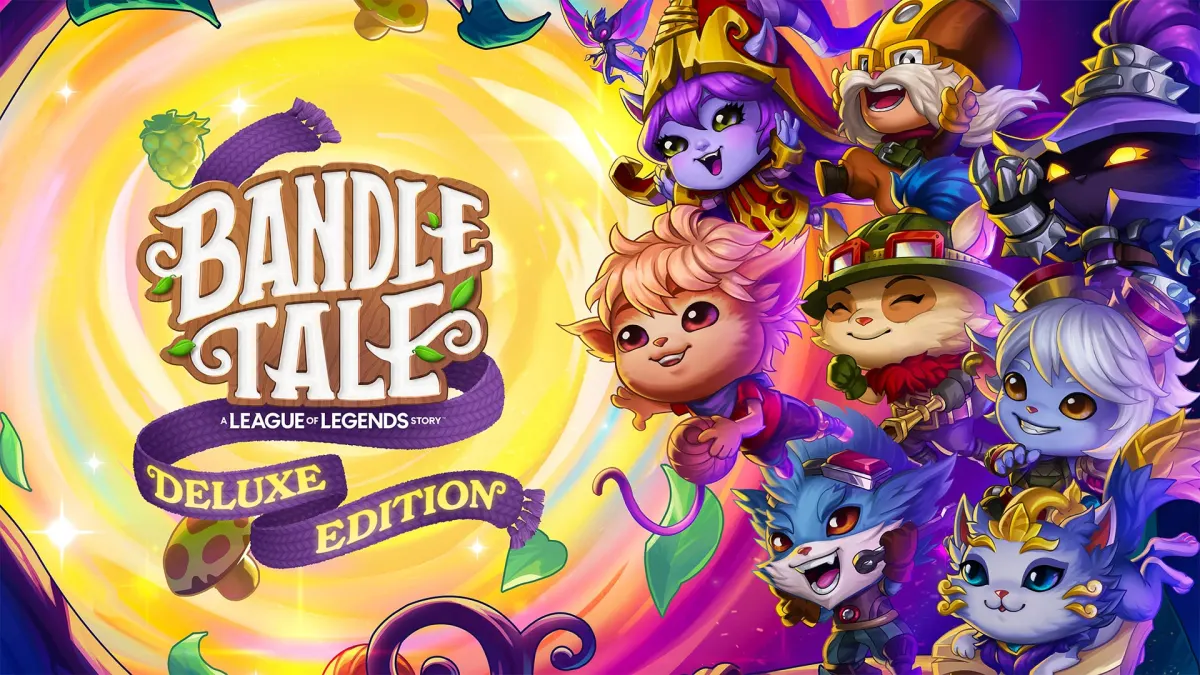
From the summary on the Riot Forge website, the game's story stars a new Yordle (the equivalent of a fairy in Runeterra), who must bring order to the fairy capital, Bandle City, after a party gets out of control and destroys the portals connecting the districts. Armed with knitting magic and a backpack house, the little Yordle will reunite the capital of tiny heroes! Throughout the story, the player will meet various champions native to Bandle City such as Tristana, Teemo, Veigar, Corki, Rumble, or even Yuumi. In the 3 hours I spent in the game, I managed to reach the aforementioned party and the immediate aftermath of the incident. Unfortunately, the combination of bugs and cumbersome systems didn't allow me to fully enjoy the game, and frustration led me to abandon it.


Too many menus
Lazy Bear Games repeated the mistakes from Graveyard Keeper in this interpretation of Riot's IP. The abundance of menus and micro-management elements not only overloads the game but detracts from the experience and breaks the story. It's an understatement to say there are many unnecessary menus in the game. Both from the time I spent with the game and from the marketing videos from the developer and publisher, it's clear that the “Drag & Drop” system is the foundation for all central game mechanics. Each object must be accessed from its menu and box and laboriously moved to its new location. This system makes the game feel more like an “inventory-management” simulator than what the game set out to be, namely a cozy RPG.
Even the RPG aspect of the game is defined by menus. Many in-game interactions require different abilities, but these can only be accessed through a special menu and cannot be bound to keys to facilitate accessibility. Combining this menu marathon with the cumbersome system created a state of confusion from the beginning, resulting in difficult navigation towards the game's defined objectives.
Even the way progression is saved is confusing. The game gives us the false impression that this important ability can only be done at game-defined points, when in reality we can save our progress at any time we wish. What can be done at these points is the distribution of ability points.
If the abundance of menus managed to interrupt the game, the icons managed to frustrate me. The menus were not implemented intuitively due to the lack of text on the icons. When I hovered over an icon, I wasn't greeted by any pop-up text indicating its function. And the size of the icons is contrary to accessibility.

Size matters
Given what an industry giant RIOT Games is, expectations for games using their intellectual property are high. All projects from RIOT Forge, their indie games division, have presented complex stories and other facets of beloved League of Legends characters. From this perspective, you'd think cinematic scenes would be a key moment in the game's story, but it seems the developers had a different opinion. They are small, centered in the middle of the screen, and surrounded by a sea of darkness. This approach by the developers is a detriment to the game, especially since the animations themselves look cute.
The game has a narrator who sets the tone of the story and guides us, and fans will recognise that the narrator of this story is none other than Tristana. Riot Forge managed to convey the character's joviality and sense of justice, but unfortunately, she was the only character I encountered who received the special treatment of having her voice heard. On the artistic direction side, the chosen colour palette and pixelated style don't live up to the standard we've come to expect from Riot Games' properties.
I found an element of originality in the naming of the points we invest in abilities. Being an excursion into Bandle City, I was pleasantly surprised to learn that the chosen name for skill points is “Imagination”. What surprised me less pleasantly is how quickly we gain points from just a few activities. If you're like me and don't want to waste points, you'll have to constantly walk to different checkpoints to invest them. The cherry on top is that the activities you perform to gain experience for skill points become redundant at an astonishing speed. To convince the player to try various activities, repeating the same activity will offer less and less experience. Thus, although abilities play an important role in story progression, unlocking them requires a major time investment.
While previous RIOT Forge games have covered a vast array of genres, Bandle Tale seems to have opted for one of the simplest: a walking simulator, sprinkled with convoluted sections. There's a lot of back and forth between characters for no particular reason. For example, a sequence of dialogues makes a key character mad at you. So, the game sends you to another character for help, but the latter tells you that no one can stay mad at you for too long and sends you back to the original character.

How much time do you have for crafting?
Crafting times are too long for certain items, even if they are imperative for story progression. This wouldn't be a problem if we had a variety of activities. However, missions and narrative are linear, resulting in dead time. This time must be filled with dialogues, in Lazy Bear Games' conception, but these are lacking in substance and hastily written. Each Yordle seems to have a shred of personality, but still too little to be noticed. And many of the lines seem to fill time more than significantly develop the story. And because of the dry dialogue, dead time can be used for activities outside the game while we wait for different machines to finish processing various items and components. What was supposed to be a cozy game has turned into a game of continuous waiting. And in combination with redundant missions, it seems to be a “fetch” quest simulator buried in a “menu manager”.
Most of the activities that can be carried out and the events that can be organised are repetitive, with minimal possibilities for adjustment. For example, at parties you can choose a few attractions, different songs, the guests who attend and… that's about it. At least we have a Poro friend to cheer us up when all these things get tiring.

Conclusion
All these aspects combined with a series of bugs encountered do not inspire confidence.
Because I felt that the game doesn't necessarily have a clear direction, but rather an existential crisis.
Does it want to be a cozy game with small adventure elements (which sometimes become too much)?
Does it want to be an adventure game that offers a few cozy moments of respite (and those are very few)?
Honestly, I can't tell you. According to my fellow reviewers who tried the game on Switch, the problems I encountered are non-existent on that platform. This makes me think of the common situation in the industry where PC players are lagging behind when it comes to quality and optimisation.
From the beginning, I felt that the game didn't know what kind of experience it wanted to deliver.
Although I waited with bated breath for more than 3 hours to see a change for the better.
My initial excitement to delve deeper into the Runeterra universe and discover interesting stories gradually turned into disappointment. The disappointment is even greater when we consider that this is probably the last game of the Riot Forge initiative.

Played on: PC – Steam
Release date: 21 February 2024
Developer: Lazy Bear Games
Publisher: RIOT Forge

0 votes
Scroll down here and stay on the page for at least 30 seconds to vote.
Pick a score from 0 to 10 (halves are allowed).