
Beyond Good & Evil 20th Anniversary Edition
First published in GRIND IV, pages 176–181.

”HOPE DIES LAST”
When I heard in 2023 that there was still a Beyond Good & Evil project in the works, I didn't know what to think. Like plenty of others, I was waiting impatiently for the sequel to Ubisoft's famous game, announced back in 2008. So I was pleasantly surprised to find that the project in question was a remaster of the original, with a whole host of surprises for fans. Given how many people never got to play this one in its day, modernising it so it opened up to a younger audience struck me as a good idea from the renowned French developer. As you've come to expect, we start with the story.
CODENAME: SHANI
The story in Beyond Good & Evil 20th Anniversary Edition is unchanged, since the game is a remaster of the 2003 title. The narrative drops us into the middle of a galactic intrigue, where the soldiers who came to defend the population don't have its best interests at heart, and the forces of evil and the intergalactic war rumbling away in the background feel like they were pulled straight out of George Orwell's head. The population is kept in the dark by the very people who 'defend' it, propaganda is the order of the day, and the ordinary citizen has no reason to question the daily reports or the messages from the front.
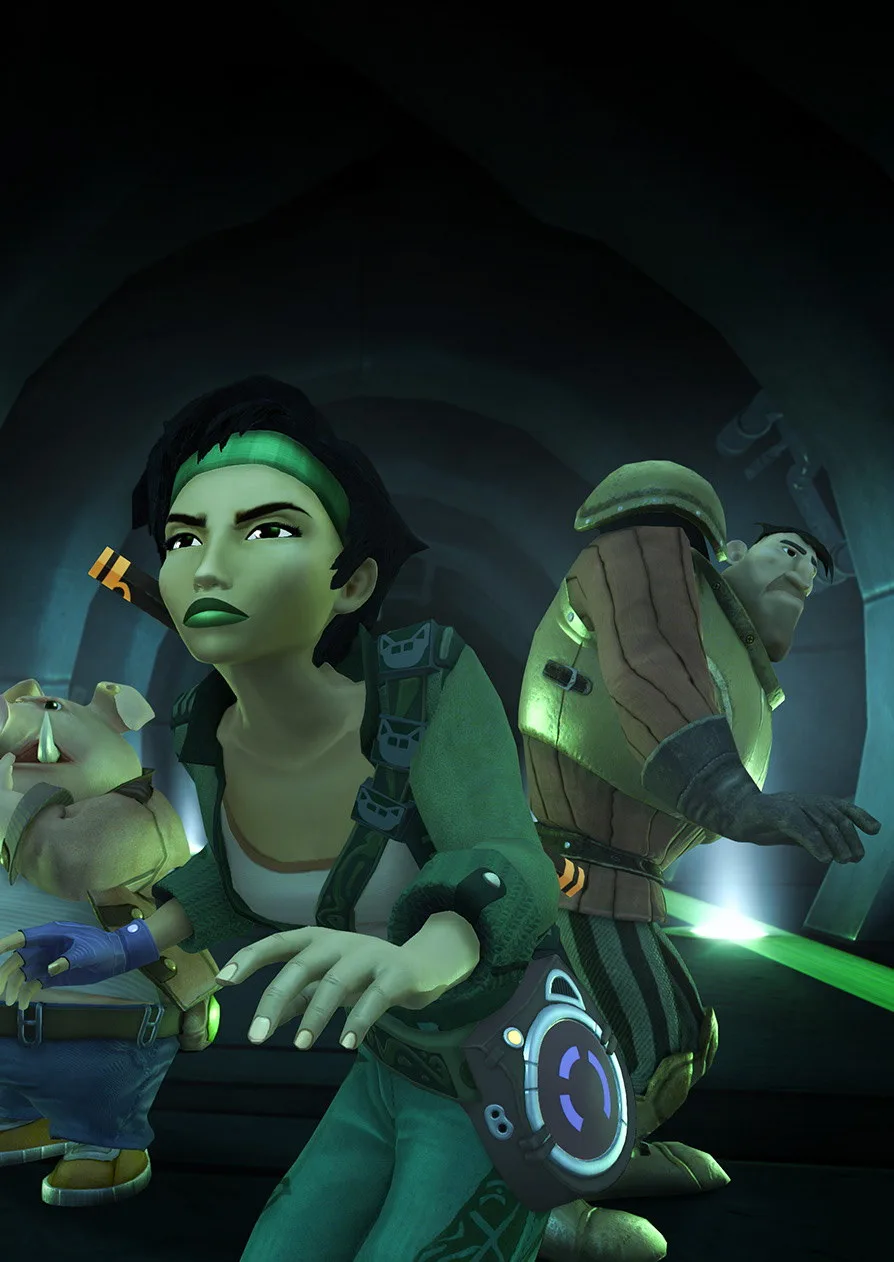
Our protagonist is a woman with a mysterious past who joins the IRIS resistance, a group of reporters from
CARLSON
AND PETERS
Despite the improvements the game has picked up, it has stayed exactly the same where gameplay is concerned. From that angle we can split it into 3 big sections: • Combat • Races • Exploration Combat in Beyond Good & Evil 20th Anniversary Edition is not a pretty sight. Jade may twirl about like a Cirque du Soleil acrobat and then some, but every scrap with an enemy is a touch clunky. That comes down to both the graphics and the way every fight in the game was designed, like a puzzle. The protagonist may have access to 2 weapons, namely the staff and the disc launcher, but each enemy has its own 'solution'. Robots have to be shoved into electric pillars, Alpha Sections soldiers the various galaxies trying to drag the true face of the Alpha Sections – the military organisation that has crowned itself 'guardians of the galaxy' – into the light. Over the course of the story Jade will uncover a conspiracy of enormous proportions, one that threatens the very life and existence of the planet.
The story feels as if it were lifted from sci-fi works like Dune, and the level of detail the writers brought to building this world is commendable.
Jade's past, only vaguely mentioned in the original version of the game, is explained a little more here, though still wrapped in mystery. The title manages to take on heavy themes few people would want discussed, and which remain as important today as they were in 2003, such as the price of peace, or the fact that it's more comfortable to live in ignorance than to accept what is happening around us.
The characters Jade meets aren't simple NPCs; they were conceived as real people, with a past and a will of their own. Every character in the game has something to say, and the game's events change both their lines and their attitude.
The game adds one new story element compared with the original, a side mission that partially uncovers Jade's past. That mission takes us to every corner of the world, and the reward at the end is worth it, because it keeps hope alive regarding the sequel announced almost 16 years ago.
have to be attacked from behind to wreck their purifier, and so on. The bosses are a puzzle on a bigger scale too, since each has a specific solution you have to work out, but once you've worked it out the fight becomes extraordinarily simple.
As for the races, they're a delight. They're designed to be easy to learn but hard to master. You'll very likely win the first race, but from the second one on you'll need a bit of practice. The tracks have all sorts of novel ways of helping pilots out, from lanes that bump up your speed to shortcuts and jumps that put you ahead of the other pilots. Each of the game's 4 classic races will keep you on your toes.
Beyond those, we also get access to a few 'races' in which we have to stay on the tail of pirates who are lifting our in-game money. These are among the most intense moments in the whole game, because the places we chase them through are full of traps and hazards, from laser walls to proximity mines. A single wrong manoeuvre will doom these optional missions to failure, because every section of these areas has a countdown we need to keep in mind. So getting through these levels as anything other than flat out is not an option.
The last aspect of the game, exploration, is the biggest of the 3 I mentioned at the start of the chapter. Jade is an investigative journalist and then some, braver than the lot at Rise Project, and the courage she shows when infiltrating the various Alpha Sections and DomZ bases is the kind you only find in war reporters who head into the heart of the conflict. We'll live through tense moments in the middle of the enemy's various secured zones, where they run experiments worthy of 60s conspiracies such as MK Ultra.
Moving through these areas we often have to sneak past Alpha Sections soldiers to reach the perfect spots from which we can photograph incriminating evidence. The exploration sections are relatively easy, but the ones where we're forced to sneak are mildly frustrating. I've yet to come across a mandatory stealth section in a game that I actually enjoyed. As with the rest, there are plenty of things you can do that will result in a sudden death for Jade, from having the nerve to walk 'normally' for half a metre to a bug that stops a soldier from turning round and spotting you.
The central element of the game, the one that turns up in all 3 aspects I described earlier, is photography. The main character is a pseudo-journalist and part of the IRIS resistance group, which wants to wake the planet Hillys from the 'slumber' brought on by the enemy's propaganda. So Jade uses her camera to show the true face of the forces occupying Sector 4 of the Galaxy. But alongside her work as a journalist in the name of justice, our protagonist also helps on the academic side, sending photos to the academy to document the animal species living on Hillys, from the only breed of dog found on the planet to the annoying mosquitoes from Rayman or the alien parasites that found the place with perfect conditions to evolve in the planet's dormant volcano.
Thus every photo Jade sends to the academy brings her a fairly sizeable profit, which helps her pick up the various upgrades she needs, from more health to more efficient armour for her ship.
PEY'J, WHAT HAVE YOU
DONE?
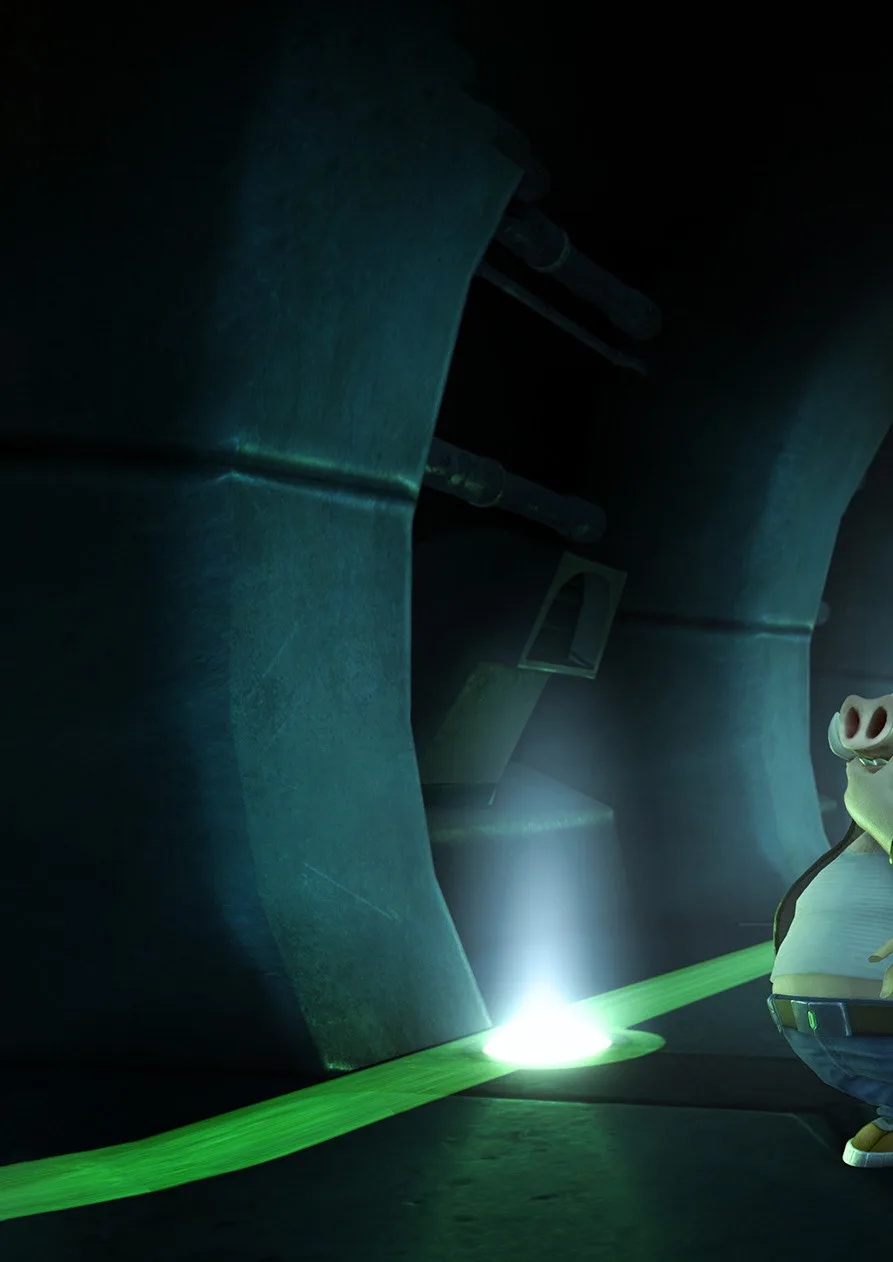
Graphically there are a few differences compared with the original game: the remaster can hold a steady 4k60fps on modern systems, and the image isn't stretched the way it has been in other remaster projects such as Chrono Cross, but adapted to the monitor or TV it's playing on.
On PS5 I had no problems with the game's framerate; it held at a level a constant 60 fps, but I've heard that on for the night-time one. Jade and the rest are much better animated, and the character models Switch have some problems in areas with far more detail, something that lets us see certain things that were more there are more details, such as in the caves subtle in the original game.
on the Black Isles. However many improvements the game has had, in the end it's a remaster of An absolutely new element from the point of the original one, and this is noticeable, because the game's look is clearly from 2003 view of the graphics is the presence of shadows and not a modern one such as what was shown in Ghost Recon Wildlands.
and an improved brightness about the game. On the sound side we have a few improvements. The music and sounds are far more of it. The characters have shadows, and these are clearer than in the original game, and some tracks have been modernised from a technical point of view are emphasised by the day-night cycle of the game, which is set to a few tens of the same intensity as in 2003, and the actors' lines are taken to the extreme in the sense that some minutes of daylight and only a few minutes among these, some seem to be a caricature of what is meant to be conveyed.
A NEW EDITION OF THE IRIS GAZETTE?
The game, though old, is now tied into Ubisoft's system. This modern necessity of being connected online in a single-player game is handled through Ubisoft Connect, which effectively tracks your in-game progress.
The developer's program lets you download your save to other platforms and access your in-game trophies/achievements on any platform. Through this system you can level up your Ubisoft account, which is absolutely necessary for other games, and also get hold of the program's currency, which lets you “buy” extra things in other games, such as costumes or additional levels. As far as Beyond Good and Evil is concerned, the only extra on offer is the fan kit, which contains a few wallpapers.
Although it's annoying to have yet another program running in the background, for well-known reasons, that's the reality of the system. You can play without being logged into your Ubisoft account, but the program will run in the background regardless.
On the accessibility front, this version gives us more options to choose from than the original did back in 2003. We can change the game's language, and the characters' language too. We also have the option to switch between the original game's control scheme and a modern version of it, though the latter swaps the position of a few buttons. If you're a fan of how buttons were mapped in the early 2000s, you'll get along just fine with these, but the rest of us mere mortals might have some trouble adapting, because we've been spoiled by the modern schemes offered by titles like Assassin’s Creed Valhalla or Immortals Fenyx Rising.
We can also switch the game's two axes from their normal scheme to the inverted one, and each is independent of the other. These can be customised for the camera, the main character, the boat and the ship, but what can't be customised is the sensitivity of the axes, this being tied to the two axes.
Another thing added to the game, and visible right from the main menu, is the bonus material option.
This consists of several photos, art and clips with developer commentary that reveal the secrets behind the original game and the lesser-known tidbits, such as the fact that during development the main character was named Sally, with Jade only being her codename. For fans who want to know more, this section of the game even includes storyboards from the concept phase, showing us a very different vision from what was released in 2003.
Speaking of the year the game came out: although this edition is called the 20th Anniversary Edition, it actually arrived 21 years after the game's original release. The developer has some other secrets tucked away in there too, such as levels that were never fully programmed, or how they tried to link this universe to a key franchise from the Parisian developer. Through these secrets we can see how ambitious the game was in its initial form, and we end up hoping for a universe in the true sense of the word for the sequel we've been waiting for since 2008.
And while we're on the subject of the sequel, the studio also added an extra side mission to the game linking it to the project we were shown in 2018, with that trailer that raised so many questions for us, the main one being: what happened that made Jade the game's antagonist?
In conclusion, I consider Beyond Good & Evil 20th Anniversary Edition to be a good remaster that lets new players experience this classic 2000s title. Although it tries to modernise certain elements of the original, it doesn't escape the 2003 conventions when it comes to camera position and the clunky character control scheme. But what has been added reveals several secrets behind the game and its development that nobody knew until now, and this remaster leaves us hoping that we'll see Beyond Good & Evil 2 in the near future.
But until then, I invite you to get through the game as fast as you can in Speed-run mode, and my thanks to the folks at Ubisoft for the opportunity to review this classic title.