
I Love the Smell of Democracy!
First published in GRIND IV, pages 74–79.
One of the strangest films I've ever seen was Team America: World Police, a puppet comedy that doubles as a satire of, and a political commentary on, the foreign policy of the United States of America. The film is packed with references to the various situations and characters of the 2000s, from Kim Jong Il to Fidel Castro, plus famous actors like Alec Baldwin or even George Clooney. What stands out is patriotism taken to its extreme, and the main characters' ability to justify absolutely anything on the grounds that they were following orders. The characters bring 'democracy' to less civilised countries, and the actions they take will create a 'better' situation for the nations of the global south. At the end of the day, the country wants what's best for itself, and your superiors know best about the orders they've given you — orders that look a lot like war crimes.
Trey Parker's film was a phenomenon in 2004 that split the critics. Many were offended by the way the United States of America came across, and 9/11 was still a lived reality for most Americans. Others picked up on the film's nuances and the message it was trying to get across: that military intervention and extreme patriotism can lead to disastrous outcomes. The last time in history these themes had been aired was in 1945, during the Nuremberg trials, and the Nazi soldiers' explanation was exactly this — they were carrying out the orders they'd been given by their superiors. The reasoning the Germans used during the Second World War was tested in 1961 in a famous experiment by the psychologist Stanley Milgram. The results showed that, seen through the lens of obedience, or of the reasoning that 'what I'm doing is just an order', anyone is capable of committing crimes or atrocities.
You may be wondering, dear readers, why I've opened a review of a funny, entertaining game with such a grim introduction. Well, in the lines that follow I'll explain why it matters that we know these rather more serious details.
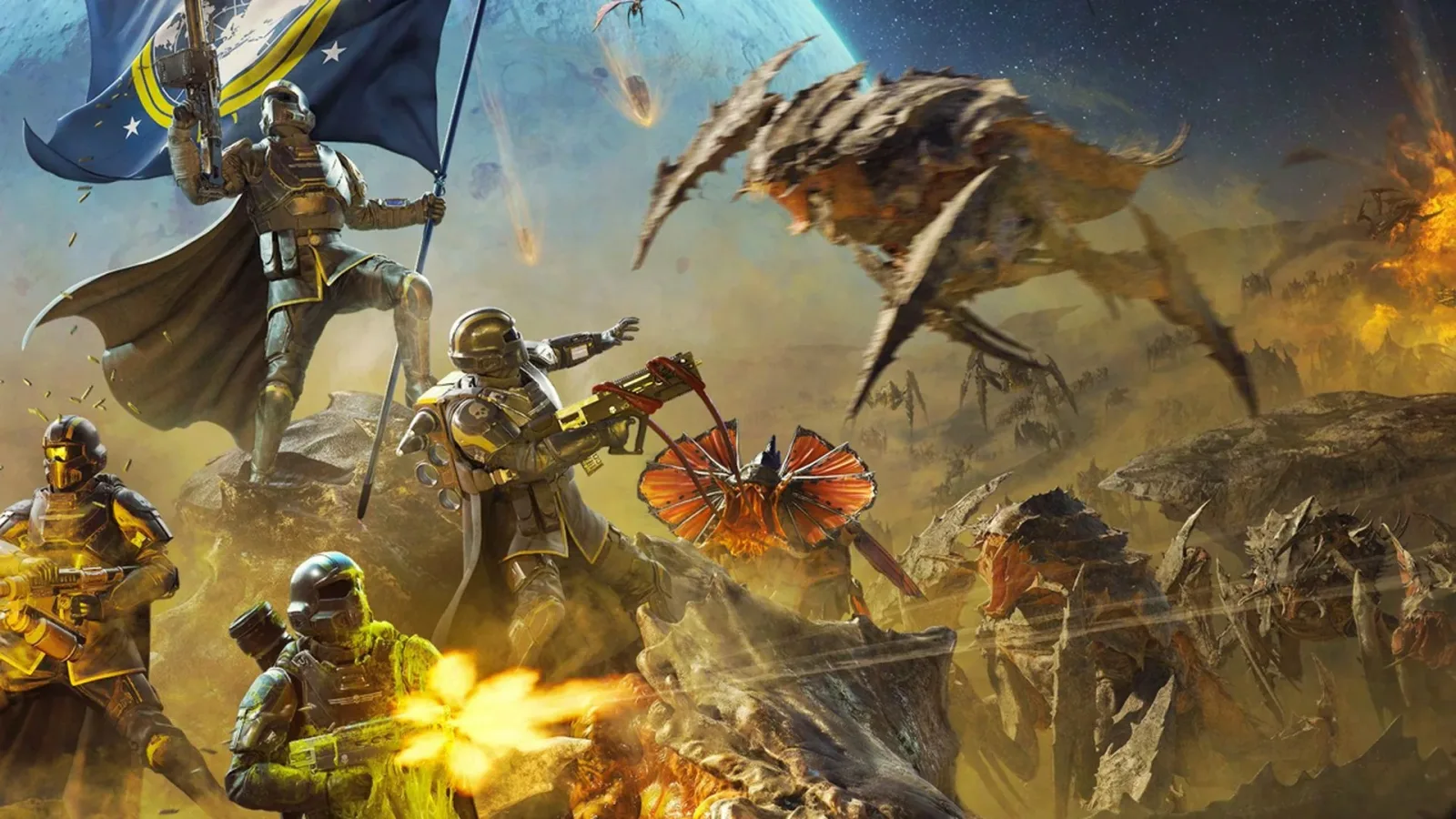
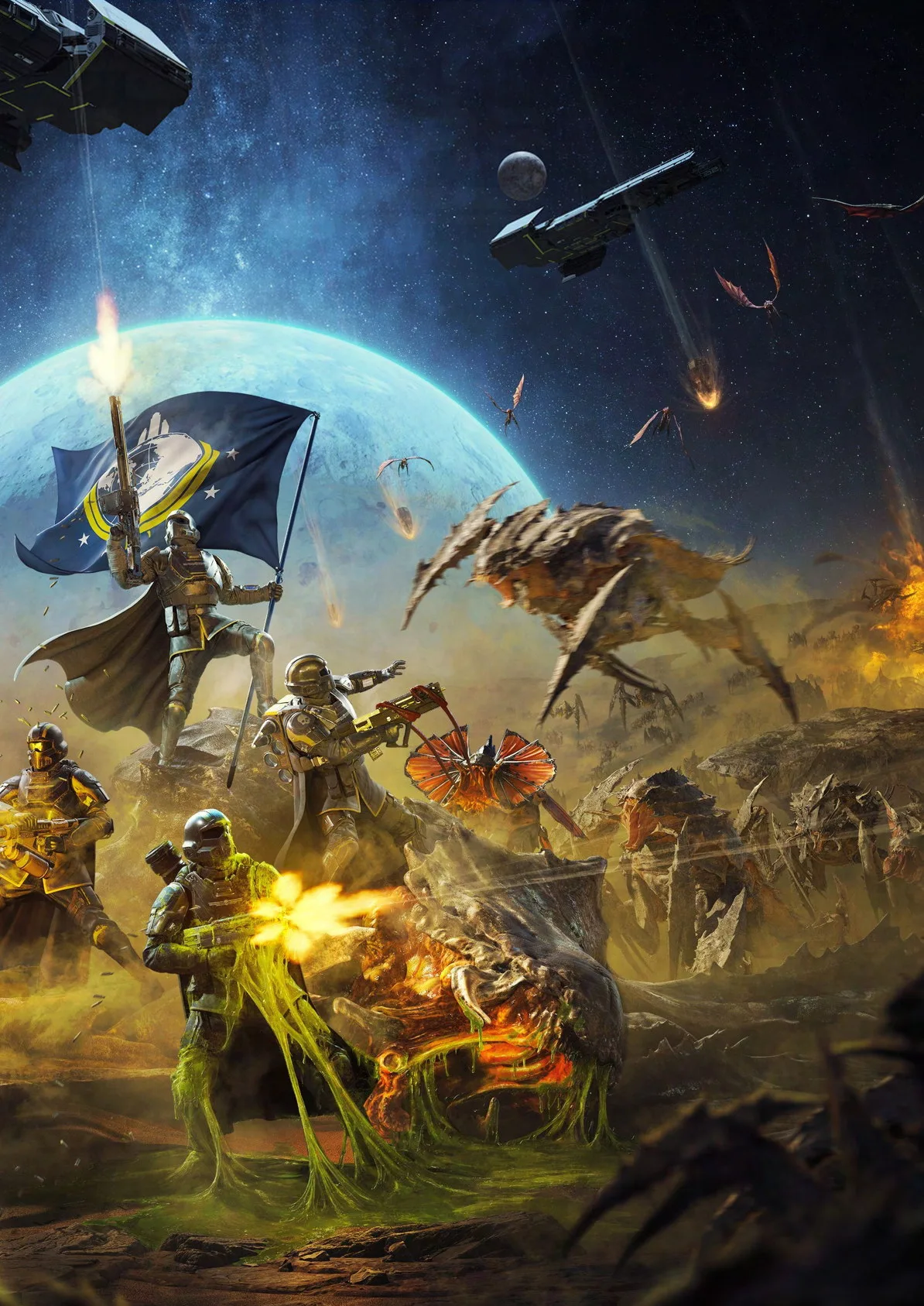
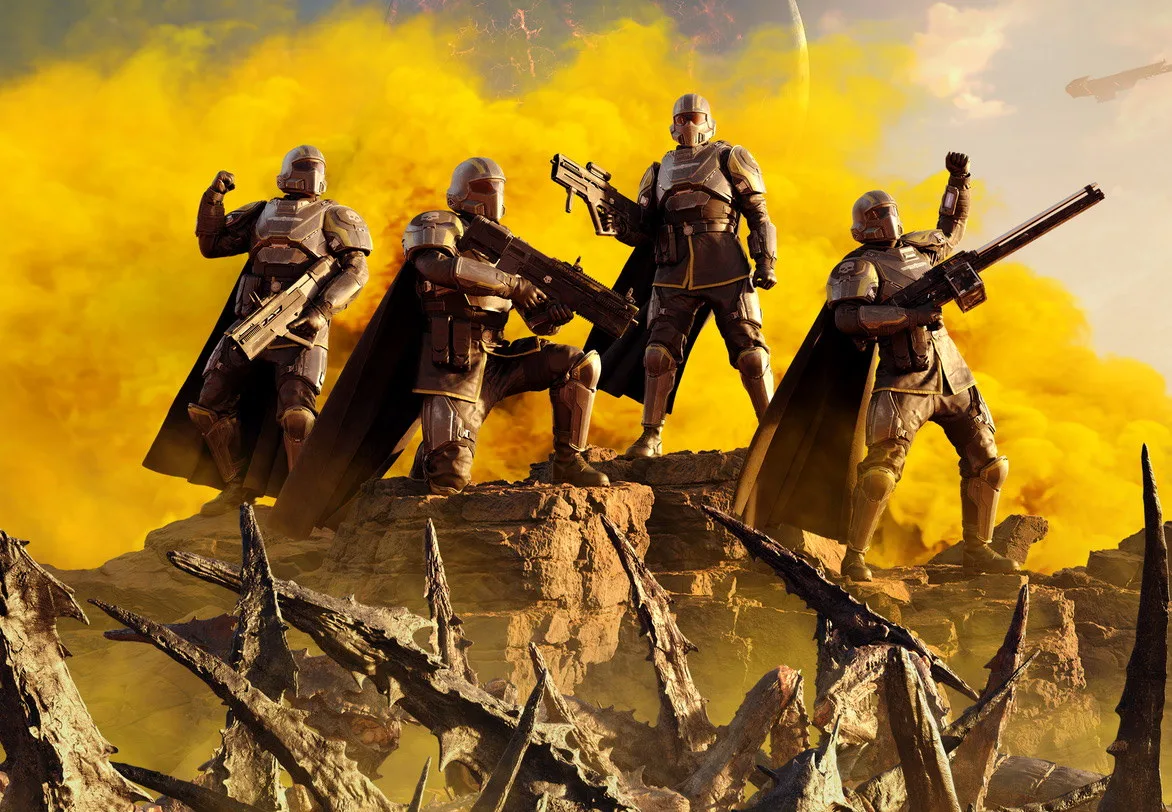
Helldivers is a series of games launched by Arrowhead Game Studios in 2015, with Sony Interactive Entertainment as its main publisher. The first title came out on PlayStation 3, PlayStation 4, PlayStation Vita and Windows. It was the famous video game company's first release to also show up on a platform other than the interactive entertainment giant's own. The first game was a top-down multiplayer shooter in which teams of four players head off to liberate various planets from occupation by the 'natives'. In the Helldivers story, we take on the role of a soldier sent by the Super Earth government to defend humanity's interests and sacrifice ourselves for the supreme good of our planet. I think you're starting to see a few similarities with what I wrote earlier, but let's push on.
In the year the game's story takes place, all the countries of the world have united under a single leadership whose goal is to advance humanity and make life easier for everyone. Or at least that's the pretext they use. The ugly truth, one the Super Earth leadership doesn't shy away from, is that our planet has fallen prey to an authoritarian regime that distributes its own brand of democracy, deliberately called 'managed democracy', to other planets through an expansionist military policy. This term, eagerly taken up by the game's soldiers and by fans of the Helldivers universe, denotes an undemocratic system of government in which citizens have limited access to information and no decision-making power, despite the elections organised by the leadership. All public information is censored and rewritten to serve those in power, and anyone who dares ask a question of any kind is seen as a traitor. The purpose of citizens under these authoritarian regimes is to serve the interests of those in power — and such regimes have been explored in famous works like Orwell's 1984 or Bradbury's Fahrenheit 451. The society they live in, which we learn very little about from the promotional material and the chatter of NPC soldiers, seems to be modelled on those in the books mentioned earlier, where citizens not only don't know the truth about the structure of government and its objectives, but don't care either, because the propaganda machine repeats non-stop that everything is fine.
The first game was a success and got mixed, but generally good, scores, from 7 to 9.5, and was nominated for Action Game of the Year and Handheld Game of the Year at the 19th D.I.C.E. Awards in 2016. It won the award in the second category at the ceremony. It got a sequel — the game we're reviewing here — announced in 2023 during Sony Interactive Entertainment's State of Play presentation and released on 8 February 2024. The 8th was probably picked by the people at Arrowhead Game Studio so that everyone could have a lovely Valentine's Day with their fellow Super Earth citizens instead of their loved ones.
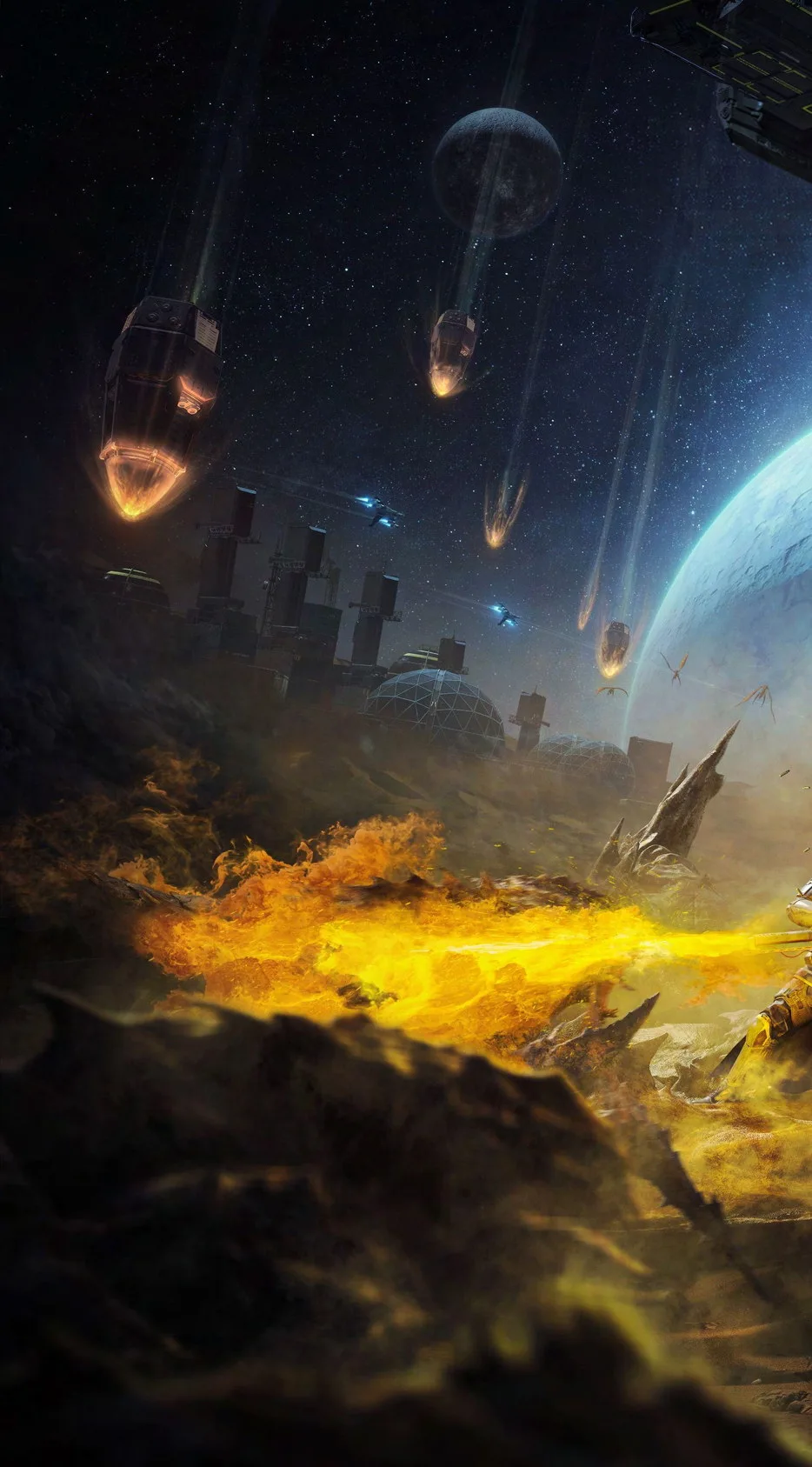
The story in Helldivers 2 is identical to the first game's. We're still a soldier of an authoritarian government, still surrounded by propaganda, and still cannon fodder in the eyes of the rulers, who send us to defend 'humanity's' interests on other planets. Amazingly, those interests turn out to be advanced technologies that have to be 'confiscated' from the inhabitants of the planets where our missions take place, plus oil refineries — because, even though humanity has gone on to conquer the stars and the universe, it seems we still need 'black gold'. The game's big surprise was the shift in genre from a top-down shooter to a third-person shooter. That 'small' change makes for a completely different experience from the first game. Thanks to the new perspective, the game is closer to an adaptation of Paul Verhoeven's infamous Starship Troopers, in which Rico, played by Casper Van Dien, fights for the United Citizen Federation against aliens that look like giant insects. Rico, like all the other soldiers, firmly believes everything the Federation tells them and is ready to sacrifice himself for the good of humanity if he's given the order. Curiously, Rico's actor recently said on his social media account that he'd be interested in taking part in filming promotional material for the game. And once again we see the similarities with what I discussed in the introduction.
As in Verhoeven's film, in Helldivers 2 we fight aliens split into two factions, as opposed to three in the first game. The two are the insects, which look a good deal like the enemies of the United Citizen Federation, and the Cyborgs, affronts to the natural order that blend technology with the organic into something more machine than man, like SHODAN's experiments in System Shock. The third faction from the first game, the Illuminates, isn't in Helldivers 2 at the moment, but plenty of players have reported and documented being wounded or even killed by blue laser beams. Those beams are the ammunition used by the Illuminates, an advanced alien race that opposes humanity and the military expansionism behind Super Earth's colonising space policy.
Perhaps you're wondering what happened to these brave soldiers for the courage they showed in reporting these strange, unexplained incidents from the front to the community. The answer is simple: they were declared traitors to humanity. The story in Helldivers 2, as in the first game, is nothing spectacular. It's a satire and a commentary on themes common in science fiction. So you're probably wondering how the soldiers I mentioned earlier ended up declared traitors in the game's story. It's because this creation of Arrowhead Game Studios is a live-service game, where the community moves the 'story' forward, guided by the game's developers. The community is a lively one, and plenty of players have chosen to take part in a kind of Alternate Reality Game (ARG), in which everyone plays the role of a character from the Helldivers universe. Many of the update notes read like a bulletin from a propaganda machine, and the game's director answers community questions as though he were part of the Super Earth government. In a recent situation, players reported flying insects appearing on the front, and Johan Pilestedt (the director), along with a significant chunk of the ARG players, denied that the enemy had evolved. What's more, they branded every player who reported this twist in the galactic war a traitor. But the truth came out in the end.
Being live-service games, they depend enormously on their community, and Helldivers 2 is lucky enough to have a very dedicated one, happy to take on all sorts of roles in this sci-fi world. But that dedication wouldn't exist if the game didn't have a clearly defined direction, because live-service titles demand commitment from the developers, who have to keep making content and keep persuading players to come back to the game every day. Arrowhead Game Studios is lucky enough to have Warmaster Joel at the controls of the galactic war, doing the job of a deft dungeon master. He sets the weekly 'missions' that every player has to contribute to, whether that's liberating a planet, destroying a number of enemies or recovering a number of objectives. Each of these weekly missions grants players huge benefits, such as the permanent ability to call mech armour down to the front, transport options and resources that matter for developing our combat abilities. Failing these 'service tasks' can have disastrous results, such as a procreation ban imposed on Earth's population for a stretch of time, for want of the resources needed to sustain it. The way the community and the developers get involved in the story is what lifts Helldivers 2 above plenty of live-service games and makes it a good title, because on the other counts it isn't a brilliant creation.
On gameplay there's no difference between Arrowhead Game Studios' creation and the hundreds of third-person shooters already on the market. The camera sits behind the character, who comes with the standard setup of 1 primary weapon, 1 secondary, explosives and ammunition. The new element the Swedish studio added is a mandatory 'mini-game' that players have to play whenever they want to call in support on the battlefield. This mini-game, also known as stratagems, means punching in a combination much like the codes we used as kids for the various 'cheats' in games, such as the famous Konami code (up, up, down, down, left, right, left, right, A, B). Once we've entered the code we wanted, we get air support, ammo boxes, weapons or even transport options, depending on the buttons we used. All missions, whatever the type, often come down to attacking objectives or defending them. At the end of every mission we face a siege at a location we're to be extracted from while we're under attack by either the endless horde of insects or the never-ending march of the cyborgs. What brings variety and fun to the missions is people. Any mission can be done solo, but most of the time they're a joint effort by at least 2 players. Other people's presence will make our missions and our objective-chasing easier, or in some cases harder. But the unpredictability that defines humanity is what makes any mission a delight. Players can choose to coordinate and tackle missions like professionals, or they can run off in random directions and find secret objectives, guided by curiosity. They can show discipline and point their weapons at the enemy, or they can shoot their teammates and discover that the 'friendly-fire' option is permanently switched on in this game. The way Helldivers was designed forces you, sooner or later, to enjoy it with others, because it gets harder and harder to level up your character through the missions you can do on your own alone, which are also the easiest. If you want to level up your soldier, you have to take part in the dangerous, hard missions, which are practically impossible to see through without teammates. That's down not only to the enemies being numerous and hard to kill, but also to the fact that teams have to coordinate. The game has no map built into the HUD, and players have to stop whatever they're doing and open the map to work out where they are and where they should be heading. Some of the more powerful weapons need 2 players before they can be used, and that's impossible to pull off when you're doing a mission solo. Still, I had no trouble at all finding people to share my Helldivers 2 experiences with, because the community is big and growing exponentially by the day. The only mission that is a genuinely single-player experience, one that can't be shared directly with other players, is the first one. It's a tutorial mission, the kind of level you rarely see in modern games, and it manages to blend military extremism, patriotism and satire in a way that's memorable and will stay in a lot of players' memory.
Like plenty of other live-service games, Arrowhead Game Studios' title has a battle pass. But unlike the rest of the games in this genre, such as Destiny or Suicide Squad: Kill the Justice League, Helldivers 2 doesn't push you to sink money into it. It's true that every weapon in the game is unlocked through the battle pass, but the basic one has everything you'd need, and each weapon is unlocked with the medals we earn at the end of missions, be they normal, daily or weekly. In 1 week I managed to get halfway through that battle pass and I'd already unlocked a few weapons I don't see myself parting with any time soon, such as an automatic shotgun.
On the aesthetic front, the game is every bit the equal of the rest of the titles Sony Interactive Entertainment puts out. Although the title doesn't have a colourful world like the one in Ghost of Tsushima or the Horizon series, it stands alongside them on the strength of its graphical quality. Every planet and battlefield is rendered in detail, despite the monotony and the uninspired colour palette we run into from time to time. On sound, though, it's immediately obvious that we're dealing with a game from the famous company in Minato. With or without headphones, it's very easy to work out which direction enemies are coming from purely by ear, and every weapon and ship has a distinct, easily recognisable sound. It doesn't take long for the player to work out how far away the enemies are, and in the Cyborgs' case what kind of weapons they're using, going on nothing but their ears.
In conclusion, I can say that Helldivers 2 is one of the best live-service games I've played in the last 10 years. That's down not only to the talent and passion the people at Arrowhead Game Studios have shown, but also to the engaged community that chooses, day after day, to go back to the front — at the risk of being cannon fodder — to hit the objectives set by the Super Earth government.
0 votes
Scroll down here and stay on the page for at least 30 seconds to vote.
Pick a score from 0 to 10 (halves are allowed).