
Eternal Strands – Review
A bit of everything, like a kebab
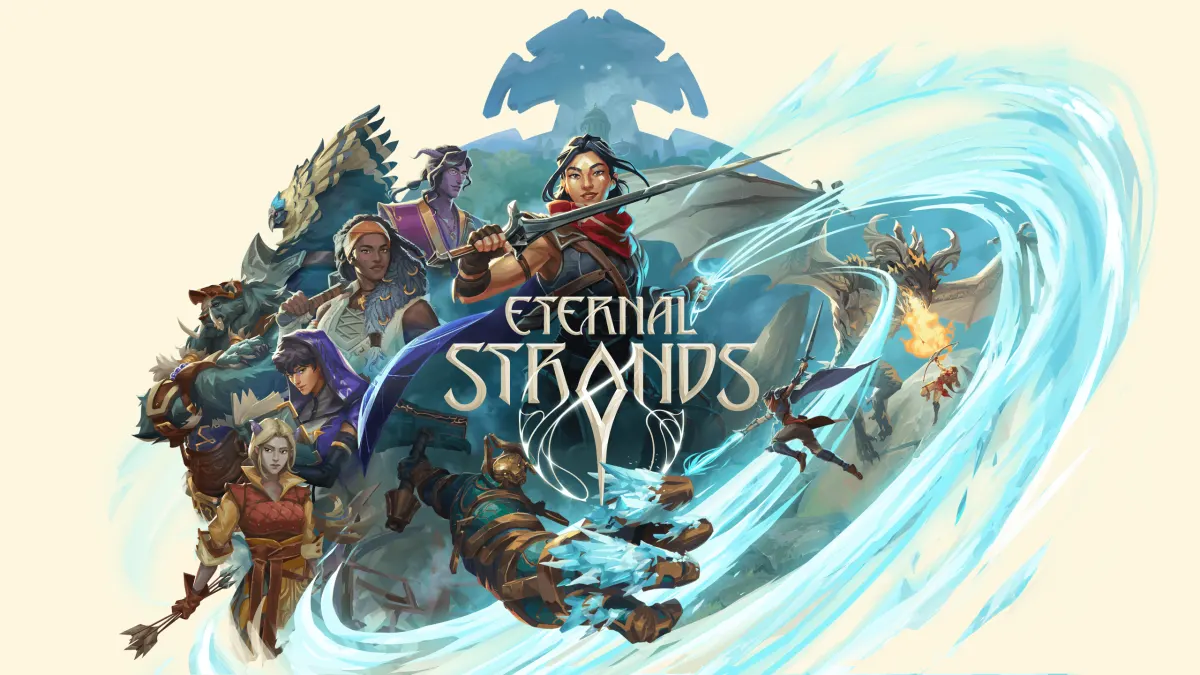
I heard about Eternal Strands purely by accident. It was sometime last April. An announcement from the folks at Yellow Brick Games had snuck into my LinkedIn feed. Back then, I was impressed and felt that we were finally getting a Shadow of the Colossus experience on PC, but with more colour. They also mentioned that the combat system was based on gravity and the ability to literally tear off parts of gigantic enemies to throw back at them. Plus, the Chief Creative Officer behind the project is none other than Mike Laidlaw. If the name sounds familiar, it's because he worked as Lead Designer and Creative Director for Dragon Age: Origins, Dragon Age II, and Dragon Age: Inquisition during his time at BioWare.
Let's recap a bit. Interesting concept and presentation – check. People who know how to deliver a successful game – check. In other words, what could go wrong? That's why I'm here today – to answer that question. Or maybe, on the contrary, everything went smoothly. I won't keep you in suspense any longer. Let's see what we have here.
You're a wizard, Brynn!

The game introduces us to the region called the Mayda Basin, a place where magic is not just a distant dream. However, magicians (called Weavers) are seen as outcasts and pariahs. And for good reason. The Enclave, the most powerful nation of mages, isolated itself from the rest of the world with a magical barrier immediately after a series of magical cataclysms struck all the lands in the Mayda Basin.
The few Weavers who remained outside the barrier are now blamed for all misfortunes. They are forced to travel in Weaver bands and be as invisible as possible to society. Our protagonist, Brynn, is the newest member of such a group. Their mission is to find a way to cross beyond the Veil, the magical barrier separating The Enclave from the rest of the world. But once they reach the other side, they are faced with more questions. Are there any survivors left? How have the creatures inside the barrier changed? And why are the weather conditions going haywire?
Each band of Weavers has a “point”, a person who leads the expeditions. This role is played by Oria, a half-bird warrior, in Brynn's group's case. Unfortunately, she suffers severe injuries following the events that help them cross beyond the barrier. And Brynn is chosen to take her place until she recovers. Some members accept the decision. And others need deeds, not words, to be convinced. But in the end, they all decide to support Brynn in her expeditions. Whether willingly or unwillingly.

Thus we meet the rest of the group. We have the couple formed by Sola, a self-taught blacksmith, and Dahm, her researcher husband who fled his theocratic country. Sevastyan, our big and fluffy friend, is Sola's apprentice. Casmyn handles supplies and is obsessed with everything being in order… even her pairs of socks. And Laen is our historian who decided to leave behind his noble family and their political games.
It's encouraging how Brynn's companions slowly open up and begin to trust her. They are there for her. And Brynn is there for them. Because they too are going through a series of personal problems that we need to help them solve. These problems are the subject of side quests and help us understand them better. And as a subtle detail, I like to see how their facial expressions change depending on the emotions they feel and the situations they go through. For example, Casmyn looks worried when she fears we don't have enough resources.

Discussions and interactions are delivered through dialogue boxes and 2D portraits most of the time. Also, characters change their facial expressions throughout the exchanges. The tone of voice captures their mood. And I appreciate the synchronisation between the length of the lines, the speed at which they appear, and how the actors deliver them. Initially, I chose to advance dialogues manually. But I quickly switched to the automatic advance option due to the fluidity of the lines. What I'm trying to say is that the lines are delivered at a reasonable pace, without losing the personality of those who speak them.
It's no big surprise that the voice actors performed exemplarily. The voices behind our adventurers have worked for games like Rise of the Ronin, Dragon Age: The Veilguard, Stellar Blade, Baldur’s Gate III, or Warhammer 40,000: Space Marine II. And that's just to list a few of their important projects.
That being said, I'm curious about one aspect. Were the dialogue boxes a stylistic choice for interactions? Or was the choice made to reduce the time and costs involved in motion capture? I wonder this because we also get some scenes with in-game models, as well as some 2D and hand-drawn animated scenes. And the scenes with 3D models seem more crudely executed.
This is one of multiple examples where Eternal Strands seems to lack an identity of its own. It tries to achieve too many things. It tries to combine elements from a variety of genres. And the result is only decent.
I'll also add that you can play detective during conversations. The top line in the list will be marked as the one that advances the conversation. And the ones below it give you the option to ask for more information. Options you've already discussed are marked, so you know which topics you have left to discuss.
Furthermore, dialogues that offer you missions are marked differently from friendly discussions. It's a nice way to signal: “Maybe you want to ask this character how they are before starting a mission.” However, I encountered situations where normal discussions mentioned events from mission dialogues. It's not like you'll get massive spoilers. Just a minor issue regarding event synchronisation.

If you're interested in the fictional universe of the games you play, Eternal Strands includes a Codex that details the context in which the game takes place. Laen will offer you the option to piece together parts of this Codex when you've found all the objects related to a certain event, character, etc. These objects can all be in the same region, scattered across multiple regions, or will be available as part of missions. You'll find most of them if you're as avid an explorer as I am. And it helps that you get an audio signal when you approach one. What doesn't help is that you hear a similar sound when you're near a resource chest. Plus the fact that these chests respawn. Plus the fact that many objects are at the top of massive structures, which are not few at all. We'll eventually get an ability that allows us to climb them quickly. But this happens somewhere at the end of the game. What I'm trying to say here is that it wasn't always fun to look for all these objects. I'll leave you a guide here to make your life easier.
Let's take a look at our protagonist. Brynn is a typical adventurer. Her evolution from “I just joined this group of Weavers” to “Wow, I'm the boss” and finally “The world can rely on me” happens at a fast pace. Perhaps too fast, considering the pace of the story itself. She is simply the hero who is around and ready to solve any problem. I didn't feel she truly grew, apart from the new abilities she gained. All in all, she's a main character who does her job to advance the story.
Something that isn't mentioned, but might interest you, is that we can have romantic relationships with group members. The developers didn't want to specifically promote this aspect. But it's good to know that some characters will develop feelings for you, depending on how you treat them. After all, we don't have multiple dialogue options for nothing, do we? You don't have to feel pressured if you have multiple favourites and feel you need to choose one of them immediately. The game gives you enough time to become familiar with them before you have to choose who you want to have a serious relationship with. Again, it depends on how you decide to treat them. To paraphrase the creators, it's just as possible to see romantic interest from all characters or none, depending on your decisions.
To summarise, the story is decent and doesn't stand out in any particular way. The characters are interesting, but not extraordinary. And the most memorable aspect is how the actors deliver their lines.
Let's take down some titans!

However, don't be fooled by the few words I've written here. It's a bit more difficult to obtain these Magic Fibres in practice. You'll get the first one regardless of how you defeat that boss. But this gives you access to a very rudimentary version of an ability. You'll have a bit more work for the next fibres. You'll have to defeat these titans by following a series of steps. Each of them has something called a “Locus Point” placed somewhere on their body. This is where their magical energy is concentrated. Obviously, these points are hidden and you have to discover them. Sometimes you'll have to knock off their armour to reveal them. Sometimes you'll have to destroy certain parts of their body. And other times you'll have to wait for them to become vulnerable to be able to collect the fibres. Fortunately, you won't have to rack your brains solo about what steps to follow. You'll unlock information in the Codex after defeating a boss for the first time. And these include the team's observations on what you should do to expose these Locus Points.
I'll be honest. Taking down these colossi feels phenomenal… the first time. I still remember how I took down the first one and the satisfaction I felt. Having to climb on it. Using my abilities to pin it in place. Destroying certain parts of its armour like a puzzle. Holding on tight when it tried to shake me off. Or changing my position so it wouldn't catch me. I had no intention of reciting from Elena Farago's "The Little Beetle": "Why are you squeezing me so hard?".
But the magic slowly began to fade. I later learned that you have to defeat the same bosses repeatedly many times. And not just to absorb more of their power. But also because they drop Legendary quality materials, which are the best for crafting new weapons and armour. And this process can easily become a chore, as you have to repeat the same steps again and again.
I spent 74 hours experiencing every element of the game. 30 of those consisted of grind (I'm being very intentional here) to get access to the best possible equipment. It's not mandatory to do this. And fully upgraded armour and weapons won't make such a significant difference. But don't tell me you wouldn't want to wear the best armour and wield the best weapons if the game gives you the option. I do. But the grind for them left me cold.
One aspect that the developers seem to have overlooked is that you'll only be guided to each colossus for the first three fights. Enough to upgrade the ability it offers to the maximum. After that, you'll have to find them on your own. Which isn't difficult when it comes to terrestrial creatures. But the flying ones might give you some headaches until you find them. They change their position much more frequently.

I also advise you to be careful with these flying creatures. More than once they decided to fall off the map after I defeated them… with me attached to them. You can guess what happened. They died. I died too. This aspect is problematic because of how deaths work in the game. You'll lose many precious resources you've collected. And you won't even be able to collect those that drop from the respective enemies. In other words, deliver the finishing blow when you're sure they'll land on the ground.
And because I'm a nice guy, I'll give you another tip to gather resources more easily: kill bosses normally after you've finished gathering all the Magic Fibres you need. You'll get more Legendary materials this way.
I've been telling you all about weapons and armour. You'll unlock different variants of these as you discover schematics in each region. These are found in areas marked with a hammer on the map.

Armour is modular and you'll be able to combine different helmets, breastplates, bracers, or footwear from any set. Each set comes with its own bonuses, such as resistance to different elements, weight reduction, more stamina, etc. Do you feel like you're getting hit very frequently? Equip some heavier armour to reduce damage. Do you feel like you don't have enough stamina when climbing on a boss's body? Put on some armour that gives you more stamina. There's something for everyone's taste and need. However, I would appreciate it if they numerically specified the impact of these bonuses. For example, a piece of armour gives me more stamina. There isn't an attribute and a number that allows me to verify this. It's one of the game's missing aspects. It's like your boss telling you you'll get a pay rise. It's great if the raise is £1000. It's not so great if the raise is only £10. You need specific data.
One last detail about armour: I encourage you to adjust it according to the gigantic enemies you have to take down. Some have fire attributes. Others have ice attributes. And others deal serious physical damage. Be sure to protect yourself accordingly. I decided to use two sets: one for fire, one for ice. And I adjusted/upgraded them as I discovered better schematics and resources. Only at the end of the game did I decide to create a more balanced set. But this set was also heavier than the others. Now, I'm not telling you to follow my example. Just remember that very few of these colossi have only physical damage. More precisely, only two out of nine.
Weapons come in three categories: sword and shield sets, bows, and gigantic weapons. Sword and shield should be very good on paper. Attacks are fast and you can parry if you time it with enemy blows. But most of the time you'll be surrounded by enemies. And if you parry one, it's very likely you'll be hit by the other three. Enemy groups are very alert, they chase you for a considerable distance, and they hit quite hard on the hardest difficulty. I don't recommend parrying in this game due to the fast pace of combat.
Regarding bows, I'll be honest: I dismantled mine for resources and never looked back. Again, I made the decision due to the pace of combat. I don't know how to put it, but you don't really have the luxury of standing still and aiming when a pack of rabid wolves is clinging to you. Plus, bows quickly become redundant. You'll unlock abilities that give you much better options for ranged attacks.

As much as I like fast weapons, gigantic ones seem to be the most effective in Eternal Strands. The damage they deal is far superior to swords. For example, wolves and mechanical soldiers fell after a few hits from them. But I needed at least five sword hits to take down the same enemies. Sure, a larger weapon consumes more stamina and is a bit slower. But the range at which you can hit and the damage you inflict are much better. Not to mention they are excellent when you need to destroy bosses. You consume much less stamina for attacks when you're attached to them. And the frequency of attacks is faster. Last but not least, freezing enemies and beating them like a drum is a very viable strategy early in the game.
These weapons also have variants that add a special fire, ice, or gravitational attack. This is the only difference from the normal variants. The damage remains the same. I didn't complicate things too much and simply chose the weapons that looked cooler. Plus, why use special attacks that need to be prepared in advance when you can throw fire, ice, and whatever else you want like a fanatic wizard?
What I would have liked to see is the option to change equipment colours or some transmog options. Let's just say that the best-looking armour doesn't necessarily offer the best bonuses. I'd be happy to trade some materials to recolour my equipment however I want. We'll have to settle for the colours offered by the materials used when crafting equipment.
In other news, I like the “full return” policy and that we can replace used materials with better quality ones. Regarding the first, you can dismantle any piece of armour or weapon at the blacksmith and you'll get all the materials used back. It's quite useful when you want to swap an outdated armour set for a new one that offers better bonuses.
As for materials, I like the tempering system they introduced. To explain it simply, you can apply fire or ice to enemies, minerals, trees, or other objects that drop materials. Apply enough of the right effect and you'll get higher quality materials. For example, if you heat minerals until they glow and then break them. Or if you apply enough ice to mechanical soldiers until they become brittle. It's an ingenious approach to resources. And it encourages you to use your abilities both in combat and while exploring.

I've mentioned bosses quite a bit. But they're not the only ones you'll have to face. Each region comes with a series of quarrelsome enemies. Urban regions will have more types of mechanical soldiers we discussed – these are called Arks. The others will include more types of wild fauna, such as wolves, poisonous chameleons, or fire insects. As you can see, the variety of enemies isn't considerable. But the developers knew how to use weather changes to diversify things. To give you a bit of context, the weather inside the magical barrier can vary extremely from day to day. You might be lucky enough to hit a normal day in each region. Or a day when some of them are hit by drought, frost, or a special type of weather called Miasma – a kind of magical poison. Why did I tell you all this? Because the weather influences the type of enemies you encounter. For example, during a drought, you're more likely to encounter insects, chameleons, or fire Arks.
But the weather doesn't just affect enemies. It affects Brynn equally. First, you need the right type of armour before venturing out into the world. Droughts don't affect you much early in the game. You just have to avoid catching fire. On the other hand, you absolutely need cold-resistant armour during a blizzard. Otherwise, Brynn will take a few steps, freeze, take a lot of damage, and eventually kick the bucket.

That being said, the type of weather can be your ally as much as your enemy. Fire abilities are stronger on hot days. The same goes for ice abilities on cold days. Plus, you'll be able to change the weather type in each region after you finish the game. And this will be a real help when fighting bosses. What can I say? It's easier to take down a gigantic ice lizard on a scorching day, and your fire abilities will roast it slowly. As for me, I would have appreciated being able to change the weather conditions somewhere in the middle of the game. It would have made the resource grind and the experience itself much more enjoyable. Because, to be honest, there's not much left to do once you've finished the game's story. It makes sense that it happens at the end from a story perspective. It makes less sense from a gameplay perspective.
Another trick you can use against Mother Nature is elemental potions. You'll receive one for fire resistance and one for cold resistance the first time you upgrade Laen's lab. And you'll have two of each when you've upgraded it to the maximum. What do these potions actually do? They increase your resistance against an element to the maximum. You won't take any damage from fire or ice when using the corresponding potion. This way you'll be able to survive blizzards more easily in the first part of the game. Or you can make sure droughts don't put a "Burn me!" sign on your back.
Furthermore, bosses that use fire or ice will only be able to hurt you physically as long as the potion is active. Which brings us to another viable strategy for collecting Legendary materials until somewhere in the middle of the game. Let's say you look at the regions you can visit before leaving camp. You see two bosses with fire attacks, one with ice attacks, and one with physical attacks. You can equip a set with high fire protection. Take down the first ones. Use a potion to deal with the ice attacker. And leave the one with physical attacks for last. It might even be smart to leave the last one alone if you're injured. Better to return to camp without losing the Legendary materials you've collected.
Your chances of survival can also increase depending on how you use vitality potions. Initially, you get three. And you can reach a maximum of five. You can bet you'll need them to navigate the treacherous lands of The Enclave. I encourage you to use them whenever you're in danger. It's better to survive, return to base, and live to fight another day. The alternative is to die and lose precious resources. Fortunately, there are plenty of pouches with such potions scattered on the map. These can also drop from material chests. And you might be lucky enough to get two for the price of one. It's good to memorise where you can find them, especially when you're grappling with bosses early in the game and it's more of a battle of attrition. A subtle detail that delighted me is that you'll automatically use a vitality potion if you have missing HP and the maximum number of potions in your inventory.

I've been rambling about the risk of losing materials when you die. Let me explain how things work. In Eternal Strands, you have a certain amount of each type of material you can carry. You can increase this capacity as you upgrade Casmyn's caravan. This means you'll have to make many trips back to base to deposit your loot. And you'll have to prioritise materials with a higher rarity:
- Common and Uncommon ones will become redundant quite quickly. But they will remain useful. You'll be able to destroy them to obtain resources that allow you to upgrade your companions' workstations.
- I advise you to keep Rare and Epic ones when exploring regions.
- And to prioritise Legendary ones when farming bosses.
You will also have an item that allows you to teleport back to camp with all your materials.
That being said, you'll be able to keep a limited amount of resources when you die. A screen will open where you'll have to choose what to take with you and what to abandon. Initially, you'll have three such safe slots. And you can reach a maximum of seven if you fully upgrade Casmyn's caravan. I'm not a big fan of this system.
On the one hand, I understand why it exists as it does: it fits the game's theme. You are an adventurer. Every journey outside the safe zone is a dance with danger. You need to know when to advance. And when to strategically retreat. Recklessness only leads to certain death.
On the other hand, I'd say it just adds unnecessary time for resource gathering. I was promised a fantasy action-adventure game. Not a survival and crafting game. Believe me, I'm a maniac when it comes to gathering resources, getting the best equipment, and I salivate at the thought of comparing different armour sets to figure out what suits me. But even I know when an experience is wasting my time. And to make matters worse, you can return to the location where you died only to see a lot of materials that you can't pick up from the ground. I would at least hide them if I were one of the developers.
However, I will mention that the developers recently added more safe slots and expanded the normal inventory by another six slots.
The game offers you a stylised map with different landmarks drawn on it. You also get a compass for orientation, as well as something called Weaver's Wisp – you can press a button and light rays will appear to guide you towards the selected mission objective. Call it preference. Call it utility. But I'm a fan of traditional maps and mini-maps. Again, I understand the idea of living in a world as an adventurer. But it doesn't help when exploring and you're not sure if you've visited a similar-looking hill or not. It's not that bad, since they use icons for armour and weapon schematic locations. But it feels very rudimentary in other situations.

And to be honest, the regions themselves feel a bit rudimentary. You have a few enemies scattered here and there. A few resources. Maybe a location you need to revisit for some mission. And obviously, the boss fights. But the more I revisited them, the more I felt I couldn't immerse myself in the game's universe. Everything looked very similar. And quite empty or scattered sometimes. The word I'm looking for is "detached." I felt obligated to go to a location and perform an action because I had a mission or needed to farm resources. Not because I was dying of excitement to see Generic Hill #27 or Castle #5 again.
The main way you access new regions is by using Loom Gates. These act as fast travel points in each region. Some of them are covered in rubble. Others are guarded by enemies. Once liberated, you can use them and establish a fast travel network. You can expect two or three such Loom Gates per region, which is more than enough when combined with the fast travel item.

Here are my final comments regarding gameplay:
- In-game time advances when you teleport back to base. I advise you to pay attention to this. You only have two fast travels before a new day begins and regions reset. This is especially important when you want to hunt a specific boss. You can also advance time by sleeping in Brynn's tent. To be honest, I wish this was the only way we could advance time. It would give us more control over when bosses respawn. Especially since the days passing in the game have no other significance.
- With a bit of luck, you'll run out of stamina when you're on a boss's surface where you can stand. This allows you to recover your energy to continue climbing on them and beating them up. However, the game doesn't always register when you jump onto a boss after standing on it.
- I'm still not sure if locking the camera onto an enemy or leaving it free is the best way to fight. On the one hand, the first option helps with aiming abilities and the bow. On the other hand, enemy groups will surround you in 90% of cases. And a free camera helps more to manoeuvre battles. Especially since a camera locked onto a single enemy has a strange focusing effect and narrows your vision.
- I find it an oversight that we can't check our equipment or aspects like resistance, attack, etc. when exploring regions. I don't even expect to be able to change weapons and armour. I just want to be able to check what equipment I have and how it affects me.
- A new conversation with Oria will appear when you are killed by a new enemy. She will explain how to approach that type of adversary.
- The way the system handles boss fights can be confusing. Generally, they will clear their path of other enemies. Some creatures will even despawn automatically when a boss wanders through that area. But you can encounter situations where mobs decide to appear out of nowhere while you're fighting a giant. Or situations where they appear immediately after you've defeated it.
I heartily encourage them to have specific arenas dedicated to such fights. I don't mind them wandering around the regions, as long as we can find them in regions where we can fight them solo.
- The parry button placed on RB/R1 seems like an interesting decision for controllers. I mention this because we also have the attack buttons on the right side. And games usually position offensive and defensive actions on opposite sides of controllers.
- Even if you are killed, the state of that region does not reset. This means that the mobs you killed remain on the ground. And the progress you made to obtain the Magic Fibres from bosses also remains.
- Armour weight can make the difference between life and death. I advise you to pay attention to how heavy the armour is and what impact it has on stamina. This also influences movement speed, as well as jumping distance. Fortunately, armour will become lighter as you use better materials.
- Some barrels may contain gunpowder. The safest way to break them is by using gravitational powers.
- Terrestrial bosses can fall on you if you cling to them when they die. This can temporarily trap you. And it will force you to teleport back to camp without collecting the resources from the fight. So be careful and let go of them after you've defeated them.
A playful artistic approach to the world and environment. And yet…

I dare say that the hand-drawn animated scenes in Eternal Strands give it a special flair. They have an energetic feel. The way the characters move, the actors' voices, the background music… All these aspects make them special. Unfortunately, we only get to see them at the beginning and end of the game. At least I can praise the artists for their contribution to them.
But if we turn our attention to the in-game world… things are a little different. I'd like to comment more on the 3D art regarding models, environments, or the enemies we face. But the crude truth is that I didn't find them special at all. We've been assaulted by this Fortnite-esque aesthetic so often. And I've reached the point where I'm indifferent when I encounter it.
But the 2D impresses where the 3D seems to disappoint. The portraits for each character are detailed and full of life. The subtle changes in their facial expressions depending on emotions are charming. And the actors manage to complete these characters with outstanding performances. I'm not a big fan of Visual Novels. But I'd bet my bottom dollar that the team behind the game could deliver a phenomenal game of that genre if they wanted to.

The visual effects for magical abilities are impressive. You can only control fire, ice, and gravity. But that doesn't stop them from offering fluidity to those animations. The sound of ice breaking when you create it or when an enemy is affected. The sound when you light fire bombs and throw them at a gigantic ice bird. These really make you feel like an almighty magician. A detail that delights me is that the model of our Weaver's cloak and its colour change depending on the type of magic we have selected. And it starts to glow when we use abilities.
Regarding armour, I can say that only three of the nine available appealed to me and had a distinct design. The rest are decent, but nothing extraordinary. You can combine different pieces of armour if you want your Brynn to participate in Bravo, ai stil! And you can make helmets visible or invisible, depending on your preference. But as I mentioned when talking about gameplay, there's a severe lack of being able to recolour armour or a transmog option. The tools to customise colours already exist in the game. Because each armour takes its colour and accents from the materials used for it. All they have to do is let us use materials to colour them however we want.

We can't talk about a game where gigantic creatures are the main attraction without mentioning them. They are probably the most refined 3D models in the game. And the fact that you can climb on them, that you can see every crack in their armour or the magical energy pulsating through their veins makes them even more impressive. I sincerely wish I hadn't gotten bored of them from how often I saw them when farming for resources.
Last but not least, the game's graphics seem poorly optimised for PC. Many of the models and objects are unpolished at the edges. And the game inexplicably taxed my system. I had to watch videos and spend an hour modifying Windows settings to get rid of lag, missing frames, and the poor quality visuals I experienced on the highest graphics settings. I don't want to believe that I could play Dragon Age: The Veilguard twice in a row on the highest settings, only for Eternal Strands to hit me with performance issues.
If we're talking about the audio, you almost don't notice that there's background music when exploring. And I say that in a positive sense. These melodies create an atmospheric setting, which helps when you're constantly going back and forth gathering materials. But fear not. You'll also get epic music throughout the battles where you face the titans. Unfortunately, repetition strikes again. And listening to the same music during battles becomes redundant. It's sad, considering that Austin Wintory has done a phenomenal job again, after blessing us with the soundtracks from Journey and Abzû.
Final Verdict

There were high expectations for Yellow Brick Studios regarding Eternal Strands. And it's clear they had many good ideas. The magic and gravity-based system were fun. The fact that the weather influences both you and enemies was a brilliant design decision. The bosses were visually impressive and had great combat choreography. The 2D art was far superior to the 3D. I have nothing but praise for the actors behind the characters. And the music managed to create a suitable atmosphere, whether exploring or fighting a colossal creature.
And yet… the other aspects didn't manage to stand out. Even though we have three different weapon types, only one of them seemed truly useful. The story and characters were just decent. The game's environment looks quite generic. There isn't really much variety in terms of enemies, even if they change depending on weather conditions. The way they handled inventory management and resource loss fits the game's theme, but adds unnecessary repetition to the gameplay. And the constant need to grind for materials made the game monotonous. And it made it last longer than necessary.
Leaving all that aside, I believe the game suffers from two major problems. The first refers to an identity crisis. I've seen this too frequently already. Developers with many brilliant ideas they want to implement. The scope of the project grows more than it should. Eventually, they realise they can't include everything. And then they have to cut or leave unfinished ideas in the game. Regarding Eternal Strands, I keep joking with people that it's a survival base-building souls-like visual novel action-adventure RPG. It simply tries to go in too many directions. It succeeds in some cases. But when all are put together… the experience is at best decent.
And this aspect brings to the forefront the second problem: the failure to retain players in the first hours of gameplay. I looked at social media posts and comments. I questioned streamers about their experience after I finished playing. I saw people who decided to give up the game after three or six hours of gameplay. And I don't blame them at all. There are probably two major events in the game that make you say "Wow!". One happens halfway through the game. The other, at the end of the game. Hence the question: "Are people still willing to spend 10 hours until something interesting happens?".
Yes, I spent over 70 hours with the game. And according to howlongtobeat.com, it will take an average of 56 hours to 100% complete the game. But not all those hours felt pleasant.
Eternal Strands receives a solid 6.5/10 from me. You can find it on Steam, Epic, Xbox or PlayStation for $39.99. But I can't say the price is justified at this moment. I would encourage you to try it on Xbox Game Pass first if you have the chance. And then decide if it's worth investing time in it. Or at least wait until it receives a generous discount.
However, I'm happy to see that the developers haven't abandoned the game. I've seen two patches implemented so far. And it's possible we'll see more depending on community feedback and how much they're willing to maintain the game. Feel free to tell me what you think about the game in the comments if you read this review after more patches.
That's all from me. See you in the Next Level!
Played on: PC
Release date: 28 January 2025
Developer: Yellow Brick Games
Publisher: Yellow Brick Games

0 votes
Scroll down here and stay on the page for at least 30 seconds to vote.
Pick a score from 0 to 10 (halves are allowed).