
Final Fantasy X
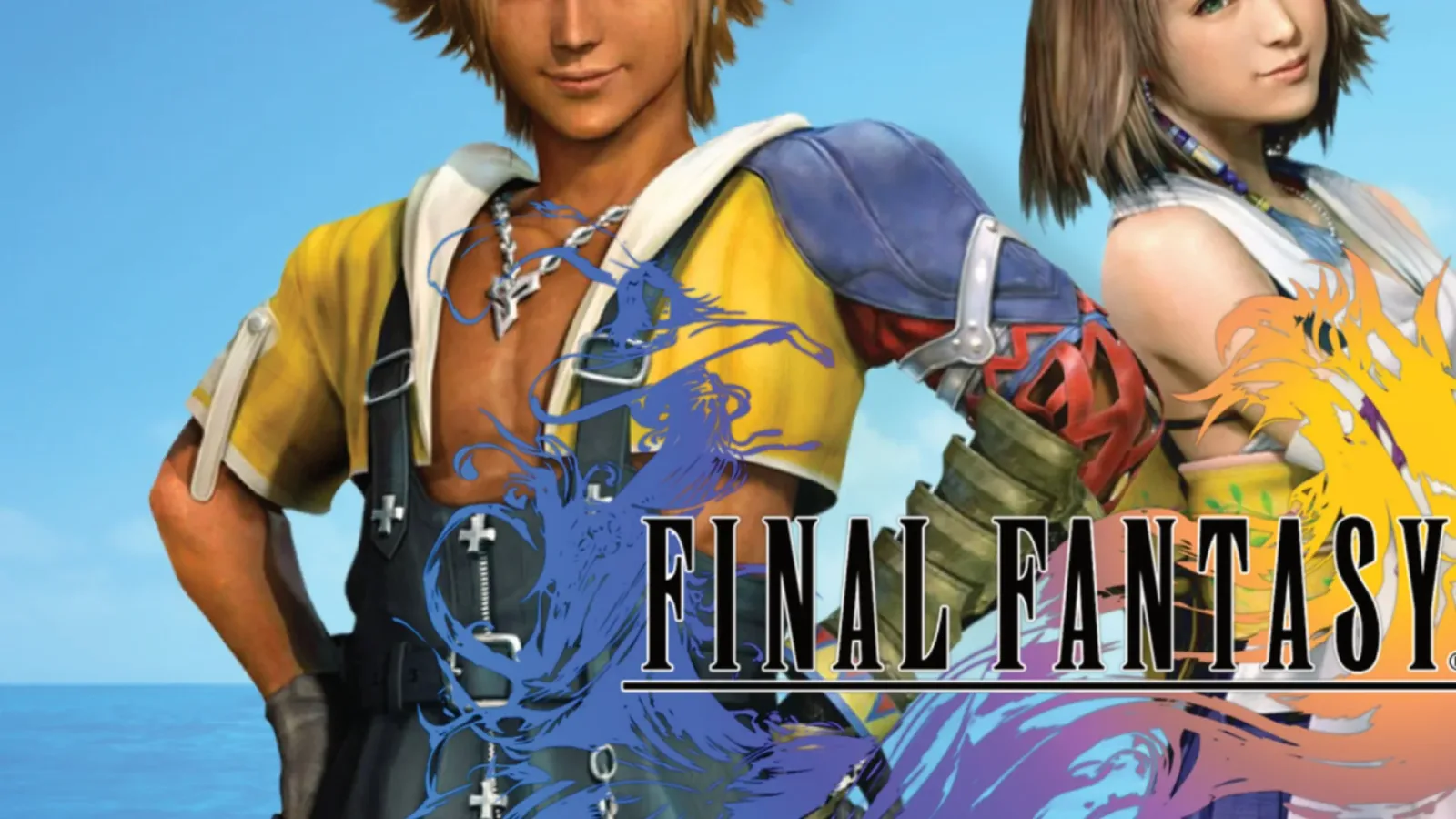
First published in GRIND I, pages 28–43.
In the year that should have marked the first space odyssey, instead of waging war on utilitarian artificial intelligences like HAL 9000, we were given the chance to explore worlds never before seen or encountered, on our tube screens and their radiation. And 2001 was absolutely spectacular where releases were concerned: Microsoft, the newcomer to the console world, gave us Halo: Combat Evolved; Rockstar Games showed us what the Grand Theft Auto universe looks like once it's handed a third dimension and the freedom to explore an immense Liberty City; Electronic Arts let us play at being God in Black & White; Sega breathed its last on the console market, releasing three of the year's best sports games (Virtua Tennis 2, NFL 2K2 and NBA 2K2), plus the masterpiece Shenmue 2 (which could easily have rivalled GTA 3 had it come out on every platform); Nintendo abandons floppy disks to embrace disc-based systems with the GameCube and hands us Super Smash Bros. Melee, still considered the benchmark of quality for the entire series; Activision still hadn't discovered microtransactions and hadn't had the chance to ruin Blizzard, so it invited us to play Return to Castle Wolfenstein and Tony Hawk's Pro Skater 2 and 3; and in that same magical year the Max Payne (Remedy Entertainment), Pro Evolution Soccer (Konami) and Pikmin (Nintendo) series were born and Devil May Cry (Capcom).
That explains why Final Fantasy X, the tenth game in the main series that Square started in 1987, can slip by unnoticed and be forgotten by the people who compile rankings and write history books. But those who had the patience to sit through 60 hours of gameplay to see how the story ends will surely disagree. And when it comes to graphics and to how it has aged against the industry's evolved trends, this tenth Final Fantasy brilliantly crushes its contemporaries. Even on the story front, the adventure across the land of Spira is far above GTA 3's gangster-film soup, Halo's interplanetary struggle and the vengeful tragedy of Max Payne. We're dealing with characters in a
= —_ — — constant state of evolution, who offer the perfect ratio of sincerity to mystery to keep us glued to our screens and make us sit through battles that sometimes turn repetitive.
I struggled for a long time to pin down Final Fantasy X. Twenty hours in, I was ready to talk about a linear initiatory journey, over the course of which the characters discover their abilities and prepare to face a universal evil that has existed for over a thousand years and returns cyclically to punish people for their sins. Forty hours in, I was trying to make my peace with the twists that had cropped up along the way and bracing myself psychologically for a tragic ending. And seventy hours in, I did everything I could to keep from shedding a few tears — the ending is the perfect definition of “bittersweet” and manages to deliver congruent doses of tragedy and hope. And yes, we're all tough and emotionally impenetrable until we're hit by the opening notes of “To Zanarkand” from the game's soundtrack.
I won't give you too many details about the story, because the point of this article is to convince you to play through it — | | pe coc an enemy Sh € - and I'd recommend you do that even if it means playing an hour a day for two months. The message, though, is a youthful, free-spirited one. It urges us to reflect on the legacies we're handed, to work out whether we really are masters of our own fate or just part of an endless cycle we unconsciously perpetuate with our every action. It shows us how a handful of characters, pure in intent and just in deed, can genuinely change the world, and how sacrifice isn't an obligation but a choice made by those willing to face their destiny.
sped Weapon.
Final Fantasy X made me pine for the vanished age of stories in which the main characters have exemplary traits and stand out very clearly from the antagonists. Because the adventure I saw through alongside 9 ) Tidus, Yuna, Wakka, Lulu, > Kimahri, Auron and Rikku helped me rediscover innocence and honour. At least on the screen of my = = Nintendo Switch I had \ the chance to observe genuine friendships, a pure and perfect love story that never once strays into sappiness, and intentions that come out better in practice than they do when put into words.
In short, I felt that Final Fantasy X fulfils art's fundamental role: helping me reflect on my own existence and making me want to be a better person. I still get shivers down my spine when I think of a few of the moments I lived through with those characters, and, as I write this, I'm still marked by the ending. Because we're not talking about an ideal situation, in which good triumphs unharmed over evil and everybody celebrates.
The characters choose to complete the pilgrimage to save the world in a definitive way, one that departs from traditional practice — but the sacrifice that gets made ends up leaving traces of regret and nostalgia. It's a strange feeling, knowing you've saved the world but that you'll never be the same again — and Square's adventure is guilty of a few waves of emotion I don't remember going through in any other game. At heart, Final Fantasy X is a work of art, and it brilliantly fulfils its role of making us more human.
Characters and Plot Moments
Without giving away too much of the narrative thread, I'll tell you a little about the 7 characters the player controls. Maybe the number sounds too big — but each of them has an important part to play in the story and brings a set of characteristics defined well enough to earn their place in the party. You'll certainly end up with a few favourites for certain types of battle. But in the cinematic sequences, each of the 7 contributes to the way the story unfolds in a way all their own, and none of them feels like an extra.
The adventure starts with Tidus – a blitzball player (a mix of water polo and football played entirely in the water) who happens to be the star of the Zanarkand Abes. He is also the son of Jecht, a genuine legend in that sport, who vanished without trace when Tidus was still a child, leaving him to grow up alone with his mother.
But the futuristic (and rather cyberpunk) city of Zanarkand is hit by a devastating tsunami. And Auron, a friend of Tidus's father, turns up to save the young player: he gives him a sword that belonged to his father and helps him survive the disaster.
From that point on, you can draw a parallel between Auron and Obi-Wan Kenobi – even if their fates end differently.
Despite this help, which introduces him to the world of warriors, Tidus is still swallowed by the tsunami, falling into a portal that sends him 1,000 years into the future, to a world far more technologically backward — backward to the point of a religious ban on machinery (generically called “machina”). But it's
) £. ( all right, Auron will turn up in this futuristic yet backward land too, one characterised rather by material modesty.
If in Final Fantasy VI the world had evolved technologically to the point where magic was on the verge of disappearing, in X we get the exact reverse: anything that isn't magic or isn't made by human hands ends up classified as heresy.
In this world, Sin is a gigantic sea monster inspired by the tales of Moby Dick and Cthulhu. It reappears every 10 years to decimate the island populations with devastating tsunamis, and according to the customs laid down by the Yevon religion it has to be faced by a missionary priest (summoner) and their guardians.
I know it all sounds complicated at first: lots of names, a multitude of concepts and terms that can overwhelm us. But the game lets us discover the universe of Spira through Tidus, who most of the time knows as much as we do (only towards the end does he decide to surprise us with a freshly acquired autonomy). The young blond will often look just as confused as we are, always using the excuse that he came into contact with Sin and is in the middle of recovering his memory and his recollections.
But once he's teleported into the future, Tidus is first kidnapped by an army of Al Bhed mercenaries: a civilisation that speaks its own gibberish and stubbornly defies the teachings of the Yevon religion so it can keep using ships, firearms and other utilitarian machinery. So the dialogue in the first few minutes of the game won't be comprehensible — but along the adventure you can find dictionary fragments that help decipher the Al Bhed language. So, if the game is played a second time, what you learned on the first run can be loaded in, letting you savour every moment of the action with full understanding of what's actually going on.
Perhaps the idea of introducing a foreign language you can learn as you go looks like a cheap trick to get us to relive the action — but for one thing, the details the language reveals aren't essential to understanding the main story, and are more like trophies for the devoted; for another, I'm impressed by the sheer scale of the game and by the efforts Square went to in 2001 to invent a foreign language purely to add more content. That kind of attention to detail seems to be missing from more recent releases, which would rather sell you the extra sequences separately and squeeze more money out of microtransactions.
But we're talking about the PlayStation 2 era, when internet access and online console play were still niche phenomena, and studios made every effort required to deliver a well-polished, complete game packed with secrets to discover. I'll end my commentary here and get back to the story and characters.
After he's captured by the Al Bhed and can't understand a single word of their language, Tidus is swallowed up again by Sin's tsunami. And this time he wakes on the shore of the tropical island of Besaid. This is where we first see the game's geography, and we realise that the landscapes are — and will continue to be — inspired by the terrain and climate of South-East Asian islands (a first for the Final Fantasy series, which usually tends towards the futuristic, drawing on Western architecture and art). It's also here that we meet Wakka, a local through and through and a great devotee of the sport of blitzball (apparently the only cultural remnant left from Tidus's world), who reminds us of Bender from Futurama and Marcus Fenix from Gears of War (because in this English adaptation the character is voiced by the same actor — John DiMaggio).
Also on Besaid, Tidus gets to meet the rest of the characters he'll set off with on an initiatory journey as a guardian. I've already told you about Wakka and Auron. Well, they're joined by Lulu (an introverted and sometimes spiteful sorceress who has been on a pilgrimage before of a similar kind that failed), Yuna (a girl of about 17 who is the daughter of the last hero to defeat Sin; she manages to rise through the ranks of Yevon so she can set out on this mission to save the world) and Kimahri Ronso (a horned, bipedal beast who became Yuna's protector after she lost her father).
Each of these characters has different reasons for setting out on the pilgrimage with Yuna, their mission being to save the world. And those motivations are rather personal: Kimahri is filling the same role he has filled for the past 10 years, protecting Yuna; Wakka and Lulu want to avenge Chappu's death (a younger brother to the former, a lost love to the latter); Auron gets to repeat the pilgrimage experience, intending to avoid the mistakes and compromises he made 10 years ago, when Yuna's father defeated Sin on unsatisfactory terms; Yuna is fulfilling her destiny, and Tidus hopes the journey will help him find the way back to his native Zanarkand. A bit like The Wizard of Oz, where Dorothy is an athletic blitzball player, the characters are driven more by idealism than by personal interest, and the wizard has to be killed (even if he turns out to be something other than what we first expected).
So begins a linear initiatory journey that carries the heroes across paradisiacal island lands. Everything feels predefined and predestined, until the moment when idealism and the desire to defeat Sin once and for all completely replace obedience to Yevon's customs. And just as in all nine canonical Star Wars films, the motif of searching for the father, and of coming to terms with an unexpected reality, are key elements of the story. In the end, Tidus doesn't make it home — but he does meet his father again, and finds his true purpose.
Around the middle of the game, one last character joins the team: Rikku, a vivacious teenager, bluntly honest, who often provides moments of childish amusement (in the best sense) to help us step back from the most tense and emotionally charged scenes. Through her attitude, her remarks and the abilities she brings to certain battles, it's impossible not to love her.
Within less than half an hour of the team being complete, I went from a “what am I supposed to do with this one now?!” attitude to a realisation that had me saying “finally, I've got a full team and the dialogue has got more interesting”.
I should also point out that, although the 7 protagonists are entirely innocent and pure in their intentions, they keep certain secrets that they reveal along the way. Each character carries a hidden suffering that they share only at certain key moments. The portrait of each of the 7 takes shape gradually and in a captivating way — never once did I feel uninterested in the stories and the events.
What's more, there are various moments when your team is split up or certain members temporarily disappear (kidnapped, or locked up). Only then do you start to realise how important each of them is, and how the absence of certain abilities (healing, armour-breaking) forces you to radically change your approach to battle. Those moments are also when I realised how well balanced Final Fantasy X is, and how it makes you aware that you need the powers of all 7 party members to save the world from Sin. And the moments of rediscovery, of getting back to “normal”, were magical every time... for as long as they lasted.
JRPGameplay, JRPGrinding
Did I mention that Final Fantasy X is a JRPG? Because I've focused so hard on context, story and characters that I've neglected the most important element: the playing itself, and the battles.
If you've ever played a title in this genre, you already know about
N battles that occur at random as you make your way through the game world. » But Final Fantasy X is better “directed”, so the experience becomes predictable in a good way, one that helps the events unfold and the story progress. Many of the early battles are deliberately built to push you into learning how to use all your abilities, and many of the elements involved in staging those battles are grandiose and theatrical.
We're talking about the first Final Fantasy game released on PlayStation 2. And the Japanese team at Square outdid themselves, delivering an experience that's visually superb and broad enough to satisfy anyone willing to sink more than 200 hours into a game. The cinematic sequences will have you asking “How could a game like this have come out in 2001?!”, and some of the battle animations and effects made me wish I'd had something like that in my distant childhood, when the PlayStation 2 existed only on the colourful pages of magazines and on billboards during UEFA Champions League matches.
The gameplay is closer to a game of chess: at the start of each battle, the combatants get to make a predefined number of moves (attacks or spells) before the opponent responds. On the right-hand side of the screen there's a list showing which character attacks next turn. And depending on the order, you have to set your priorities so you come out of each confrontation as unscathed as possible.
The order of attacks can be changed with special spells: Haste increases the number of attacks you can launch in the same stretch of time (effectively doubling your turns), while spells that block certain abilities (Darkness, Poison) can make the opponent's next move completely harmless, buying you more time to attack.
i,
Ş
Battles in Final Fantasy X give you time to think. Unlike earlier titles in the series, there's no reward for moves executed quickly (with the exception of “Overdrive” abilities, which generate their own little mini-games to determine attack power). In technical terms, the action is turn-based — exactly as in the Heroes of Might and Magic series.
What's more, X lets you swap characters in and out of your three-person party during battle. So, depending on the attack coming your way, you can adjust your strategy on the fly to maximise efficiency and minimise damage. You can choose to build your warriors around physical attacks (Tidus, Auron, Kimahri), lean on magic (Yuna for white magic, Lulu for black magic), fall back on Rikku's tricks (she can combine various ingredients to make devastating bombs, or strip enemies of the potions and items they use in battle) or go for ranged attacks through Wakka (who throws blitzballs, but in practice behaves more like an archer).
The essential thing here is that you can approach each battle in several different ways, combining the abilities of the characters you have to get the best result. At first everything seems chaotic, and you'll most likely try every spell in the menu — but the game itself is more forgiving and gives you enough room to learn. Towards the end, any carelessness can be punished by a fatal attack that brings up the “Game Over” message on screen, followed by a return to the main menu and a reload of your save. I'm convinced the process is a legacy of the period when every game sequence was read from a disc, and limitations like this cropped up for technical reasons. But the punishment of going back to the menu and finding out when you actually last saved before the fatal battle will push you to learn, and you'll feel the consequences of carelessness first-hand.
The difficulty climbs at a natural pace, and for every ability you gain and every aeon (a kind of oversized Pokémon that Yuna has to collect to get ready for the final confrontation with Sin), new challenges appear. What is remarkable about X is the way you level up, by unlocking points that can be spent in a system of trees and ability spheres. In other words, Final Fantasy X doesn't decide for the player how the character should develop, and gives you the freedom to follow any path.
If you want, you can turn Yuna into a warrior and Kimahri into a consummate magician.
Or you can make Auron deadlier with a magic wand than with his oversized sword. You can even amuse yourself by following the same path with every character, so that they end up almost equal in abilities, health points and mana. But efforts like that aren't really worth it, and a balanced team needs a bit of everything. Ideally you'd focus on each character's unique characteristics, so that there aren't too many points of intersection — that way each of the
7 warriors will find their use in certain situations. But if you want to have fun on your second or third playthrough, you can run experiments like that and make a whip out of ether.
Like any self-respecting JRPG, Final Fantasy X also lets you grind — that is, kill monsters in succession in order to obtain certain items or rack up more experience points.
The practice is even encouraged in one area of the game called the “Arena”, for which you have to capture 10 specimens of every monster you kill across the land of Spira. In exchange you get various items and even the chance to face beasts far stronger than anything you'll meet in the main story.
There are also the so-called “celestial weapons”, arms that unlock special abilities for each character. And if you're curious, you'll even run into disproportionately powerful secondary aeons, which Yuna can use to turn the final battle with Sin into a Sunday-afternoon picnic with a barbecue and industrial heavy metal.
And since I've brought up the final battle with Sin, I should describe the grandeur of that event a little. Once you get there, the beast that shows itself to you, the attacks it throws at you and the atmosphere around you genuinely make you feel that the fate of the whole world is in your hands, and you have to choose your moves carefully to maximise your chances of winning.
No matter how powerful you end up and how quickly you beat Sin, the final battles last at least 30 minutes. So you'll feel you've made a remarkable, memorable effort, whatever the amount of grinding you did beforehand. Here's a small hint, too: the fight with the beast that punishes people every decade for their own sins isn't the final element of the game. After a few twists, Tidus and Yuna's mission takes on cosmic and planetary proportions — to make sure their mission really is final and the monster Sin won't come back to kill the people of Spira, the effort you put in during the battle will be greater than that of any other warrior pilgrim who has carried out the mission in the last 100 decades.
Cinematography and Music
In 2001, 3D graphics were still in their early days, and many of today's conventions weren't yet established. And from that point of view, Final Fantasy X is entirely a product of its time: when you move your character, the camera is fixed and adjusts its angle by itself depending on where you are.
Maybe some people see this stylistic choice as rudimentary. But I admired the way the programmers at Square used a cinematic approach for every scene. In other words, instead of letting me keep the camera behind the character at all times for the perspective of a partner trailing them everywhere, the game decides for itself how the scene is presented — depending on the area, the landscape or the room.
It's exactly like the point-and-click adventures of the Monkey Island, Syberia and Sam & Max kind, but with graphics that were impressive for 2001 and a spectacular presentation at every moment. The game looks as though it was directed, and for me that was a plus: it gave me the chance to see little details in the scenery that I'd have ignored if I could have moved the camera however I liked.
That's why I like to say that Final Fantasy X offers a cinematic experience. The argument is strengthened by the fact that the animated sequences that set out the story for us, and the dialogue between characters, add up to 11 and a quarter hours (yes, they're available for free on YouTube and could become the next “series” you watch). That means 20% of the time I spent in Final Fantasy X involved watching cinematic sequences — and that only bothered me in the somewhat later sections of the story, where the battles are harder and every fatal mistake forced me to replay the mission from the save point... with no option to skip the clips, sequences and dialogue.
So one of the battles made me watch the same discussions 5 times in a row, and I hated having to lose time on them every single time.
But the Japanese at Square were probably so proud of their story (rightly so, they've got every reason) that they insisted on not letting any player get through the game without following it.
The music is absolutely superb — so good that I sometimes listen to it on YouTube while I work. What's more, there are some songs that ring out in the temples of Yevon and play a more important role than I first thought. Later in the story, the whole land ends up singing a song of hope in chorus, which hypnotises the monster Sin during its attack to raise the heroes' chances of victory. Among the most memorable pieces are “Someday the Dream Will End”, “Suteki Da Ne”, “Yuna's Theme”, “Rikku's Theme”, “To Zanarkand” and “Jecht Battle”. The genres on offer vary between jazz, ambient music, neoclassical music and even industrial heavy metal for the final battle. If I can't convince you to play Final Fantasy X, then please at least listen to these pieces from the soundtrack. I tried watching the cinematic sequences without music... they simply had no charm and couldn't hold on to their emotional weight. It's worth noting that more than 90% of the game's soundtrack was composed by Nobuo Uematsu, the man responsible for the music in almost every game Square released from 1985 (including Rad Racer for the NES) until 2004 (he stopped at Final Fantasy XI, though he did collaborate sporadically afterwards). The other two composers who worked on the Final Fantasy X soundtrack are Masashi Hamauzu and Junya Nakano. You probably won't remember their names, but the music they wrote is genuinely special.
It's also worth noting that the Remastered version of the game lets you choose between the original soundtrack and the remastered one (which has slightly better fidelity and stands out for its somewhat better-defined orchestral sounds). I went for the original purely because I tried to imagine the experience from the point of view of someone who got Final Fantasy X in 2001 and enjoyed it on a PlayStation 2 console. But when I go through the adventure again, I'll definitely change the setting.
Tidus and Yuna
The love story between Tidus and Yuna is different from anything else I've come across in a game. They come from different worlds, set out on the adventure with different expectations, cross paths in an unexpected way and end up finishing in a way I can't describe in words — and anyway, I wouldn't want to give it away.
They fall in love along the way, but there's only one moment when they share their feelings.
Both are convinced their meeting will be marked by imminent tragedy, since they believe the sacrifice made for the good of the whole land of Spira matters more than their own romantic fulfilment.
In some ways, the idyll reminded me of what I read in high school in Maitreyi: more a pure exchange of feelings and intentions than anything carnal. Clearly, the game has Eastern cultural influences and a philosophical depth specific to this culture. And the characters are unexpectedly profound and wise for the ages they are supposed to be.
This idyll set me thinking so hard that I started looking for comments and clues online — not necessarily to gather material to add to this already long article, but to satisfy a few personal curiosities. Well, in the original Japanese version, Tidus has a name that refers to the Sun, and Yuna represents the Moon. The cosmic meeting between the two happens at a rare and unique moment... and the result is memorable and even spectacular every time. But as opposing astral entities, they have only a short, decisive window in which to meet.
The dialogue between Tidus and Yuna is seemingly trivial and characterised more by a timid and reserved attitude.
But the thoughts and intentions they express beyond words always prove to be much deeper. They get a single spontaneous moment of tenderness, after which they submit to a destiny that demands sacrifices. We are later given the chance to discover Yuna's unrequited love for Tidus... but by then when we find out, it will already have been too late to fix anything. Yuna uses a sphere that records her thoughts and monologues along the journey (a kind of magic vlog that pilgrims facing Sin make for posterity), and Tidus finds the messages when it is already too late. Some of the reflections from the female character's perspective can become heart-rending, especially when you know everything that happened in the past and realise you can no longer change the situation.
When I wrote the article “Japanese People Make the Best Games”, I was thinking about this aspect too: Americans (or Western cultures in general) would not have been capable of writing and staging a love story like this. They wouldn't have been able to capture the purity of first love without dragging carnal elements into it, and they couldn't have refrained from adding obscenities or mawkishness. And
I think Final Fantasy X is worth playing and seeing through just to discover the love story between Tidus and Yuna.
Foreign Languages, Exotic Sports, Treasures and Hidden Lands
The main story is only about 80% of Final Fantasy X's content. The rest is made up of stretches of the game that can be discovered, explored and exploited for extra experience points and rewards.
As I mentioned earlier, you are given the chance to learn a foreign language so you can understand the dialogue between members of the Al Bhed clan. Deciphering that language is really a matter of converting letters (A is Y in Al Bhed, for example).
Although I never managed to find all the dictionary pages that help me understand this civilisation's conversations, I was constantly fascinated by the fact that the Square team invented its own gibberish purely for the sake of cramming extra content into the game and encouraging exploration. It's the Final Fantasy X equivalent of Klingon in Star Trek or Orcish in the Warcraft universe. But unlike those series, which have mined their linguistic inventions for decades, the Japanese at Square used Al Bhed in just two games (Final Fantasy X and its sequel X-2).
Remember blitzball? It's the reason Tidus and Wakka become friends in the first place, and it's also a sport you can actually play. Square presumably wanted to offer a complete experience that would fully justify buying the title. And yes, meta-games are nothing new — even as far back as Commander Keen you could enjoy a game of Pong. But in Final Fantasy X we're talking about a blitzball league you can sign up for, players you can recruit to your team depending on your budget, rivalries, and even bonuses handed out in the main game for wins in the sporting matches. In other words, the meta-game isn't just decorative: it unlocks certain items and abilities you can't find anywhere else.
Blitzball itself, though, is a sport based more on mathematical calculation than on quick reflexes and coordination. In other words, it's still a turn-based RPG in which you're presented with choices.
If you're a striker with 12 shot points and you come up against a goalkeeper with 20 save points, then any attempt to score will be blocked by the superior abilities of the player favoured by the numbers. But those numbers drop over the course of the game as the players tire, which can hand you various tactical advantages.
I have to admit, blitzball isn't my kind of game at all and I gave up on it fairly early — which didn't affect the story one bit, but it did restrict the final attacks (Overdrive) I could unlock for Wakka and deprived me of a few powerful weapons, which I did successfully replace in order to beat Sin. The sport is entirely optional, but it can offer certain advantages.
Final Fantasy X is a fairly linear game, but it also has forks in the road where you get the chance to stray from the main story to do a side quest or explore another land. You can end up discovering monsters far stronger than Sin himself and facing challenges that demand a solid command of your arsenal of spells and items. Nemesis (a beast created purely for the arena) and Penance (the hardest monster in the game, unlocked only after you beat all the others) can give you extra reasons to grind for dozens of hours.
What's more, as is traditional for the series, towards the end of the game you gain access to an airship that can help you revisit every part of the game. If you scan certain points on the map, you unlock hidden areas offering extra treasures and rare items. Again, there's absolutely no obligation to try to explore every region of the game.
But this magazine is called Grind, and I really did try to venture out as much as possible (even if I never threw myself too hard into long, difficult battles, and blitzball never appealed to me).
I can say that, most of the time, the game's rewards are worth the effort. But the most interesting part of Final Fantasy X is the story — and my advice is strictly to play through it (you'll need at least 50 hours to reach the end anyway). For everything else, you can watch YouTube videos of people who genuinely have nothing better to do with their time than spend hundreds of hours unlocking absolutely every bonus hidden behind repetitive tasks.
Why Do I Recommend Final Fantasy X?
When was the last time a game made you feel something? Have you had moments in recent years where you were emotionally involved in the action and projected your expectations onto the characters? I ask these questions because Final Fantasy X is the kind of game I hold up as art — not because it renders pixels and polygons on screen spectacularly (though it does that too, and far beyond the 2001 standard), not because of out-of-the-ordinary gameplay (though it does make its own contributions to the genre's progress), but because it makes you live through the events alongside the characters.
A new lunch-break hobby of mine is hunting down YouTube clips of players who literally burst into tears at certain scenes — and if I were a little weaker, I'd probably have done the same (ninja warriors chopping onions don't count).
Over the hours of play, you feel Final Fantasy X purifying you and helping you reflect on your own condition. It helps you confront dilemmas and twists you have most likely never come across anywhere else. And in the calmest moments it puts your brain to work solving the transitional puzzles between scenes and battles.
X helps you make your peace with the idea that you will never have anything perfect, and that the flawless happy ending isn't possible — whatever choices you make, you'll end up accepting sacrifices that won't let you have it all.
In the end, you'll let go of the keyboard or controller and ask yourself, “What would I be willing to sacrifice, and for what or for whom would I be willing to do it?” And accepting sacrifice in the face of greater ideals is something truly uplifting, which only real art can explain to you and instil in you.
I know, I'm only talking about one game I bought from Altex for 100 lei (and which, thanks to the goodwill of Square Enix, is now available on every platform from PC to Switch). But Final Fantasy X was the best purchase
I made in
2021 – it helped me accept certain losses in my life, and it inspired me to start a new magazine project to write this super-sized article.
When was the last time gaming was more than a passing amusement or a way to fill the moments of waiting and boredom?
_. e.
0 votes
Scroll down here and stay on the page for at least 30 seconds to vote.
Pick a score from 0 to 10 (halves are allowed).