
Final Fantasy X
First published in GRIND Definitive Edition, pages 36–47.
In the year that should have marked the first space odyssey, instead of fighting utilitarian artificial intelligences such as HAL 9000, we were given the chance to explore worlds never before seen or encountered, right there on our radiation-emitting CRT screens. And 2001 was an absolutely spectacular year for releases: Microsoft, the newcomer to the console world, gave us Halo: Combat Evolved; Rockstar Games introduced us to the Grand Theft Auto universe when it was granted a third dimension and the freedom to explore a vast Liberty City; Electronic Arts let us play at being God in Black & White; Sega breathed its last on the console market, releasing three of the year's best sports games (Virtua Tennis 2, NFL 2K2 and NBA 2K2), plus the masterpiece Shenmue 2 (which could comfortably have rivalled GTA 3 had it launched on every platform); Nintendo abandoned floppy disks for disc-based systems with the GameCube and gave us Super Smash Bros. Melee, still regarded today as the quality benchmark for the entire series; Activision hadn't yet discovered microtransactions and hadn't had the chance to ruin Blizzard, so it invited us to play Return to Castle Wolfenstein and Tony Hawk's Pro Skater 2 and 3; and in that same magic year the Max Payne (Remedy Entertainment), Pro Evolution Soccer (Konami), Pikmin (Nintendo) and Devil May Cry (Capcom) series were born.
Which explains why Final Fantasy X, the tenth game in the main series Square began in 1987, can pass unnoticed and be forgotten by the people who compile rankings and write history books. But anyone with the patience to sit through those 60 hours of gameplay to see how the story ends will surely disagree. And when it comes to graphics and to how well it has aged against the industry's shifting trends, this Final Fantasy entry brilliantly crushes its contemporaries. Even on story, the adventure through the land of Spira is far ahead of the gangster-film soup of GTA 3, Halo's interplanetary scrap and the vengeful tragedy of Max Payne. We're dealing with characters in constant evolution, who strike the perfect balance of sincerity and mystery to keep us glued to our screens and make us put up with battles that sometimes turn repetitive.
I agonised for a long time over how to define Final Fantasy X. After 20 hours of gameplay, I was ready to describe it as a linear rites-of-passage journey, one in which the characters discover their abilities and prepare to face a universal evil that has existed for over a thousand years and returns cyclically to punish people for their sins. After 40 hours of gameplay, I was trying to make my peace with the plot twists that cropped up along the way and bracing myself psychologically for a tragic ending. And after 70 hours of gameplay, I was doing everything in my power not to shed a few tears – the ending is the perfect definition of “bittersweet” and manages to deliver consistent doses of tragedy and hope. And yes, we're all tough and emotionally impenetrable until the high notes of “To Zanarkand” from the game's soundtrack hit us.
I won't give you too many details about the story, because the aim of this article is to convince you to play through it – and I recommend you do, even if it means an hour a day for two months. But the message is a youthful, free-spirited one. It urges us to reflect on the legacies we're handed, to work out whether we really are masters of our own fate or merely part of an endless cycle we unconsciously perpetuate with our every action. It shows us how a handful of characters, pure in intent and just in deed, can genuinely change the world, and how sacrifice isn't an obligation but a choice made by those willing to face down their destiny.
Final Fantasy X made me yearn for a vanished era of stories in which the leads have exemplary qualities and stand clearly apart from the antagonists. Because the adventure I saw through alongside Tidus, Yuna, Wakka, Lulu, Kimahri, Auron and Rikku helped me rediscover innocence and honour. On the Nintendo Switch screen, at least, I got to watch genuine friendship, a pure and perfect love story that never once strays into syrup, and intentions that come off better in practice than they ever do in words.
In short, I felt that Final Fantasy X fulfilled art's fundamental role: it helped me reflect on my own existence and made me want to be a better person. I still get shivers down my spine when I think about some of the moments I lived through with those characters, and as I write this article I'm still marked by the ending. Because this isn't an ideal situation in which good triumphs unscathed over evil and everyone celebrates. The characters choose to complete the pilgrimage to save the world in a definitive, irreversible way that departs from traditional practice – yet the sacrifice leaves behind traces of regret and nostalgia. It's a strange feeling, knowing you've saved the world but will never be the same again – and Square's adventure is guilty of a few waves of emotion I don't remember going through in any other game. Ultimately, Final Fantasy X is a work of art, and it performs its role of humanising us brilliantly.
To Zanarkand with Tidus and his gang
Without giving away too many of the twists that come along the way, I'll tell you a bit about the game's world and the 7 characters who are about to change it. That number may sound like too many – but every member of the party has an important part to play in the story and brings a set of traits defined clearly enough to prove useful at particular moments. You'll certainly end up with a few favourites for certain types of battle. But in the cinematic sequences, each of the 7 contributes to the story in their own way, and none of them feels like an extra.
The adventure begins with Tidus – a blitzball player (a blend of water polo and football played entirely in water) who happens to be the star of the Zanarkand Abes. He's also the son of Jecht, a true legend in that sport, who vanished without trace when Tidus was still a child, leaving him to grow up alone with his mother. The age-old story of the dad who walks out the door muttering something about buying cigarettes, leaving behind a strapping lad full of inner conflict.
But the futuristic (and rather cyberpunk) city of Zanarkand is struck by a devastating tsunami. And Auron, a friend of Tidus's father, turns up out of nowhere to save the young blitzballer: he hands him a sword that belonged to his father and helps him survive the disaster. From here we can draw a parallel between Auron and Obi-Wan Kenobi – even if their fates end differently.
Despite this helping hand, which marks the bridge between adolescence and manhood, Tidus is still swallowed by the tsunami, falling into a portal that sends him 1,000 years into the future. A millennium later, the world is technologically backward and traditionalist in bizarre ways. Machinery is banned by the land's dominant religion (known as Yevon), and blitzball is the only cultural link between a glorious past full of technological progress and a future that even Daco-Roman ancestors would laugh at. But that's fine – Auron will turn up later too, to fulfil his role as mentor and add another layer of confusion to the whole time-travel business.
Here I think it's worth drawing an interesting parallel across the series: if in Final Fantasy VI the world had evolved technologically to the point where magic was on the verge of dying out, in X we get the exact reverse – anything that isn't magic, or isn't made by human hands, ends up classified as heresy.
In the world of Final Fantasy X there's also an antagonist of epic proportions: his name is Sin, and he's a gigantic sea monster inspired by the tales of Moby Dick and Cthulhu. Every 10 years, Sin rises again to decimate island populations with devastating tsunamis. Civilisations can therefore never develop too far, because they have to rebuild almost everything from scratch. In this state of perpetual crisis, the Yevon religion is what offered most of the realm's inhabitants a plausible explanation: Sin is divine punishment for the ultimate sin of creating and using technology (generically called “machina” throughout the story). To restore a temporary state of “calm”, a pious youth is chosen to sacrifice themselves after a winding pilgrimage round every temple in the land. They will gather their strength, surround themselves with trusted friends and defeat Sin… with no way back. After this noble act, the sea monster disappears for another decade.
But why does Sin keep reappearing? Well, the church's official explanation is that it all happens because of the Al Bhed civilisation: a bunch of hyper-technological heretics who speak their own language, have shut themselves away in the desert far from the critical eyes of the clerics, and allow themselves the luxury of using airships and other inventions with an industrial-steampunk look. The truth is far more perverse and shocking, but I don't want to spoil your pleasure in discovering it.
I know it all sounds complicated at first: there are a lot of names, a multitude of concepts and terms that can overwhelm us. But the game lets us discover the world of Spira through Tidus, who for the most part knows as much as we do (only towards the end does he decide to surprise us with a newly acquired autonomy). The young blondie is often just as confused as the player controlling him, always using the excuse that he came into contact with Sin and is in the middle of recovering his memory and his recollections.
After being teleported into the future, Tidus is first kidnapped by an army of Al Bhed mercenaries: yes, THAT civilisation, the one that speaks its own gibberish and stubbornly defies the teachings of the Yevon religion so it can go on using ships, firearms and other utilitarian machinery. So the dialogue in the first few minutes of the game will be incomprehensible – but dictionary fragments can be found over the course of the adventure that help you decipher the Al Bhed language. Which means that if you play through the story a second time, the lessons from the first playthrough can be loaded in so you can savour every line in full possession of the facts.
Perhaps the idea of introducing a foreign language you can learn as you go looks like a cheap trick to motivate us into reliving the action – but on the one hand, the details the language reveals aren't essential to understanding the main story, they're more like trophies for the devoted; and on the other hand, I'm impressed by the scale of the game and by the effort Square put in back in 2001 to invent a new language purely to add more content. That kind of attention to detail seems to be missing from more recent releases, which prefer to sell certain bonuses separately to rake in a bit more money from microtransactions. But we're talking about the PlayStation 2 era, when internet access and online console play were still niche phenomena, and studios made every effort required to deliver a well-polished, complete game packed with secrets to discover. Ultimately they had to justify the price through the number of hours of entertainment – because parents back then were less willing to buy their kids a new game every month. I'll end my commentary here and get back to the story and the characters.
After being captured by the Al Bhed and unable to understand a word of their language, Tidus is swept up by Sin's tsunami once again. And this time he wakes on the shore of the tropical island of Besaid. Here we see the game's geography for the first time and realise that the landscapes are, and will continue to be, inspired by the terrain and climate of the islands of South-East Asia: a first for the Final Fantasy series, which usually tends to be futuristic or medieval… but in any case inspired by Western architecture and art. It's also here that we meet Wakka, a local through and through who is mad about the sport of blitzball (the only cultural remnant of Tidus's world) and is zealous to Zanarkand and back when it comes to the teachings of the Yevon church. Somehow, in a bizarre way, Wakka reminds us of Bender from Futurama and Marcus Fenix from Gears of War… because in this English adaptation, the character's voice is performed by the same actor – John DiMaggio.
Also on the island of Besaid, Tidus gets to meet the other characters with whom he'll set off on a rite-of-passage journey as a guardian. I've already told you about Auron and Wakka. Well, they're joined by Lulu (an introverted and sometimes spiteful sorceress who has taken part in a similar pilgrimage before, one that failed), Yuna (a teenager of about 17 who is the daughter of the last hero to defeat Sin; she manages to climb the Yevon ranks in order to set off on this world-saving mission) and Kimahri Ronso (a horned, bipedal beast who became Yuna's protector after she was left fatherless).
Each of these characters has different reasons for setting off on the pilgrimage with Yuna, their mission being to kill Sin (at least temporarily). And those motivations are rather personal: Kimahri is simply doing the job he's done for the past 10 years, protecting Yuna; Wakka and Lulu want to avenge Chappu's death (a younger brother to the former, a lost love to the latter); Auron gets the chance to repeat the pilgrimage experience, intending to avoid the mistakes and compromises he made 10 years ago, when Yuna's father defeated Sin under unsatisfactory conditions; Yuna is fulfilling her destiny, and Tidus hopes the journey will help him find the way back to his native Zanarkand. A kind of Wizard of Oz, where Dorothy is an athletic blitzball player, the characters are driven more by idealism than by self-interest, and the wizard at the end of the yellow brick road has to be killed.
So begins a linear rite-of-passage journey that carries the heroes across paradisiacal island realms. Everything seems predefined and predestined, until idealism and the desire to defeat Sin once and for all come to replace, entirely, obedience to Yevon's customs. And just as in all nine canonical episodes of the Star Wars films, the motif of searching for the father and of coming to terms with an unexpected reality are key elements of the story. In the end, each hero finds their true calling and discovers something new about their own place in the world of Spira.
About halfway through the game a last character joins the team: Rikku, a vivacious and bluntly honest teenager who often provides moments of childlike amusement (in the best sense of the word) to help us detach from the tensest, most emotionally charged scenes. Through her attitude, the remarks she makes and the abilities she brings to certain battles, it's impossible not to love her. Less than half an hour after the team came together, I'd gone from a 'what am I supposed to do with this one?!' attitude to a realisation that had me saying 'finally, I have a complete team and the dialogue has got more interesting'.
I should also note that although the 7 protagonists are entirely innocent and pure in their intentions, they keep certain secrets that they reveal along the way. Each character carries a hidden suffering that they share only at certain key moments. The portrait of each of the 7 takes shape gradually and in a captivating way – I never once felt uninterested in the stories and the events.
What's more, there are various points at which your team is split up or certain members disappear temporarily (kidnapped, or locked up). Only then do you begin to realise how important each one is, and how the absence of certain abilities (healing, stealing items from enemies, breaking armour) forces you to radically change your approach to battle. It was in those moments too that I realised how well balanced Final Fantasy X is, and how it makes you understand that you need the powers of all 7 team members to save the world from Sin. And the moments of rediscovery, of getting back to 'normal', were magical every single time… for as long as they lasted.
JRPGameplay, JRPGrinding
Have I mentioned at any point that Final Fantasy X is a JRPG? Because I've been so focused on the context, the story and the characters that I've neglected the most important element: the actual playing, and the battles. If you've ever played a game in this genre, you already know about the battles that break out at random while you're navigating the world around you. Final Fantasy X, though, is better 'directed', so that the experience becomes predictable in a good way, one that helps the events unfold and the story progress. Most of the early battles exist specifically to push you into learning how to use all of your abilities, and many of the elements involved in staging those battles are grandiose and theatrical.
We're talking about the first Final Fantasy game released on PlayStation 2. And the Japanese at Square outdid themselves, delivering an experience that's visually spectacular and expansive enough to satisfy anyone willing to sink over 200 hours into a game. The cinematic sequences will make you wonder, 'How could a game like this have come out in 2001?!', and some of the animations and effects during battle made me wish I'd had something like that in my far-off childhood, when the PlayStation 2 existed only on the colour pages of magazines and on the advertising hoardings at UEFA Champions League matches.
The gameplay is closer to a game of chess: when a battle begins, each combatant gets a set number of moves (attacks or spells) before the other side responds. Down the right-hand side of the screen there's a list showing which character attacks next. And depending on the running order, you have to set your priorities so you come out of each confrontation as unrumpled as possible.
The order of attacks can be rearranged with special spells: Haste increases the number of attacks you can unleash in the same window (in effect doubling your turns), while spells that block certain abilities (Darkness, Poison) can make the opponent's next move entirely harmless, buying you extra time to attack.
Battles in Final Fantasy X give you time to think. Unlike earlier games in the series, there's no reward for executing moves quickly (with the exception of Overdrive abilities, which spin up their own little mini-games to determine attack power). In technical terms, the action is turn-based – exactly as in the Heroes of Might and Magic series.
What's more, X lets you swap the characters in your party of three during battle. So, depending on the attack coming at you, you can adjust your strategy on the fly to maximise efficiency and minimise damage. You can choose to build your warriors around physical attacks (Tidus, Auron, Kimahri), lean on magic (Yuna for White Magic, Lulu for Black Magic), fall back on Rikku's tricks (she can combine various ingredients to make devastating bombs, or relieve enemies of the potions and items they use in battle), or go for ranged attacks with Wakka (who throws blitzballs, but in reality behaves more like an archer).
The crucial thing here is that you can approach every fight in several ways, combining the abilities of the characters you have to get the best result. At first everything seems chaotic, and you'll most likely try every spell in the menu – but the game is more forgiving too, and leaves you enough room to learn. By the end, any carelessness can be punished with a fatal attack that slaps a “Game Over” on screen, followed by a return to the main menu and a reloaded save. I'm convinced the whole process is a legacy of the days when every game sequence was read off the disc, and such limitations cropped up for technical reasons. But the penalty of being sent back to the menu and finding out when you last actually saved before that fatal battle will push you to learn, and you'll feel the consequences of negligence first-hand.
The difficulty ramps up at a natural pace, and every ability you gain and every aeon (a sort of oversized Pokémon that Yuna has to collect to prepare for the final showdown with Sin) brings new challenges. What stands out about X is the way you level up by unlocking points that can be spent in a system of ability trees and spheres – the Sphere Grid. In other words, Final Fantasy X doesn't decide for the player how a character ought to turn out; it gives you the freedom to follow whichever path you like.
If you want, you can turn Yuna into a warrior and Kimahri into a master mage. Or make Auron more of a force with a magic staff than with his oversized sword. You can even amuse yourself by running every character down the same path, so they end up almost equal in abilities, HP and mana. Such efforts aren't really worth it, though, and a balanced team needs a bit of everything. Ideally you'd focus on each character's unique traits so there isn't too much overlap – that way each of the 7 warriors finds a use in a particular situation. But if you fancy some fun on a second or third playthrough, you can run those experiments that make a whip out of ether too.
Like any self-respecting JRPG, Final Fantasy X also offers the chance to GRIND – that is, killing monsters in succession in order to get certain items or rack up more experience points. The practice is actively encouraged in one area of the game called the “Arena”, for which you have to capture 10 specimens of every monster you kill on the land of Spira. In exchange you get various items and even the chance to face beasts far stronger than anything you'll find in the main story.
There are also the so-called “celestial weapons”, arms that unlock special abilities for each character. And if you're curious enough, you'll even run into secondary aeons that are disproportionately powerful – Yuna can use them to turn the final battle with Sin into a Sunday-afternoon picnic with mititei on the grill and industrial heavy metal blasting from the boombox on your shoulder.
And since I've brought up the final battle with Sin, I should describe a little of the grandeur of the event. Once you get there, the beast that rises before you, the attacks it throws at you and the atmosphere you're surrounded by genuinely make you feel that the fate of the whole world is in your hands, and that you have to pick your moves carefully to maximise your chances of winning.
However powerful you end up and however quickly you beat Sin, the final battles last a minimum of 30 minutes. You'll feel you've put in a remarkable, memorable effort no matter how much GRIND you did beforehand. A small hint here too: the fight with the beast that punishes people every decade for their own sins is not the last thing in the game. After a few twists, Tidus and Yuna's mission takes on cosmic, planetary proportions – to make sure their pilgrimage is truly final and the monster Sin will never again come to kill the people of Spira, the effort you put into that battle will be greater than that of any other pilgrim warrior who has completed the mission in the last 100 decades.
Cinematography and Music
In 2001, 3D graphics were still in their infancy, and many of today's conventions hadn't been settled yet. And from that angle, Final Fantasy X is entirely a product of its time: when you move your character, the camera is fixed and adjusts its own angle depending on where you are.
To some, that stylistic choice may look like a rudiment. But I admired the way the programmers at Square used a cinematic approach for every scene. In other words, instead of letting me keep the camera permanently behind the character, with the perspective of a partner following them everywhere, the game itself decides how a scene is framed – depending on the area, the landscape or the room.
It's exactly like point-and-click adventures of the Monkey Island, Syberia and Sam & Max ilk, but with graphics that were impressive for 2001 and a spectacular presentation at every turn. The game looks as though it were directed, and for me that was a plus: it gave me the chance to see details in the scenery that I'd have ignored if I could have moved the camera as I pleased.
That's why I like to say that Final Fantasy X delivers a cinematic experience. The argument is strengthened by the fact that the animated sequences that tell the story, plus the dialogue between characters, add up to 11 and a quarter hours (yes, they're free on YouTube and could be the next “series” you watch). That means 20% of the time I spent in Final Fantasy X went on watching cinematic sequences – and that only bothered me in the later stretches of the story, where the battles are harder and every fatal mistake forced me to restart from the save point… with no way to skip the clips, sequences and dialogue.
One fight in particular made me sit through the same dialogue and lines 5 times in a row… and I hated the penalty of losing time to them every single time. But perhaps the Japanese at Square were so proud of their story (rightly so – they have every reason) that they insisted on not letting any player get through the game without watching it.
The music is absolutely superb – so good that I sometimes listen to it on YouTube while I work. What's more, there are certain songs that echo in the temples of Yevon and play a more important role than I initially thought. Later in the story, the whole land ends up singing a song of hope in chorus, which hypnotises the monster Sin during the attack to improve the heroes' chances of victory. Among the tracks the … The love story between Tidus and Yuna is different from anything else I've come across in a game. They come from different worlds, set off on their adventure with different expectations, intersect in an unexpected way, and end up in a manner I can't describe in words – and wouldn't want to give away anyway. They fall in love along the way, but there's only one moment when they actually share their feelings. Both are convinced their encounter will be marked by imminent tragedy, since they believe the sacrifice made for the good of the whole land of Spira matters more than their own fulfilment.
In some ways, the idyll reminded me of what I read in high school in Maitreyi: more a pure exchange of feelings and intentions than something carnal. Clearly, the game has Eastern cultural influences and a philosophical depth specific more memorable are “Someday the Dream Will End”, “Suteki Da Ne”, “Yuna’s Theme”, “Rikku’s Theme”, “To Zanarkand” and “Jecht Battle”. The genres covered vary between jazz, ambient music, neoclassical music and even industrial heavy metal for the final battle. If I can't convince you to play Final Fantasy X, then please at least listen to these tracks from the soundtrack.
I tried watching the cutscenes without the music… they simply didn't have the same charm and couldn't hold on to their emotional weight. It's worth noting that more than 90% of the soundtrac
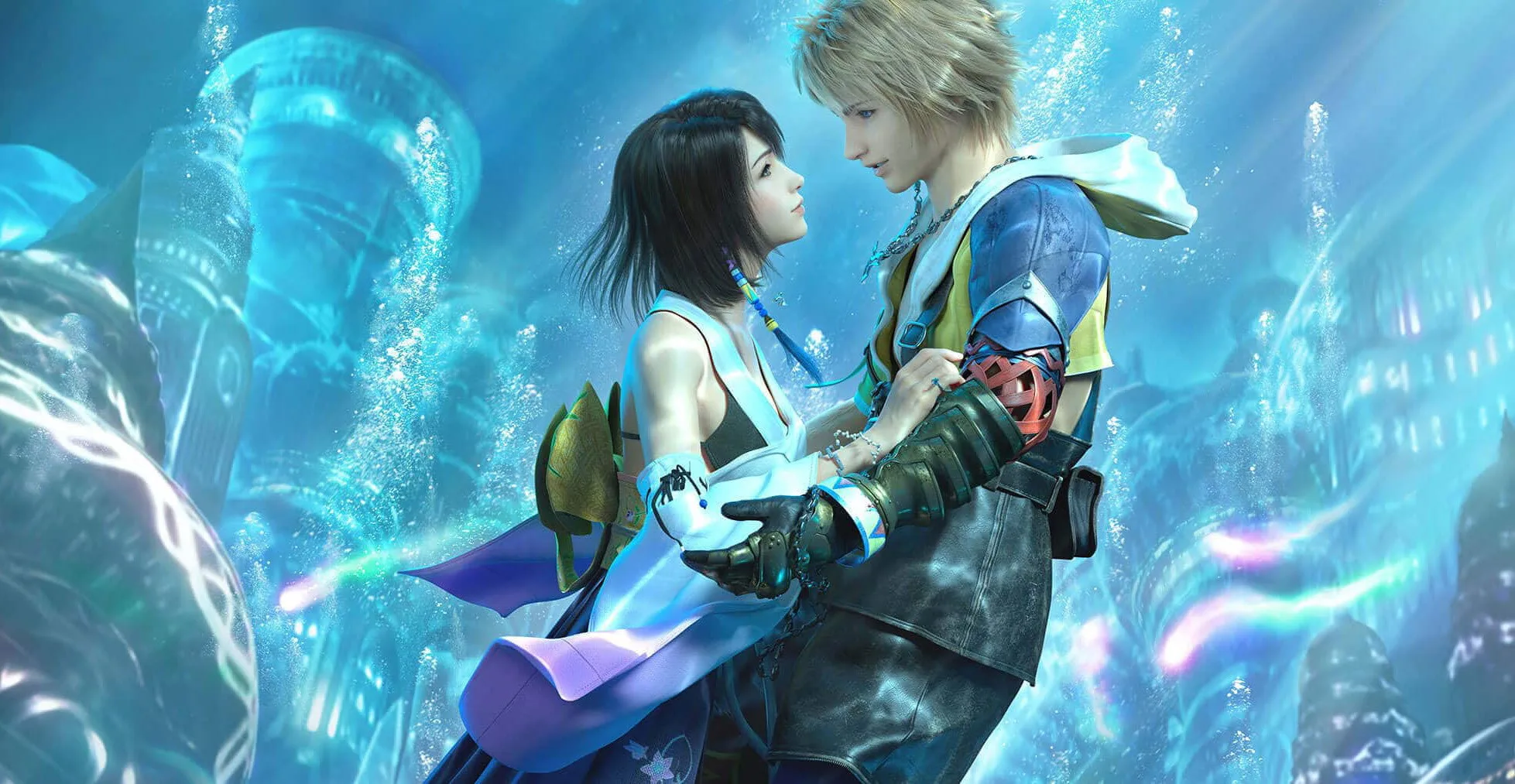
Tidus and Yuna
of this culture. And the characters manage to be both naive and wise for the ages they are supposed to be.
This idyll made me think so much that I started looking for commentary and clues on the internet – not necessarily soundtrack of the game was composed by Nobuo Uematsu, the man responsible for the music in almost every game Square released from 1985 (including Rad Racer on the NES) until 2004. He stopped at Final Fantasy XI, but later had sporadic collaborations. The other two composers who worked on the soundtrack for Final Fantasy X are Masashi Hamauzu and Junya Nakano. You probably won't remember their names, but the music they wrote is truly special.
It should also be noted that the Remastered version of the game lets you choose between the original soundtrack and the remastered one (which has slightly better fidelity and somewhat better-defined orchestral sounds). I opted for the original simply because I tried to imagine the experience from the perspective of someone who got Final Fantasy X in 2001 and enjoyed it on a PlayStation 2. But when I play through the adventure again, I will definitely change the setting. to acquire material to add to this already long article, but to satisfy some personal curiosities. Well, in the original Japanese version, Tidus has a name that refers to the Sun, and Yuna represents the Moon. The cosmic meeting between the two takes place at a rare and unique moment… and the result is always memorable and even spectacular for those who watch it. But as opposing astral entities, they have a short and decisive window in which to meet.
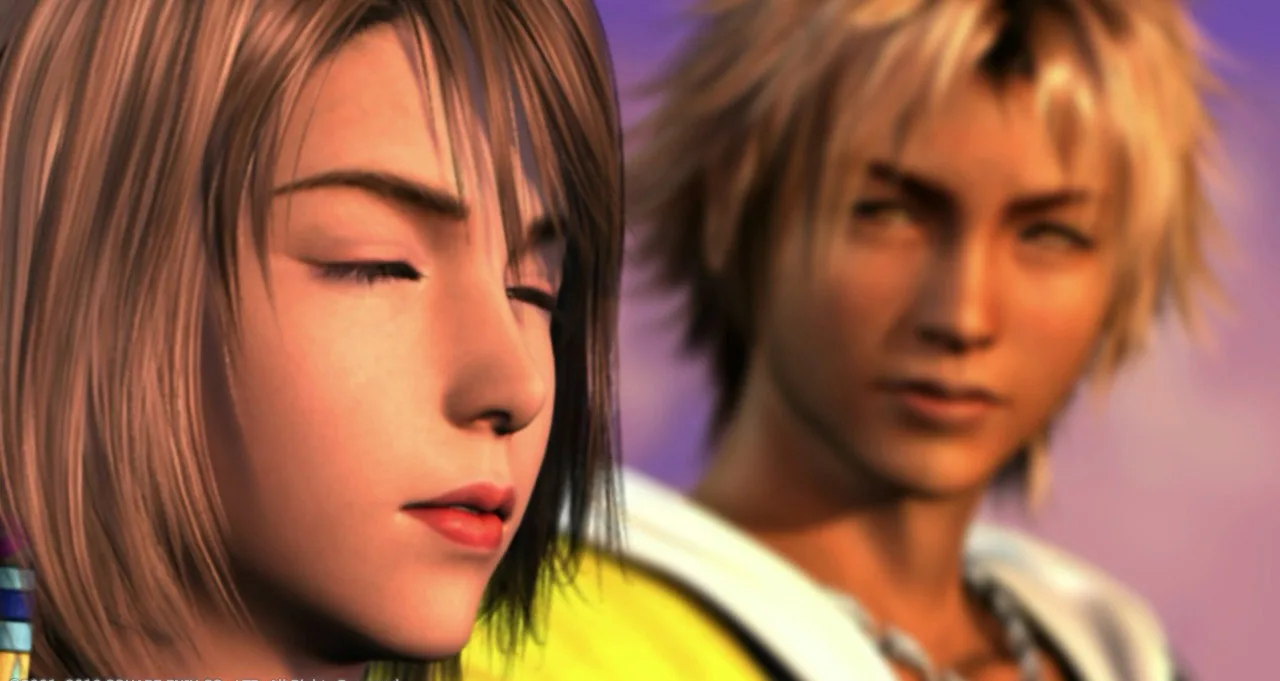
The dialogues between Tidus and Yuna are seemingly mundane, marked more by a timid and reserved attitude. But the thoughts and intentions they express beyond words prove to be much deeper by the end of the game. They share only one spontaneous moment of tenderness, after which they submit to a destiny that demands sacrifices. Later, we get the chance to discover Yuna's unrequited love for Tidus… but by the time we find out, it's already too late to fix anything. Yuna uses a sphere that records her thoughts and monologues throughout the journey (a kind of magic vlog that pilgrims facing Sin make for posterity), and Tidus discovers the messages when the new information is more painful than joyful. Some of the reflections from the female character's perspective can become heartbreaking, especially when you know everything that happened in the past and realise that it's all irreversible.
When I wrote the article “Japanese People Make the Best Games”, I thought about this aspect too: Americans (or Western cultures in general) wouldn't have been capable of writing and staging a love story like this. They wouldn't have been able to capture the purity of first love without bringing in carnal elements, and they wouldn't have been able to resist adding obscenities or sappiness. And I believe Final Fantasy X is worth playing and seeing through just to discover the love story between Tidus and Yuna.
Foreign Languages, Exotic Sports, Treasures and Hidden Lands
The main story only makes up about 80% of Final Fantasy X's content. Beyond that, there are parts of the game that can be discovered, explored and exploited to gain more experience points and rewards. As I mentioned earlier, you get the chance to learn a foreign language to understand the dialogues spoken between members of the Al Bhed clan. Deciphering it is largely a matter of swapping letters (for example, A is Y).
It's Final Fantasy X's equivalent of Klingon from Star Trek or Orcish from the Warcraft universe. But unlike those series, which have exploited their linguistic inventions over several decades, the Japanese developers at Square only used Al Bhed in two games: Final Fantasy X and its sequel, X-2.
Remember blitzball? It's the reason Tidus and Wakka become friends in the first place, but also a sport you can play. Square probably wanted to offer a complete experience that fully justified buying the game. And yes, minigames aren't new – even back in Commander Keen, you could enjoy a game of Pong. But in Final Fantasy X we're talking about a blitzball league you can sign up for, where you can recruit new players for your team depending on your budget, and where you earn useful combat bonuses for your characters. In other words, the minigame isn't just decorative; it unlocks certain items and abilities you can't find anywhere else.
Blitzball, however, is a sports game based more on mathematical calculations than on quick reflexes and coordination. In other words, it's still a turn-based RPG where you're faced with choices. If you're a forward with 12 shot points and you're up against a goalkeeper with 20 save points, then any attempt to score will be blocked by the superior abilities of the player the numbers favour. However, these numbers drop during the game as the players tire, which can give you various tactical advantages.
I have to admit, blitzball isn't my kind of game at all, and I abandoned it quite early on – which didn't affect the story one bit, but did limit the final attacks (Overdrives) I could unlock for Wakka and deprived me of some powerful weapons that would have made defeating Sin much easier. The sport is entirely optional, but it can offer certain advantages.
Final Fantasy X is a fairly linear game, but it also has crossroads where you can stray from the main story to do a side quest or explore another land. You can end up discovering monsters far more powerful than Sin himself and facing challenges that demand a good mastery of your arsenal of spells and items. Nemesis (a beast created just for the arena) and Penance (the toughest monster in the game, which you only unlock after beating all the others) can give you extra reasons to GRIND for several dozen hours.
What's more, as is traditional in the series, towards the end of the game you gain access to an airship that lets you revisit every part of the game. If you scan certain points on the map, you'll also unlock hidden areas that offer extra treasure and rare items. Again, it's absolutely not mandatory to try to explore every region of the game.
But this magazine is called GRIND, and I really did try to venture out as much as possible (even if I didn't get too bogged down in tough, long battles, and blitzball didn't appeal to me). I can say that, most of the time, the rewards in the game are worth the effort. However, the most interesting part of Final Fantasy X is the story – and I strictly recommend playing through that (you'll need at least 50 hours to reach the end anyway). For everything else, you can watch YouTube videos of people who genuinely have nothing better to do than spend hundreds of hours unlocking absolutely every bonus hidden behind repetitive tasks.
Why do I recommend Final Fantasy X?
When was the last time a game made you feel something? Have you had moments in recent years when you got emotionally involved in the action and projected your own expectations onto the characters? I ask because Final Fantasy X is the kind of game I elevate to the rank of art – not because it puts pixels and polygons on screen in a spectacular way (though it does, and it far exceeds the standard of 2001), not because of any out-of-the-ordinary gameplay elements (though it makes its own contributions to the genre's progress), but because it makes you live the events alongside the characters. A new lunch-break hobby of mine is searching YouTube for clips of players who literally burst into tears at certain scenes – and if I were a bit softer, I'd probably have done the same (ninja warriors chopping onions don't count).
Over the hours of play you feel Final Fantasy X purifying you, helping you reflect on your own condition. It helps you confront dilemmas and plot twists you've most likely never come across anywhere else. And even in the calmest moments it puts your brain to work solving the transitional puzzles between scenes and battles. X helps you make your peace with the idea that you'll never have anything perfect, and that a happy, flawless ending isn't possible – whatever choices you make, you'll end up accepting sacrifices that won't let you have it all.
In the end, you'll let go of the keyboard or controller and ask yourself, 'What would I be willing to sacrifice, and for what – or for whom – would I be willing to do it?' And accepting sacrifice in the name of greater ideals is something genuinely uplifting, something only true art can explain to you and instil in you.
I know, I'm only talking about a game I bought from Altex for 100 lei (and which, through the good graces of Square Enix, is now available on every platform from PC to Switch). But Final Fantasy X was the best purchase I made in 2021 – it helped me accept certain losses in my life and inspired me to start a new magazine project just so I could write this oversized article.
When was the last time gaming was more than a passing distraction, or a way to fill the moments of waiting and boredom? When was the last time you discovered something so good that it gave you the motivation to put up with all its little imperfections just to find out more about the story? When was the last time finishing a game sent you obsessively consuming every scrap of content you'd missed, reading about other people's experiences and analyses?
Which is exactly why I recommend Final Fantasy X: it's more a fully realised parallel universe than a mass-market product. It won't be to everyone's taste, but everyone who sets off on the adventure alongside Tidus and Yuna will come away permanently changed for the better, managing to rediscover that kind of purity of intention which sometimes seems to be missing from our world. GTA III may well go down in history as the best game of 2001 – but if I have to choose between playing through Claude's story for 20 hours or redoing Yuna's pilgrimage for 50 hours, I'll pick Final Fantasy X every single time.
0 votes
Scroll down here and stay on the page for at least 30 seconds to vote.
Pick a score from 0 to 10 (halves are allowed).