
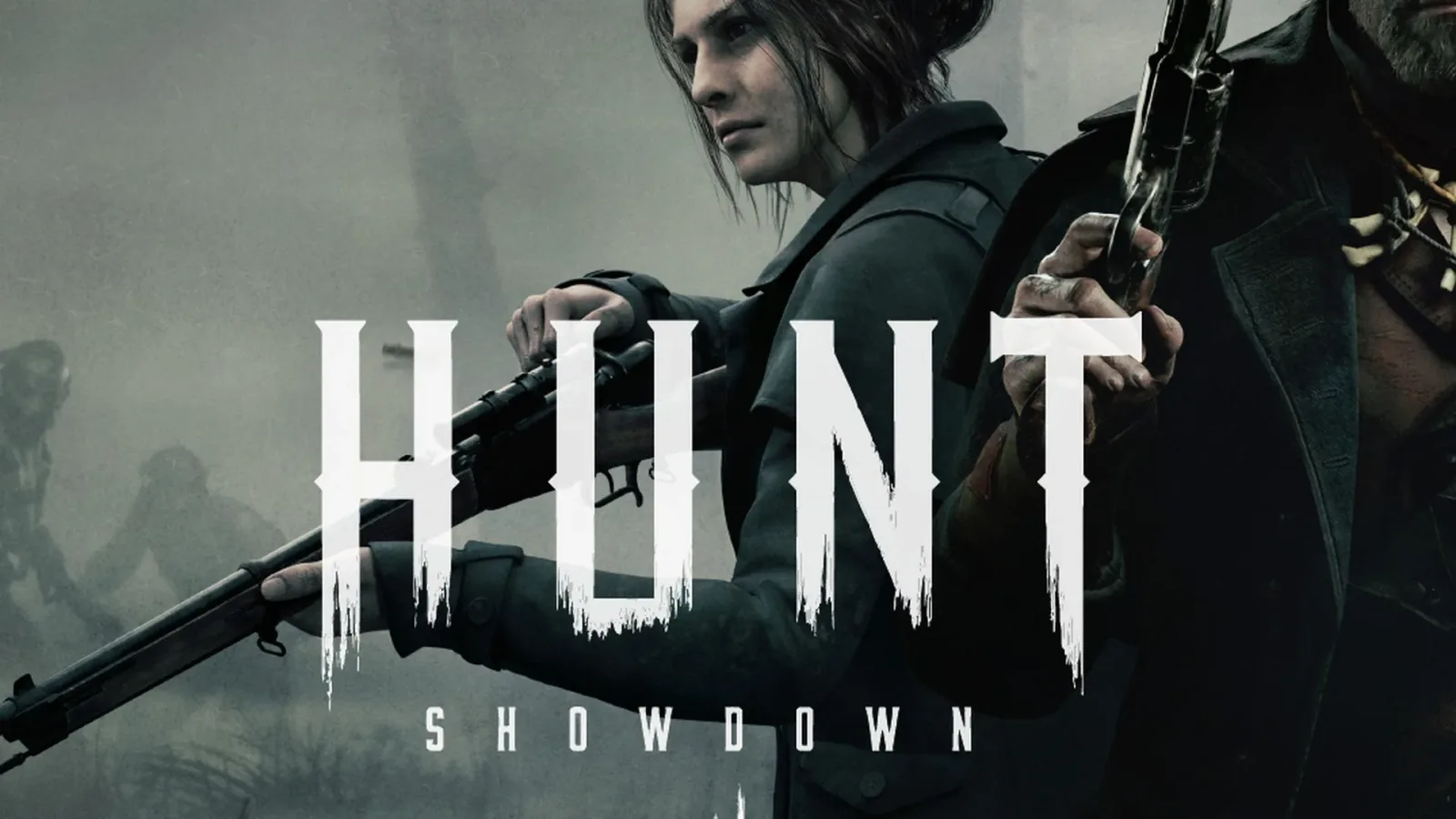
Hunt: Showdown 1896
First published in GRIND V, pages 94–101.
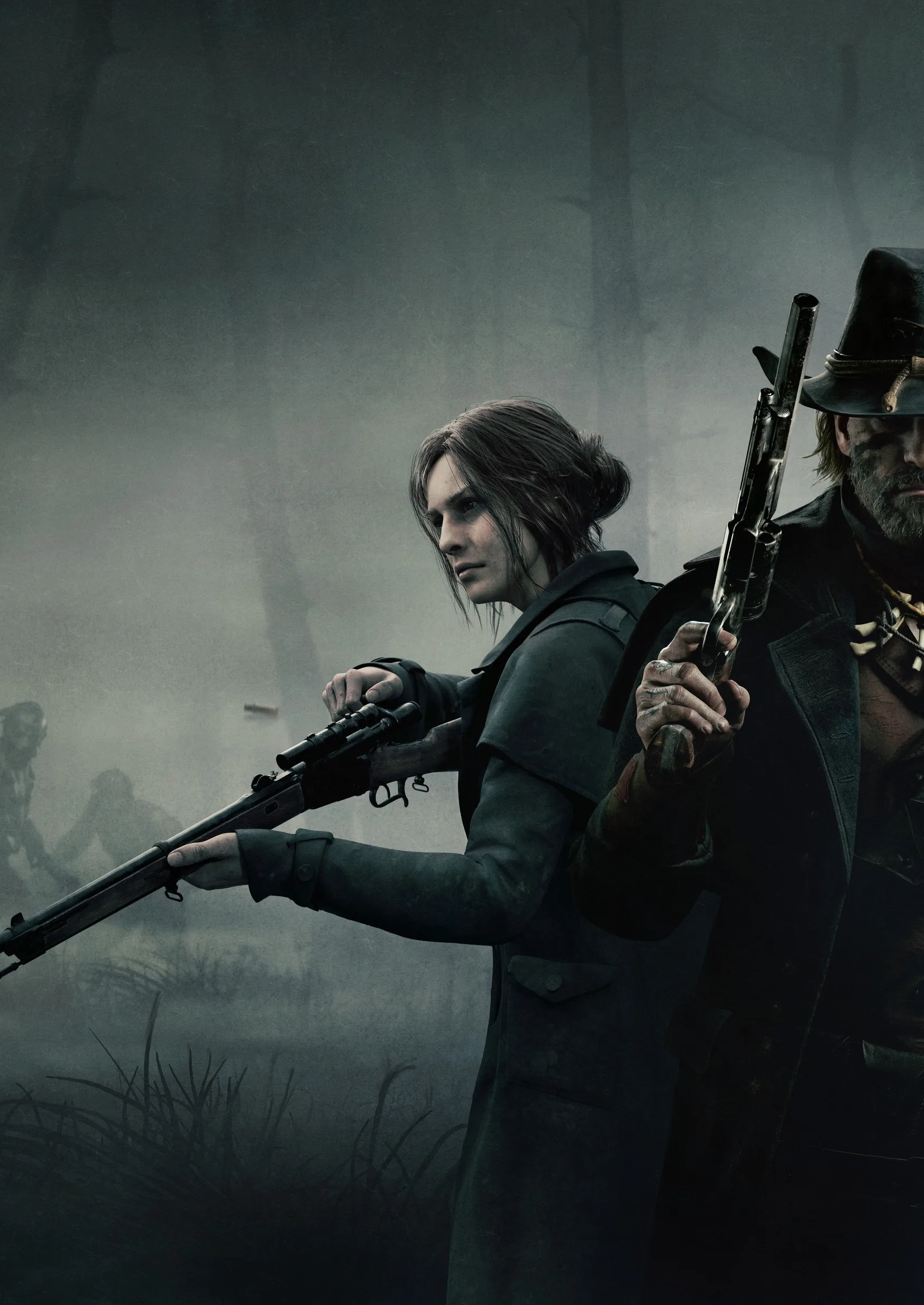
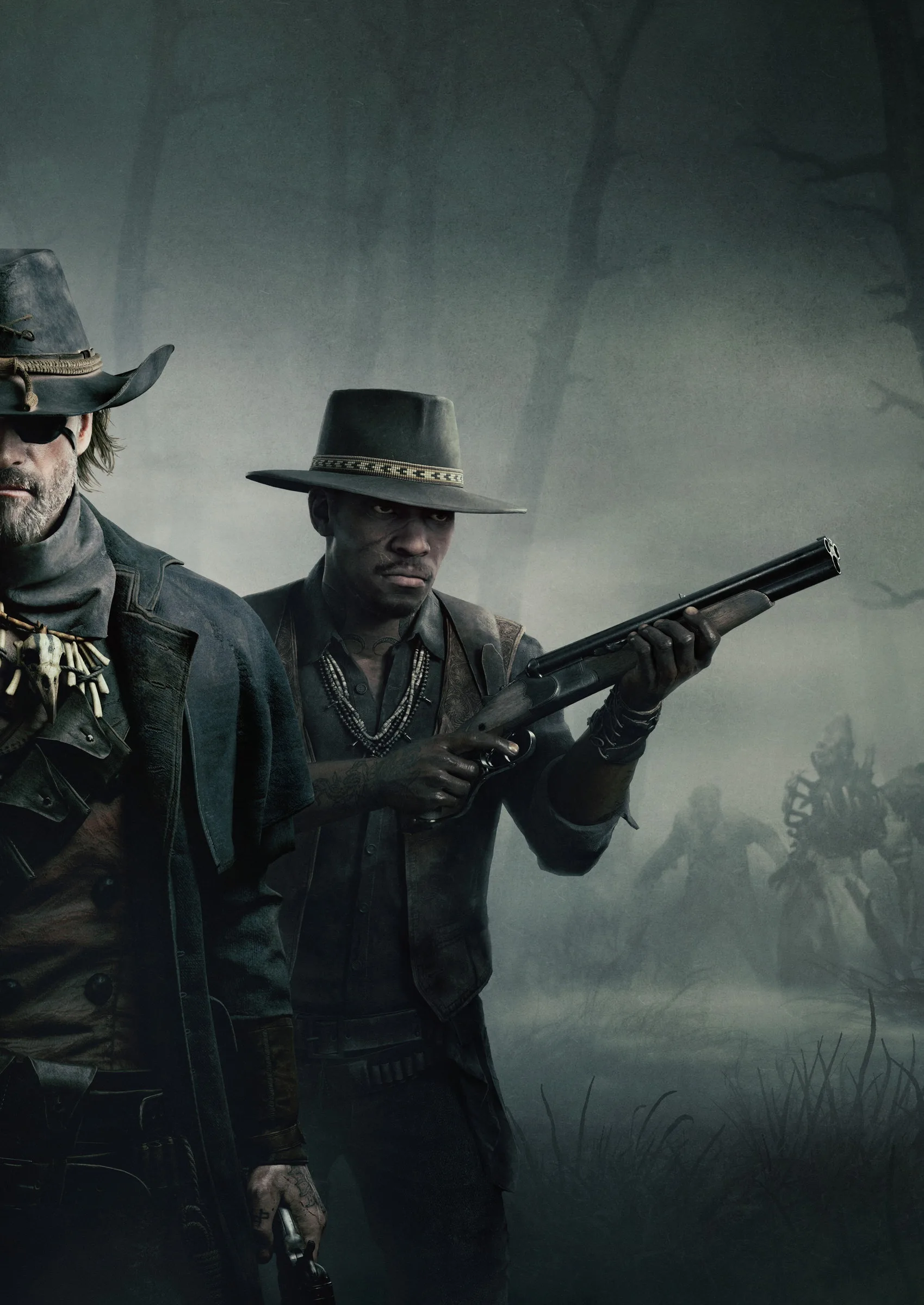
A LOVE LETTER TO THE MOST
ATMOSPHERIC GAME OF THE LAST DECADE
I've played Hunt: Showdown on PC from the very start.
Exclusively. Not because I didn't have access to a console, but because something in this game's DNA always told me it was made for a keyboard, a mouse and good headphones. Sound is half the experience. The other half is pure tension, atmosphere as thick as Louisiana mud, and decisions that take your breath away.
If you're reading this and you've never played Hunt: Showdown, let me say it upfront: it isn't an easy game, but it might be the most special game you never knew you needed.
GAMEPLAY
THAT
TESTS YOUR NERVES
At its core, Hunt: Showdown is a PvPvE game (Player versus Player versus Environment), in which up to 12 players – solo, in duos or in teams of three – compete to locate and eliminate one or two legendary monsters, then have to get off the map alive, extracting the bounty.
Sounds simple... but every step, every breath, every decision can be fatal. This isn't a classic shooter where you survive just because you fired first; in Hunt you survive because you listened better, waited for the perfect moment, or knew when to run. Every match is a mix of strategy, experience and instinct, plus a healthy dose of luck and nerves of steel.
What sets Hunt:
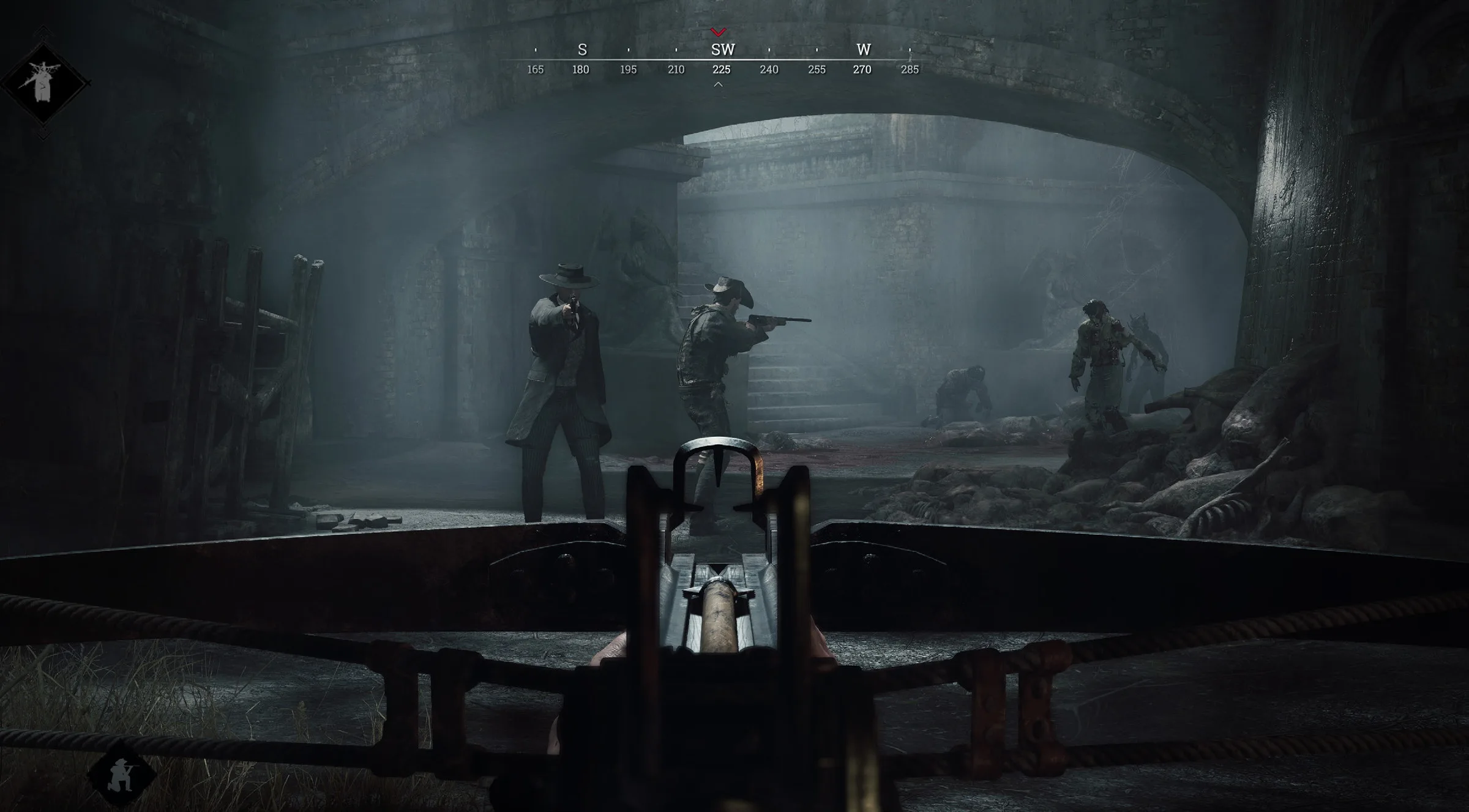
Showdown radically apart from any other shooter is the way it organically braids PvE and PvP together in a confined, tense space where every action can be tracked and heard by the other players. You fight terrifying creatures – the giant spider crawling across the ceiling, the Hellhounds that come in packs, or The Hive, which sends toxic swarms of insects at you – but at the same time you have to keep your ears pricked. Because any gunshot, any broken window, any startled crow can give your position away and pull in other hunters, who aren't only after the same monster but also the chance to take you out and steal your bounty. (What I wouldn't give for a Bounty bar right now.)
Unlike traditional battle royales, where the winner is the last one standing, in Hunt victory comes only through extraction, which adds another layer of tension. You can play aggressively, chasing the fight, or you can turn into an opportunistic vulture, lying in wait for the right moment to snatch the bounty off someone else. Neither approach is wrong, and each comes with its own risks.
The maps are populated with zombies, infernal creatures and sound traps (dogs, wounded horses, flocks of birds) that can raise the alarm. Navigation becomes a choreography of silence, in which the most dangerous thing you can do isn't to shoot, but to step on a shard of glass or accidentally trip a trap you never saw.
That makes Hunt a game of detail, patience and calculated decisions. There's no minimap. No radar. Just sound. Only what you see and what you know might be hiding beyond the next dark corner.
There is, however, a mode called Soul Survivor that adds a unique angle: a sort of PvEvP battle royale in which only one player can come out on top. Here it's no longer just about the bounty, but about pure survival. And the fact that you can recruit the winning character for the classic modes adds yet another layer of strategy.
On top of that, the Bounty Clash mode was built specifically for people who want immediate action. It strips out the exploration and throws you straight into the firefight: four teams, one location, one bounty. No boss, no breathing room. It's a mini-coliseum where every move counts and the tempo is far faster, but where sound, positioning and weapons still matter enormously.
All of these modes are held together by one central mechanic: if you die, you lose your hunter. Not just the gear, but that character's progress, their abilities and the money you put into them. This permadeath gives every decision weight and makes every extraction a genuine victory.
something that refuses to leave. With the 1896 update, Hunt leaves the swamp for the first time, and we get a mountainous stretch of America in Mammon’s Gulch, a fictional region inspired by the Rocky Mountains of Colorado. The change of scenery doesn't spoil the atmosphere, it enriches it. If the swamps of Stillwater Bayou and the rotten floor of DeSalle had a kind of wet horror about them, in the Gulch you feel something else: the cold emptiness of rock, the deep silence of the mines, and a potential violence lurking behind every corner of stone.
Mammon’s Gulch introduces verticality the series has never seen: hills, grottoes, mountain passes, narrow valleys and even mega-structures like the Oro Gordo mine, which work as veritable labyrinths THE ATMOSPHERE IS A CHARACTER of overlapping corridors and rooms, all If gameplay is the heart of Hunt: Showdown 1896, then atmosphere is certainly its soul. In an age when most shooters are fast, bright and chaotic, Hunt takes the opposite road: slow, grim, silent. It draws you in not with explosions but with tension; not with spectacle but with atmosphere. It's the kind of game where you aren't frightened by what you see, but by what you hear, and above all by what you haven't heard yet.
Starting with the sound design, Hunt:
Showdown 1896 reaches a rare level of realism and artistic intent. Crytek has implemented the CrySpatial system, a dedicated 3D audio solution that lets the player perceive the direction and distance of every sound with impressive accuracy.
When you hear a chain swinging in a barn or a dog barking away to your left, you can trust that the sound was intended, calculated, and – most importantly – heard by someone else too.
Every sound is like a piece of a puzzle. Wood creaking underfoot, a hunter's ragged breathing after a desperate sprint, the lap of water as you cross a marshy stretch, the groan of doors, crows bursting into flight – all of it can give you away. This isn't a game to play with your speakers turned down low; Hunt is played with headphones on and your heart in your throat.
And sound isn't the only thing playing a crucial role.
The world itself, with its gothic, dark, alternate-history aesthetic, is one of the most immersive environments ever built for a multiplayer game. The original game carried you through the damp swamps of Louisiana, an America sick with something supernatural, where everything seemed to have died long ago and yet was still moving. Collapsed cabins, open graves, ruined churches, mould-covered barns – all of it looks like an abandoned past, but one haunted by laid out with Swiss-watch precision.
Positioning on the map becomes more strategic than ever. The high ground is a blessing and a condemnation both, because it leaves you maximally exposed.
And yet, impressive as Mammon's Gulch is, the game's real atmosphere is found in the return to the classics: in the shadow of the cross at Stillwater Cemetery, in the ruins at Lockbay Docks, in the silent dread of Pitching Crematorium. More recently these classic maps have had a full visual remaster, rebuilt in the new CryEngine 5.11: more realistic water, richer vegetation, improved textures and global lighting that transforms the night- into something that can no longer be ignored, only feared. Each map has its own personality, its own visual history, its own shadows that seem to tell forgotten stories.
It's easy to lose yourself in a landscape, to stop fighting just to watch the moonlight fall across a burnt forest, or the fog lift off a forgotten mill. But be warned, Hunt never lets you forget that beauty is only a The atmosphere in Hunt: Showdown 1896 isn't just a background element. It's a stage set for death. It isn't gothic poetry a character in itself. It provokes you. It tricks you. It embraces you only to betray you. And gratuitous, it's the perfect trap. Which is exactly why, once you've stepped into its world, it's hard to get out again.
THE GAME'S CONSTANT EVOLUTION
One of the things that define Hunt: Showdown 1896 isn't only its disturbingly realistic atmosphere or the tension of its gameplay, but the fact that it's a living game. From its launch in 2018 right up to the present, Hunt has never stopped transforming, growing, refining itself. And the massive 2024 update, known as Hunt:
Showdown 1896, marks a significant turning point in the title's history, a kind of 'soft reboot' that brings with it the promise of another decade of life for the game. The move to CryEngine 5.11 meant more than a simple aesthetic upgrade.
Beyond the clear improvement in visual fidelity — finer textures, realistic lighting, more coherent reflections and a global illumination system — the new engine allowed for the introduction of modern technologies the community had been asking for: support for HDR, DLSS, FSR and DirectX 12, plus a “true speed of sound” audio system that adds an extra layer of auditory realism. Sound is an essential element of Hunt, not just as aesthetics but as a survival tool.
With CrySpatial, Crytek pushed that idea further, offering a 3D audio system based on HRTF (Head-Related Transfer Function), capable of accurately rendering the direction and distance of every sound in the game: footsteps, gunshots, sound traps or the simple rustle of wind. Combined with the new “true speed of sound” system, where a gunshot fired at a distance reaches you after a realistic delay, the result is a soundscape with a vital tactical dimension. Players who choose to play with stereo headphones, CrySpatial switched on and no other external audio filters get an immersive, competitive acoustic experience that few other titles can match.
Malone for the Murder Circus event, they transformed the game into a living space that breathes in time with the people playing it. The collaboration with Port Sulphur Band, made up of Crytek developers themselves, or the release of the Rise Up Dead Man Anniversary Collection album are just a few examples of how Crytek encourages a spirit of community and creation.
For me, Hunt has also meant
PLAYER REACTION
Although the changes weren't without controversy, especially when it comes to the new UI, which some veterans perceived as too “console-ified”, most of the technical and gameplay updates were well received. The new map was praised for how refined it is, and the reworks of the older maps were read as clear proof that Hunt isn't an abandoned game but one still being built.
Another remarkable aspect of Hunt:
Showdown is its dedicated community. In an industry where plenty of games lose their player base fast, Hunt has held on to — and cultivated — a loyal core of fans who don't just play every day but take an active part in the game's development. From constant feedback on Reddit, Discord or Steam to direct suggestions that ended up shaping map and menu design, the community has become an integral part of what Hunt: Showdown means today.
A concrete example of that bond was the players' reaction to the changes brought by the 1896 update. Although the launch arrived with a wave of criticism, Crytek didn't stay indifferent. What followed was a period of intense communication: initiatives like Community Triage, frequent patches and clear promises that feedback would be taken seriously. In a landscape where developers often ignore player discontent, Hunt has become a rare model of transparency and adaptability.
But perhaps the most beautiful side of the Hunt community is its creative, human one. The themed events, such as the unexpected collaboration with Post the discovery of a new world in streaming. That's how I stumbled on one of my favourite Twitch streamers, Ghouly (https://www.twitch.tv/ghouly), who plays Hunt almost exclusively and does it with contagious passion. With over 14,000 followers and an average of 187 viewers per stream over the last 30 days (at the time of this article), Ghouly ranks 11th among Hunt: Showdown 1896 streamers.
In a vast community of streamers, Ghouly stands out for her authenticity and charisma. Describing herself, with humour, as “a rat in an egirl costume”, she brings a distinctive note to the streaming landscape. Her playstyle is a mix of strategy and humour, keeping a relaxed atmosphere even in the game's tensest moments. The constant interaction with chat and her genuine reactions create a real connection with viewers. One example is the clip titled “you save me… I save you.”, which shows off both her in-game skills and the close relationship she has with her community. Beyond streaming, Ghouly also expresses her creativity through how she looks, changing her hairstyle and style often, as you can see on her Instagram profile. That visual expressiveness reflects her vibrant, open personality.
Her community is a welcoming, active one, where newcomers are greeted warmly and the conversations are lively and full of jokes. That positive atmosphere turns every stream into a pleasant, absorbing experience. Ghouly isn't just a talented Hunt:
Showdown player but also a content creator who brings joy and authenticity to her community. Through her unique style and the sincerity of her interactions with fans, she manages to create a virtual space where everyone feels welcome. She's just one example of the people who make up this community.
The Hunt community as a whole is a fascinating mix of veteran players, content creators, artists, passionate developers and fans who aren't afraid to criticise or praise when it's deserved. And it's precisely that real connection between everyone involved that makes the game more than a shooter: a collective experience that keeps evolving.
Since we're on the subject of controversies, one concerned the Ghostface crossover. The iconic character from Scream, even reinterpreted in a “historical” form by Crytek, was seen by many as an unacceptable intrusion into the Gothic American atmosphere of the 1890s.
Forums and Reddit filled up with bitter jokes: “If Ghostface is in, how long until Shrek and Goku?” Crytek's answer was clear: “We won't introduce characters that destroy the game's tone. You won't be seeing a Peter Griffin or any anime in Hunt.”
Whatever problem cropped up or was raised, Crytek never hid behind silence. Unlike other developers, they quickly put out a Developer Update video, brought in the Community Triage system to organise bug reports straight from the community, and promised a gradual overhaul of the interface in the patches to come. They openly admitted that “we didn't communicate the new UI direction well” and that “we learned from your reactions”.
That honesty, rare in the AAA industry, calmed tempers somewhat.
Even so, perhaps the biggest challenge is the day-to-day one: keeping the balance between realism and playability. Whether it's footsteps that don't sound right on the vertical axis, players camping in bushes or inconsistent hit detection, Hunt remains an imperfect game. But, like the world it builds, its beauty comes from those imperfections too.
And Crytek's willingness to listen and try to fix things, to keep going even when they get it wrong, is why a lot of us give it another chance. And another. And another.
A UNIQUE EXPERIENCE IN THE REALM
OF “EXTRACTION SHOOTERS”
Hunt: Showdown 1896 isn't for everyone, and it doesn't try to be. It's not the kind of game that waits for you or gives you any respite. It's slow, tense, sometimes merciless, and often without glory. You can go into a match with the best intentions and come out ten minutes later, charred by a Hellborn or shot in the back of the head by a player hiding in the trees, with zero rewards and a hefty dose of frustration.
But if you're patient, if you learn, if you listen to your own footsteps and master your fear, the reward is beyond compare.
In an industry where everything seems to be in a hurry, where shooters get faster and faster, where everything is instant and satisfaction can be filed as “disposable”
Hunt: Showdown 1896 dares to be different. It asks you to stop. To listen. To watch. Not to shoot. To set a trap. To understand that sometimes the best bullet is the one you don't fire. It's a game that rewards silence, attention and the ability to act deliberately, and that is exactly how it manages to create something rare: a genuinely immersive and memorable experience.
It's an ode to the hunt, in the deepest sense. Not just hunting monsters, but hunting authentic emotions, unique stories, the moments when a perfect plan comes off or an unexpected disaster forces you to improvise. It's about that dull fear that stops you breathing when you hear footsteps on the roof. About the moment when all your teammates are down and you have to choose: do you rescue them or extract alone? About the decision to keep a Hunter you've played dozens of matches with, because by now you feel they're part of you.
Behind every gunshot, every sound of breaking glass, every shadow slipping past a tree, there's a
›› SILVIU TĂNASE
team of people who painstakingly built a universe that feels alive. Hunt isn't just about winning — it's about feeling.
About living for a few minutes in a space that breathes tension and mystery.
For me, Hunt: Showdown 1896 was, is, and probably always will be one of the most singular experiences in video games. A game I rediscover again and again, with friends, with the community, with streamers like Ghouly, who turn every match into a story.
A game that won me over not with promises, but with atmosphere, courage and consistency.
If you haven't tried it yet, maybe the time has come. Load your weapon. Light a torch. Listen to the wind. And step into the grim, unforgiving but fascinating world of Hunt: Showdown 1896 — if you dare.
See you in the Gulch. Or maybe Stillwater. But watch out: I haven't fired a shot yet, and I still heard you..00 For me, Hunt: Showdown 1896 was, is, and probably always will be one of the most singular experiences in video games. A game I rediscover again and again, with friends, with the community, with streamers like Ghouly,
FINAL SCORE
who turn every match into a story.
0 votes
Scroll down here and stay on the page for at least 30 seconds to vote.
Pick a score from 0 to 10 (halves are allowed).