
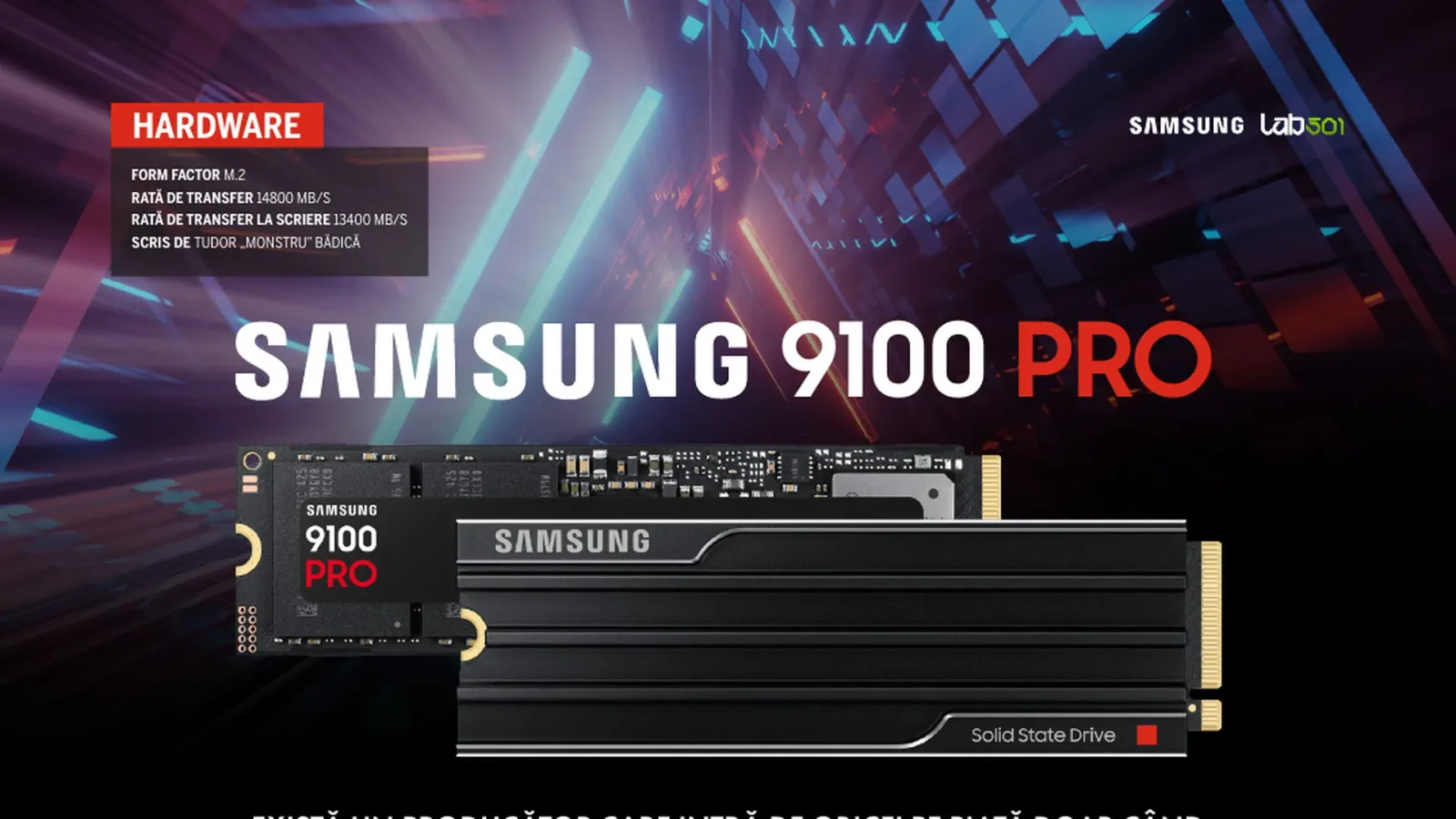
Samsung 9100 Pro
First published in GRIND V, pages 230–233.

FORM FACTOR M.2
TRANSFER RATE 14800 MB/S
WRITE TRANSFER RATE 13400 MB/S
PRO
THERE IS A MANUFACTURER THAT USUALLY ENTERS THE MARKET ONLY WHEN
THERE ARE MATURE SOLUTIONS AND A HIGH DEGREE OF ADOPTION - SAMSUNG
Over the almost 18 years LAB501 has been going, I've personally written more than 1600 articles, the vast majority of them reviews — which has kept me up to speed with every new technology launched in the last two decades, from the perspective of a working professional in the field.
And although I genuinely enjoy doing this job — born out of passion and nothing else, after all — as I'm sure you've gathered by now, not all articles are created equal... and between you and me, they couldn't be.
I say that because we cover a wide range of subjects, from processors and graphics cards to cases, peripherals, laptops and phones. And it's quite hard to put a graphics card launch on the same footing as a case launch, for example, not to mention the fact that not even all graphics card launches are alike. Sometimes you're dealing with a revolutionary product that brings a leap in performance the likes of which we hadn't seen before; other times it's variations on the same theme, with technological progress handed out in carefully measured doses.
What's certain is that some articles are closer to my heart (and, I'd guess, yours too), and that's easy enough to spot. And today I think we're dealing with one of those articles... You see, it's been 10 years since we tested the first NVMe SSD on LAB501, 6 years since the first PCI-E 4.0 NVMe SSD, and 2 years since we tested the first PCI-E 5.0 drive, and I've been following the subject closely ever since. So over the last two years I've tested models based on the Phison E26, from GIGABYTE and ADATA, the Innogrit IG5666 from ADATA, and the Phison E31T from Corsair, and I've kept a close eye on the new products announced at Computex or CES.
Well, every time it was pretty clear that the manufacturing process needed refining — the 12nm and 7nm lithographies used by the controllers we tested throw up problems the moment you start talking about the power-to-performance ratio.
That's why the PCI-E 5.0 SSDs launched so far have either come with somewhat conservative firmware on the performance side, or with a system of enormous cooling — in some cases we're literally talking about SSDs shipped with active cooling!
Against that backdrop, the whole industry is waiting with bated breath for the new controllers to launch, with several manufacturers trying to come up with the winning solution.
I'm talking, of course, about Silicon Motion and their SM2508, which is already in testing in implementations from several manufacturers, ADATA and Patriot among them. Maxio Tech's MAP1800 should also be ready for launch in 2025, Phison are preparing the E28, while Realtek have announced they'll launch the RTS5783 in 2026.
And yet the biggest NVMe SSD manufacturer still hasn't made its presence felt in the PCI-E 5.0 segment (I mean full-power solutions, not compatible ones), with enthusiasts waiting for their implementation with bated breath. Because there's one manufacturer that usually only enters the market once there are mature solutions and a high level of adoption, and that manufacturer is called Samsung. Initially, Samsung have
OVERVIEW
The Samsung 9100 Pro 2TB ships in the packaging that has already become standard for Samsung SSDs, with the SSD and the user guide in the box. As befits a manufacturer of Samsung's calibre, there's no plastic in the package any more: the box, the SSD holder and the envelope the user guide comes in are all made of cardboard.
As I was saying, the Samsung 9100 Pro 2TB is currently available in 3 variants, namely 1TB (199.99 USD MSRP), 2TB (299.99 USD) and 4TB (549.99 USD), with the 8TB version to follow later.
been at the forefront of PCI-E SSDs, offering some of the first NVMe solutions 10 years ago, but as the market evolved, the Korean giant tackled the PCI-E 4.0 generation with maturity, dodging the first wave of launches, and it looks like we're getting the same approach with PCI-E 5.0 SSDs. That strategy makes Samsung's drives among the most stable and best-performing SSDs of their generation, but also among the ones on the market — and the 8TB version. We got the 2TB model in for testing, and it sells here for a starting price of around 1399 RON.
It can hit sequential read speeds of up to 14700 MB/s, and write speeds of up to 13400 MB/s, and it's made up of a Samsung Presto controller (S4LY027), produced on Samsung's 5nm FinFET process, 2 Samsung V-NAND V8 TLC ICs with 236 layers, plus 2GB of LPDDR4X memory for cache. The manufacturer quotes an endurance of 1200TBW for the 2TB model, with a standard 5-year warranty. Last but not least, I should mention that Samsung the most sought-after by consumers. Well, on 25 February Samsung announced the 9100 Pro series, made up initially of 3 models, with capacities of 1TB, 2TB and 4TB, with the flagship model, which stores up to 8TB, to follow over the course of 2025. Naturally, we prepared ourselves properly — not just with a performance test for the Samsung 9100 Pro 2TB, but with a comparison of the PCI-E 5.0 solutions currently on the market too. The 9100 Pro 2TB is a perfectly ordinary NVMe SSD, looking like any other Samsung Pro-series SSD launched so far, and it ships without a heatsink. There is, however, a 9100 Pro Heatsink variant too, which will sell for an MSRP $20 higher than the equivalent model without one.
SAMSUNG MAGICIAN
Whether we're talking storage, peripherals or motherboards, a well-built companion utility can improve the experience for the consumer, and that's exactly the point of Samsung Magician. Through it we get access to a whole range of useful functions, such as firmware updates, secure erase, encryption, data mi-
TEST SYSTEM
We used a platform built around an X870E AORUS Xtreme AI Top motherboard and an AMD Ryzen 7 9800X3D processor, together with a GSkill TridentZ 5 Neo 32GB DDR5-6000 CL28 memory kit, set to DDR5 6000 28-36-36-96. The processor is cooled by a Noctua NH-D15 G2 LBC.
We used an Nvidia GeForce RTX 5080 graphics card, with the latest driver available on the manufacturer's site. The operating system was installed on a 2TB PCI-E 4.0 Kingston Fury Renegade SSD – obviously, we're running Windows 11 Pro, fully up to date. We only use licensed operating systems, benchmarks and games, all kept current with updates. The system was tested out in the open, on an OpenBenchtable BC1 V2 test bench, at an ambient temperature of around 25 °C, using a Seasonic PRIME TX-1600 Noctua Edition PSU and an MSI MPG 321URX QD-OLED monitor. For the best possible repeatability, the SSD was connected as a secondary drive in the system, using the M.2 PCI-E Gen 5 slot wired straight to the processor. Testing always began after a Secure Erase, and the tests were always run in the same order so the results could be compared with those from other SSDs tested over the years.
gration of data or setting over provisioning (which is set to 186GB by default).
With the utility we can also test the SSD for any errors, monitor how much data has been written or the drive's temperature, and get at a range of performance-related settings. So, in the Performance Optimization tab, we see there are three preset modes (Power Saving, Standard and Full Performance), plus a Custom mode, where we can set the parameters we want for Over Provisioning, TRIM and Full Power Mode.
By default the SSD leaves the factory in Standard mode, with TRIM the only one of the three active, but we ran the tests in both this mode and Full Performance mode to see what the differences are.
RESULTS
As I said, we tested both in the mode the SSD comes in from the factory, namely Standard, and in Full Performance mode, set in Samsung Magician. In both cases the SSD was mounted in the first slot on the X870E AORUS Xtreme AI Top motherboard, using its heatsink. Well, a glance at the results below and we quickly reach a few rather simple conclusions.
First of all, the Samsung 9100 Pro 2TB is indisputably the fastest SSD we've ever tested, and the difference between Standard mode and Full Performance mode is pretty small, apart from performance in the 3DMark Storage test.
Secondly, the main difference between the two operating modes is the temperature the SSD reaches after running the whole test suite. In standard mode the temperature never goes above 48 °C, whereas in Full Performance mode we hit 68 °C. In both cases the SSD's performance is enviable, especially considering we're talking about the passive cooling setup supplied with the motherboard. Obviously, we thought it wouldn't hurt to compare head to head the performance of the 4 PCI-E 5.0 controllers we've tested so far. What's more, for anyone interested in the detailed specifications of the 4 models tested on the same platform, we've included a very handy table above. Well, the Samsung 9100 Pro 2TB comes out on top whatever the situation, with the gap to the other models nothing short of drastic in certain cases. And we're not just talking about sequential read or write here, but also operations per second, and loading times in games or various applications, as tested in 3DMark.
CONCLUSIONS
This year it's 10 years since we tested Samsung's first NVMe SSD, the 950 Pro to be precise, along with its OEM variant, the SM951. And from then until now we've tested every SSD in this series, with the exception of the 990 Pro. And as I mentioned in the introduction too, with the exception of the first generation, the 950 Pro, Samsung has made a habit of leaving the “testing” of new technologies to other companies, each time arriving on the market with a mature solution at the right moment. That's why Samsung's Pro series SSDs are probably the best-selling drives in their category, launched at the right time with the right specifications.
This also seems to have been the case with the PCI-E 5.0 generation, with companies like GIGABYTE, ADATA or Corsair launching models powered by Phison or Innogrit controllers over the last two years, while Samsung worked, as ever, on its own controller, built on an advanced process, Samsung FinFET 5nm. And the combination of that, Samsung V-NAND V8 TLC memory on 236 layers, 2GB of LPDDR4X memory and roughly 226GB of SLC Write Cache turns out to be a winning one, with the Samsung 9100 Pro 2TB being the fastest consumer SSD on the market right now. And no, we're not just talking about sequential read or write speeds here; we're talking about the whole range of performance tests, including operations per second, program and game loading, and even temperature. Because at the 48 °C it reaches in standard mode, the Samsung 9100 Pro 2TB is right now not only the fastest PCI-E 5.0 SSD on the market, but also the coolest. Of course, we tested ours passively cooled, using the motherboard's cooling system, as the vast majority of users will most likely run it.
Those who want a drive like this for consoles will have the version fitted with a heatsink, which costs only $20 more, and for notebooks we'll most likely see the OEM version at work, namely the Samsung PM9E1. Of course, that doesn't mean it's advisable to run the Samsung 9100 Pro without any kind of heatsink at all — we're still talking about an SSD with a power draw of around 8.1W in the case of the 2TB model. But these days any PC with a modern motherboard will have at least one heatsink for SSDs, and that is absolutely enough in Standard mode, the way the SSD is configured from the factory. If we want to run mode
Full Performance, then we need to make sure we have a somewhat beefier heatsink to hand, like the ones in the first slot of high-end motherboards.
What's certain is that the Samsung 9100 Pro doesn't need an active cooler to deliver optimal performance, and that performance is above anything the competition offers at the moment. So we can say that Samsung has once again managed to hit the market at the right moment, offering a solution with an optimal balance between performance and heat dissipated, which hasn't really been the case so far with PCI-E 5.0 SSDs.
That means that slowly but surely, PCI-E 5.0 SSDs will start to become more and more widespread, especially in high-end PCs, with Samsung once again the spearhead for popularising a new technology. At the end of the day, that's what it means to be a giant that builds both its own controller and its own memory, with a properly sized R&D team!
Finally, I have to tell you that the Samsung 9100 Pro is already available in shops, at prices of around 929 RON for the 1TB model and 1399 RON for the 2TB model.