
Onimusha 2: Samurai’s Destiny – Review
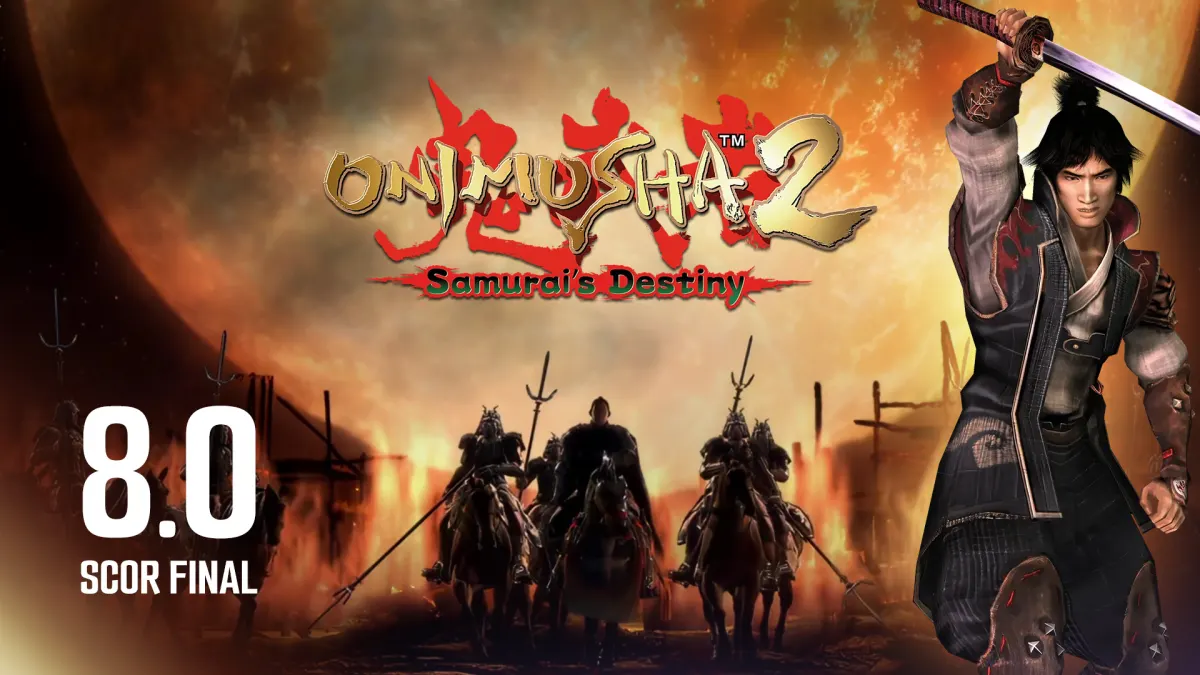
The Oni-moving and the 4 warriors
In a recent article, we talked about the industry's growing trend of releasing remasters. These projects aren't made for the players' sake; they're meant to generate extra income for a new game in the remastered franchise or to gauge market demand for a sequel to a series most fans consider dead. This is how games like System Shock, Legacy of Kain: Soul Reaver, or even The Elder Scrolls: Oblivion have received the support and resources needed to be ported to modern systems. Although not all titles are re-released in HD, those that are chosen usually had some impact on the industry. This is how we can enjoy games like Okami, the original Devil May Cry trilogy, Persona 3 along with Persona 4, or even Kingdom Hearts.

One of the titles I didn't get to play in its time was the first Onimusha – a Resident Evil with ninjas, where the protagonist fights against hordes created by the T-virus with a sword and shurikens. The idea evolved a bit more from this initial premise and became a standalone franchise, which can be summarised as Biohazard in medieval Japan. The first and second games were created in tandem, and the initial plan was for them to appear on the first PlayStation, but it wasn't to be. Although they are part of the same universe, each Onimusha title has its own story. Thus, it is not necessary to play through all the games in the series to better understand the story of Way of the Sword – which will be released next year. There are only two common elements that link all the games: the presence of fantastic creatures from Japanese mythology called Oni, and the great unifier of Japan – Oda Nobunaga. As we've accustomed you to, dear readers, we'll start with the story.
Revenge is not a noble feeling, but it is a human one.
Onimusha 2: Samurai’s Destiny stars Jubei Yagyu, a samurai thirsty for revenge after his village was decimated by the infernal forces of Lord Oda Nobunaga. During his mission, Jubei will discover his Oni powers and the legacy left by the demons' mortal enemies. To face the Genma army, our samurai is tasked with finding five Oni clan crystals. But the protagonist will not face the infernal general's horde alone; he will be aided by four great warriors, each with their own reason for wanting to defeat the great unifier once and for all.
While this is the general story, it can have major differences in each playthrough. Certain events can have different outcomes or even not happen at all, depending on how the player interacts with the game's friendship system. This obscure system requires Jubei to talk to his four allies and offer them gifts at every opportunity. Depending on the friendship level, which is secret and cannot be accessed, the adjutants will come to the protagonist's aid in various battles, will have sections where they can be controlled, or will even betray Jubei if they are dissatisfied with the gifts offered. Although interesting, the opacity of this system, which is essential to the story, forces the player to replay Onimusha 2 several times until they manage to achieve the best ending (or use a guide for the friendship system).

Unlike the first game, this one has no connection to the survival-horror genre. Onimusha Warlords is a classic tale of rescuing a damsel in distress, held against her will in a castle full of demons. The protagonist of that game is literally alone and must face the infernal hordes through calculated attacks and resource management. In the sequel, the genre seems to have changed completely. The emphasis is on action, and the presence of adjutants eliminates much of the tension of the first game. Moreover, the diversity of locations detracts from the fear that Onimusha Warlords evoked, and honestly, I don't really see how I would still feel fear when I'm riding a robot horse to escape an explosion.
Bushido
Compared to the previous title in the franchise, Samurai’s Destiny comes with significant optimisations to everything players loved. A bigger story encompassing several different regions, a simplified equipment upgrade system, and the ability to parry absolutely all attacks in the game. The developers implemented player feedback and made a better game in every respect.
The battles are simple, yet intense. Jubei has five melee weapons in his arsenal (katana, spear, hammer, staff with blades at the ends, and a longsword), complemented by two long-range weapons (bow and a matchlock arquebus). Each tool comes with its own fighting style and magical attacks, which must be combined in a “danse macabre”. Unlike Devil May Cry, there are no combos in Onimusha, and the player must strategically calculate each move. Compared to modern titles, the combat system in Onimusha 2: Samurai’s Destiny is relatively simple and even archaic. Some weapons and attacks are more powerful than others, and the emphasis is on so-called perfect parries. The latter have the potential to eliminate battalions of enemies, one after another. And unlike Warlords, in this title we can also perfect parry boss attacks. However, one of the eternal problems of 2000s titles remained – stun-locking. With some dexterity and a lot of patience, Jubei can catch enemies in an involuntary “combo” from which they cannot escape. But if the protagonist has to work a bit for this result, it is very easy for enemies. Some attacks throw Jubei from one corner of the room to another, and the “synchronisation” of some enemies can have tragicomic results that turn the protagonist into a tennis ball.

Another aspect different from Warlords is the upgrade system. This is simplified in Samurai’s Destiny and allows for a much more efficient investment of points. If in the first game we had to upgrade weapons and powers separately, in this game they have been combined. However, to prevent it from being too easy to reach the maximum weapon level, the number of points required for upgrades has increased exponentially.
Where the combat system suffers the most is in the final battle, due to a design that was either not well thought out or not sufficiently tested. If throughout the game until the final battle we confront demons directly, in hand-to-hand combat, the final boss forces us to use a laser pistol and shoot at him from a distance.
Unfortunately, not only the battles are archaic. The puzzles suffer from a problem due to their simplistic design. Most of them boil down to: find object X and use it at point Y. There are also a few special puzzles that require a bit of thought, and solving them will reward the player with various items, from remedies to gifts and ammunition. These special cases fall into three categories: puzzle box type that requires recreating an image with as few moves as possible, sudoku type, and one with sliding tiles. The puzzle boxes are fun and can challenge many players to deduce the solution, and the sudoku type can be completed with a sheet of paper and a pen handy. The one that makes no sense, however, is the sliding tile one. It doesn't seem to have any logic, and simply pressing the tiles randomly seems to force the solution to appear.

One aspect that many will appreciate is the fixed camera. Each level is divided into several areas, and each area comes with its own angle from which it is presented. Unlike modern games, we cannot control the camera, nor can we see from the “over-the-shoulder” perspective that has become the industry standard today. Forcing a certain angle from which we can see the action has different effects, from suspense to frustration. Unfortunately, the fixed camera that will be appreciated by nostalgic players will most likely be hated by new ones. And this is due to the fact that there will be enemies that we cannot see from the angle presented by the camera.
The Shogun's New Haori
In terms of graphics, the biggest difference from the previous 2002 version is felt. The models look much better, thanks to the HD textures used by the developer for this remaster. The characters are more expressive, and this is due not only to the new models but also to the improved lighting system. It is now clear that Jubei is based on the famous Yūsaku Matsuda. Where a bit more work could have been done is on the textures used for the underground levels, as they are very repetitive and slightly monotonous.
Another good addition to this remaster is the option to choose the dubbing. In the original 2002 version, we could only play in English (at least in the Western versions). I don't consider the acting in the lingua franca to be deficient, but the direction leaves much to be desired. Most accents are taken to extremes, and complex characters end up looking like cheap caricatures and stereotypes. Therefore, I recommend playing the entire game in Japanese (and you can find the option in the audio settings). The direction is far superior to the English one, and the acting has emotional depth, especially when it comes to the monk Ekei.

In addition to these improvements, Onimusha 2 comes with a host of surprises for players. A significant collection of behind-the-scenes materials, from the initial concepts of various characters and enemies to new game modes that even the game's director, Motohide Eshiro, couldn't finish.

Conclusion
Although it may seem like I've criticised the game a lot, I must confess that I appreciate it greatly. As I mentioned above, Onimusha is, in this form, a clear improvement on all the aspects that I, and I'm sure all fans, loved in Onimusha Warlords.
Recently, CAPCOM has brought an important part of its franchise catalogue to modern platforms. And through these ports, it not only reactivates our nostalgia but also introduces new generations of players to the universes that defined our childhood, adolescence, or student years. I consider the initiative of these HD ports to be essential for the video game industry, both from a historical and cultural perspective.
I hope that, in the near future, we will see HD versions for Onimusha 3 and Dawn of Dreams as well. Not least because I wholeheartedly want to play alongside Jean Reno again and shoot an FN P90 at Nobunaga's infernal horde.
Thanks to CD Media S.E. for the review code and for the opportunity to play Onimusha 2 before release, so we could publish this review in time for you.

Played on: Nintendo Switch
Release date: 23 May 2025
Developer: CAPCOM
Publisher: CAPCOM, CD MEDIA S.E. (Romania)
0 votes
Scroll down here and stay on the page for at least 30 seconds to vote.
Pick a score from 0 to 10 (halves are allowed).