
D.N.G.N – Core Game
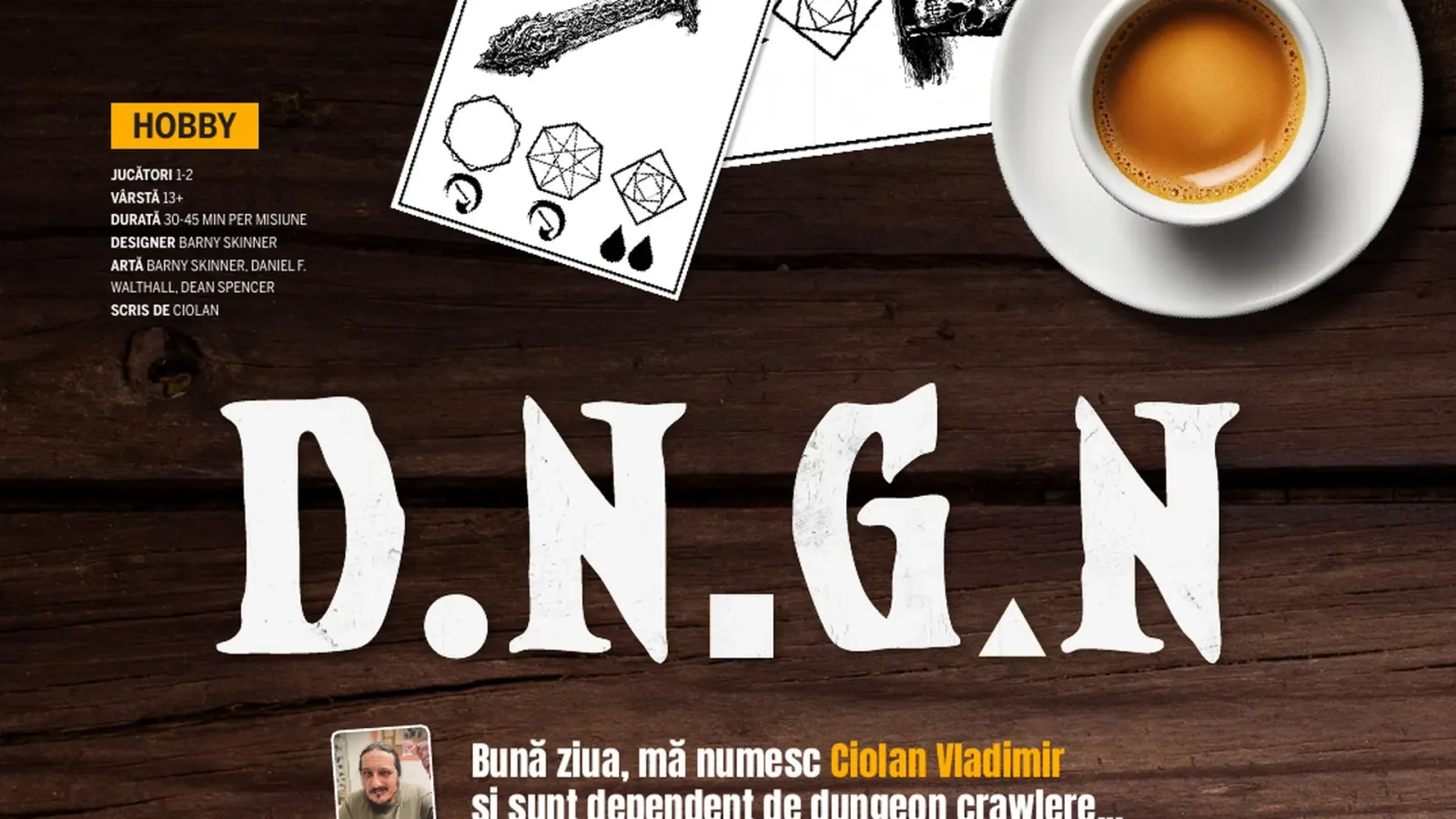
First published in GRIND V, pages 224–229.

PLAYERS 1-2
AGE 13+
DURATION 30-45 MIN PER MISSION
DESIGNER BARNY SKINNER
ART BARNY SKINNER, DANIEL F.
WALTHALL, DEAN SPENCER
Hello, my name is Ciolan Vladimir and I'm addicted to dungeon crawlers...
Wherever I find them and in whatever form I find them, I snort them, I drag them down into my chest, I inject them, I stick them in the smoke machine at the disco so that lot get hooked too. From giant board games that need more room than our two medium-sized dogs, to micro-crawlers printed on a matchbox, I don't pass anything up. Once a year I finish the Holy Trinity of PC crawlers:
Wizardry (all nine of them), The Bard's Tale (the first three) and Might and Magic (everything except IX). That's how I came to love the Agile methodology, which let me sneak in one more mini-dungeon of Basilisk or Dark Fort (look them up, they're worth it) during the daily scrum of thirty-odd people, where my report never ran past two minutes.
I even go in for a bit of proselytising, preaching about them with a fervour unseen since Paul turned up on the biblical scene. I won't even tell you what gets said, and at what level, when I meet Mike, our former shepherd at LEVEL, to whom I'm bound by two decades of sincere friendship and some two years of unhealthy passion for artisanal dungeon crawlers.
The common thread running through every cardboard or paper crawler I've devoured over the years is their reliance — to a greater or lesser degree — on the almighty die. You walk into the dungeon, you roll dice the way the Germans threw stick grenades, to see how much mould is on the walls, how much of it reaches your chest, and how much hallucinogenic dust off enchanted lichens has to penetrate your nostril before you see seven dragons guarding a +1 slingshot without which YOU CANNOT EXIST!!
The sex appeal of a process like that lies in a beefy system of talents, bonuses, colourful mushrooms and enchanted raspberry seeds that help take the edge off the bitterness left by a roll that's too low or too high. But in the end you're still at the mercy of the die. Most of the time I like systems like this because the random element somehow clears away a bit of the puzzle smell given off by a deterministic system. Which is to say, crudely put, a system where the outcome of your actions is known in advance and isn't influenced by a random element. Between you and me, a deterministic system means a good deal more than what I've just babbled above, but for the purposes of this article my definition will do. Don't quote me in exams, though.
Another reason chance is dear to me is that I can win without necessarily being all that good at the game. The flip side is that even when I lose, despite having been remarkably skilful, I'm not necessarily losing through my own doing, which can get a bit annoying, especially on days when bad luck dogs my every step.
DNGN, the creation of Barny Skinner (all hail Barny!), tries to remove randomness from the gameplay almost entirely — and succeeds, or at least to the point where your brain carries more weight than the die.
It does so by elegantly borrowing and combining two or three elements from eurogames. The very short description would be that DNGN - Core Game is a co-operative dungeon crawler for one to two players (which means it runs like a dream solo) with a solid worker-placement mechanic. For the most innocent among you, who never got caught up in the eternal eurogames vs ameritrash war: DNGN is a diceless dungeon crawler in which every action always succeeds, as long as you commit the necessary resources. In short, if you can afford it, it comes off 100% of the time. Like chess. The pawn will always take any piece that's in the right spot (right for the pawn, of course). In DNGN you always know how much damage you'll do, how much you'll take, roughly where the beasties standing between you and the exit will move, and so on. There are no random bonuses to damage or movement; everything is out in the open and can be used to cobble together the most efficient strategy you can manage.
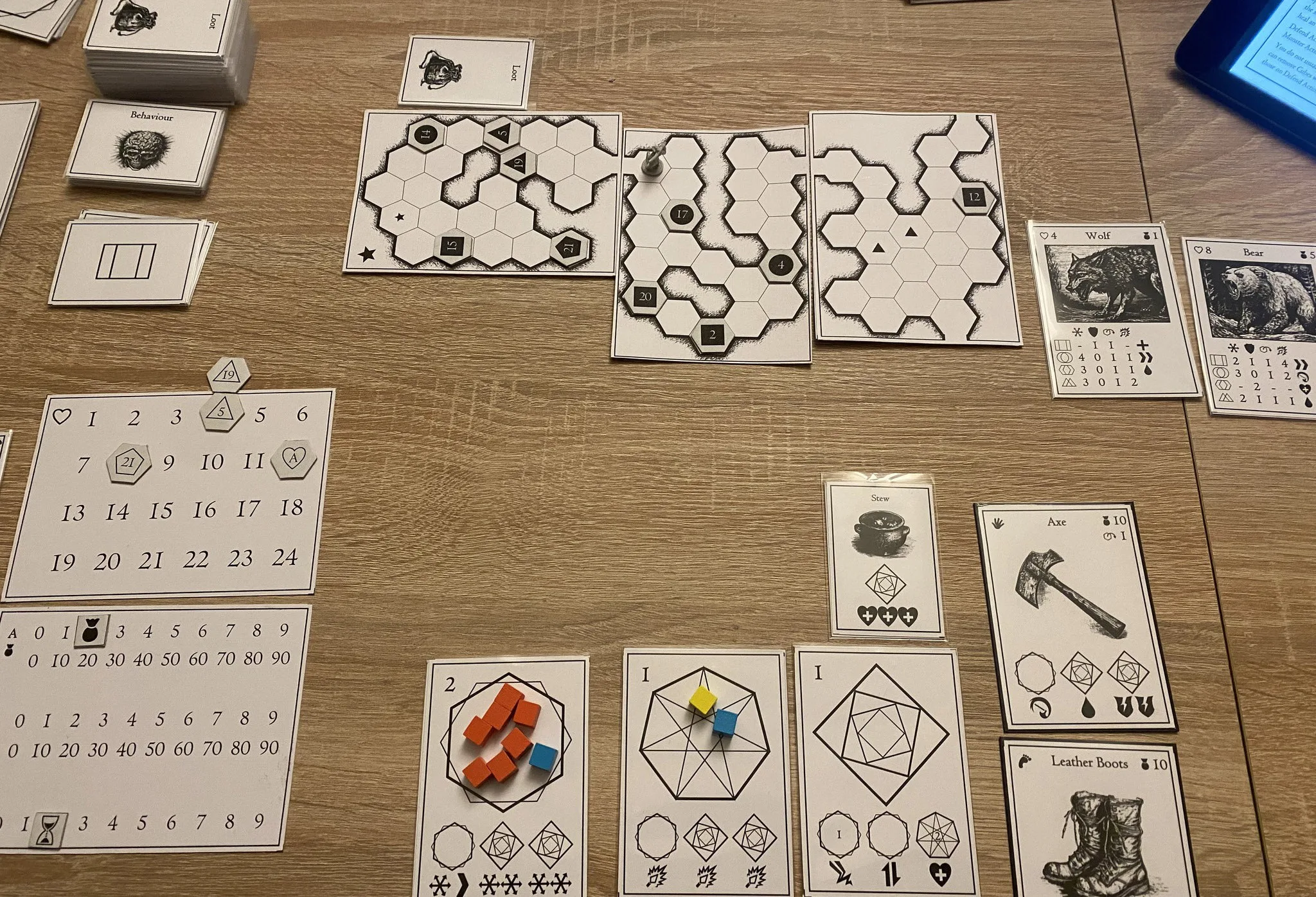
Your character has a fixed number of stamina cubes (which can go up or down permanently) to allocate to actions printed on the three skill cards and on the equipment/loot cards, depending on what the current round demands. The actions range across movement, attack, miracles, defence and the like. At the end of the round the cubes come back to you, ready to be spent again next round. The exception are those assigned to somewhat more potent actions (a two-hex move, an extra attack, healing, say), which are set aside in a little exhaust pile and moved back into the pool a round later.
The structure of a round is simple.
It starts with the bleeding phase (sângerare sounds dodgy, especially when it's cyclical and comes round once a turn, so I'll stick with the English term), in which any living thing, your hero included, loses one hit point if it's carrying a bleed token. Then comes the stamina/mana/focus allocation phase.
The explanation is in the name. You assign your available stamina cubes to the actions on skill cards, equipment, items and so on. After which you pray that the next phase — the one where you find out the monsters' behaviour and characteristics (there are four such sets, printed in plain sight on the monster card) — doesn't land you with something that blows your carefully laid plans wide open.
Of course, the deity doesn't listen. In the monster behaviour phase, where you draw a card from a tiny little deck, you pull exactly the card with the crappiest option on it. The one where the monster you were about to finish off in any situation bar this one has two points of armour, and stings you for a bleed token into the bargain. You'll have twigged that I conned you a little there. There is, all the same, a bit of chance in DNGN, and the Monster Behaviour phase ushers it in. We're talking controlled chance, mind, the sort that adds to the play experience rather than shrinking it. Cards drawn from the deck don't go back in until there's nothing left to draw. As the rounds pass the options thin out and you can make an informed prediction. Nor is anyone stopping you from keeping a backup plan for the crappiest option, and I'll admit it's an immense pleasure when you slip elegantly out of a situation you had the foresight to factor in when you drew up your strategy. There are moments, too, when an “all in, Hail Mary and let the light...” sort of plan is the most logical option, especially near the end. But even then, at least across the handful of games I've played, you can win apotheotically, but you don't lose
READY FOR PRINT
I printed the cards at home on 250gsm textured cardstock (about 16 lei for ten sheets) and didn't trouble myself at all with laying them out for double-sided printing. Classic printer settings: A4 fit to printer margins. I printed the card backs and fronts separately, cut them on a TEMU cutting board with any old cutter, and slid the two halves into any old sleeve (Sleeve Kings 63x89mm, I think). Same approach for the monster behaviour cards. I made a bit more work for myself with the tokens (I was dead set on having them hexagonal; there are square versions too) and with the cards holding the pieces of dungeon. There I bought A4 self-adhesive sheets and 1mm greyboard. I printed the token page onto the adhesive sheet, stuck that to the greyboard, and went to town with scissors and cutter until the tokens came out somewhere between okay and not bad. I made a mess of the dungeon tiles, which I first printed like the regular cards on 250gsm textured cardstock, only I glued the front to the back with liquid glue (because it smelled and looked like aracet, I concluded it was aracet, but it's actually liquid glue for the napkin technique — someone did explain what it was, but I've forgotten). I made a mess of it because they warped and I had to leave them pressed for a few days, and even then they came out iffy. So I went back to self-adhesive sheets and 1mm greyboard and an extremely sharp cutter. Which I managed to cut myself with. The dungeon boards came out razor-sharp, they look semi-pro, they sit nicely on the table and give an impression of... solidity. All told, a few hours of work — not many — plus outgoings of at most 40 lei on top of what I paid for the game. So for nearly 60 lei I ended up with a really fine dungeon crawler that has already clocked up more table time than the hundred- and hundred-and-fifty-dollar games sitting on my shelf. For hero miniatures I used something from Gloomhaven: Buttons & Bugs, because they seem incredibly cute and they fit DNGN like a glove.
LIFE
!
DEATH
After a fight to the death, the mini-miniature from Gloomhaven: Buttons & Bugs tore victory from the claws of a 21 black pentagon maddened with fury, its breath putrid and strands of white triangle 14 dangling between its fangs like daggers. The 5 Black Triangle and the 19 Black Triangle bowed before my hexagonal majesty, putting their faith in the old saying that “the rhombus doesn't cut a bowed head”. They were bitterly mistaken, for I drew from its sheath a little red cube inscribed in a spiral rhombus, smacked them with it right in the name of the Father, and they collapsed before you could say “two times blue cube on the hexagram inscribed in a circle for healing plus one with no refresh at the end”. With the final objective, a little black star, three hexes from me, I hurried to the pentagram like a bride late for the altar, and carelessly fell into Black Square 15, where a few well-sharpened stakes gave my Heart With An “A” Inside a thoroughly unpleasant tickling and it took refuge on 9. One last sprint brought me to the much-coveted black star, where I danced the patriotic dance of victory and pelted the onlookers with red, yellow and blue cubes.
In a parallel universe almost identical to ours, the strapping Bartok the Centurion, a mercenary by trade, killed a bear and two wolves, fell into a pit and came panting into a little village, where he made straight for the inn, downed a tankard of cold beer from the cellar and fell asleep in front of the fire. It's wonderful.
AND disastrous than in extremely few cases. If you play well, master the rules and the mechanics, and have a brain capable of medium-term thinking, there are very few cases where you bet everything on a single card. There are all sorts of escape routes out of nasty situations.
So what do you do when things don't work out?
You swear, and move swiftly to the hero's action phase. Now you try to do everything you can with at most half of what you had. Didn't it occur to you to put a cube on Armor Piercing? You can kiss those two one-hit-point attacks goodbye.
But. BUUUT, you notice the beast has its back to a trap, and you have one stamina point allocated to an action that lets you move one hex or push a monster. So you land a couple of axe swings to break its armour and shove it into the trap, where the sharpened stakes tickle its ribs in a most unpleasant way. One by one, moving the allocated cubes back into the immediate reserve or into the little exhaust heap, where they'll wait a turn before they can be used again, you complete all the actions you meticulously prepared in the stamina-point allocation phase, and then comes the part where the beasts on the map — because there can be several — act according to the card drawn in the monster behaviour phase. That's if anything's left standing after your acts of bravery in the previous phase.
If you've emptied the map, Exploration comes next. Where you draw a new dungeon card or, if you're feeling lucky, you can take a loot card. Which can be a nourishing stew, or an unpleasant event, like a fireball that gives you an appetising colour and smell. As if it were written for you in the lottery, I say, because here — and possibly in the monster behaviour phase — are the only moments when luck or ill fortune can creep into your adventurer's career and turn your plans upside down.
Once you've finished exploring, the cycle starts over again, until you complete the objective stated on the mission card.
Or until you meet your end in the belly of a wandering bear. Or in its claws.
Or in the frozen embrace of some spirit that took a fancy to you. Or... you get the idea. There are plenty of ways to shuffle off this mortal coil before you even catch sight of the objective.
Core Edition, which is also the only edition published so far, offers a branching campaign made up of nine missions. A mission card usually contains, alongside a short narrative that eases you into the atmosphere a little, instructions for building the dungeon deck, the types of enemies you'll meet (usually two or three devils) and the objective. On the back of the card, again through a short, efficient little story that doesn't overdo the figures of speech, the outcome of the mission is described, along with a small choice that the next mission will depend on.
To make you feel your efforts weren't wasted, there's also a character progression system. Between missions you can buy equipment, and you're entitled to an upgrade (a skill, extra stamina points, etc.). The missions are fairly varied, with a range of objectives. Sometimes you have to clear everything off the map, other times you just have to get out alive or take down a specific monster.
The dungeon cards that make up the play area contain information about the placement of enemies and traps.
Since this is a print-and-play, don't expect museum-grade artwork.
The graphics do the job perfectly without being too much of a slog for your printer. Everything is black and white, drawn with a great deal of taste and a fairly high degree of abstraction. Personally, I love to death how the cards are illustrated. We get very detailed, elegant black-and-white illustrations for equipment, enemies and loot.
Interesting iconography, and an abstraction that's a close sibling of design art when it comes to actions and skills. The ideograms aren't very telling, true enough, but they look very... esoteric. If this had come out in the '90s, it would definitely have convinced my parents that I was trying to summon at least a minor demon who brings Turbo chewing gum back from the Turks in exchange for our eternal souls. Anyway, they're explained in the manual, and after three or four games you'll know what each one does without going back to the documentation every time. It's a very elegant game, I say, both in graphics and in gameplay. It abstracts very intelligently without pulling you completely out of the atmosphere, it simplifies without trivialising, and it gives you solid tactical challenges without loading you up with useless fluff and obscure rules. And remember, armour protects you from traps too. It's very important, trust me.
This review was written after about five games, of which I only won two. It gets harder as you work through the campaign; in places it feels a little "puzzly", but it's the kind of puzzle with several solutions that a Panzer General gives you, not The Abduction from the Seraglio with 5,000 pieces, one of which — a tenth of a horseshoe — you've lost.
I can't tell you how you'll see the game after a hundred plays, for instance, but personally it seems to me it has that elegant simplicity of a Tetris that makes it appealing in the long run, in short-to-medium sessions. Plus, it costs 14 lei. Probably more if you want to print it professionally, though a big part of the fun is the assembly too. Fourteen lei for at least twenty hours of entertainment doesn't seem like such a big deal to me. Plus, some new campaigns built on the existing mechanics have been promised, though I wouldn't hold my breath. The author isn't incredibly active on the forums, but hope dies last. And nobody's stopping you from building your own adventures, if it comes to that.
I recommend it with great warmth and enthusiasm. Mike compares it to XCOM. I say he's exaggerating a bit, but that's a conversation I'll have with him over a beer, not on the internet. XCOM or not, DNGN is one of the best and smartest dungeon crawlers I've played. And I'm counting the AAA production-value ones in there too.
It's simple enough to get on the table in five minutes and complex enough to keep you at that same table for a few hours.
And it's cheaper than a beer in a bar with no rats and no cobwebs. Okay, if we count the printing too, it's cheaper than a bottle of wine in a bar with no rats and no cobwebs.
›› CIOLAN
A podcast for hardcore gamers, with level 9000+ guests, where sometimes we also answer the question "what have we played this past week?".
Warning: Sometimes the episodes last 7 hours!
HARDWARE
234 GPU ROUND-UP 2025
NVIDIA Blackwell vs. RDNA 4 – the next-gen duel, in the LAB501 ring