
Stray Blade – Review
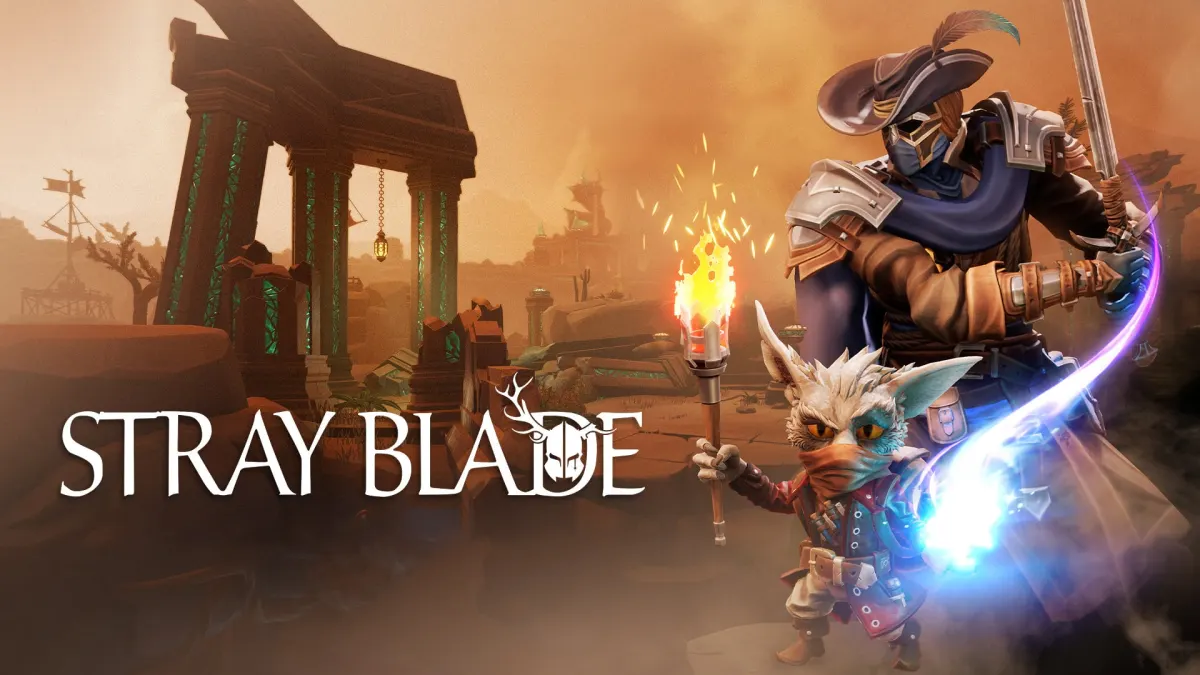
A souls-lite where explorers and adventurers will feel right at home
I discovered Stray Blade quite late, as the game was released in April 2023. Even though we have many new and solid titles to write about, I felt that this “older” game had something special in terms of art direction and the way combat unfolds – plus, it’s promoted as a souls-like, and you already know how much I love the genre. Now it’s time to see if this game, developed by the German indie studio Point Blank Games and published by 505 Games, fooled me with what it has to offer or not.
You’ll explore a land devastated by tense relations between factions and tribes
In Stray Blade, you play as Farren West, a lone wolf and explorer of anything ancient, mysterious, or unique in the world. But when he discovers the Lost Valley of Acrea, well… he gets pretty much beaten to death. And that would be the end of the story. If he hadn’t been found by his future companion and travel buddy, a sentient wolf named Boji. Even though Boji manages to revive Farren, there’s a problem: to bring Farren back among the living, he has to bind him to the energy and life force of Acrea island – he stabs him directly in the heart with a stone containing the three metals that govern Acrea, linking him to this land. If Farren decides to return to the outside world, he will die, as the connection between him and Acrea would break. Fortunately, there is a way for him to regain his autonomy and not remain bound to the island forever. That way involves finding Erray, Boji’s master and an extremely powerful sage, which makes Farren and Boji travel companions, willingly or not. While Farren simply wants to regain his freedom, Boji is worried about his master and wants to know what happened to him.
The game efficiently introduces all plot elements, and then gradually builds upon them. This way, you’ll quickly learn that there were tensions between the Acreans, the island’s original inhabitants, and the Elessins, a nomadic people who travelled to Acrea, decided to settle there, and combine their forces with the Acreans for a better future for both populations. Even though the Elessins were two or three times larger than the Acreans and much more worldly, the Acreans had a special relationship with the Flux, the energy that governs every living being. Thus, both tribes shared their knowledge and prospered together. This was until three of the four Elessin leaders became greedy, changing the collaborative relationship between the two peoples into one of master and servant. Each of the three was reborn as a master of one of the metals that govern Acrea: Intium, Manninite, and Xhinnon. Erray, being the fourth leader and the only one who could master all three metals, couldn’t stand idly by while the Acreans were enslaved. So he cast a spell upon himself and the three to imprison their bodies in metal to stop the abuses. He sent Boji to the edge of the island, as the spell would have affected him too, given that he had died and been revived using Xhinnon.
Now, however, Farren and Boji embark on a journey to free these leaders and their generals from their metal prison to defeat them definitively, gain control over each metal, and thus gain access to the Spiral – the place where Erray and their answers should be found.
But their path to the three leaders and their generals won’t be a simple stroll – besides the dangers posed by Acrea’s fauna and flora, they must confront the three factions fighting for control of the island: the knights of the Golden Order, the hunters of the Black Claw clan, and the assassins of the Church of the Observer.

The first aspect I almost instantly liked about how the story is told in Stray Blade is that we have a second main character like Boji to accompany us. He doesn’t just act as a guide for Farren, teaching him about the mysteries of the land, its history, and why things are the way they are now. The dynamic of their relationship is truly touching. From two strangers working together simply because it benefits them, their relationship gradually evolves, and the two learn about each other and how they aren’t as different as they think. The dialogue between them explores the theme of loneliness in an emotional way – Farren being this solitary adventurer due to a lack of trust in people, and Boji being this creature brought back to life who couldn’t fully integrate into Acrea’s society.
You can also see the little guy appearing in various places you visit, doing various activities like warming his hands over a campfire, trying to keep his balance while crossing narrow scaffolding, or simply admiring the breathtaking landscapes alongside Farren.
Not to mention that he keeps Farren alive in this cruel world – every time Farren dies, he is brought back to life at the last altar where you saved your progress. I like that we are given a plausible reason why the main character is immortal, rather than it just being a mechanic that people simply accept because it benefits them. But don’t worry, Boji will give you an earful every time he has to drag you to these altars to revive you.
In addition to the information Boji presents to Farren about Acrea’s history, there are also stone tablets scattered across the land by Erray that explain what happened before his arrival. Discovering them not only teaches you more about this land but also grants you skill points that you can use for Boji to expand his arsenal and turn him into a reliable ally during battles.

I want to commend the developers for their effort in making Farren as full of vitality as possible, rather than just another mute protagonist from a souls series who has nothing to say about what’s happening. In this regard, you can choose between a male and female body, as well as a male and female voice. Because yes, our protagonist benefits from voice acting throughout the game. Personally, I only enjoyed James Alexander’s performance as the male actor and can say that he offers a variety in expression and an ability to convey feelings on another level – but you’d expect that from someone who has worked on projects like Baldur’s Gate 3, Dragon’s Dogma 2, or Lords of the Fallen. The same can be said about Alec Newman, the voice behind Boji, who has worked on a series of spectacular projects such as Elden Ring: Shadow of the Erdtree, Alan Wake 2, or Cyberpunk 2077.
The way the story is told in the vanilla version of the game impressed me so much that it made me buy the DLC on my own, in addition to the review copy provided by 505 Games. I wanted to experience much more of the phenomenal way the developers managed to build the world. Unfortunately, I was disappointed by the quality of the DLC in this regard – it felt more like a side quest that adds nothing valuable to the events of the main story. If you want to remember Stray Blade as a fantastic game in terms of story, I suggest you let the conclusion of the initial story be the final one.
How do a funny adventurer and a talking wolf fare in the cruel world of Acrea?
The gameplay contributes enormously to the Stray Blade experience. To begin, let’s talk about the weapon and armour system. Unlike the traditional model in such games, you unlock weapon schematics after defeating enemies, and armour schematics can be found in chests scattered across the map. If you have enough coins, as well as materials obtained after defeating enemies or collected, then you can unlock the next weapon in your arsenal or the next piece of equipment to protect you.
Additionally, a special category called “Elessine Weapons” can only be unlocked if you visit the special locations where they are found. And believe me, it’s worth the effort, because they look phenomenal and add even more variety to combat than traditional weapons. Just to give you an example, there’s a katana that extends its blade after each hit.

Speaking of weapons, they greatly influence how you level up. Once you reach a new level and gain a new skill point, you can only use it on upgrades associated with weapons you’ve mastered 100% – meaning you’ve used them enough to reach a 100% mastery level. For example, if you want to improve your HP and take more hits, you need to reach 100% mastery for a weapon that has an HP upgrade attached. Some might say this system doesn’t offer much freedom as a player, since you have to constantly switch weapons and can’t enjoy just one. I found it fun because it constantly encouraged me to learn the moves of a new weapon and kept the enemy combat experience fresh – plus, I had enough time to enjoy my favourite weapon until the end of the game.
In terms of combat, I was pleasantly surprised by the variety each weapon brings. Each weapon has a unique set of moves and behaves differently when performing light attacks, heavy attacks, special attacks, or when performing an execution when enemies are staggered. And the executions in this game are absolutely glorious. Sometimes I even chose to perform executions when the enemy had very little HP left and a light hit would have finished them off, simply because the animations look so good.
Although I mentioned the varied range of attacks, it feels like the game favours slightly slower weapons in terms of damage dealt. Faster weapons or those with moderate attack speed didn’t impress me much in this regard, and I mostly chose to use them because I liked how the character moved when wielding them – this is because the damage they inflict is much lower compared to heavier weapons. Additionally, these heavier weapons reduce enemy energy much faster and help you perform an execution much quicker, which was a more than viable strategy for me until I reached the middle of the game, considering I played on the highest difficulty. By the end of the game, things balanced out, and the same weapons dealt similar damage in terms of HP and energy – ultimately, it became my choice whether I wanted to exhaust enemies or send them to the ground without an execution.
Also, the abilities you unlock encourage you to use slightly slower weapons that deal more serious damage. After defeating the first general, you unlock the teleportation ability, which helps you move around more easily and also in combat, as the character performs a quick attack when you teleport to an enemy’s location – in such a scenario, the quick attack of a huge mace will clearly hit harder than that of a short sword. The second and third abilities you unlock have similar utilities. The second ability makes the character strike the ground forcefully and activate a metal called Manninite to create platforms in certain regions; if you use it in combat, it massively reduces enemies’ energy bar. The third and final ability can be activated to create Xhinnon platforms that disappear when the ability’s timer expires; if you use it in combat, it freezes enemies around you until they take a hit.
Each ability is timed until you can use it again, but once you unlock them all, you can alternate between them and turn combat into a rather trivial experience, as you can easily reduce opponents’ energy bars and prepare them for an execution.

As for human enemies, their variety depends heavily on the weapon system I mentioned above – they will have different moves, combos, and executions depending on the weapons they use. Some of these enemies will also have ranged weapons like bows, but also melee weapons when you get close to them. Even if they aren’t extremely complex and difficult to understand, one enemy that particularly caught my attention is the fencer: equipped with a foil, his movements are extremely fluid, he uses feints, provokes you, dodges, practically everything you’d expect from a master swordsman – if there’s one type of enemy that received a lot of love from the developers, it must be this one, and you’ll greatly enjoy fighting against him once you figure out how.
Besides these enemies, there are also wild animals that will attack you. Some of these are even more dangerous than the soldiers, so keep your eyes peeled.
There are also mini-bosses scattered throughout Acrea, and when you defeat them, you’ll receive an additional Heart Berries slot – the equivalent of vitality potions in games like the Dark Souls series or Elden Ring. Their attack patterns are unique the first time you encounter them, but once defeated, weaker variants of them will appear as normal enemies.
One aspect I want to praise the developers for is how they handled enemy placement: after you defeat a group of enemies (you’ll receive an in-game notification), if you revisit the same spot, you’ll be surprised to find a different type of enemy. I particularly like how they use this to advance the story – some locations become enemy camps after Farren discovers them, creating the feeling that you’re always being hunted and that enemies are using your discoveries for their own benefit.
If we’re talking about actual bosses like generals and leaders, the game will challenge you a bit – nothing you can’t overcome with a little patience and planning. To give you some numbers from my playtime, it took me one attempt to defeat the first general, three attempts to defeat the first leader, five attempts to defeat the second general, and seven attempts to defeat the second leader – most of my failures came from trying to test how close I could dodge or parry attacks. And if you’re a fan of games like Dark Souls 3 in terms of final bosses, let’s just say you’ll absolutely love the last fight.

Speaking of dodging and parrying, both have a chance to shine. I didn’t feel the need to parry normal enemies, as a simple dodge and maintaining distance were more than enough. Parrying is very effective when facing bosses – or maybe I just flexed my Sekiro-acquired skills too much. I like how precise and short the window is for parrying a boss, and if you’re also a fan of a more reactive combat style, you’ll like it too. You’ll have to pay attention to the types of attacks you can’t parry, but I’ll let you discover what and how here. Additionally, the developers do a good job of combining heart-pounding combat with various tricks that mark the transition to other boss phases. All put together, combat controls won’t be delayed, and the fights themselves are satisfying and will challenge you enough to want to play through the game.
However, I also have a negative point: you can’t tiptoe when you want to sneak behind enemies and stab them. Instead, you have to walk veeery sloooowly so as not to alert them until you get behind them – now, I don’t know about you, but a character walking upright with a huge axe on his shoulder doesn’t inspire confidence when I’m sneaking. Besides, it takes a long time.
If you’re a fan of the divide and conquer method and like to lure opponents one by one from the enemy group and defeat them, you’ll have some problems. Especially since the main character doesn’t have access to ranged weapons.
The vitality recovery system is a mix of traditional and consumable. What do I mean by that? You have a certain number of Heart Berries you can use, but to refill your slots, you have to pick them up when you find them or be killed by opponents – if you save at an altar, you won’t get used Heart Berries back.
Altars are scattered throughout Acrea and are points where Boji will drag Farren when he kicks the bucket to bring him back to life. I advise you to save at these altars every time you encounter them – not because I don’t trust you to defeat the enemies, but because if you’re defeated and the last altar you saved at is on the other side of the map… well, the game will get stuck in a loading screen loop. I would have also liked these altars to be usable as fast travel points – instead, you can unlock one fast travel point per region, but it’s largely useless.

A few final thoughts on gameplay before we talk about the more artistic side:
- I appreciate that the game lets you set the difficulty you want to play, encouraging both experienced players like me and people who just want to enjoy a good story (also like me) to explore Acrea.
- There’s also a map, but it never opens centred on your location; you have to adjust it manually.
- I absolutely love how perceptive the enemies are. You can run away from them once they’ve spotted you, but if you try to approach them again to stab them in the back, you’ll be pleasantly surprised to be recognised and pursued. What exactly do I like about that? That it makes sense. It’s impossible to forget a lad you saw two minutes ago and let your guard down after he disappeared.
- The game auto-saves, but it’s always a pleasant experience. Sometimes you can lose levels and progress because the game didn’t save properly.
- Traps and wild animals also affect enemies – if there’s a carnivorous or poisonous plant nearby, you can trick enemies into getting caught by them, adding an extra layer of complexity to battles.
- The game includes a rune system – consumables you can prepare to increase your attack, defence, experience gain, and many other attributes. I didn’t feel the need to use them.
- You don’t lose anything when Farren dies – in fact, items dropped by defeated enemies will still be there when you return to the area.
Aesthetics similar to Dauntless. Soothing music
Stray Blade’s art style screams high fantasy and colour. There’s a great deal of attention to detail in every piece of equipment, weapon, animal, and flower. The island is brought to life with vibrant colours, making it a place I’d happily get lost in to admire its landscapes. The game even features a day-night cycle that you can observe with the naked eye – though I would have liked to have some control over it, instead of it being automated.
An inspired aesthetic choice is also the use of branches and roots instead of stairs to connect different sections when the developers wanted to add verticality to the terrain. You can summon some of these natural bridges and stairs as shortcuts using the Flux that circulates through every living organism. This also adds to that feeling of an interconnected world – if you’re a fan of Dark Souls 1 and remember how all regions were interconnected, then Stray Blade will create a similar sensation for you.

What stood out most to me visually is the high capacity to customise the colours of each piece of equipment. You can discover different colours that you can apply to your weapons and armour. Sure, you can choose a single colour for a piece of armour or your weapon, but… you can also alter each one individually and choose different colours for different parts. I think it’s a clever approach to offer a fresh experience to players when you don’t have too many armour sets included in the game.
However, I would have liked to see more violence or a filter of that kind that you could apply or not. It already shows blood, so why not dismemberment or similar things?

Another standout aspect is the hand-drawn cinematic panels. They are detailed yet not overly cluttered with too many elements, evoking a comic book feel when the story is presented to you.
The ambient music is relaxing and complements the visual direction, maintaining an atmosphere of mystery and exploration throughout. Of course, things change when you enter combat, and the soothing music changes to alert drum rhythms, notifying you when you are in danger and have been detected.
The impact of weapons and the sound of metal hitting metal/armour or animal skin/fur are satisfying. The sound design simply does a good job of supporting combat situations. Also, harmonica sounds are present when you pick up items or discover new locations. The only thing I would adjust is related to enemy dialogue, as there is a lack of variety – as I mentioned at the beginning, I heard the same lines repeated over and over by enemies to the point where they irritated me.
What drags the game down?

The PC optimisation is very poor. Regardless of the visual settings, my fans were running as if I had a Harley Davidson next to me. Sure, you can wear noise-cancelling headphones, but that won’t make the stress on your system disappear. Not to mention I had to stop streaming the game due to system overload and four black screens. I experienced something similar when I played Horizon Zero Dawn, which might imply that Stray Blade was first developed for consoles and then ported to PC.
The teleportation ability is very buggy and got me stuck inside enemy models too many times – the last thing I want when facing a giant swinging a huge axe like a maniac is to be stuck inside his model and fighting for my life.
There were also moments when dialogue abruptly stopped being delivered, even though subtitles appeared on screen.
The weapon and armour crafting menu could use some adjustments. Let’s say you want to craft more than one piece of equipment. That means you have to move away from the forge, come back to access that menu again, find what you wanted to craft in the list, and then repeat this process. They could make things easier and automatically return you to the menu after you’ve finished crafting a piece of equipment. And they could separate each equipment category to make searching easier.
Enemy AI frequently circles when trying to return to its post, but eventually settles down.
When you stab enemies, you deal damage three times, coordinated with three character movements. But often, the damage for the second and third movements wasn’t registered, even though my character performed them.
Add to all this the fact that the final boss in the DLC glitched out the first time I tried to fight him, and when he finally unlocked, he didn’t have very impressive moves – I faced more dangerous enemies in the base game than this boss. Not to mention that the music for this fight abruptly cut out and that enemies in the DLC often got stuck in walls. The biggest pain in the DLC was the constantly and visibly freezing frames.
Final Verdict

The micro-cosmos created in Stray Blade truly feels alive. Farren and Boji make an extraordinary team and demonstrate to developers that not all souls-like games need to have a stoic protagonist fighting alone and often clueless about the events happening around him – sometimes having a travel companion is more pleasant. The voice actors behind the two performed exemplarily, but enemy dialogue could be more varied. The combat feels optimised for most of the game, excluding obvious problems like enemies stuck in walls, going haywire, or even your character getting stuck in enemies. The game excels in its audio-visuals, creating an organic and mysterious world worth exploring.
The DLC content feels forced in terms of story. It only brings performance issues as the price for an experience that is better left forgotten.
I enjoyed playing Stray Blade, as evidenced by the 55 hours I spent to complete it 100%. But I can’t give it more than a solid 7/10 due to performance issues, mechanics that need adjustment, and DLC content that brought more problems.
I’d say the base game is an 8/10 – as I said, if you plan to buy it, let the conclusion of Farren and Boji’s first journey be the final one if you want to keep pleasant memories.

Played on: PC
Release date: 20 April 2023
Developer: Point Blank Games
Publisher: 505 Games

0 votes
Scroll down here and stay on the page for at least 30 seconds to vote.
Pick a score from 0 to 10 (halves are allowed).
Comments (2)
Comments are shown in their original language.
Am și eu jocul în librăria de Steam de ceva timp, dar nu am apucat să îl joc. In schimb, un joc care este destul de asemănător și care m-a făcut să depășesc cele 80 de ore jucate in Horizon: Zero Dawn, este Asterigos: Curse of the Stars. Este un ARPG Souls-Like, dar mai accesibil din punct de vedere al dificultății decât adevăratele Souls-Like (Elden Ring, Lies of P, samd) cu o poveste interesantă, grafica viu colorata și un gameplay foarte plăcut. Nu mai zic de muzica care m-a captat de la început. M-am bucurat timp de 92 de ore cu acest joc, căutând toate scroll-urile, item-urile, rezolvând toate side-quest-urile și maximizând toate armele (6 la număr). A trebuit să fac 2 playthrough-uri că sa pot vedea ambele finaluri ale jocului. Dar de fiecare data când îl jucam, pierdeam noțiunea timpului și chiar dacă trebuia să traversez un sfert de harta că sa ajung undeva sau să găsesc un item, totul a fost foarte plăcut. Nu prea a avut parte de publicitate acest joc, fiind creat de un studio indie din Taiwan, insa merita incercat 110%. Kena: Bridge of Spirits pare ceva similar, dar nu l-am incercat, inca.
Am fost tentat să încerc Asterigos acum ceva vreme, când îl aveau Humble Bundle într-un pachet. Dar am mai citit câte ceva despre el și mi-am dat seama că nu e pentru mine – cel puțin nu acum. Știu totuși că a fost lăudat pentru nivelul de calitate ca și indie.
New comments will open again soon.