
Venture to the Vile – Review
A metroidvania on the border between amusement and horror
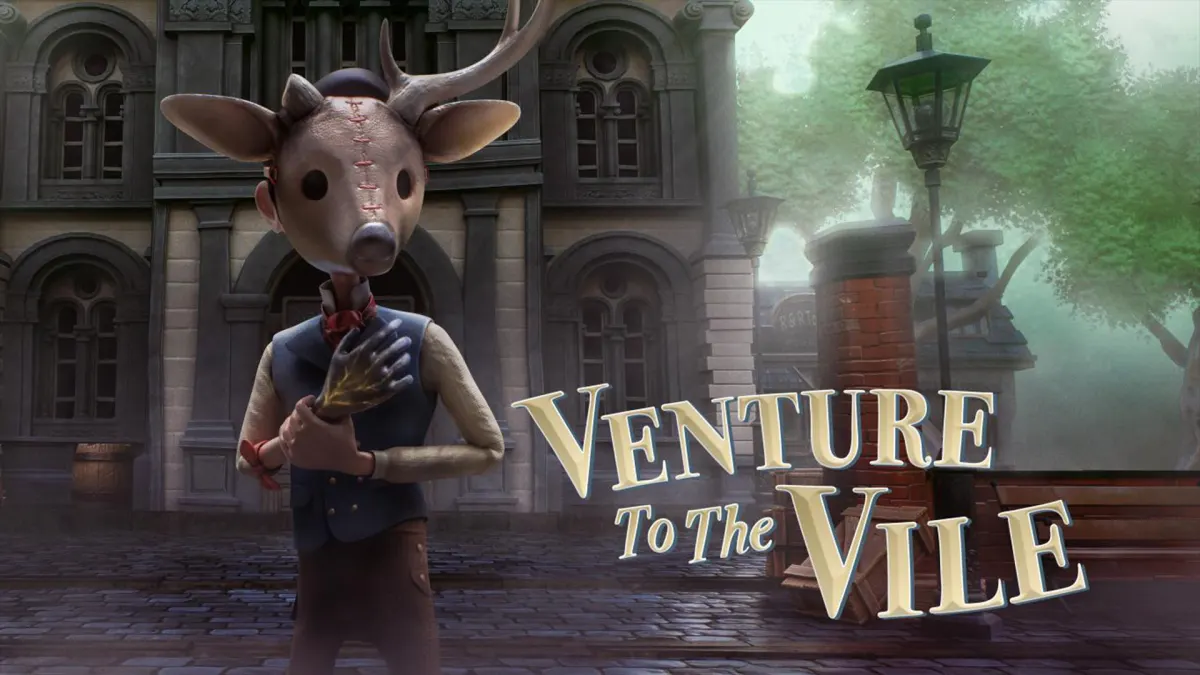
Venture To The Vile looked promising in the trailers I saw. That's why I was excited when the folks at Cut To Bits offered me the chance to review it. The story and setting seemed like a well-deserved breath of fresh air. I say this because the Metroidvania genre has become dominated by Hollow Knight clones or titles that borrow too many elements from it. But just exploring new territories and innovating doesn't guarantee success. Let's see if the people at Cut To Bits have raised the bar.
How convincing is the story?
Venture To The Vile tells the story of a small town affected by a kind of virus called… you guessed it, The Vile. Its inhabitants, who wear animal masks, used to have a more pleasant life before the infections spread. Our main character, who wears a deer mask, is at the centre of events. We are brought back to the present after a short childhood sequence, and he and his then-girlfriend, Ella, wander lost through the forest. Unfortunately, a monstrous creature affected by the virus hunts him the entire time. Although he manages to escape by the skin of his teeth, he is scratched and infected. Thus, he undergoes mutations that allow him to play Wolverine – meaning a claw now grows from his hand on command. And lo and behold, a dubious character named Dr. Crow becomes interested in how our character is affected by the mutations. The good doctor offers him access to a machine that allows him to evolve his newly acquired powers. Armed with his new powers, the deer boy has only one goal in mind: to find Ella, as she hasn't returned since the incident in the forest.
I don't have much to comment on regarding the story and narrative aspects. It doesn't feel like they're developed enough. You have NPCs who send you on quests to bring them things, and that's about it. We're sent to find creatures, objects, or people in classic Metroidvania style: in Venture To The Vile, you have to find children lost by their professor and convince them to return to town. In terms of "lost objects," you have to find horse shoes that you can trade for rewards and upgrade materials. You can also find masks of missing people or special coins. And this list of lost objects could go on forever. As you've probably realised, we get a lot of "Go there. Find this. Bring it back." I don't have a problem with this type of activity. It's just that their abundance doesn't add much value to the game's progress or the unfolding of the action.
The characters are slightly to not at all interesting, and you don't establish any relationship with them. You see most of them a maximum of twice: once when they send you to bring them something, once when you bring them that thing. Interaction is almost non-existent, except for discussions with Doctor Crow and a few NPCs who ask you to bring them more than one item back. What exactly am I trying to say here? That the world, story, and characters feel empty. And to add even more salt to the wound, there are also problems with the dialogue system:
- The fake language they implemented for the characters has a fast pace and is unpleasant to listen to, especially during long dialogues;
- We cannot skip dialogue sequences and are forced to listen to them until they scroll automatically;
- There are many inconsistencies in text sizes and fonts. The text itself and the boxes it appears in sometimes blend with the background. And this negatively impacts readability.
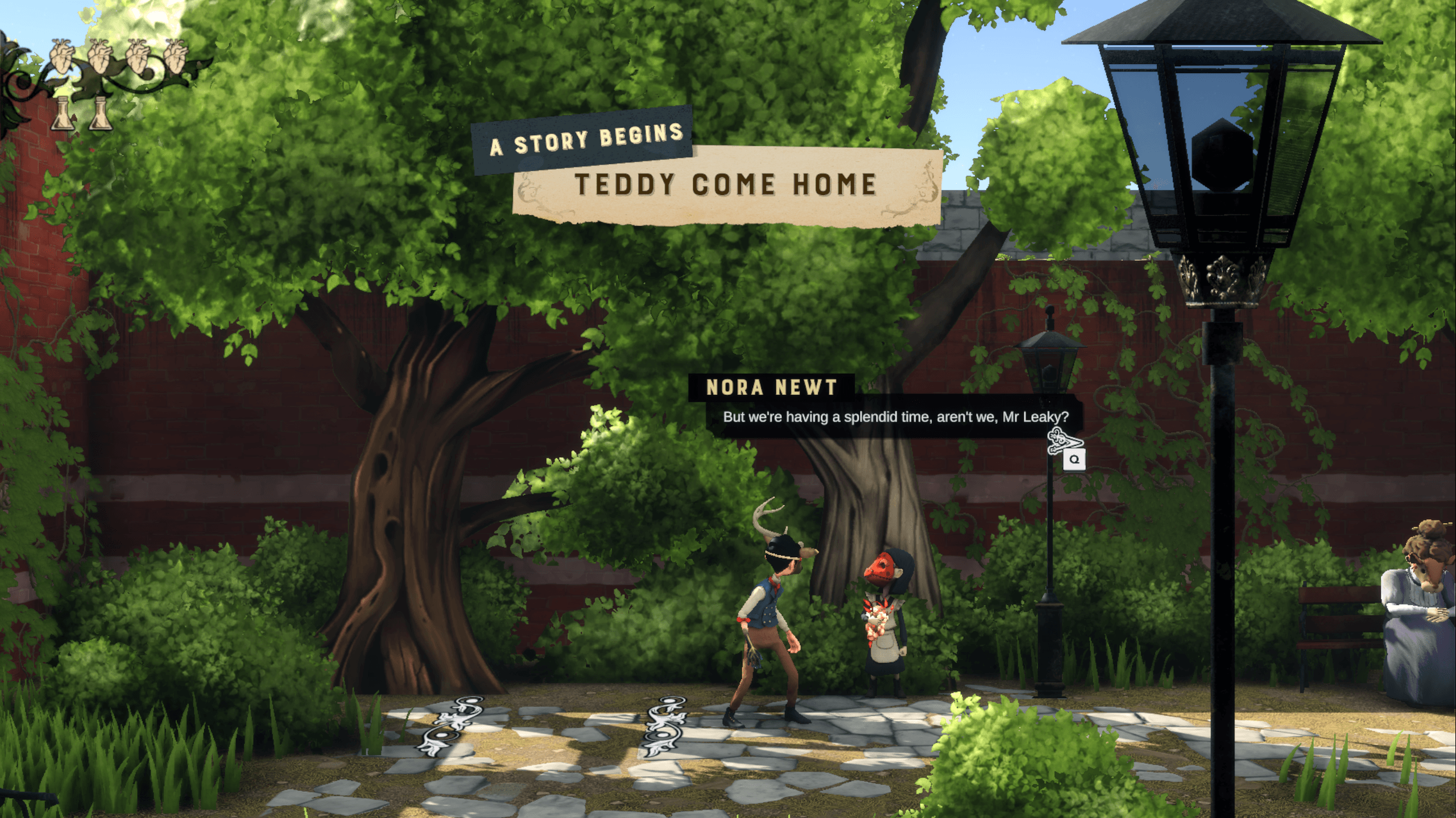
I had hoped that one of the three endings would save the story, tie things together, and give me a satisfying conclusion. Unfortunately, that wasn't the case. It gave me a feeling of incompleteness, an overly fast pace of events, and characters that were slightly to not at all important. I truly believe they had a fascinating premise on their hands that was just waiting to be developed and nurtured. But this didn't happen.
Does the gameplay manage to wash away some of the story's sins?
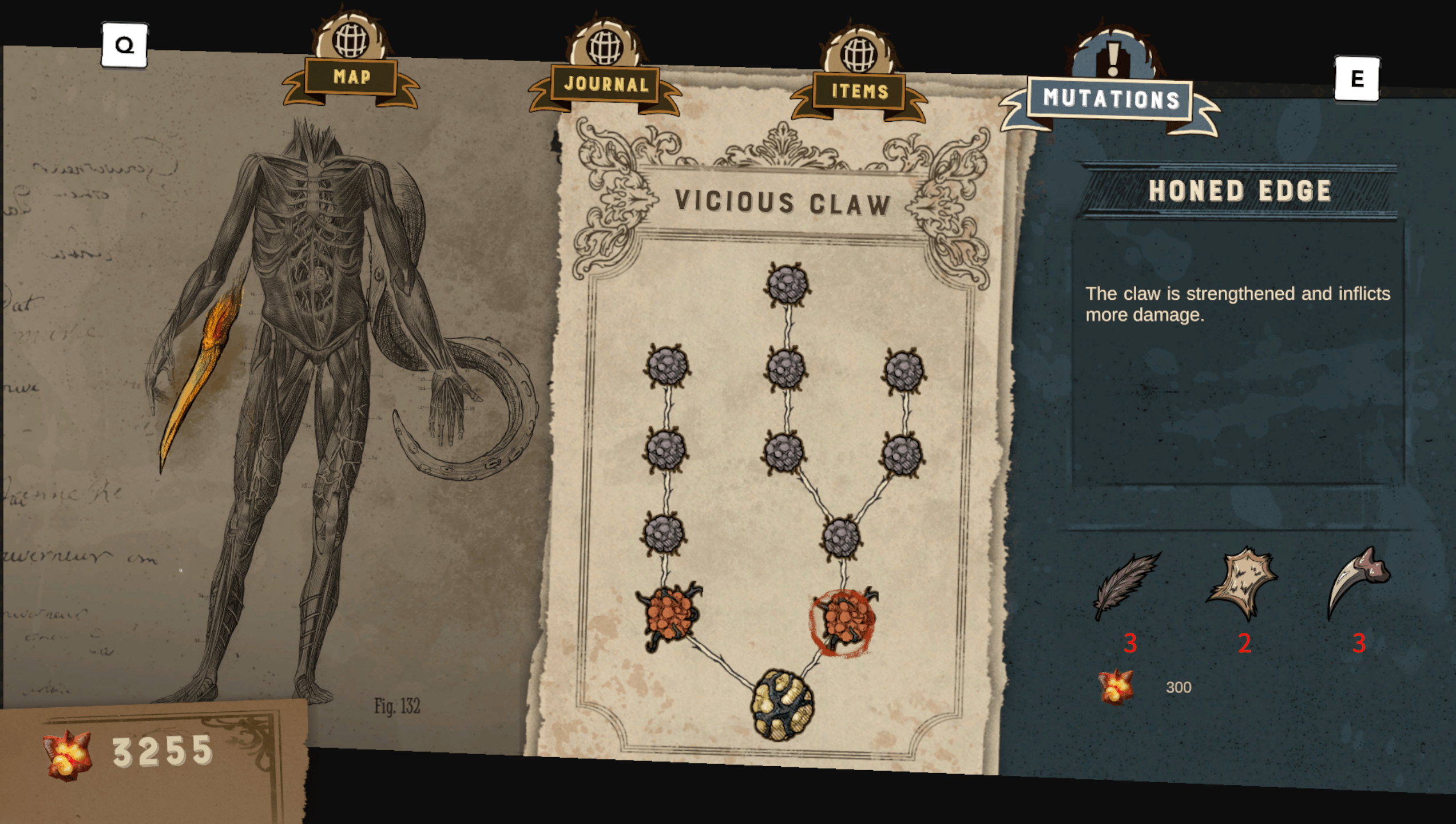
As I mentioned, the difference between the protagonist and the rest of the townspeople is that he can use the powers granted by the virus in combat. The claw you receive is just the beginning. But you'll gradually get upgrades and abilities that allow you to jump higher, grow a kind of organic sledgehammer from your arm to smash enemies, as well as a tentacle that latches onto enemies or lets you access new areas. You can improve these abilities and become even more dangerous with materials obtained from hacking monsters. Just remember that you need better quality materials as you advance with upgrades – some of them drop less frequently, but there are also upgrades in this regard to make your life easier. I like this approach of using materials you no longer need to obtain better ones that you do need. I think it's clever that they also introduced a butcher in town. He allows you to recycle useless materials for the game's currency.
Even if the abilities themselves seem interesting and I like the idea of the character's actual evolution, they are not satisfying to use during combat. There's a lot of repetition in terms of animations. The main claw attack reminds me of the nail attack in Hollow Knight. If I had to put my finger on it, I'd say the lack of variety kills the way you can use your arsenal: the claw slashes a few times, the sledgehammer hits once and hard, the tentacle grabs enemies and… that's about it. The combos and interactions between them are too limited, even after you've unlocked everything.
If we're talking about those who receive our weapons in the face, I can say there isn't much variety. We encounter about 2-3 types of enemies per area, and many of them are just moved and combined in other regions. It's not difficult to predict their attacks. The only time you're put in a difficult situation is when several of them have cornered you. You can parry attacks and return them with significant impact, but the timing is often lacking. At first, I thought I was rubbish and hadn't gotten used to it, but it turns out it wasn't my fault after all. This aspect doesn't complicate fights much, as it's not instrumental to parry like Sekiro or Lies of P. But it becomes confusing to have a mechanic that doesn't feel natural to use after a certain point. I'll also add that the controls didn't feel responsive at all. It's not a problem in 1-on-1 situations. But you also don't want input lag when a group of monsters wants to ask you how you're doing.
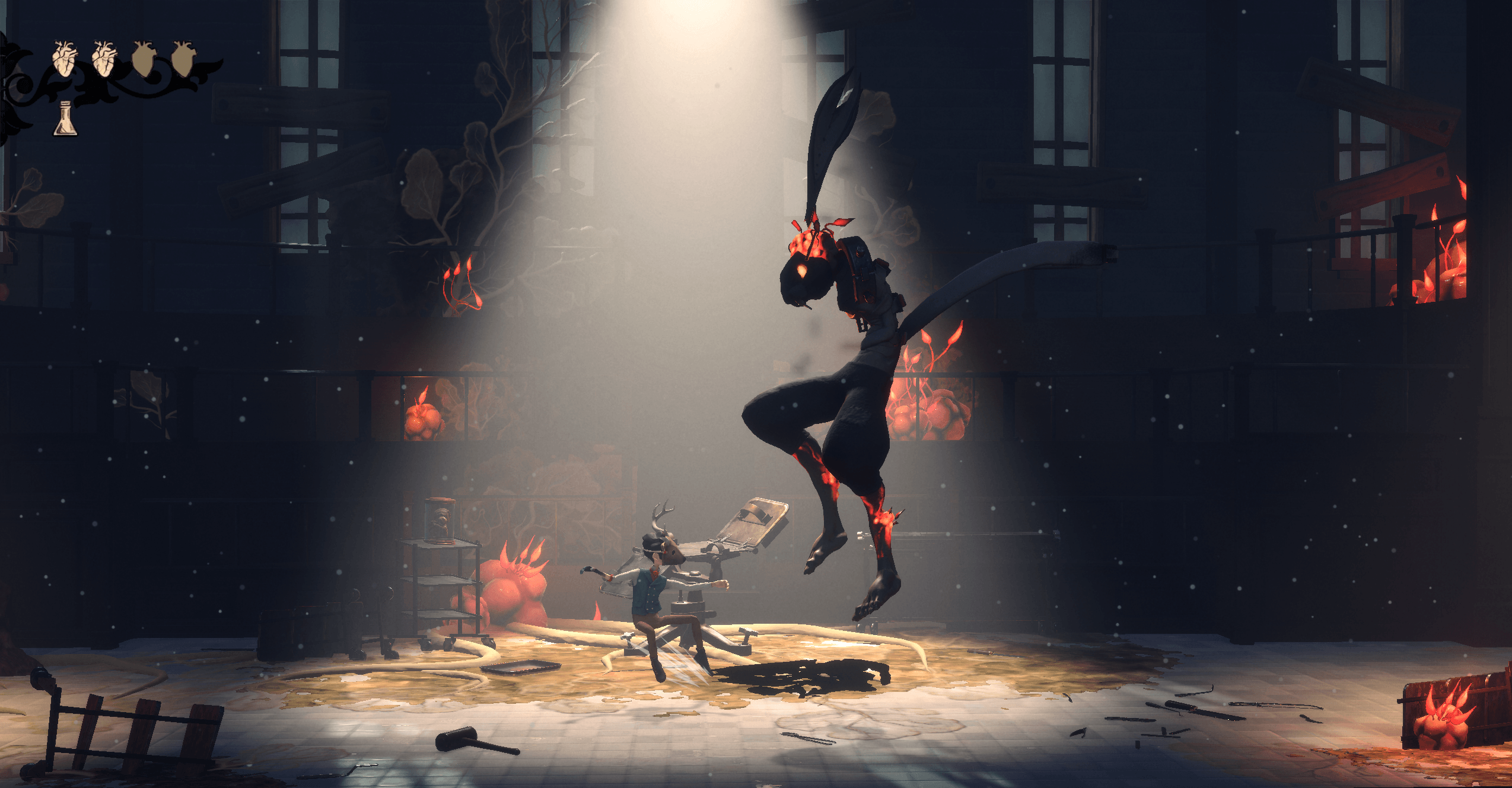
The first two boss fights are cool and innovative. The rest feel like you're the boss and they're stuck in a room with you. It's not like you can't show off with dodges and abilities. But why would you when you can just bash them like a piñata, regenerate your health, and then repeat the process until they drop? I've always been a fan of difficult enemies that encourage you to learn their patterns. And even if it pains me when I encounter confrontations that are the complete opposite, I'm not going to waste time with acrobatic moves. There are a few others programmed to make you use the environment to defeat them or to go through a parkour sequence. Personally, I find it a weak substitute for a proper fight.

The approach to level design intrigued me. Instead of the room system used in 2D and 2.5D platformers, the developers opted for larger areas made up of paths that allow you to go up or down them. It seems to work in small to medium areas. But it can just as easily become confusing in large areas. And the stylised map doesn't help you figure out where you are too much. You can have a vague idea of your general location, but it's not clear where you are exactly. I do appreciate that they tried to create an interconnected game world through a network of canals. This is made up of pipes and shortcuts that connect all visited regions, if you have the necessary ability to unlock them.
To put things in perspective, the idea behind the path system is clever, but the execution leaves something to be desired, just like with the map. Perhaps some maps for each region would have helped us figure out where we were, instead of making us feel lost.
The game has an option to change the time of day at save points. And some missions are dependent on the time of day. I found it innovative at first, but I'll penalise it for two simple reasons: first, you're not taught how to use it and I stumbled upon it accidentally – there's a small clock hanging from the tents that serve as save points, so you don't have to struggle; second, you can't set the precise time you need for missions. The second part wouldn't be so bad, as you only have three options: morning, noon, and evening. The problem arises when you want to set the time for noon. Why? Because these times of day don't follow chronologically and you have to be lucky to catch noon. This aspect becomes irritating when you want to tackle missions that take place in the afternoon. Plus, sometimes you also have to hit the right weather type for missions.
What's happening in the art and sound departments?
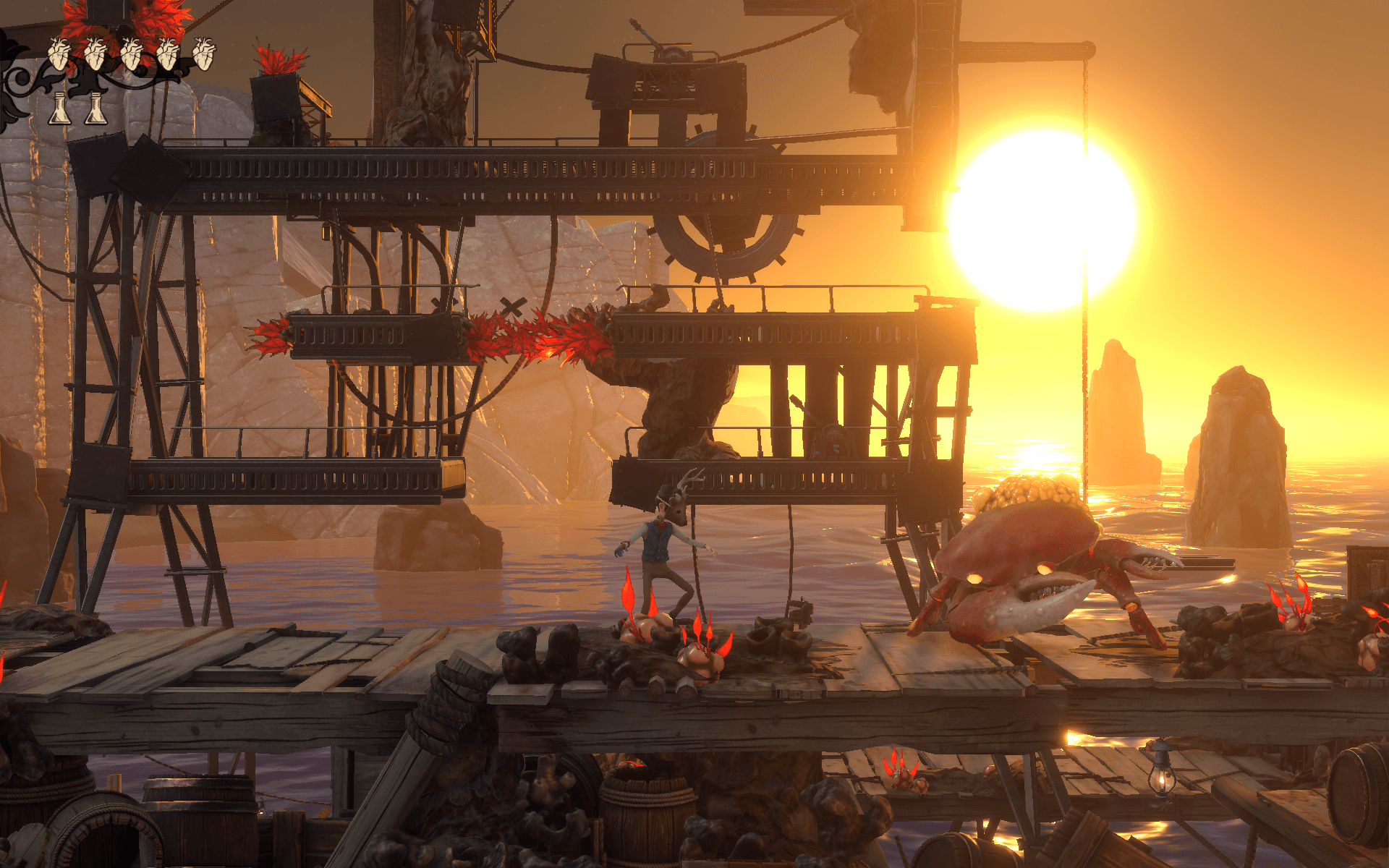
The art direction was the first element that initially drew me to Venture To The Vile. It made me curious to explore the macabre events taking place in this Victorian-style adventure. Unfortunately, I was disappointed when I started the game. I had many moments of dizziness and motion sickness due to the background images. I could barely understand what was happening in the background while my character was moving. You might also need to stop to admire the art and what surrounds you. The flowers in vases have a strange transparency effect and appear-disappear as if they're having a seizure. The enemy models lack detail and seem unpolished. Their artistic style doesn't feel like it fits with the rest of the elements.
To look on the bright side, we can unlock many costumes for our character. They come with a series of bonuses. With the exception of the Prisoner Garb – that one just doubles the damage you receive, buuut… you need to use it if you want to unlock all achievements. I advise you to be careful with darker coloured clothes, as you might not be able to distinguish where your character is at night.
The sound is neither good nor bad. The sound effects for attacks and when you get hit are well-synchronised. Although sometimes they sound too muffled and give me the impression of poor quality. I didn't notice a distinct audio identity for the different regions visited. Only boss fights get special treatment in this regard.
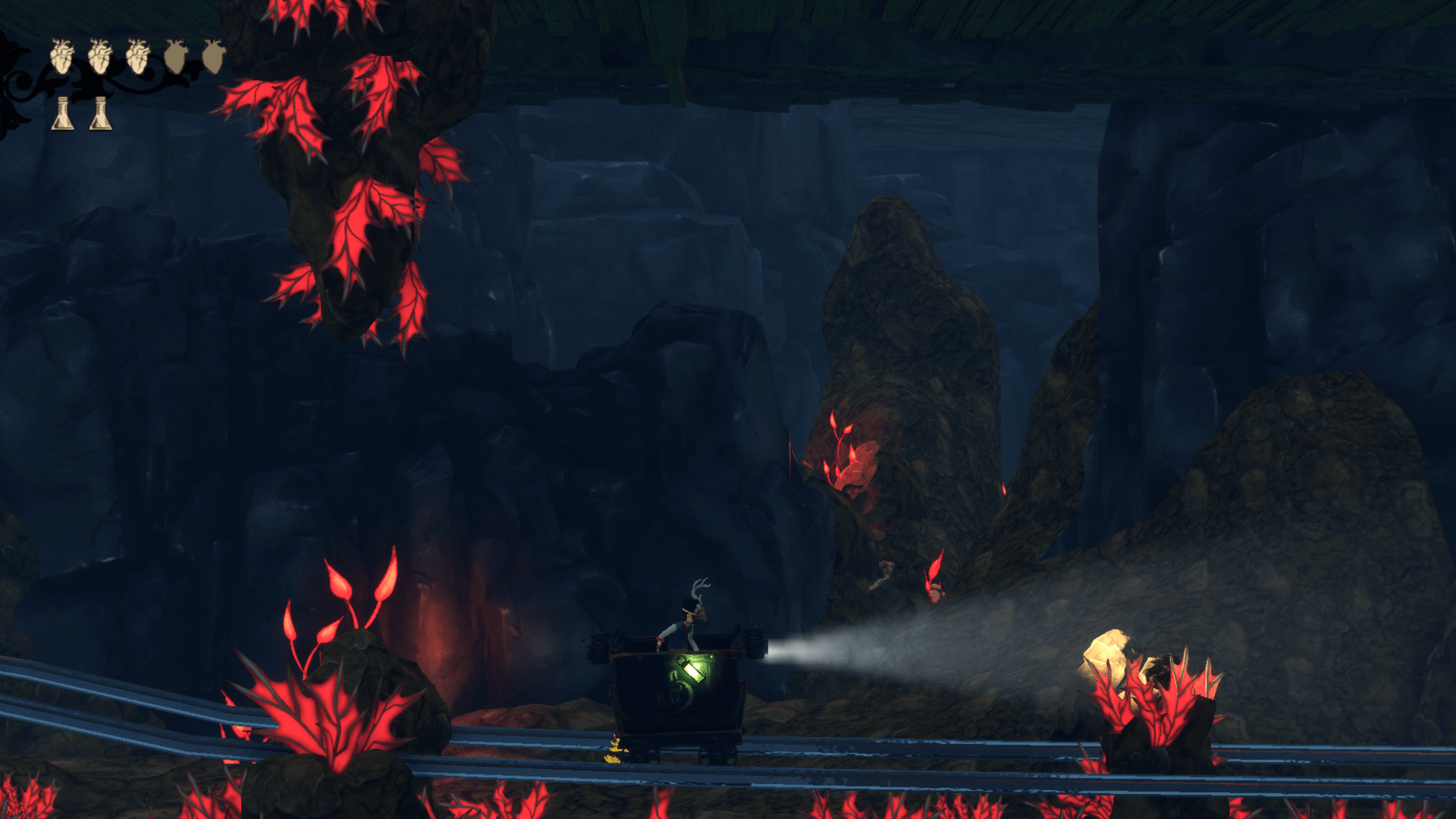
There's a mine you have to navigate using minecarts, and you have to jump over disused tracks. And when you jump, the sound is completely cut out. I usually associate the lack of sound when I make a jump with a failed attempt. You can rest assured if you're on the same wavelength as me – you'll land safely. The sound can also cut out completely when using Doctor Crow's machine if you use it multiple times in succession.
What can you expect in terms of accessibility and optimisation?

I haven't played around with the accessibility options much. But I'm glad to see options for larger fonts for those with visual impairments. The problem is that this option is dragged down by the text and font irregularities I mentioned at the beginning. The options that extend the parry window and extra health points are useful for those interested in the story, but not necessarily in combat. I don't expect you'll need to activate these assistive options, as the standard difficulty is more than adequate. I'm not saying this because I'm a big fan of Souls games who can't cope unless constantly beaten by enemies. The game simply has an acceptable difficulty.
Even if the text doesn't play an important role in advancing the story, I would have expected it not to have problems like multiple sizes and fonts for letters in the same paragraph. Or words that blend and merge with each other.
There are many moments when you will unexpectedly fall into the void. It happens more frequently in boss arenas or in the combat tournament similar to the one in Hollow Knight. I'm just saying be prepared and save when you have the chance.

The game also freezes or drops frames when you fight overly large groups or open chests with too many coins. It seems it can't handle so many elements present on screen simultaneously.
There's a bestiary, and you have to defeat each creature 10 times to fill it completely. But as one of the developers mentioned, there's a rabbit enemy that doesn't respawn after you defeat it. Even if this isn't the intended behaviour for this Easter bunny. The only way you can roast it 10 times is to remember all the locations where it appears. So grab your pen, paper, and screenshots, kids. Especially since it will run from you like the devil from holy water.
Final Verdict
Venture To The Vile is a game I wanted to adore because of its theme and the events at the beginning of the story. But it has too many aspects that sabotage it: bland story exposition, far too many fetch quests and unimportant characters, bosses put there to be mocked, simplified combat and unresponsive controls, lack of enemy variety and design that doesn't fit with the rest of the environment, poor audio quality, plus video, audio, and mechanical bugs.
Initially, I wanted to give it 4/10 after finishing the game. I ended up with 4.5/10 after weighing all the pros and cons. No matter how much you want to like the game (and believe me, I desperately wanted it to be a success), the visible problems don't justify the €24.50 price tag. If you still want to try it, it's better to wait for a massive discount.
Encouraging news is that the developers are working to fix the problems, even if the team has officially been let go. I can't guarantee they'll fix everything. But I would keep an eye on the changes they announce in patches and if they resolve the issues I mentioned.

Played on: PC
Release date: 22 May 2024
Developer: Studio Cut to Bits
Publisher: Aniplex, Inc.

0 votes
Scroll down here and stay on the page for at least 30 seconds to vote.
Pick a score from 0 to 10 (halves are allowed).