
Anno 117: Pax Romana – Review

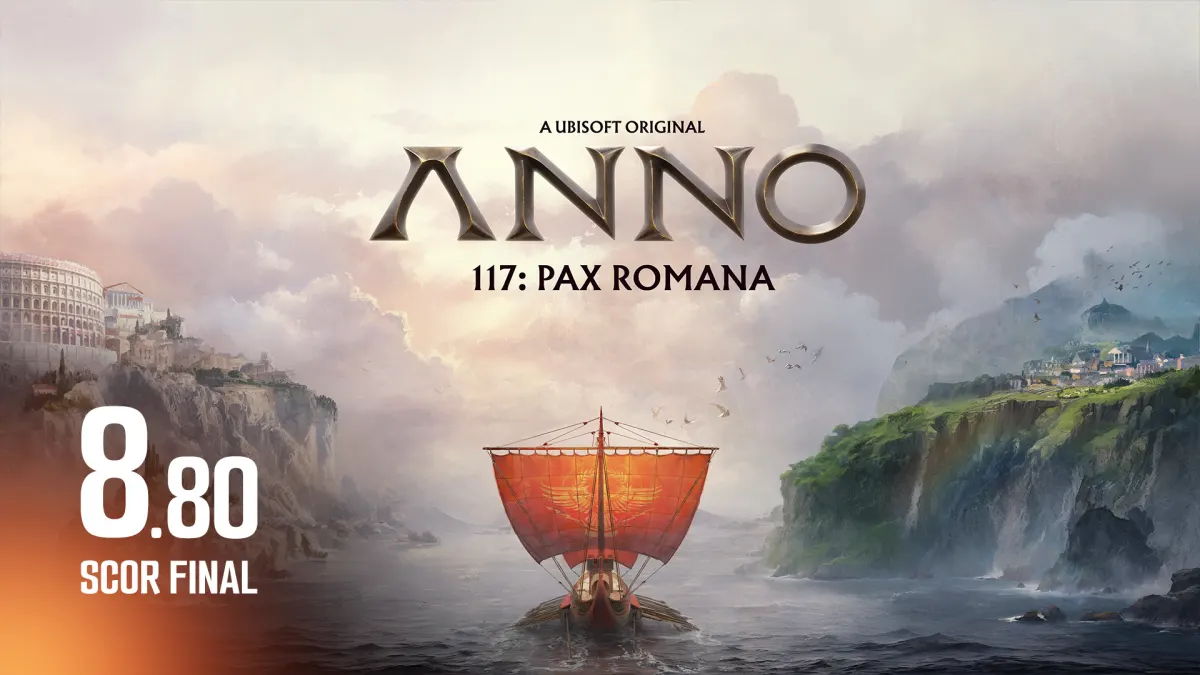
Semper Ubi, Sub Ubi
Ave, friends! The Empire has never been better than today, in 117 AD. From Britannia to the Red Sea, the campaigns of the recently deceased Trajan have secured us more real estate than Rome has held at any other point in history, and no major conflict is on the horizon. A prosperous period is announced, perfect for urban development activities on the northern frontier.
Of course, the life of a praetor is no walk in the park. Anno 117: Pax Romana offers us precisely such a role in probably the most interesting setting the franchise has ever tackled, with its established gameplay format where we satisfy needs through elaborate production chains to reach increasingly sophisticated populations. Developed by Ubisoft Mainz, the latest title in the Anno Domini series is a huge and complex beast that manages to balance accessibility with depth, with a simple and clear foundation but elaborate ramifications that we continuously discover over several dozen hours of gameplay.
Whether you're an Annoholic with thousands of hours logged in the series or a newcomer with no experience, the visual spectacle you witness as you spread the glory of the Empire from one island to another is impressive, and the clean interface and intuitive tools create a relaxed and airy learning curve.
Salve, Praetor!

As the series has accustomed us, the campaign takes place in an alternative reality that emulates the geopolitical situation of the time, but does not use real historical characters. The Emperor here is Gnaeus Firmius Caldus, and the player can choose their avatar between Marcus Naukratius or Marcia Tertia, potential governors of the province where we begin the adventure, Latium.
A generic name for a domestic province, it looks and feels like the heart of Italy, large, flat spaces where we lay down the first districts of freedmen (emancipated slaves) and deal with the lowest rung of Maslow's hierarchy of needs. We cut trees to make planks and place the first food-producing buildings, before dressing them in hemp clothes.
The importance of space economy is evident from the first moment: lumberjacks naturally need forests, while the expansion of residential areas must be done wisely, with the idea that later we will have to offer them various services for which we will need dedicated space in the citizens' proximity. If we have access to marshland, we collect reeds to produce the first footwear, and later we will exploit ores to arm our forces or engage in advanced projects, such as aqueducts or theatres.
Compared to Anno 1800, spatial efficiency is not conceived in zonal blocks, but on access to specific resources, allowing a bit more disorder than in the last few titles, without compromising development speed. Although there is still value in right angles and limitatio (the land surveying method invented, incidentally, by the Romans and whose influence is still felt today, especially in American urbanism), the scattering of resources and terrain types on the map encourages us rather to spread out our settlements to have access to everything, in a fairly casual way (there is no traffic or congestion, production times are clearly included in each window's panel, and island-specific fertilities and resources are clearly described in the dashboard).

In true Anno style, once we satisfy the range of needs of one class, we can invite the next social tier to join us. Plebeians, equites, and eventually patricians appear, in turn, as we satisfy increasingly complex systems of needs and production. Nothing new at first glance, but each addition brings with it synergies that organically intertwine with the simple foundations of the preceding classes.
Religion, for example, plays an important role here. Each island can fall under the patronage of a chosen god, and this brings significant improvements in certain sectors or production chains, but the population must fall under the aura of a temple, which generates the necessary points to unlock these bonuses. Governors in sandbox mode also have specific inclinations and bonuses, and the accumulation and superposition of these advantages will be the icing on the theorycrafting cake for those inclined towards profit maximisation. There is a complex and satisfying mathematical component that interacts with the other systems and satisfies your meticulous side like one of those Olympiad problems that requires a touch of imagination in addition to understanding the basic algorithms.
Moreover, public institutions and social centres augment the stats of nearby districts, like an aura. A school in the middle of a residential district will produce more research points than one on the periphery, and the strategic placement of public institutions will minimise the chances of a revolt, an epidemic, or a fire, depending on their purpose. Taken individually, these components have existed since time immemorial (in the Caesar series, we had prefects), but in the Anno series there is always a geometric elegance to how you combine all the needs and services of the people on the map.
Ships primarily help us transport resources from one island to another (we will need at least planks and bricks to lay the foundations of a colony) and, later, troops. Combat is not mandatory, of course (in fact, I avoided this component as much as possible) and diplomacy is more tonally appropriate with the rest of the gameplay. They have crews, various weapons, and you can buy or build both civilian ships for trade and military vessels.

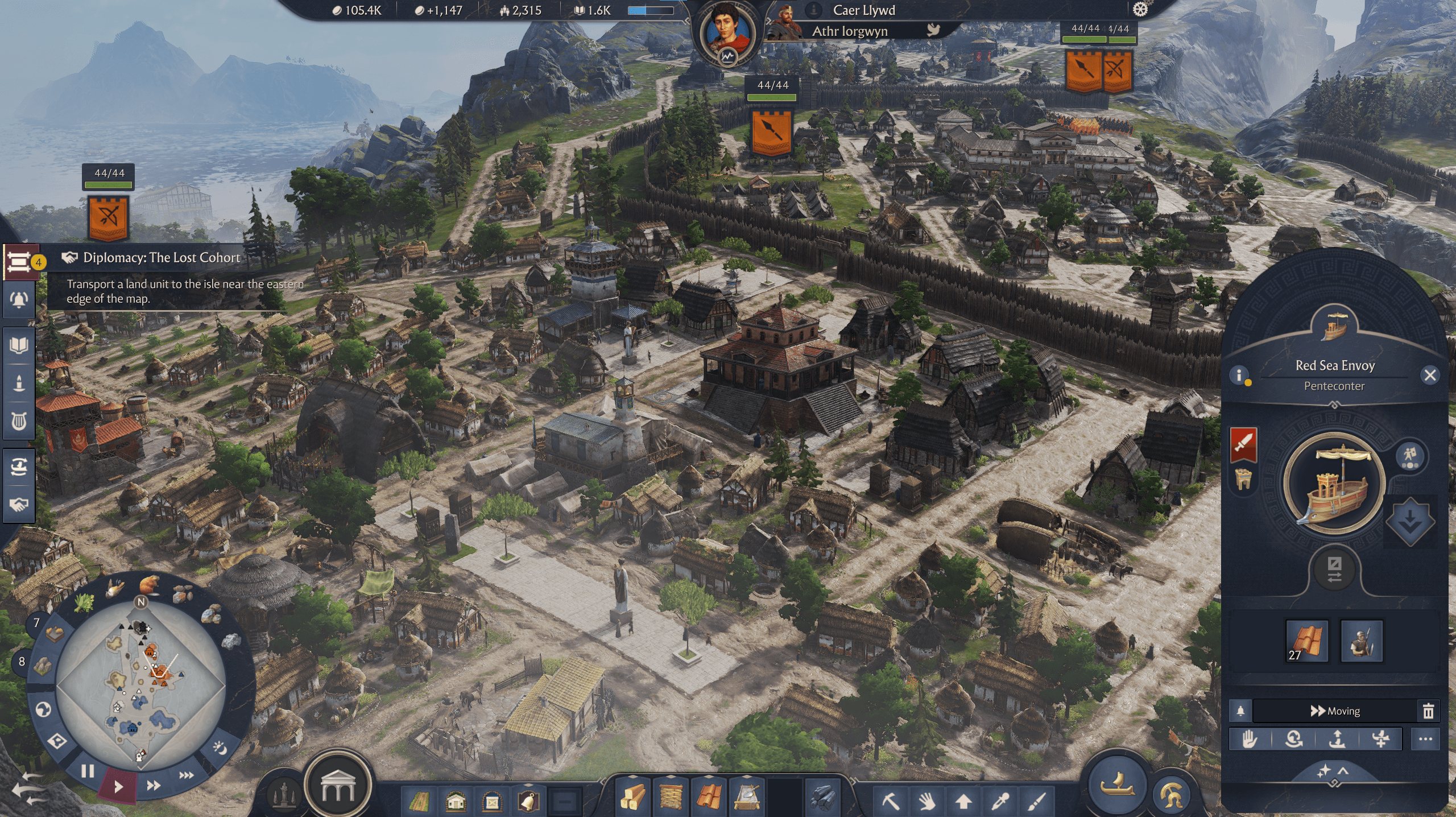
Nevertheless, you can recruit armed forces from the civilian population (if you have the weapons, population, and capital to sustain this extremely costly endeavour) and invade your adversaries. Combat is not instanced (unlike Anno 2205, you don't go on missions to isolated maps), but is integrated into the same world where you peacefully build and manage cities. This creates a centralised experience, where the risk and benefits of aggressive gameplay have direct consequences on the evolution of your settlements.
As for the actual fighting, Anno is not Total War. Sure, tactical movements, war machines, and troop distribution play a central role in determining the winner, but the manoeuvres we have access to are simple and at roughly the same level of accessibility as the rest of the game. Anyway, you can almost completely avoid combat during the campaign, and if you choose the path of war, you'll still need to have built a solid economy to sustain the brutal costs of a military campaign.
To England
After the first segment of the campaign, we are exiled to Albion, a province at the north-western edge of the Empire, where we must start over and prove that we know how to govern barbarians.
Here we have more freedom of decision when it comes to the composition of the population. First of all, the Celts are a radically different population from the Romans we are used to, with different needs and capabilities. Moreover, the four tiers of citizens from Latium are replaced by two parallel trees that we can explore: after satisfying the needs of the most primitive Celts, we have the option of Romanising them to obtain a hybrid population or not altering their culture. Pure-blooded Celts can produce cheese, beer, and other things unknown to the Latins, and the rarity of a resource is a major factor in dictating its price.

Then, the central mission of this province is to defeat or diplomatically persuade the enemy chieftain, Voada, to put an end to the barbarian invasions. We can build a fleet and troops or take advantage of the trade that takes place between all factions on the map to develop our civilisation, and even within this framework where we are constrained by clear objectives, we enjoy a high degree of freedom when it comes to creativity and charting the most suitable path to achieve them.
The tech tree is massive, divided into three branches (economic, civic, and military) and unlocks access to new structures, optimises production, and offers bonuses for existing buildings. It functions globally, regardless of the province you are in, and you will most likely finish the campaign long before you reach the most advanced technology of any branch. Some technologies are conditioned by reaching certain development thresholds, such as expanding to other islands or building a barracks, but almost all have a practical use.

In addition to technology, there's a kind of meta-progression in a system called the Hall of Fame, an achievement system with which you unlock content that persists between saves and varies from new portraits for the governors you can choose in Endless mode to decorative structures.
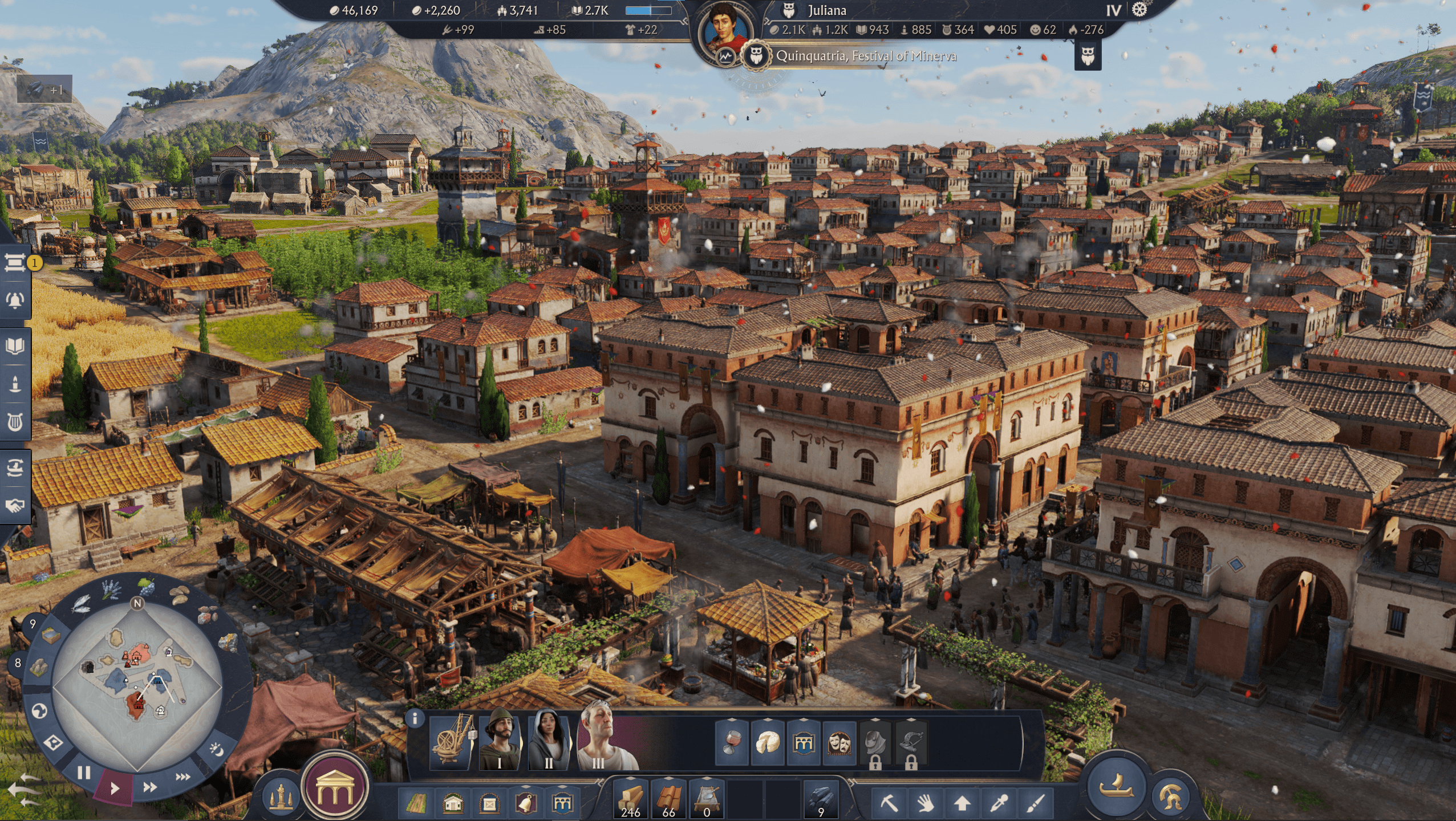
The level of detail of the buildings and terrain is absolutely sensational. It happened to me (and not just once) to completely forget about missions and objectives just to wander the streets, mesmerised by the architecture, hustle and bustle, processions during a festival, or mundane interactions between merchants. The atmospheric effects, draw-distance, camera fluidity, and lighting contribute to a visual experience that is as modern and immersive as possible.
One of the most satisfying aspects of a city builder is that break you take to admire your work from all angles, to see districts bathed in the morning light, to fly over a few hours of urban expansion work, and technically Anno 117: Pax Romana is everything I could have wished for in these segments. The multicoloured fields with all sorts of crops, the street networks that criss-cross my toy city, all look incredible, and even in a genre that doesn't lack good-looking titles, this game is superb.
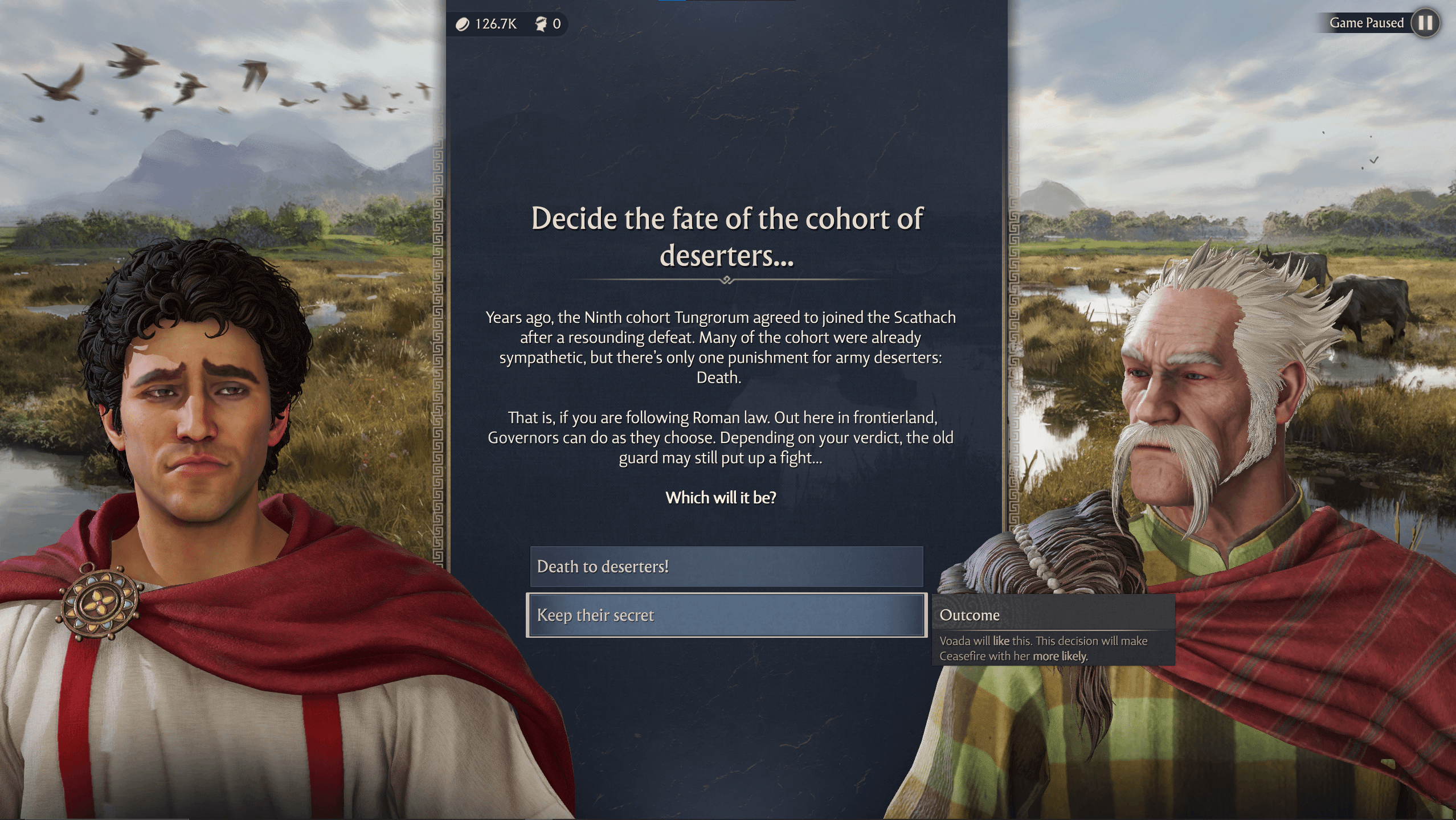
In contrast to this, the models of important characters are outdated and rigid. The lip-syncing has nothing to do with what you hear, the expressiveness is akin to what happens in a Bethesda RPG, and it doesn't help much that the game's story in general is mediocre. The history of Rome, in general, is anything but boring, and it's packed with betrayals, intrigues, and elaborate political conflicts, while the narrative of Anno 117 is more or less a tutorial disguised as a few predictable steps cooked up in a production meeting about a hypothetical interaction between Roman civilisation and the most generic Celts you've ever seen. Probably new chapters will be added through DLCs; in principle, if you don't waste time, the campaign can last between 6 and about 15 hours, but I saw it more as a broad overview of the systems, requirements, and different playstyles you can venture into in sandbox mode, in the ocean of which the narrative is just a drop.
As Above, So Below
After you finish the story, the much freer and unconstrained by objectives mode awaits you, where some end up spending thousands of hours spreading across every square metre of the map: Endless. First, you choose your starting province (Latium or Albion), the difficulty level, as well as the number and playstyle of AI-controlled enemies.

You can also choose at the end of the campaign to keep the progress obtained during it and practically continue in a sandbox, after returning from exile and keeping all the settlements and islands conquered and developed during the two acts, a very nice way to give permanence to your previous efforts.
There's also a co-op mode, which unfortunately I didn't get a chance to try, but which I'm convinced makes the experience twice as fun. In its absence, you have up to four AI-controlled factions spread across the surrounding islands.
Less fun is Ubisoft Connect, which stubbornly insists on existing and getting in my way. Screenshots taken through its overlay came out corrupted, and I had to resort to other tools to take pictures for the review. Also from the collection of Ubi faux pas, which includes hits like “Get used to the idea that you no longer own games” from EPs “Pay monthly until you die” or “Psst! Mate? Want an NFT? I've got car NFTs.” this time we have “genAI on your loading screen”. It's absolutely sinister that a game with Anno's budget, which has been in production for over five years, would invoke excuses like “we rushed and forgot the placeholders”.

The illustrations on the game's loading screen are, as a rule, one of the most meticulously and artistically treated aspects of the game, and I find it absolutely outrageous that a $60 game allows itself to sell you sloppy work made with a hallucinating photocopier in certain components of the game. It's the ultimate form of disrespect not only to the customer but also to the tens of thousands of professional illustrators who would do a better job.
Too long; didn't read. What's the verdict, brother?
Anno 117: Pax Romana is a massive but accessible game, with the most distilled gameplay loop since Anno 1602. The fact that we even got here is a testament to how solid that loop is in the first place, and the airy approach will attract numerous new fans, I'm sure. If you can get past the fact that somewhere in the game's production someone thought it was okay to sell you gruel made with a hallucinating photocopier in certain components of the game, a huge and complex world awaits you where you can rebuild the grandeur of the Roman Empire in its most prosperous and advanced era.

Played on: PC
Release date: 13 November 2025
Developer: Ubisoft Mainz
Publisher: Ubisoft
Plus
- A vast and complex world, superbly modelled, from the terrain to countless impressive buildings from all angles and at all zoom levels
- The same solid and engrossing gameplay loop that made the franchise famous, here with some new, organically integrated systems
- Combat is integrated into the same world where you build your empire, if you choose a more militaristic playstyle
Minus
- Outdated characters and non-existent lip-syncing
- genAI used in production and “forgotten” in the product you buy
- Ubisoft Connect is disappointing…
0 votes
Scroll down here and stay on the page for at least 30 seconds to vote.
Pick a score from 0 to 10 (halves are allowed).