
Biomorph – Review
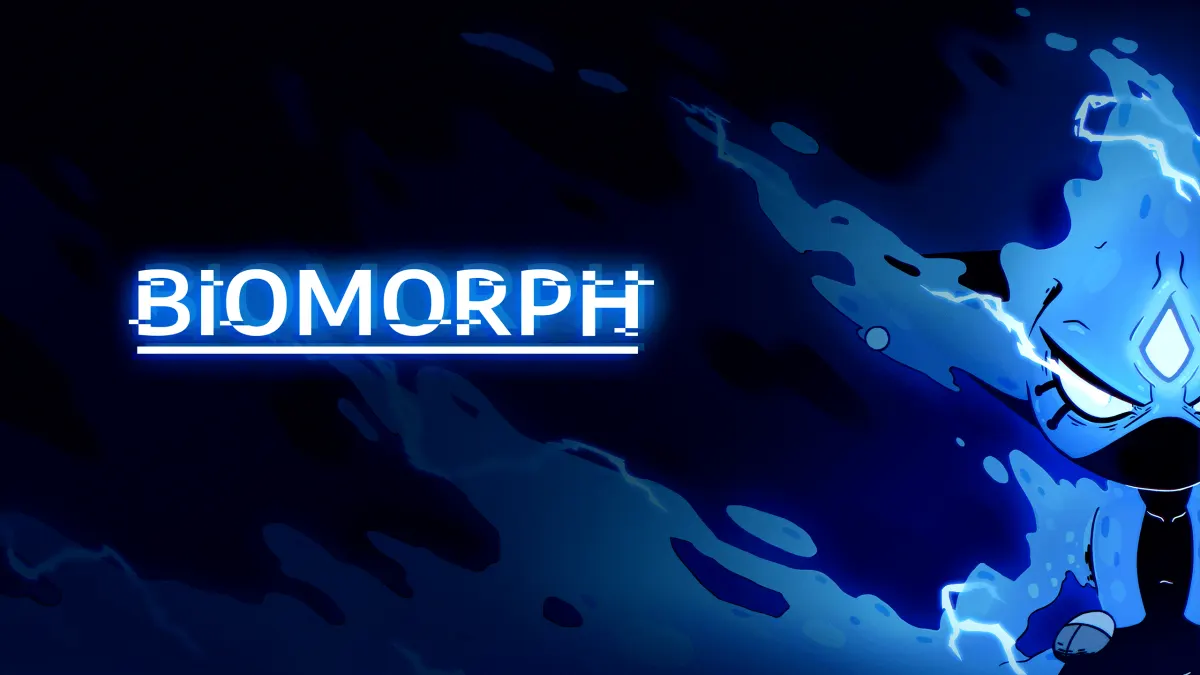
A Metroidvania where you face your enemy and become one with it.
April is shaping up to be a good month for Metroidvania and rogue-like games. I won't tell you too much about the latest releases and announcements, because you'll most likely see reviews of these games quite soon – keep an eye out until we get to the rest of the games.
Today we're seeing what BIOMORPH has to offer, developed and published by indie studio Lucid Dreams Studio on 5 April. The game is basically a Metroidvania action-adventure, but with a rather ingenious trick – you can assimilate the creatures you defeat; copying their form and abilities, they will help you traverse a world destroyed by the struggle for ferrox, a blue substance that drives many creatures mad and distorts their bodies and minds in horrible ways, transforming them into true monsters.
A story that could use more ferrox… I mean, substance
As the name suggests, in BIOMORPH you take control of a shapeshifting creature named Harlo. You escape from a device that kept you in stasis due to a system error, but you have a teeeeny problem: you have amnesia and don't remember much of your past. What you do recognise is that your friend, Kleio, is also captured by such a device and you're trying to free them. Everything would be fine and dandy, if the entire complex you're in (called The Core) didn't collapse on you and block the way to Kleio.

You still manage to escape and arrive in the town of Blightmoor, meet the locals, and begin your adventure to regain access to The Core – to do this, you must activate all 4 power sources that fuel it, which are scattered across the map. What I appreciate about unlocking these sources is that they don't feel like repetitive missions where you go, unlock the sources, go to the next one – each time you activate them, you get glimpses into Harlo's and Kleio's past, and what happened to bring the planet to such a dismal state.
One aspect that slightly grated on my nerves is how Harlo suddenly becomes best mates with everyone he meets, as if they went to uni together and just last night had a cracking booze-up, like old pals. The main character only needs two or three dialogues with the locals to transform from a sceptic who doesn't know if he can trust those around him (because duuuh, you have amnesia; you don't know who's a friend and who isn't) into the most loyal friend of the characters, willing to help them without questioning their motivations too much. The change felt too sudden and unnatural. I expected relationships to improve and build more gradually, from being a cold person who doesn't even trust his own mother to someone who slowly opens up to people and becomes a reliable ally over time.
And yes, you read that right: DIALOGUE! We already know that protagonists in this genre of games aren't exactly chatty if you think of the little knight from Hollow Knight, or The Vessel from GRIME, and the list goes on. I was pleasantly surprised that the main character finally has a voice and an opinion, instead of passively listening to the incoherent babble of NPCs. But what I felt was missing were some sound effects or vocalizations of the characters during dialogue; yes, it's very moving to read about someone who lost their wife, but it would have been even more moving if they had added sounds of weeping or sighing. Even a few vocalizations in a fake language created just for the game would have helped. I desperately wanted to resonate with the story and characters, but the absence of these aspects prevented me from fully immersing myself in the game world.
Most of the missions will send you on thrilling adventures to discover the game's universe, gain new powers, and learn about the game's story. But you'll also encounter one mission that screams at the top of its lungs, “How long and tedious can we make this fetch quest?” Yes, it will take you across the map and you'll meet new characters. But by the time I reached the end of the mission, I felt extremely bored from all the useless talking with NPCs who did nothing more than tell me “You did great and found me. Now go to the next NPC. Kisses.” Even the main character makes fun of it at the beginning of the mission, saying “Couldn't you just go and tell them yourself?”
Most characters don't seem to have a very significant personal story. Their role is more as guides to tell you where to go and what to do, as merchants, or as upgrade points. There are a few exceptions: Eny and Zeki, the two prosthetics you have instead of arms, who are excellent at making fun of each other – I laughed quite heartily at their interactions – and Will – a nomadic musician who is the living embodiment of the meme:
“- I had to fight all these enemies and climb all sorts of platforms. How did you get here?
– You know. I walked.”

The authors also included some references to general knowledge or pop culture, such as the reinterpretation of the song “Romeo and Juliet”. I found similar references in the Reports that can be found scattered throughout all regions of the game: a scientist named Benz who invented a ferrox-powered vehicle; one named Franken, who encourages the creation of monsters instead of building robots; another named Vegapp (I won't say more, so as not to upset One Piece fans who aren't up to date with the anime), and the list goes on.

The gameplay has enough substance to compensate for the story
As you might expect, the coolest part of the game is that you can assimilate the monsters you've defeated and transform into them. Some of these monsters are very useful in combat, such as Thogwar, who spits fire and decimates ferrox creatures. Some help you traverse different sections more easily, such as Oddwing, who can fly through narrow pipes. And some help you remove obstacles, such as Thorot, who can destroy solidified ferrox blocks by crashing into them. I find the way they implemented this mechanic both intelligent and reasonable, instead of letting you become any creature you want as soon as you destroy it; you have to destroy a certain number of specimens of each species before you can transform into it at will. You can only equip 3 such transformations at any save point. And you have to pay attention to what types of creatures you want in your arsenal depending on the area of the map you are in. A nice bonus is that you can assimilate creatures even after you've passed the necessary number to transform into them at will, and this will give them different improvements.

Chips are how you add new weapons to your arsenal and become a dangerous little monster – they act as weapons and you can find them scattered throughout the regions you explore. Even though the game offers a variety of 14 chips, I didn't really feel the need to make major changes to the initial 3 options the game gives you to deal with any specific boss or enemy. The only significant change I made was to replace the close-range weapons I initially received with faster ones that have the option to charge a stronger attack when needed. I also tried the other ranged weapons, but I still stuck with the initial option. Only the third weapon slot seemed more flexible, but often it didn't make a difference. That's how I managed to make mincemeat of the enemies, without too much effort. The rest of the chips might be interesting if you're curious to challenge yourself to finish the game using only a certain weapon, but that's about it.

Even though I didn't feel the need to adjust weapons too frequently, the story was a bit different with Mementos – augmentations similar to Charms in Hollow Knight. Yes, you still have to search for them like crazy in every corner of the game, but it's worth it due to the high level of customisation they add, depending on your playstyle. Are you a maniac obsessed with dealing as much damage as possible? Add some Mementos that improve your attack, attack against bosses, or that hurt enemies back when they hit you. Do you like to play it safer? Add some Mementos that increase your HP, as well as the value and frequency at which you can recover HP.
To all this is added the possibility of unlocking permanent HP and attack improvements that you can discover as you progress through the game.

The variety of enemies isn't very large, with a maximum of 3 species of enemies for each distinct zone. This aspect is understandable, because if you think about it, each new enemy would add extremely many challenges for the design team to find a utility for them in terms of combat or game traversal – because you'd want to transform into a creature that brings you utility, wouldn't you? Even in this case, they have the possibility to make up for it with more zones and enemies in a DLC, if it's ever in Lucid Dreams' plan.
The bosses didn't feel very difficult, and the Mementos and Chips I unlocked made the difficulty level drop even further. Most of them had easily identifiable and memorisable patterns. My only complaint would be with the hitbox of a certain flying boss – I couldn't damage its tail at all, but this didn't stop it from hitting me every time I got close to its tail. Speaking of contact damage, you have to remember that you will be considered hit by an enemy if you touch it – so umm… you know… don't touch them; just hit them in the liver.

Another aspect related to combat is that contact damage alters your position. And I wouldn't have any problem with that – if you take a hit, you involuntarily take a few steps back – if the animation didn't make it very difficult to figure out where my character is. I won't lie, most of my deaths are due to the fact that I couldn't see where Harlo was after being hit, to plan my next move.
The game is generous with save points (called S.A.F.E.). You even have the option to upgrade them to a superior version – S.A.F.E.-T – with the help of kits offered for free by an NPC – which means you can also use them as fast travel points. You can increase the number of kits this NPC offers you by upgrading their lab. I wasn't too keen on the idea, as I never ran out of such kits. Well, I admit, I'm also a madman who searches for everything that can be found on the map.

Speaking of finding things on the map, undoubtedly the best Quality of Life improvement is the map itself – every time you've discovered everything there was to find in a certain room, its outline automatically turns golden and you know you no longer have to frantically search for a secret room. Something that isn't mentioned is that you have to have defeated every monster and transformed into it to get the golden outline for that room – a good detail to keep in mind before banging your head against all the walls, hoping one of them is fake.

Remaining true to the Metroidvania genre, in BIOMORPH you will acquire abilities that make your life easier in terms of movement. These include standard abilities such as limited flight, the ability to launch yourself into the air for a short distance, or the option to climb walls. Personally, I felt a little disappointed that you don't receive such abilities after defeating a boss, and the only way to unlock them is to wander through the world. What can I say, I like to gain something substantial after taking down a difficult enemy – I'm a souls-like player.
Borrowing a little inspiration from its cousin Hollow Knight, BIOMORPH also sends you searching for fluffy and adorable creatures – CATS! Well, technically, they're called Scargatos. But considering that “gato” means “cat” in Spanish… you get it. You receive rewards in the form of coins and materials for each of the 40 fluffies you send back to their home.
Added to all this are puzzles that include finding numbers to unlock different safes or platforming sections at the end of which are various rewards. The platforming sections weren't unreasonably difficult – even though I died a few times, I had a blast figuring out what to do to traverse them. However, the puzzles were quite vaguely implemented – for example, one of them tells you to look for the respective numbers through a small village, when in fact they are hidden outside the village as well. I had to keep my eyes wide open and keep visiting the different rooms of the level until I figured out where the numbers actually were. I'll be honest, the process bothered me enough that once I discovered 2 of the 3 digits, I'd just guess the third one so I wouldn't have to desperately search for it anymore. It's not stupid if it works, right?
Art direction and music rarely complement each other so well
The hand-drawn characters and environment design for each level simply blew me away. I could feel the love that the people in this indie studio put into every detail – and most importantly, into every cinematic sequence. I would have liked to see more such sequences to reveal the story, given how well the existing ones were executed. I found the same quality in the music – be it the drum rhythm of a war-torn sky kingdom, the sombre soundtrack of deep caves, or the majestic orchestra of a religious cult's cathedral. The only aspect I felt was missing was some voice actors to bring the characters to life.

It could be better
The folks at Lucid Dreams are skilled with their creature transformation mechanic: they made sure that once you transform back into Harlo's original form, you'll leave behind a spirit you can return to anytime, should you need to. What's more, you can even transform in mid-air to deal with difficult platforming sections. But some of these transformations could use some adjustments – for example, one of the creatures makes safe platforms appear over spiked ones, but if you deactivate the transformation, the spikes kill you and you're respawned… on top of the spiked platforms… until they kill you for good. And that's how I was relieved of a lot of coins right when I needed them, right at the beginning of the game, bless their hearts.
Speaking of coins, once I got over the aforementioned incident (I like to be a dragon who hoards everything he can get his hands on, so he can buy everything as quickly as possible, don't judge me), I realised that you get a lot of them just by playing, without too much stress. The idea itself is nice, but I feel like they were a liiittle too generous and didn't make me feel like I was being rewarded for the effort I put into collecting the coins, because everything was very accessible and easy to buy. Maybe they could tone it down in a future patch.
Another problem I had was with the disappearing and reappearing platforms, which still showed the platform graphics on screen, even though they were long gone for a stroll.

What bothered me in the end was that the game crashed 4 times – twice in the penultimate live stream with the game, twice on the last day. This made me cancel the 2 streams. Sure, you could blame hardware or OBS, but not when you've already played the game live for 32 hours without technical issues.
Final Verdict
BIOMORPH has many strengths: extraordinary hand-drawn art, music and sound design that immerse you in the game's atmosphere, Quality of Life improvements not normally found in a Metroidvania, and intriguing gameplay, combat, and mechanics. Unfortunately, it loses points when it comes to the many forgettable characters and missions, the lack of vocalizations to make the text-based dialogue more interesting, the bosses that aren't difficult to defeat + the technical difficulties I mentioned.
It gets a solid 7 from me and I encourage you to give it a spin – especially if you're not as picky about the story as I am.

Played on: PC
Release date: 5 April 2024
Developer: Lucid Dreams Studio
Publisher: Lucid Dreams Studio

Plus
- Extraordinary hand-drawn art
- Immersive music and sound design
- Quality of Life improvements not normally found in a Metroidvania
- Intriguing gameplay, combat, and mechanics
Minus
- Many forgettable characters and missions
- Lack of vocalisation to make text-based dialogue more interesting
- Bosses that aren't difficult to defeat
- Technical difficulties (crashes)
0 votes
Scroll down here and stay on the page for at least 30 seconds to vote.
Pick a score from 0 to 10 (halves are allowed).