
Death Stranding 2: On the Beach – Review

Go where you want, not where you're told.
When it launched in 2019, Death Stranding took the world by surprise. It was a highly anticipated game for Hideo Kojima's fans, but it divided the gaming community. Some accused it of being a simple walking simulator with courier elements. Others said it represented an misunderstood genius's attempt to remain relevant in the industry. And for some, it was the ultimate title, an analysis and socio-political commentary on modern life and how technology has transformed our relationships.

Personally, I considered this first creation from Kojima Productions to be a breath of fresh air for the AAA industry, where creativity has been replaced by generic formulas and annual releases. Uncle Hideo Kojima's first game after leaving Konami was a complex title, hard to define with 2019 vocabulary. I admit that what he created wasn't for everyone, due to the themes addressed, its bizarre way of seemingly predicting the future (many noted striking similarities to the Covid-19 pandemic), and the monotonous gameplay loop, occasionally interrupted by tens of minutes of video sequences presenting story fragments that required several doctorates to fully understand.
Kojima-san closely monitored player reactions to Death Stranding to see what could be improved further, and in a recent interview, he stated that he hopes On the Beach will be as controversial as the first title. At the same time, to avoid being considered a modern-day Nostradamus, he massively altered the story from the initial version, hoping not to predict any major historical event. Unfortunately for the legendary developer, Death Stranding 2: On the Beach is a resounding success, pleasing players and critics alike, with a score of 90 on Metacritic. This direct sequel to the 2019 title is more ambitious in every way: more bombastic, larger, and more complex than its predecessor. As with many sequels, it improves upon what the first game built and gives the developer the freedom to do everything they couldn't before due to technological limitations. As we've accustomed you to by now, we'll start with the story.

Should we have connected?
On the Beach begins 11 months after the events of Death Stranding. The protagonist – Sam Porter Bridges – has chosen a hermit's life, hiding from the United Cities of America (UCA) on the border with Mexico, to raise little Lou. But his parental leave doesn't last long, due to the appearance of Fragile, who asks him to help her connect the territories of other states to the chiral network (a kind of mystical successor to the current internet). Sam reluctantly agrees, after the character played by Léa Seydoux promises to look after the baby while he's away and that this network expansion is not an attempt to increase the UCA's influence. This is the premise of the story, which becomes much crazier along the way and forces Sam to traverse the world to connect Mexico and the Australian continent to the network, in his attempt to save humanity from a catastrophe of biblical proportions.
Unlike the first game, the story in this sequel is more “accessible”, in the sense that it is told through frequent video sequences. Although there are still clips lasting tens of minutes, especially towards the end, there are enough breathing moments that develop the narrative thread and explain the events and the post-apocalyptic world the protagonist finds himself in. Typical of Kojima, On the Beach continues his social commentaries and artistic vision begun in the previous game. If the first title discussed how the internet radically changed human relationships and the need to be connected to each other, the sequel addresses the exact reverse: one of the central themes is how technology is used – for both good and evil. In the first game, we saw the power to build connections. Now we also see the negative effects of a hyper-connected world, from the spread of extremism to the harmful impact technology has on nature.

I wish I could tell you that the story in On the Beach is easier to understand, but I'd be misleading you with that statement. Although it's more streamlined, the narrative thread remains complex and assumes familiarity with the Death Stranding universe and its specific terminology. There's an atlas that explains the terms and events mentioned, but constantly consulting it can become tiresome. My recommendation is to watch a few explanatory videos before playing, otherwise, you might not know how to differentiate Ka from Ha and BBs from BTs.
Through wind or rain
If you played the 2019 title immediately after launch and haven't touched this universe since then, you might remember it was a walking simulator that encouraged avoiding combat. This was due to Sam's limited arsenal, which was more equipped to handle the challenges of the apocalyptic landscape than the bandits and outlaws that infested the ruins of the USA. The base version received a significant update in 2021, which improved both the combat and stealth systems.

Gone are the days when the protagonist had to circumvent enemy bases. Our tired courier has learned from his first adventure and is ready to take revenge for all the times he had to change his route in Death Stranding because of bandits. It's clear that the developer was inspired by his previous works, because Sam now resembles a new version of Solid Snake (the main character from Metal Gear Solid). He can eliminate enemies with the skill and experience of a black ops agent, easily confronting supernatural creatures, paramilitary groups, and robots bent on exterminating organic life. The great stress caused by killing a human enemy in the previous game has completely disappeared here. Most weapons use special bullets, few being truly lethal. Thus, the risk of so-called “voidouts”, nuclear explosions caused by the necrosis of a corpse or the reaction between the matter represented by the deceased's body and the antimatter of a BT that comes into contact with it, is minimal to non-existent.
If I haven't lost you yet, I can tell you that much of the game can be approached in “stealth” mode, meaning by sneaking through enemy bases or the territory of supernatural creatures and eliminating them one by one. In the case of criminal factions, you can defeat them however you wish, and in the case of tar monsters, you can use your equipped weapons. Yes, you read that right: in this sequel, rifles, pistols, and grenade launchers can harm creatures that haven't managed to cross over to the other side. This small detail simplifies most confrontations, which in Death Stranding were true tactical puzzles.

A major difference from the previous game appears in the so-called “boss battles”. In the 2019 creation, these were simple one-on-one confrontations with various powerful opponents. On the Beach abandons the monotony of the classic formula and aims to be a truly unforgettable spectacle: from fights against giant robots, to brawls between kaiju that resemble a “fighting game” more than a walking simulator, or even a QTE section that seems ripped from Guitar Hero, Kojima unleashes his imagination and builds a truly creative AAA. The diversity of these battles reminded me of the golden age JRPGs (the 90s), when developers introduced mini-games from different genres to extend the game's duration. The difference is that here, nothing seems like filler! And if a certain section seems too difficult and you can't defeat the enemy, you have the option to skip the fight and pretend you won. Although it seems like a strange inclusion, this allows all players, regardless of experience, to enjoy Death Stranding 2: On the Beach.
What has remained relatively unchanged from the previous title is the central courier mechanic. Sam must pick up orders from various isolated cities and settlements and transport them to their destination. However, we are not talking about a faithful copy of the 2019 system. The protagonist gets a vehicle fairly quickly (even in the introductory area), and connecting a new region to the chiral network will populate the world with all sorts of constructions that will streamline deliveries. Come wind or rain, our trusted courier will deliver absolutely anything, from a new rag bought from the post-apocalyptic Temu, to canned goods ordered from this world's equivalent of Glovo.

What I found fascinating was the tango between the two game modes. I could be the coolest super-soldier and stylishly slaughter all the enemies in a base, only to immediately after trip over a pebble and watch helplessly as my unsecured packages fell out of my “backpack” and rolled downhill. Instead of getting frustrated, I checked what equipment I still had and embarked on another grand adventure to retrieve the lost packages. The impulse didn't come from an obsessive need to complete the game (100% completion), but from the fact that the developer perfected the formula from the first game and made it truly fun! Countless times I told myself: “I'll deliver one more package, then I'll close the game”, only to discover that it was already one in the morning and that single parcel had turned into twenty.
For you, the untamed
In an older interview, Kojima-san confessed that he desperately wanted to become a director, but fate had something entirely different in store for him. Although many jokes circulate online about how Hideo tells his stories, namely through long video sequences of at least 20 minutes, in Death Stranding 2: On the Beach, most narrative exposition moments are short and concentrated, rarely exceeding five minutes. I'm not saying there aren't some that are more like short films, but they are rarer and appear predominantly towards the end of the game.

I firmly believe he could be an extraordinary director, and the artistic direction in this legendary sequel is clear proof of his talent. Many joke that Hideo uses his studio and projects to meet all his favourite artists, but what he does is, in fact, a sincere tribute to all those he admires. Besides the actors (and director) already featured in the trailers, other renowned artists also appear in the game. I had known for some time, from Kojima's Instagram, that he was a fan of Mike Flanagan (horror director), but I didn't expect to meet him and his wife, Kate Siegel (actress), precisely on the Australian continent.
The acting is impeccable, and Norman Reedus's character is much better developed in the new Death Stranding. If in the 2019 creation he had more of a passive role, traversing America and being more of a witness than an active participant, here the courier is involved to the core. Kojima manages to harness the actor's full potential and creates an authentic protagonist, with feelings, fears, and hopes. Sam's sadness and joy not only humanise him but make you identify with this character who goes through indescribable hardships but doesn't stop. And he is not alone in this adventure! He is accompanied by characters like Fragile (Léa Seydoux), Tarman (director George Miller), and Dollman (whose appearance is based on Fatih Akin, but who is played by Jonathan Roumie), each with a well-defined role and an enviable performance. Kojima takes full advantage of everyone's talent and gives them space to shine. However, I must admit I was slightly disappointed that the series veterans are more involved in the story than the newcomers. Léa Seydoux's character becomes the glue of Sam's team, being the captain of the ship and having a role similar to Charles Xavier from X-Men, gathering characters with special abilities for the mission of connecting Australia to the chiral network. The newly arrived adjutants are excellently played, but their role seems more functional: they help the protagonist and that's it. They do, however, have a few moments where their story and motivations are outlined through short cinematic sequences. For example, Tarman is inspired by Ahab from Moby Dick, both having a missing limb and a consuming obsession (the captain in the novel with the whale, Miller's character with supernatural tar). His past is presented in a short but superb cutscene in terms of performance and cinematography, where we learn how he lost his son and his hand.

Regarding music and sound design, I have nothing to reproach Kojima for. The soundtrack is superb – a successful mix of original songs, composed specifically for the game, and well-known tracks from artists like Woodkid, Magnolian, and Gen Hoshino. Every important moment is accompanied by a song that elevates the scene and triggers a wave of emotions.
Pure art
Death Stranding 2: On the Beach is, without a doubt, the first truly next-gen game on PlayStation 5. The developer has spent the last six years testing Sony's new console and pushed it to the limits of rendering and performance. The introductory scene is something unprecedented in video games, a visual fidelity so high that it makes you wonder if you're looking at something created in a graphics engine or a real recording of the Sonora Desert. The characters are rendered with impressive realism, but the true star is Australia – the continent that Decima recreates in a palpable way. Whether we're talking about the highest, white-clad peaks, or the primordial valleys burning under the merciless rays of the sun, each landscape is a spectacle and a true visual delight.
In addition, the engine successfully reproduces complex weather phenomena – floods, torrential rains, wildfires, and sandstorms – and each of these influences not only the environment but also the way you approach deliveries.

What completely blew me away were the battles with Neil, the smuggler played by Italian actor Luca Marinelli. These are a true spectacle of lights and a demonstration of Kojima's creative power. The fireworks, fire, tar, and every tiny reflection are rendered in-engine, without the “help” of modern tools like Lumen or A.I., thus preserving the developer's artistic identity and vision.
Without a doubt, Death Stranding 2: On the Beach is an extraordinary game, which I consider to be Hideo Kojima's magnum opus. It will inevitably be part of the discussions regarding the Game of the Year 2025 award. In every respect, it is a work that shows the industry what can be created when a developer is given the freedom to follow their imagination. It is, undeniably, an experience worth trying for anyone who has a PlayStation 5 on their living room console.

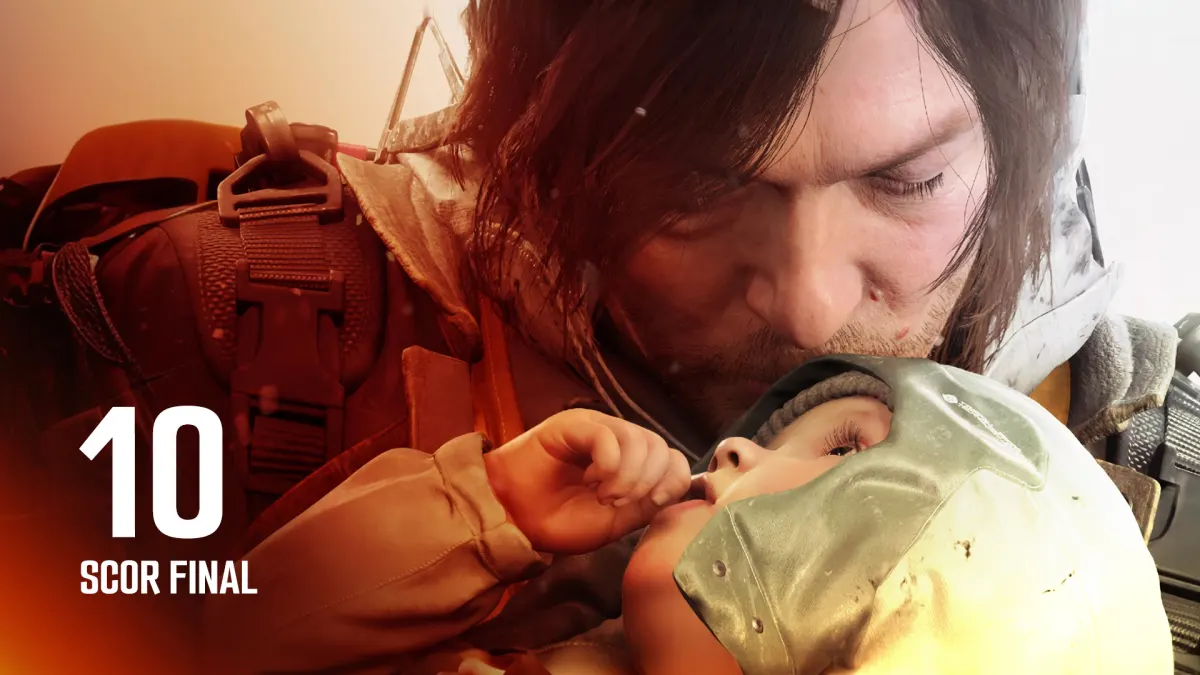
Death Stranding 2: On the Beach receives a score of… 10/10! The new title from Kojima Productions and published by Sony Interactive Entertainment becomes the newest member of GRIND's exclusive list of “Masterpiece” games.
Thanks to PlayStation Romania for the review code and the opportunity to play this masterpiece.
Played on: PlayStation 5
Release date: 26 June 2025
Developer: Kojima Productions
Publisher: Sony Interactive Entertainment
0 votes
Scroll down here and stay on the page for at least 30 seconds to vote.
Pick a score from 0 to 10 (halves are allowed).