
Deathbound – Review
A party-based souls-like
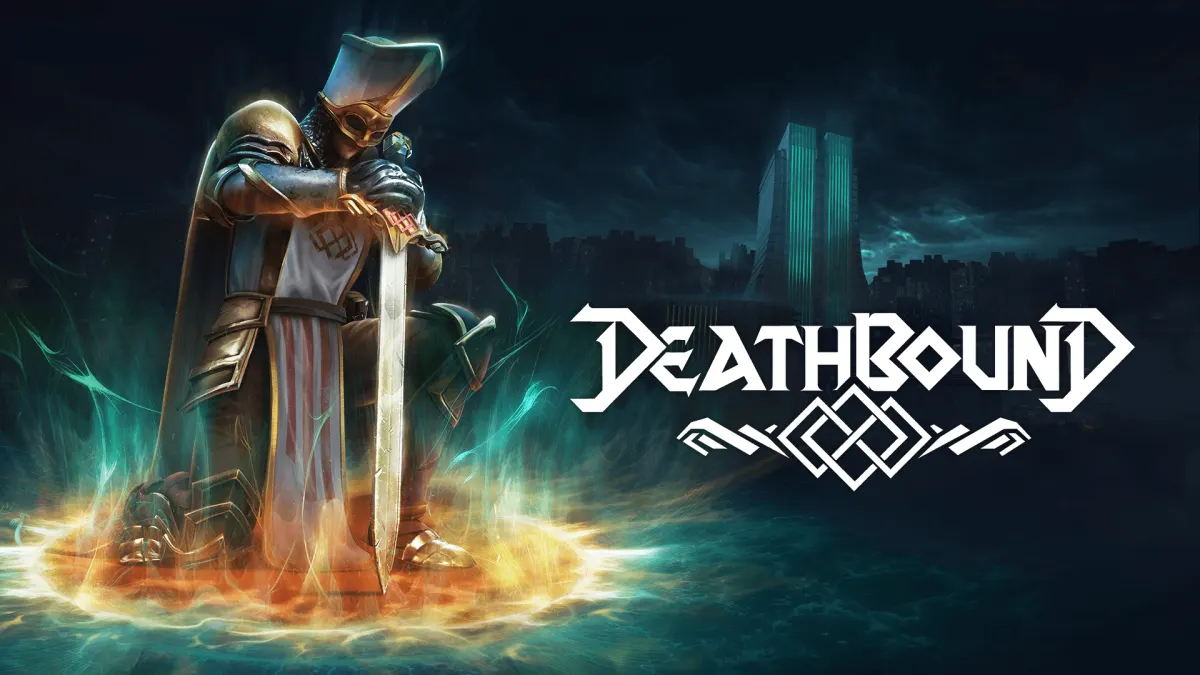
You only have to mention “souls-like” and my eyes widen and my ears perk up. Deathbound intrigued me the moment I stumbled upon it. The post-apocalyptic setting sounded interesting. The clash between the Church of Death and the Cult of Life seemed like a conflict ripe for exploration. And the combat looked superb in the trailers from Trialforge Studio.
Let's find out once again whether my hype was justified, or whether this is just another example of “how not to do it”.
A story that tries to say a lot

The game doesn't waste much time getting you to the heart of the story. The Goddess of Death and the Goddess of Life had a family quarrel. And what do you do when you end up in a hair-pulling fight with an annoying sister? You hit her where it hurts most. So the Goddess of Life made sure the souls of the dead would find no peace in the afterlife. Her followers formed the Cult of Life in the wake of this incident. But they aren't the main force in this universe. No, no, no. The Church of Death is the dominant power in this post-apocalyptic world. The fanatics who serve it have a single goal: to restore the life-death cycle to normal. You learn all this in the first cutscene, done in comic-book style. The voice actors pull you into the atmosphere, and it feels like the start of a cracking adventure.
At first you play as Therone Guillaumen, one of the knights in the service of the Church of Death. You're sent to investigate a secret laboratory belonging to the opposing faction. But you sort of die a little in the process. Just a little. No worries, though, because you wake up resurrected. Our boy Therone is a bit on the religious side, and he believes his return to life is a gift from the Goddess of Death, giving him a fresh chance to fulfil his sacred mission.
But he finds out fairly early on that his role is more that of a vessel that can be possessed by several souls called Essences. And let's just say not all of them share Therone's view of the world. You could say the story is mostly about acceptance. Sure, not all the Essences get along from the start. Some of them are in direct conflict. But they begin to see how things stand as they spend more time together.

The friendships and antipathies between these Essences are cleverly used in the gameplay. You can get bonuses and penalties depending on which members you have in your party and how they relate to each other.
Unfortunately, the story takes a sharp turn for the worse once we're past the Therone segment. You'll realise just how poorly written the characters are as you add more of them to the team. My feeling is that the writers wanted to do a lot more with them, but ended up presenting them extremely superficially, barely showing a fragment of who they really are. Or rather… who they could have been.
Diversity can be an advantage when it's executed well. But Deathbound is more of a stew into which they've thrown a bunch of cultures and ideologies, and that's about it. The main religious elements lean heavily on Christianity for inspiration. But then our characters show up and neglect or forget all about it. I get the sense they rushed things to the point where you no longer know who is who or what they believe in. We don't get enough time to understand their cultures and beliefs, or what influence those have on them as individuals.
Our group of protagonists displays instability and emotional immaturity, and I don't mean in the cool, Joker kind of way. In one scene they'll declare firmly what they believe in. Then in the next dialogue sequence they'll cooperate anyway, as if they'd forgotten which side they were on. The pace at which they turn from a bunch of misfits into a team that can work together is far too quick.
You find out about each Essence's past when you recruit them. You get a sequence of events showing the key moments of their lives. Sadly, that's more or less where what you learn about them ends. A short sequence that doesn't add anything very profound. Their story is decent at best and superficial at worst.
The other characters in the game are even easier to forget. You won't feel any real connection with them, and you won't grasp their complex motivations, whether they're allies or enemies. You'll occasionally get quests from NPCs, but only one of them delivered in terms of emotional impact. The others either didn't matter or handed out useless rewards.
You can also find party members' memories in various locations. But again, there are too few of them to build a believable portrait. On top of that, I had to keep swapping who was in the party to work out who could unlock those memories. It would have been nice if the game at least told us which character we needed, or that we hadn't recruited them yet.

You'll also get the feeling that the game world is made up of sections that are either too big and empty, or too small and cramped. You'll either cross claustrophobically narrow areas packed with enemies, or, on the contrary, find yourself in gigantic empty spaces with no sign of enemies or items to collect.
And what started out as impressive voice acting turns into a lottery. Either they nail the delivery or they miss. And most of the time it's the latter. I ended up feeling nothing. The fact that dialogue lines advance automatically is a problem too. Sometimes it happens too quickly, sometimes too slowly.
The game has two endings, and you'll have to play through twice to see both.
Taken together, the story feels like it never got past the sketch stage. The potential is definitely there. The themes it tries to explore are intriguing. The character ideas are unique. But they don't get enough time and gameplay space to be developed. I'll repeat myself here: it's decent at best and superficial at worst.
It feels more like a hack’n’slash

Controlling the protagonist is simple enough. You have a quick attack and a heavier one that deals more damage. Melee characters also get the option to block, plus a special attack. Ranged characters get a mix of special attacks and buffs. On top of that, you have a Morph Attack and an Ultra Morph Attack. These let you swap your character for another who performs a special attack. The second version simply deals more damage. But you'll need to build up Sync Points, which you get when you hit enemies or are hit by them.
If I were to look at these abilities a little more closely, I'd say blocking is very rarely useful. I say that because you still take some damage, on top of losing stamina. You do have the option to parry and stagger your opponent if you block perfectly. But the parry window is too short and you'll miss it most of the time. The most reliable method is to dodge attacks altogether.
It's hard to pull off an Ultra Morph Attack, because it uses the same buttons as a normal Morph Attack. Most of the time you'll end up switching to another character without executing either of them.
You also get a lock-on option, and you can switch targets easily.
An interesting but rather pointless design decision is that vitality and stamina are linked. More precisely, your stamina depends on how much vitality you have. If you take too many hits, you won't have enough energy to perform every action, and that can leave you exposed. It sounds good on paper, and it makes sense for a healthy person to move with more vigour than an injured one. But in practice I don't see it bringing any benefit. Most of the time its impact is negative, if negligible.
You'll find different items that regenerate characters' vitality, and they work in an interesting way. You can use them to recover some of the active Essence's HP, but they will reduce the HP of the inactive ones in the group. Again, the idea sounds good on paper. It's not as interesting or useful in practice. I'd simply have gone for items that recover less HP, so people couldn't abuse them.
You can also recover vitality for the inactive Essences when you hit enemies with the active one, but the game only tells you this later. I'd call that a tutorialisation problem.

The rest of the consumables exist to give you attack or attribute bonuses. But in the time it takes to use them, you might as well hit your opponents a few more times and execute them. The only ones worth using are those that give you XP when consumed.
You can equip one Artefact and two Rings, each with two passive bonuses. You can choose to upgrade one of the two bonuses using Mystical Catalysts or Ancient Catalysts. These pieces of equipment are useful enough to support your fighting style and the party members you've decided to bring along.
Speaking of passive bonuses, you can unlock character-specific ones called Talents, and you get access to them after finding the characters' memories. Each memory gives you a Talent Point, and you're free to spend it on whatever you think will help.
Last but not least, there's also a skill tree. It expands as new Essences join you, and the bonuses you earn apply to all characters. The problem is that you never know for sure whether you're getting a flat or a percentage bonus. On top of that, the font used for the skill tree is tiny and hard to read.
As you can see, we have a plethora of resources to help us in combat, but you won't use as many of them as you think. At the end of the day, I got by without any trouble with a party of melee characters. It dealt enough damage while soaking up enemy attacks. I could simply hold down the attack button continuously, then switch to another character and carry on destroying enemies to recover the vitality the first one had lost.

Combat ended up feeling more like hack 'n' slash, or like what we find in classic action RPGs. The meticulousness that souls games demand simply wasn't there. And to be completely honest, the only soulsy elements are that you lose experience if you die and that you have save points.
All these talents and skill trees felt like too much for the game's actual length. I think it would have been much easier for the developers to make a regular action RPG. Instead of XP, they could have unlocked important abilities and passive bonuses after each boss fight, or after each important story moment.
Some of the attributes you can improve are unclear. Take Attack Weight, for example. You don't really understand what it means. Do they mean opponents will get dizzy faster from hits?
I mentioned earlier that the areas are either small and crammed with enemies, or huge and filled with a whole lot of nothing. This leads to an imbalance in the number of enemies and where they're placed. Either you feel like everyone is after your life, or you can stroll around whistling as if you're walking the dog in the park.
Enemies move sluggishly and you can predict their movements from miles away. The only time they become a threat is when they appear out of nowhere after a short cutscene, or when so many of them are hiding behind a wall that you wonder: “How did they manage to hide so many in such a small space?”
You can get behind some of them just by moving very slowly right in front of them. They should take another look at the AI's detection system.

Boss fights are simple. The strategy of mashing the attack buttons and then swapping to another character works a treat. And the bosses don't feel unique or hard to beat at all. It was like fighting versions of the normal enemies with more health that hit a teeeny bit harder. In fact, you'll run into some of them regularly afterwards, just not as bosses. On top of that, their cutscenes when they appear, and the moments they move into another phase, are very rough around the edges.
One annoying detail in these fights is that all sound cuts out whenever you perform an Ultra Morph Attack.
The save points are called Phylacteries. They let you manage your party, the skill tree, talents and equipment upgrades. Some of them become fast travel points once you reach the final section of the game. I find it odd that we unlock such a feature so late, and that only a few Phylacteries can be used this way. Isn't their whole purpose to make moving between areas easier?
Progression is linear and you won't get lost. The only difficulty you'll run into is finding the game's final area. The game doesn't tell you to go there, and you have to work out for yourself that you need to head back to an earlier area and set off from there.

I'll leave you with some final thoughts on gameplay and optimisation:
- They've included an arachnophobia filter for people who are afraid of spiders.
- They still need to work on the physics system when you smash objects. The broken pieces hover in the air for a while before falling, and the hoops from barrels constantly get stuck on the main character's model.
- When you press the sprint button, the character “jumps” into the running animation, which looks very unnatural.
- I always had frame drops during the memory sequences.
- The game crashed after only 30 minutes of my setting the graphics to maximum. For context, I haven't had that with games that look far more impressive, like Lies of P. Oddly, it didn't happen again after I restarted my PC.
- You can perform jump attacks, and they're animated properly.
- The game puts enormous strain on the system every time an area has to load or you die. I experienced this the first time I launched it and was hit by the big black screen of death. Not to mention that the frame drops were constant, or that the game will suddenly start consuming even more resources out of nowhere. The fans will start whirring as if you're standing next to an aeroplane.
- Sometimes Essences will get stuck in moonwalk animations after you defeat enemies you've locked on to.
- The game can double the number of enemies that spawn in a location for no apparent reason.
- I ran into a bug with a character who is automatically revived the first time they die. The problem was that they couldn't deal any damage whenever they were revived, and ended up dying for good.
Graphics and sound need some tweaking

I had high hopes after watching the first cutscene, done in an animated comic-book style. But the hope vanished quickly once I moved on to scenes with 3D models, and to the fact that the protagonists had no sense of balance.
I had constant motion sickness when rotating the camera, and it persisted even after I turned off the motion blur option.
The animations are extremely rough when you execute opponents. You instantly teleport to their location to finish them off, with no animation or anything else.
And the enemy models are very rough around the edges.

Brightness in the darker areas is a problem, and details are hard to make out. They could have added a few lamps or torches for sections like these.
The old-film filter laid over the image doesn't feel like part of the scenery. It gets in the way of your view more than it helps you sink into the game's atmosphere. And that's the case even on the highest graphics settings. The level of visual detail suffers as a result.
The developers handed out a few skins as Twitch drops when the game launched. You can also buy them as separate DLC. But I'll tell you now that the original models look far better.
On the audio side, some characters' accents are much too heavy, and you may not always catch what they're saying.
The quality of the cutscenes drops massively as you play. Plenty of accents and cultures overlap for no good reason. Plenty of characters talk over one another. And the way the actors deliver their lines gets steadily worse.
Put it all together and the portrait of this post-apocalyptic world it's trying to paint leaves a lot to be desired.
Final Verdict

Sadly, Deathbound is another victim that falls into the “Good ideas, poor execution” category. And I don't say that lightly. I wanted to like this game, and I take no pleasure in watching a souls-like fail. But the story is dry, inconsistent and incomplete. The main characters are poorly developed and easy to forget. There's a strange mix of cultures that does nothing for the idea of diversity; instead, it feels at odds with the game's universe. Fights quickly turn into a button-mashing festival, and there's no real strategy to taking down regular enemies or bosses. Levels are either too small and stuffed with enemies, or too big and completely empty. The graphics and sound have visible problems, and the actors start out delivering their lines promisingly but end up in tragedy. And I haven't even mentioned the technical issues.
The game gets a 4/10 from me. The €30 price tag isn't justified in the slightest. You can often find it on sale for €21 on Steam, and it can drop as low as €15.25. But I wouldn't recommend buying it even then. Only if you've got absolutely nothing better to play.
If you're still curious to try it, the game received monthly patches from August, when it launched. They stopped in October, when it got a new DLC.

Played on: PC
Release date: 8 August 2024
Developer: Trialforge Studio
Publisher: Tate Multimedia
0 votes
Scroll down here and stay on the page for at least 30 seconds to vote.
Pick a score from 0 to 10 (halves are allowed).