
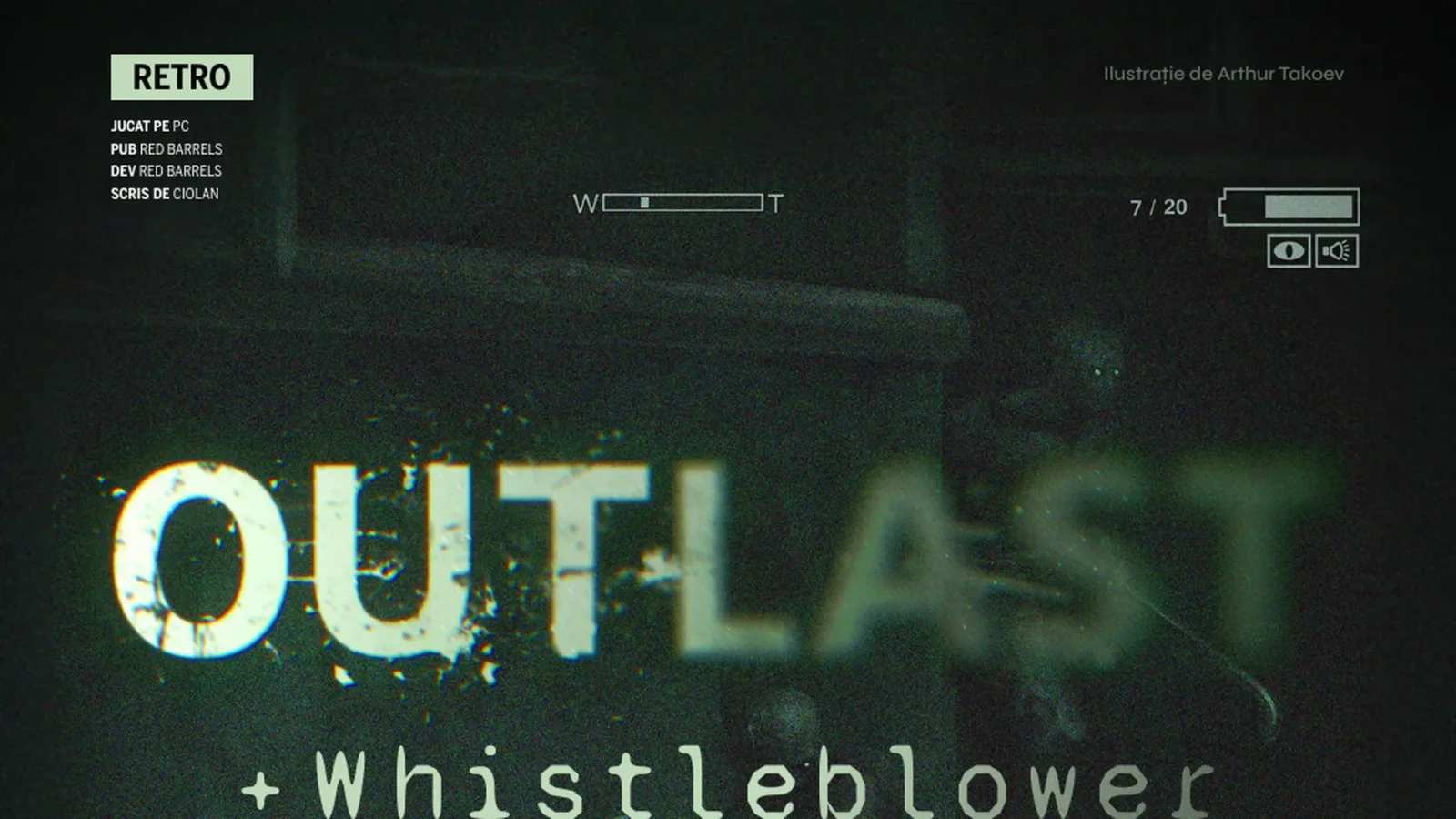
Outlast + Whistleblower
First published in GRIND V, pages 190–195.
+ W
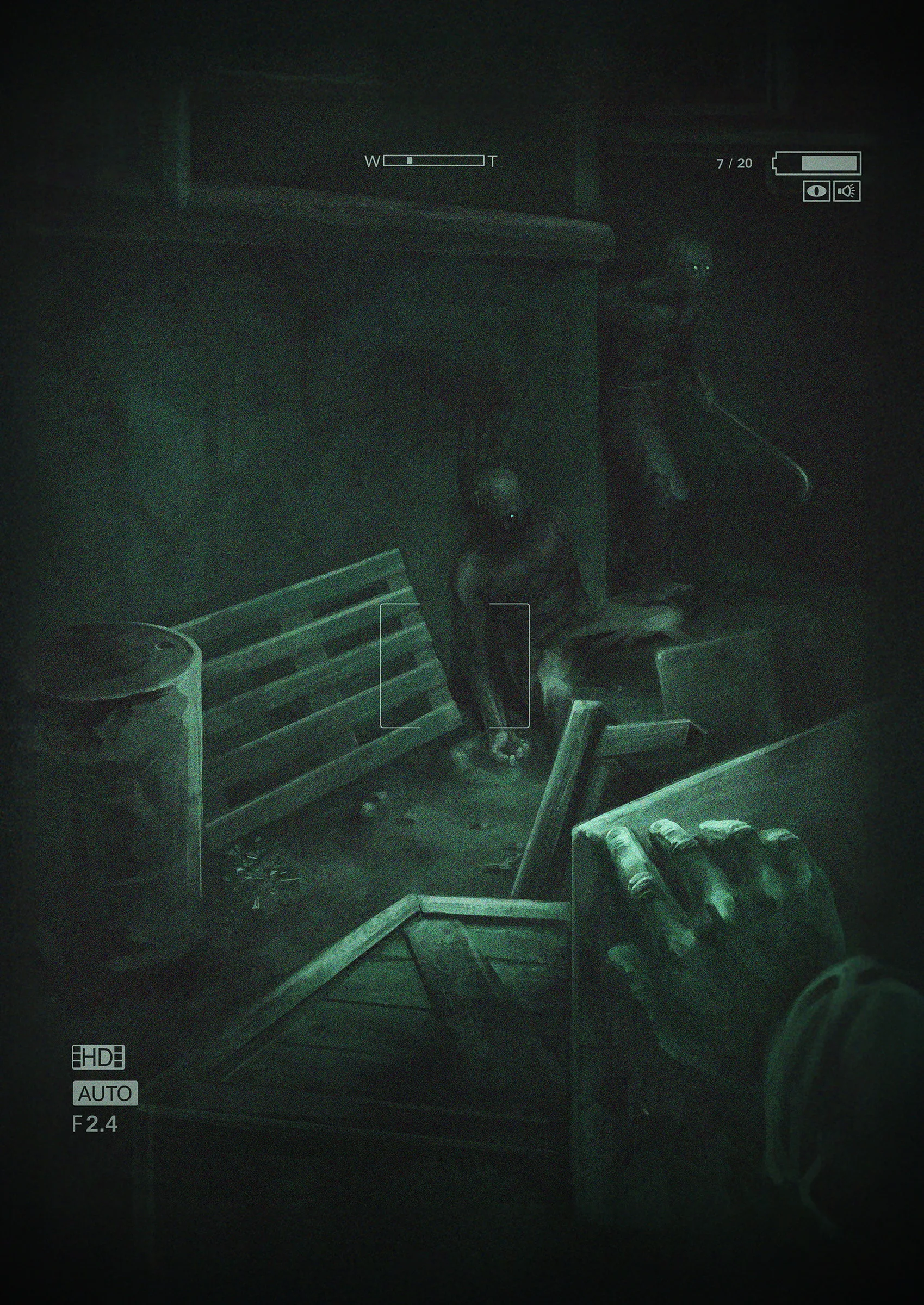
Illustration by Arthur Takoev
histleblower You'll go mad if you read this article...
Eager to defend what little is left of my sanity, I decided to juggle my addictions a bit. Right now, when I'm being assaulted by Georges, Donalds, Musks and other creatures that send my blood pressure to heights untouched by any human tension, scrolling through Facebook strikes me as the most ruinous, self-destructive activity going. So I decided to swap it for short gaming sessions, spent chipping away at my enormous backlog, where I have at least thirty games I absolutely want to finish and over a hundred I absolutely want to try.
The other day, it was Outlast's turn.
I've started it a few times over the past few years, but I've never reached the end. In fact, I haven't even made it halfway. I'm not a guy who scares especially easily and I've built up a fair bit of immunity to jumpscares, so it's clear I didn't abandon it because it was too frightening. But whatever it was, I thought to myself before starting it again and abandoning it halfway once more, it's a lot better than reading about the latest antics of sociopaths. Better to play them. And surprise! This time I held out to the end, and I'm glad I did.
If you haven't played it already or haven't heard of it, Outlast is a first-person horror adventure with a whiff of the walking sim about it. It looks decent enough for the era it came out in, and it "sounds" pleasingly good on headphones. Technically it isn't a revelation, or even close to one, but everything you see and hear in Outlast (including the violins... aaah, the violins, the curse of the jumpscare) is all but flawless, even if it isn't an artistic achievement you'd frame and hang on the wall.
The story is a classic one. Journalistic good versus corporate/governmental/occult-masonic-boyar evil. Pretty much what we've been living through for a few thousand years now. On the side of absolute Evil we have a sinister corporation experimenting like mad (hehe) on the patients of an asylum where the CIA had also romped about, just as experimentally, during the Cold War. The malevolent corporation isn't exactly the most inspired choice of villain, but at least it's a choice you can rely on. When the Devil is busy elsewhere and doesn't fancy a part in your story, there are always at least ten legal entities with zero liability that 1 Sony HD AVCHD is the video camera used in Outlast, inspired by the real model.
...you don't need any other tool besides the portable camera... in
wait, like in those older American films with Mexican immigrants, to be loaded into a pickup truck with the promise of a job that'll put bread on the table.
The good, as in all those urban legends ending with YOU'LL GO MAD IF YOU CLICK ON THIS ARTICLE, is embodied by Miles Upshur, an investigative journalist. Acting on a tip from an insider, Miles decides to drag the remarkable scientific adventures of the Murkoff corporation at the enchanted asylum into the spotlight. Armed with nothing but a handheld video camera and TRUTH on his side, Miles bursts into Mount Massive Asylum, ready to catch a few scientists with their trousers down, enthusiastically raping every moral and ethical principle of the profession. What awaits him inside, though — besides some rather cheap jumpscares — is a scientific-religious bedlam that defies every written and unwritten law of humanity and, as a bonus, about seventeen laws of physics.
As gameplay, Outlast is a plain old walking sim if you play it on easy, as I did. I'll explain a little further down what's behind that decision. It can become a plain old walking sim with a fairly hefty dose of frustration if you dare switch to hardcore or insane. Personally I don't think those difficulty levels add anything to the experience, unless you're a player with a burning passion for S&M — and I'm not talking about the Metallica album. It isn't quite survival horror, where a bumped-up difficulty setting piles on tons of tension (careful: tension, not frustration, there's a major difference between the two), nor is it stealth on the level of Thief, where difficulty can improve the experience, so you can safely play on normal without missing much.
Because you have TRUTH on your side, it's taken as read that you don't need any other tool besides the portable camera, so any form of violence in Outlast is either watched by you or aimed at you. What nobody told you is that TRUTH wilts on the spot the moment two stark-naked, fit-as-a-fiddle brutes armed with rusty machetes single you out. Where the hell they got their hands on machetes in a mental hospital is as big a mystery as the one Outlast serves up in its story. Anyway, the only weapons you have are a sprint button and a handful of lockers or beds that'll hide you for a while. And here I want to explain why I opted for easy difficulty.
To spice up the walking sim gameplay a bit, there are a few sections where you have to solve a rudimentary puzzle (turn two valves and press a button, say) while some of the asylum's permanent residents chase you with anything but peaceful intentions. Since there's no map, and I get the impression the pursuers cheat a little and don't roam the level organically (I may be wrong, but I've noticed they occasionally pop up from impossible directions with no spawn), the whole thing turns into a trial & error affair. That is, you run through the scenery until you work out an optimal route to an objective, then you repeat the segment until it comes off. You die, reload, get a bit further, die again, reload again, and so on until you've learned the map by heart. You trip over something, forget to close a door, hide too late, stare too long at a spot on the wall that looks a bit like your cousin Constantin — I admit, those moments got my blood pumping and I welcomed them. Until I had to run through them about ten times for reasons that weren't exclusively down to me and my legendary two left hands. I played it on Normal and one of these... let's call them stealth sections frustrated me so badly that I quit the game. Twice. There, I've said it, I'm not a hardcore stealthed-up player. In fact, I refuse to be a hardcore stealth player in any game that isn't Thief. And Outlast isn't Thief. Anyway, I switched to easy and those chases became exactly what they were supposed to be: short build-ups and releases of adrenaline, very welcome in a walking sim, especially a horror one. The one I replayed most was the ending of Whistleblower, I think about six times before I twigged that the AI was trolling me a little. Or that a script was buggered, I still don't know for certain. That was fairly horrific. And not the good kind. Especially since I played it on PS5, to enjoy the big screen and a comfortable position on the sofa.
The real horrors and dramas come when you admire the scenery...
Now let's talk about horror a little. Outlast has good horror, the kind that pats you on the head and makes you go 'hmm' while the goosebumps rise, and the kind that tickles your auditory nerve with zillions of violins and has you swearing copiously — 'Outlast, you bastard, what did you have to go and scare me for with your violins, bugger off'. Yes, it has jumpscares and yes, they're fairly cheap. Good thing there aren't many. If you like the BOO! variety, with violent violins on top, you might count their presence in Outlast as a plus. They annoyed me more than they scared me, but with an effort of will I managed to ignore them successfully until I'd finished the game.
The real horrors and human dramas come when you admire the scenery, which says more in Outlast than the text does, and when you study the documents found around the asylum, which depict both the horrible treatment dished out to certain patients and the cynicism of corporate bigwigs when it comes to dodging legal complications, or other human ones. I mean, a routine memo written by some company lawyer struck me as ten times more demoralising and sinister
REC
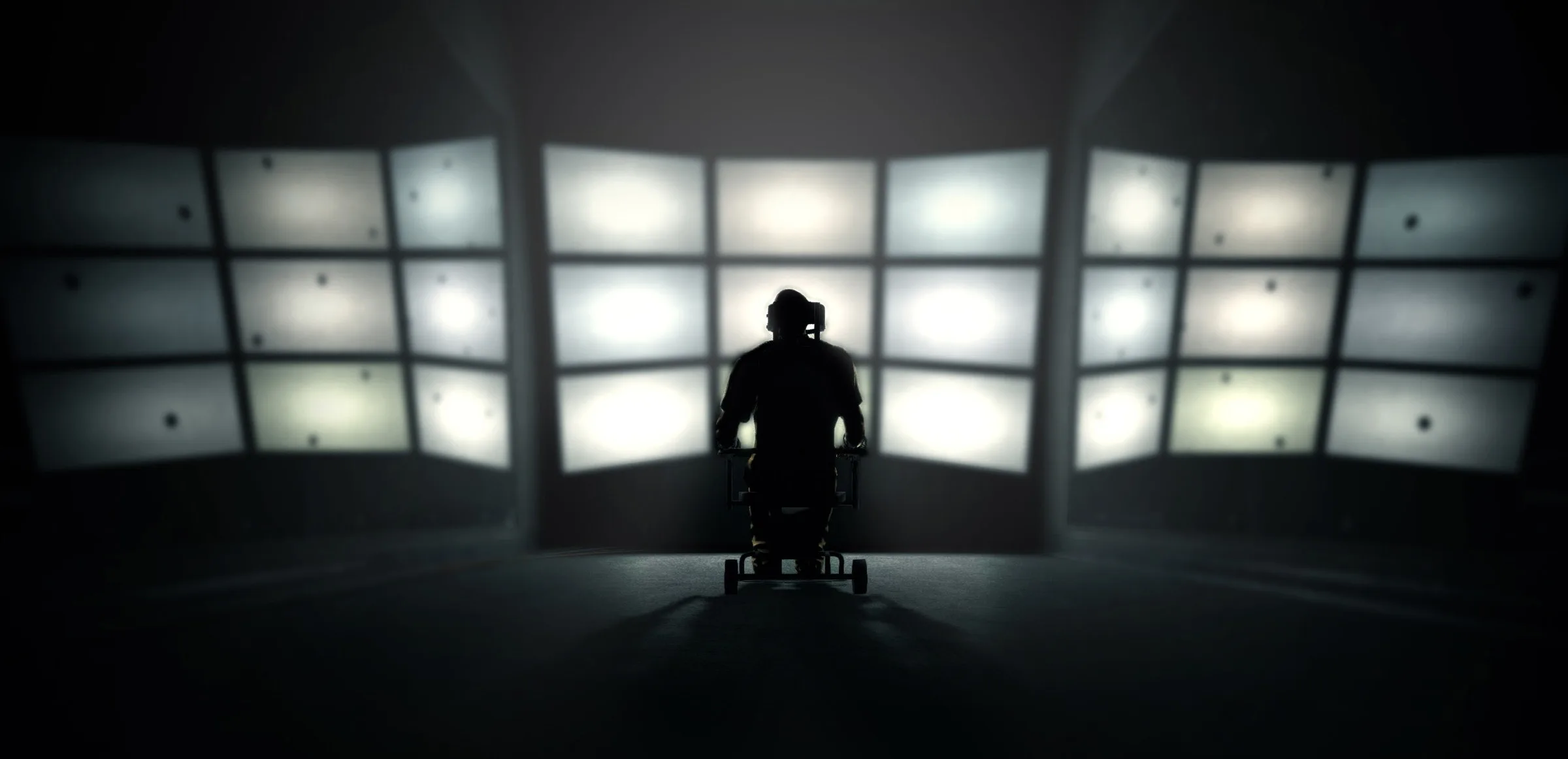
Whistleblower was only ever meant to be a short DLC offering a bit of context for the events of the main game — but over the course of development, Waylon Park's story became so complex and intense that the DLC almost works as a second game. than a disturbed individual rubbing one out on a pile of corpses (in Whistleblower). I know, the evil corporation trope has been pretty stale for about twenty years, but as I was saying earlier, you can rely on it to supply a slightly more refined dose of horror than the monster that kicks you out of the wardrobe and sucks your eyes out with the power of its mind. Reading through the documents found around the asylum, I discovered with astonishment that the administrators and some of the doctors at Mount Massive are more devilish than the people chasing you. More than once I stopped mid-chase to think that, actually, the one chasing me is the real victim, not me.
What I liked most about Outlast is that a threat (the Wallrider project, the reason you take photos around the asylum) that seems supernatural at first becomes scientifically explicable towards the end. Yet if you read carefully all the documents scattered around the asylum, the mystery isn't 100% solved and, with a little imagination, you can believe the supernatural is still present in the story. Something along the lines of Event Horizon. You can read it as the faster-than-light drive having taken them to Christian Hell, you can explain everything that happened there as simple mass psychosis set off by a few scientific terms or, as another theory doing the rounds goes, you can consider Event Horizon the beginning of the Warhammer 40k universe, with the poor sods on the ship assaulted by entities from the warp. Simple, right? Oh, and back to Outlast: another really effective trope is the Nazi researcher put in charge, by consumer society, of a project to create super-soldiers. But I don't want to give spoilers. What I mean is that the mystery isn't fully cleared up at the end, leaving plenty of room for interpretation if you're into that sort of thing.
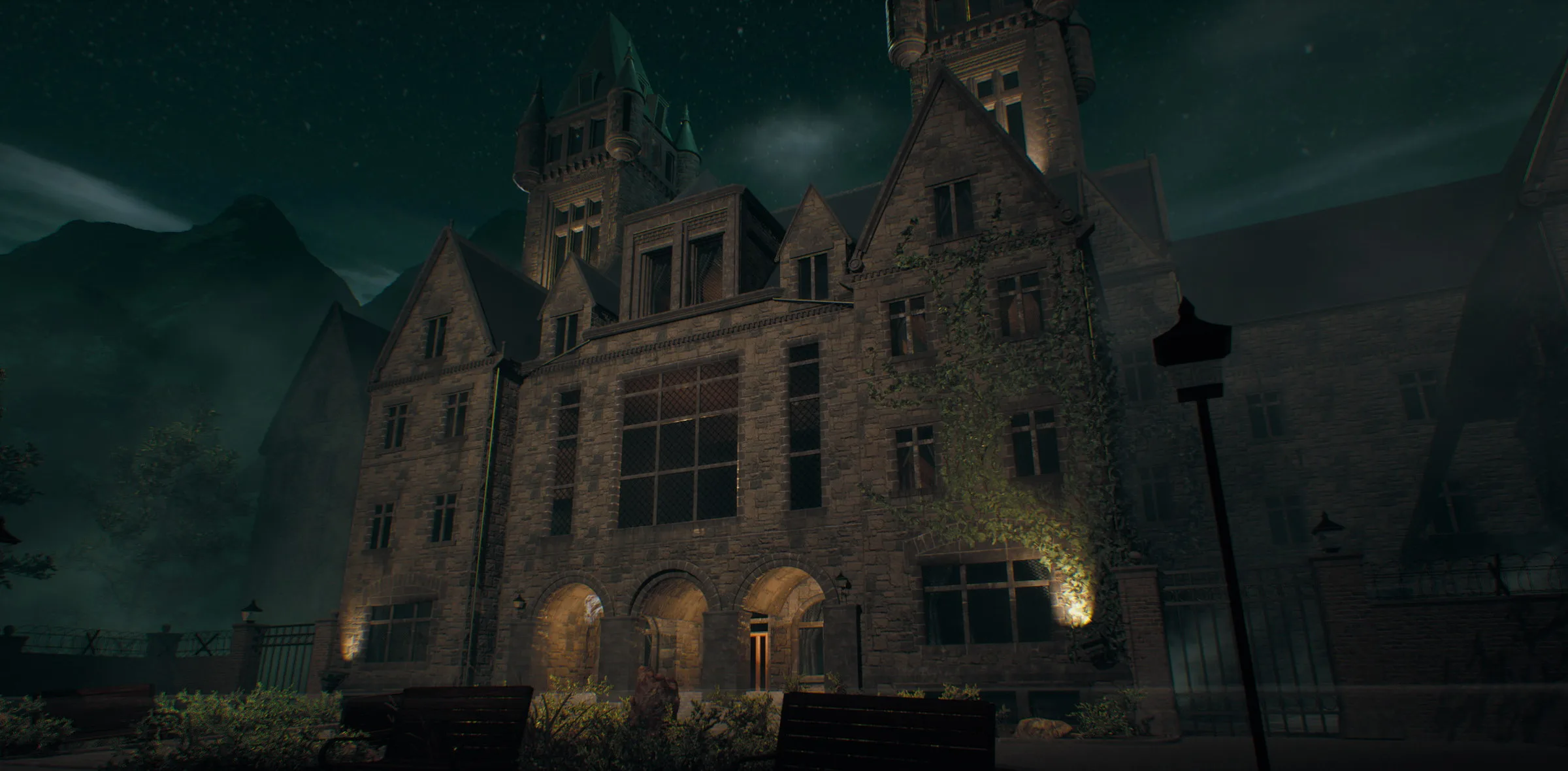
The atmosphere, for its part, is top notch. Outlast hooked me and refused to let go from my very first steps through Mount Massive Asylum. I've only felt something similar in STALKER, when I left the noob camp and stepped onto a road flanked by poplars that looked exactly like the road out of my home village, Dumbrăvița. What does Mount Massive have to do with real life? I'm glad you asked, voices only I can hear. In Brașov there was a mental hospital; we called it Eminescu because it stood on Eminescu Street, not because we gave any credit to the slanderous rumours that the one and only poet had been touched by the uncreative kind of madness. Well, the hospital, which no longer exists, looked in its heyday as if it had been lifted out of Silent Hill and planted on a hill. I walked its gloomy corridors a couple of times, and even attempted an initiatory ascent up the staircase hemmed in by bars, which smelled strongly of symbolism and petrol, and all I can say is that Outlast comes from there. I played it with a lump in my throat, which hasn't happened to me in a while. It's not the kind of horror you play for entertainment. Who the hell knows why you'd play it, given that it evokes rather powerfully the atmosphere of a real-life mental hospital (minus the patients stabbing their doctors), which I wouldn't call "entertainment". For me, this pull the human being (myself included) feels towards horror is a mystery, and I can only explain it as a morbid curiosity about the pits the human psyche can sink into. And in Outlast, and especially in the Whistleblower DLC, the pits are deep. Now, I'm not advising you to check yourself in for a few days before playing Outlast so that you can 3D illustration by William Kitchen appreciate it at its true value. It gets to your subconscious a bit even if you've never had the pleasure of ending up in the sinewy hands of a well-meaning orderly.
The Whistleblower DLC, similar in gameplay, raises the bar of madness by several metres. Outlast seems rather well-behaved compared with what happens in Whistleblower. The main character is the bloke – I can't quite remember his name – who siphoned off the confidential information that set off the events of Outlast. Naturally, he's caught and sent off for re-education. The man escapes and, in his attempt to make it back into the light, descends into Hell, becoming witness to and protagonist of the savagery committed by the corporation that, until then, had put food on his table.
I won't say much about a DLC that can be finished in two or three hours. It's short and sweet. Just a warning: Whistleblower sort of paves the way for Outlast 2, where the main sources of horror have a strongly sexual streak. In Outlast 2 we deal with a dodgy cult up in the mountains, where incest, rape, live C-sections and other vile things are the main occupations of a community led by a dubious saviour who smells more like the antichrist he claims to fight, snatching children from... I'll stop there, my skin's crawling a bit.
Whistleblower preaches the coming of Outlast 2 the best way it knows how.
From a man who masturbates over corpses to the debauched final boss who sank to the bottom of the Abyss of depravity, thought he glimpsed some light when he looked up, and dug a few more metres down, we pass through the whole spectrum of deviance. I won't give spoilers, but the classic jump scares have been replaced by authentic "WHAT THE F*CK DID I JUST SEE???" moments. Far more effective than the creatures that burst out of lockers and scream at you while dozens of out-of-tune violins screech chaotically, these moments stay with you long after you've uninstalled the game, while you ask yourself in all seriousness why the hell you played something like that instead of harvesting kohlrabi in Farm Simulator.
In the end we're dealing with a truly respectable horror: Outlast plus its DLC behaves like any horror with pedigree. It scares you, disturbs you, frustrates you, saddens you, enrages you, stays with you longer than you'd like, and leaves you with a bitter taste and a single question. When, Lord Sabaoth, are you sending that asteroid down on us?