
The Year 2004: 20 Years Later
First published in GRIND IV, pages 158–161.
The Year 2004 years more later "For me, the year 2004 means discovery and innocence." In February 2004, my parents made a monumental effort to buy me a state-of-the-art computer: a Pentium 4 clocked at 2400 MHz, with 256 MB of DDR RAM, a GeForce FX5200 graphics card and a 40 GB hard drive. It even had a Lite-On CD-RW drive to go with the classic 52X BenQ CD-ROM… how else was I supposed to make the most of the deals on Traxdata and 'no-name' CDs, sold in plastic bags just like Naty peanuts and loose wafers? At the tender age of 12, the boundless world of pixels and polygons was about to reveal itself to me in its most current and realistic form!
And I was perfectly aware that I wasn't getting my hands on a 'high-end' system — I had spent hundreds of hours drooling over the Best Computers, Ultra Pro and Flamingo Computers catalogues. With '24 million' you couldn't work miracles… for that money you could barely buy a Radeon 9600XT graphics card or a measly GeForce 5900 Ultra, which today you can find on Olx for the same price as a Razer keyboard or a Logitech webcam. But let's return a little to the reality of those times: on a minimum wage of 2,800,000 lei, the sum represented the equivalent of 9 individual incomes! Practically 27,000 lei in 2024 — a considerable financial effort for a family of four, with bills to pay and individual aspirations that often exceeded the budget. So I'd like to express my admiration for the fact that my parents chose to believe I would have a better future if I spent more time in front of the computer.
Half-Life 2
If they had known that I would play instead of learning to program, and would end up plagiarising essays off the Clopoțel.ro website instead of taking advantage of its vast learning resources, they probably would have taken a more calculated risk and I'd have got an AMD Duron.
But let's return to the system and talk about the games too. My 'Delux' case with a handle had no label from Avenger, nor Davio, nor Coral or Diablo 666, nor Ultra Pro, but neither from
Star Wars: KOTOR II HP, Fujitsu Siemens or Dell. I couldn't claim to have a 'brand-name' computer. It was a system built from parts by a PC enthusiast working at a 'neighbourhood' shop that offered more favourable instalment terms than Flamingo and Altex.
But the colourful stickers proudly declaring 'Intel Inside Pentium 4', 'Gigabyte' and 'Designed for Microsoft Windows XP' made a serious statement — the components inside offer both the promise of present-day performance and a doorway to the technological optimism that the future failed to deliver on.
I knew very well what I was about to receive and I was grateful beyond measure… after all, I was upgrading from an AMD K-6 II with Windows 98 and a hard drive so small that I had to delete a game every single time I wanted to install something new. But now, for the first time in my life, I had a computer at home that could run all the wonders I read about in magazines. I was endowed with the power to NFS: Underground test the most demanding demos. I was handed on a silver platter the ability to watch trailers straight off a CD, without noticing a single freeze or stutter. And I had the downright incredible ability to actually make proper use of my collection of discs — copied, gifted and set aside for that magical future moment when technical limitations would no longer stand in the way. Few kids at school (and in the whole neighbourhood) could boast of such an 'achievement' — only a handful had a computer at home, and among them I rarely heard accounts of the titles described in such colourful yet literary language in magazines like XtremPC, LEVEL and PC Games.
There's also something to be said about the transition from Windows 98 to XP: the two operating systems were only 3 years and 4 months apart. But the technological leap was enormous: from the colourful menus in delicious shades of blue, green and red, all the way to peripherals that worked 'plug & play' (before I made the jump to XP,
GTA: San Andreas Far Cry I kept CDs of drivers for the printer, the scroll-wheel mouse and the monitor), absolutely every element celebrated the progress of technology and design. I wish I could say the same about the Windows versions released after 7… but that subject deserves an article of its own.
There was no way I could have guessed that at the age of 12… but my gaming experiences were contemporary with a golden age of creativity, when evolution was happening on every front. Genres weren't standardised yet, studios took on a few more risks in search of a winning recipe, stories explored more original themes, and graphics didn't necessarily mean everything.
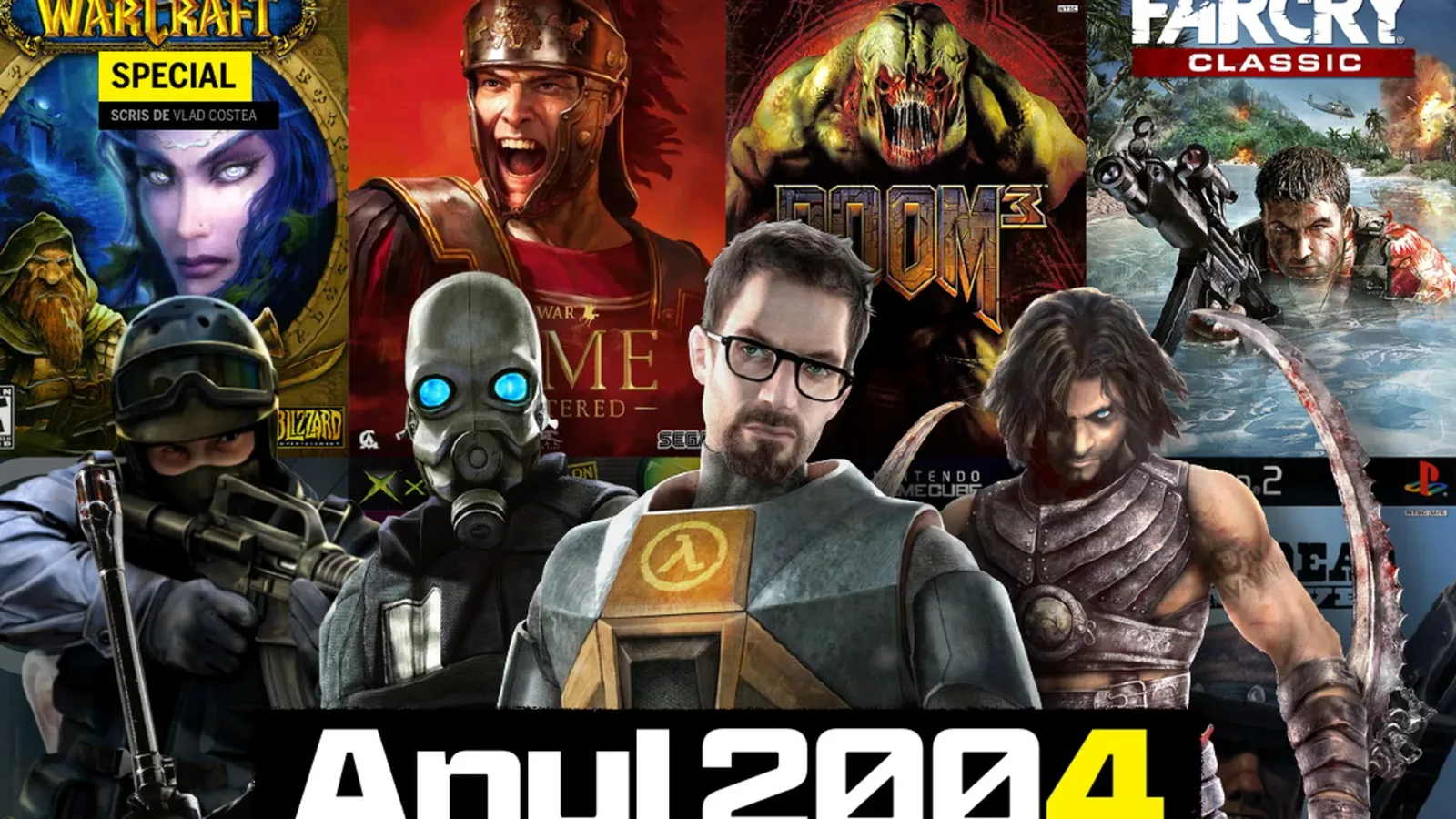
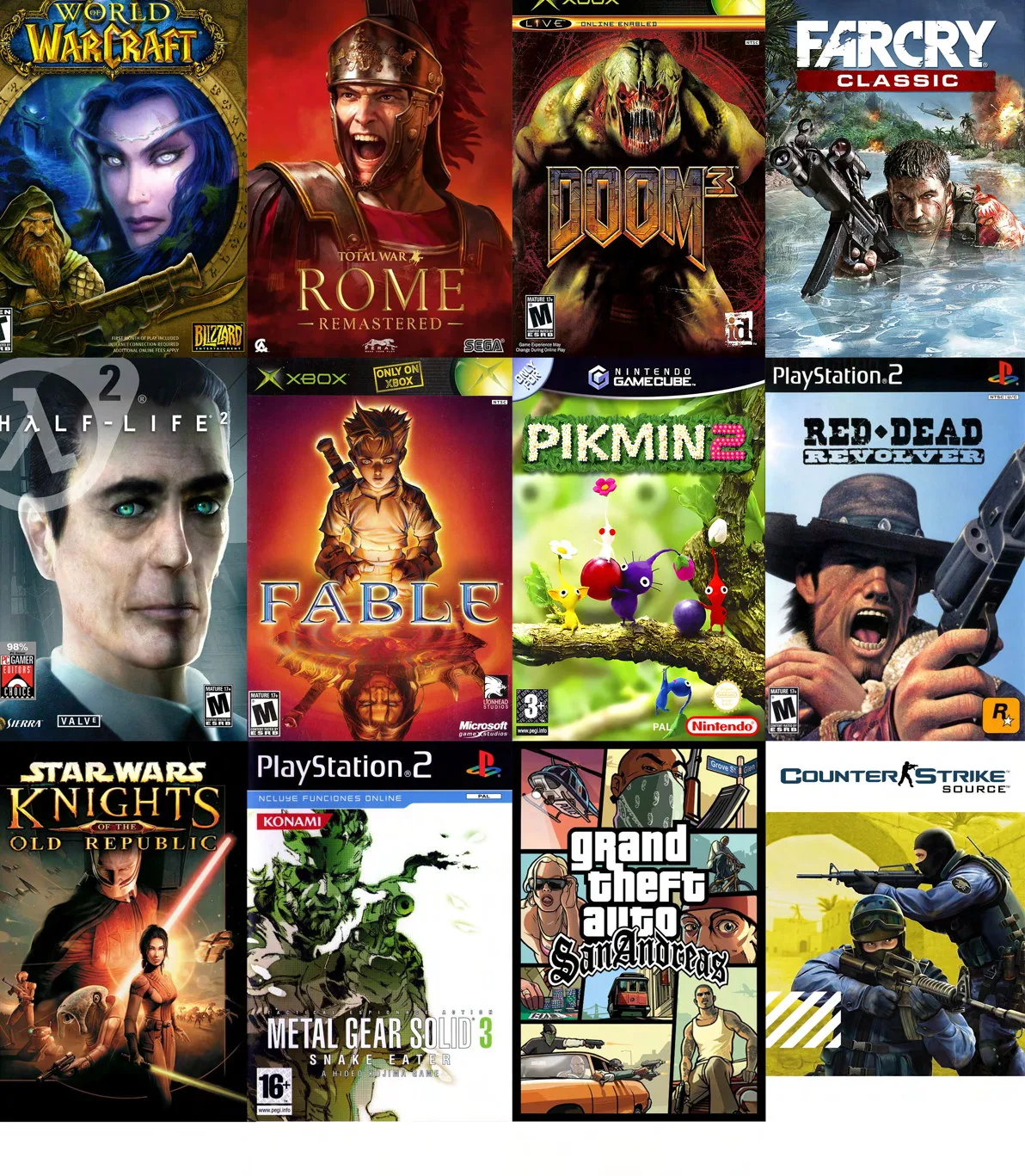
Over the course of 2004, I tried everything that came my way: from the demonic Painkiller to the epic Rome: Total War. From FIFA 2004 (bundled with Total Club Manager 2004) to Pro Evolution Soccer 4. From the terrifying, pitch-dark DOOM 3 (which literally brought my graphics card to its knees) to the magnificent Half-Life 2. Among these memorable experiences, I escaped from Butcher Bay alongside Riddick, I explored the World of Warcraft universe during the free one-week trial, I blew up the lush jungle in Far Cry, I racked up hundreds of spectacular car crashes in FlatOut, I played God with the lives of innocent beings in The Sims 2, and I developed the nuclear weapon for every civilisation in Rise of Nations. I even enjoyed an unexpected wave of retro comebacks via Sid Meier's Pirates! and witnessed the popularisation of the concept
Halo 2 Prince of Persia: Warrior Within of the remake through Counter Strike: Source.
When I wanted to look sophisticated in the eyes of guests or schoolmates, I'd fire up Prince of Persia: Warrior Within, Thief 3 or Splinter Cell: Pandora Tomorrow.
And when I was after a boundless feeling of freedom, I'd drive a Japanese supercar that looked like a UFO through the streets of Bayview in Need for Speed:
Underground 2. When I'd had a bad day at school, I'd deflate some kid's balloon in RollerCoaster Tycoon 3. And in the moments when I could no longer wait for the PC port of the masterpiece GTA: San Andreas, I kept myself going with True Crime:
Streets of LA. Towards the end of the year I also indulged in Fable and Knights of the Old Republic 2: two games that let me be a rebel and experiment with morally dubious decisions, precisely so I could learn just how much reputation matters and see the real-time consequences of every action. I'll also add a title long since forgotten, but one that gave me an equal
Counter Strike: Source measure of relaxation and frustration: it's called Ballance, it challenges you to manoeuvre a ball from point A to point B while clearing a series of obstacles, and I think it taught me more about physics than my school teacher did.
Sure, not all the games were excellent. Harry Potter and the Prisoner of Azkaban didn't seem as good to me as its predecessor (and the critics' scores seem to confirm my impressions from back then). Counter Strike: Condition Zero was cursed to come out in the same year as Half-Life 2, proving that outdated technology and a lack of originality in design can overwhelm even the most popular titles.
Leisure Suit Larry: Magna Cum Laude is still a negative example of how to bring classic point-and-click series back into the spotlight. And the dynamic quartet of Shrek 2, Disney Pixar: The Incredibles, Spider-Man 2 and Catwoman continued the tradition of bad games, released solely to provide extra content for people who like the films.
As I write these lines, it's hard to believe I ran so many newly released games in the space of a single year. Today I play 4-5 games a year… which I choose very carefully and make sure I see them through to the end. But at the tender age of 12, when the world of interactive digital entertainment lay open to me and I had access to absolutely everything (within the limits imposed by the efforts of Romania's pirates), I wanted to try absolutely everything. Of course, far fewer games came out in 2004 than today, and you could actually keep up with the industry's pace — titles didn't feel pressured to pack in a minimum of 60 hours of content and a checklist of objectives for earning assorted trophies.
The games were shorter, but more original and richer in hidden content.
Now I'll also talk about a utopian world… because in no parallel universe do I believe I'd have been given a console and original games. But if I had owned a Nintendo GameCube, then I would most certainly have indulged in Metroid Prime 2: Echoes, Pikmin 2 and Paper Mario: The Thousand-Year Door. If I could have got my hands on a PlayStation 2, I'd have explored every patch of the map in GTA: San Andreas and had my understanding of road safety radically rewritten by Burnout 3: Takedown.
And if an Xbox had teleported itself into my living room, I'd have headed off alongside Master Chief in Halo 2. But let's be serious: the price of consoles and games was still
MGS 3: Solid Snake prohibitive in 2004, and few families could have afforded such a thing. And even if I had owned a GameCube, a PlayStation 2 or an Xbox, I'd have missed out on the friendships forged in the schoolyard with other kids who were stuck in Prince of Persia: Warrior Within or couldn't get past a race in NFS Underground 2. Playing on the most popular platform often brings social perks with it… just as today a Netflix subscriber is more likely to make friends than a Paramount+ enthusiast.
In the Terminator era, we'd swap yellow cassettes all over the neighbourhood. In the Windows XP era, I'd burn CDs at 16X with Nero Burning ROM and talk novices through finding the folder with the crack for the executable. But 2004 was genuinely something special for me. Sure, I've had other glory days too: my first current-gen console, current generation, my first laptop, my first retro systems, the Switch I got for my birthday in 2018, the PS5 I bought during the pandemic with arrangements and dodgy dealings like in the Shot One's day, and the first time I stumbled on a goldmine in a title I'd pre-ordered months before launch.
But the feeling was never quite the same again. Sometimes I wish I could look at games with the enthusiasm I had 20 years ago. To be able to find the charm in a mediocre release, to not feel pressured to finish everything I start, and to not have a library full of sealed discs I'm keeping for some uncertain moment in my life when I'll have more free time. To enjoy it all without prejudice and launch an executable simply because a friend recommended it — and not because I read the reviews in the specialist press.
For me, 2004 means discovery and innocence. Even if other
Thief 3 Jak 3 GRIND editors will argue that 2007, 2011, 2017 or even 2023 marked the release of more masterpieces, I remain firmly convinced the peak came a little earlier. Nostalgia for 2004 pushed me to keep the PC that guided me through the wonderful world of new-generation gaming in a place of honour, and it later prompted me to buy original copies of the games that changed my life.
What were you playing in 2004? What sort of computers did you have? I look forward to reading your stories on the GRIND project's Discord channel!