
Like a Dragon: Pirate Yakuza in Hawaii – Review
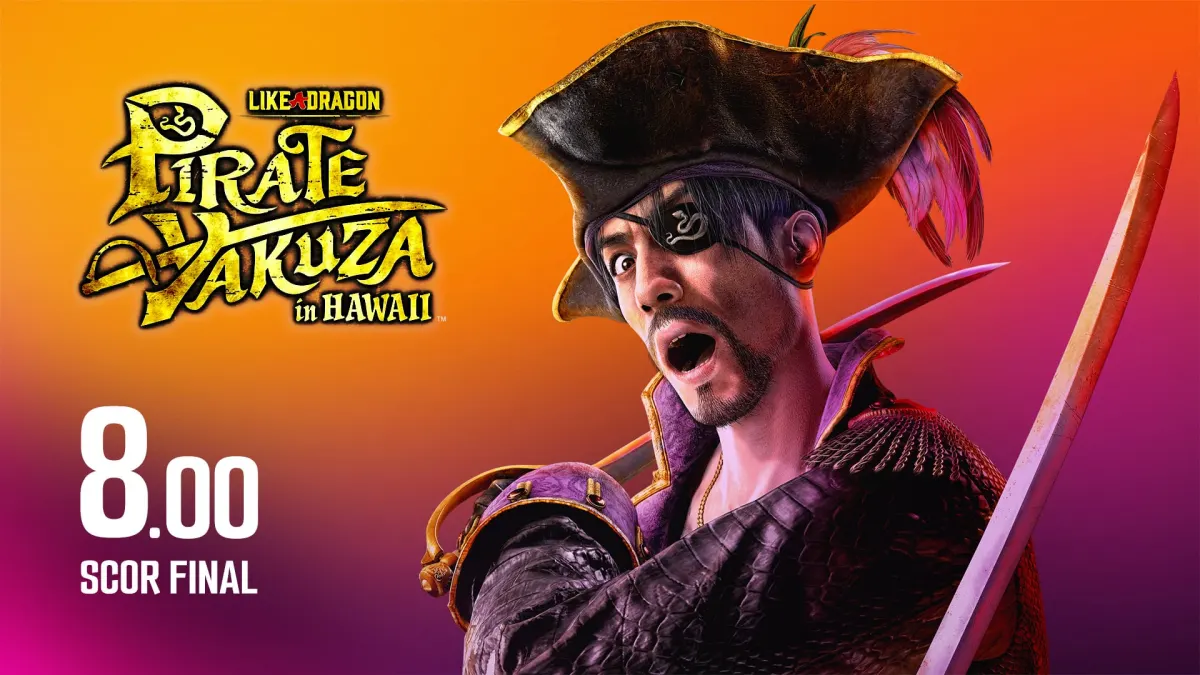
Let Kiryu go to the sea,
I want fun and sun!
Although I had heard of the Yakuza franchise since 2005, I didn't have the opportunity to interact with any game until I picked up the Kiwami collection on sale on PlayStation 4 in 2018. The famous creation of Masayoshi Yokoyama (the current director of Ryu Ga Gotoku Studio, the franchise developers) and Toshihiro Nagoshi (the studio's founder) is very dear to me and I enjoy it more than an excellent TV series or a good book, but I can't enjoy more than one game without taking a fairly long break. This break usually lasts about 6 months or a year, because the titles are quite long and hard to digest.
Even though Yakuza's origins are as humble as can be, the franchise has transformed over the years into something completely insane, where any trace of logic disappeared long ago. The only titles where I tried to finish everything 100% were the original game (in the form of Kiwami with graphical and control improvements) and the prequel (Yakuza 0 which was released in 2017). After finishing those two creations to 98%, I decided that I would enjoy the rest of the games in the franchise without trying to reach 100%. And the reasons behind many events, such as how poor old Kiryu ended up exchanging blows with a mafia group where the leader makes all members wear nappies, hold dummies in their mouths and be rocked by scantily clad students, will remain unsolved mysteries. If I haven't scared you off yet (or piqued your interest), then I invite you on a journey into the madness of the most beloved character in the entire series: GORO MAJIMA! (also known by his numerous titles and nicknames: White Horse, Idol of All, Goromi, Lord of the Night, Hannya Man, Majimeow-kun, Saint of PAIN, One-Eyed Demon and Shimano's Mad Dog, and more recently Captain).

I don't think there's been a single fan of the series who hasn't wanted a game where they could play as the patriarch of the Majima clan. This is due to his unforgettable personality and eccentric fighting style that hasn't been equalled in the 20 years the franchise has existed. Although he seems completely unhinged and could do with a long visit to Obregia or Socola Hospital, Goro has his own logic. The funny thing is that it makes more sense than the nonsense I've heard from a certain candidate who wants #BalanceAndVerticality. Unlike this person I won't name, Majima has always been a trustworthy person for the player. It's true that in the first game you could count on Shimano's mad dog to appear out of nowhere and stab Kiryu in the neck just when things were going well, but this fraternal "love" was to help the protagonist of the first 6 titles regain the strength and reflexes he lost in the 10 years he spent in the cooler (for a murder he didn't commit).
But let's get back to it! Our burning desire to have a game with Majima-san was partially fulfilled in 2017 when the prequel to the franchise, Yakuza 0, was released. In this title, we had the opportunity to experience his story and understand how a simple lackey from the Omi Alliance could become one of Japan's most feared gangsters. The game is a genesis of the protagonist from the first 6 games as well as his aniki. What's truly impressive is that in Yakuza 0 we see an ordinary gangster, who doesn't have straitjacket-worthy habits. However, throughout the events, he learns to live his life by his own rules and only accept orders from superiors he respects.

The series, which purports to be serious in essence, has always managed to combine epic action with serious introspective moments. I don't think I've ever encountered a game where I could suplex a tiger, and then discuss with my "blood" brother how the world we grew up in disappeared with the passing of years. Moreover, playing the franchise in chronological order of events, we will see how society changes. Most games take place in the same district (Kamurocho in the game – a slightly dramatic representation of Tokyo's famous Kabukicho district), and each title shows us how it has gone through the process of gentrification. If in the 80s we saw Japanese pachinko parlours on every street corner along with the famous cabaret clubs, by the 2010s these had largely disappeared from the famous district and cafes and hostess (and host) clubs had replaced them.
Perhaps you're wondering how the series went from stories about Japanese gangsters to grandiose adventures across seven seas and lands, aboard one of the most feared pirate ships? Well... I don't have an answer. I just ask you to do as I do and accept that this is the situation we're in. Before we begin, I'll let you know that Like a Dragon: Pirate Yakuza in Hawaii is a spin-off, and for this reason, you don't need to play all 13 titles before this adventure. As you're used to, we'll start with the story.

You're a pirate, Majima!
The story begins with our handsome protagonist greeting us with a smile from his armchair and inviting us to listen to what he's been up to in the last 6 months (basically explaining what happened during and immediately after the events of Like a Dragon 8: Infinite Wealth). He recounts how he woke up shipwrecked on the beach of an island with a severe case of retrograde amnesia. Once we get past the protagonist's physical appearance (who looks better at 60 than most athletes at the peak of their careers), we learn how a promise made to a little boy pushes Majima-san into his epic adventure, where he ends up as captain of his own 18th-century frigate and searches for a legendary treasure.
Unlike the myriad roles the protagonist has had throughout the series, here he finally takes on the role of a paternal figure. Little Noah (the boy who found Majima-san on the beach of Rich Island) becomes the central point of the story, as he is the one who urges the old Yakuza to go in search of various treasures in the hope that he will regain his lost memories.

Over the course of 20 hours of story (or 40-60 depending on how much you want to complete all the side activities in the game) you'll experience all sorts of adventures, each more insane than the last, and side missions that will leave you speechless. The good part is that every objective not tied to the main story has its purpose beyond being a way to gain experience. At the end of each side mission, we'll gain a new crew member, and among these veritable Pirates of the Caribbean are androids, octogenarian farmers, 5-star chefs, or even rock stars. And believe me, you'll need the help of every character to face the enemies in the game, including Nickelle Kidman (yes, you read that right, they couldn't get the rights from the famous actress from Moulin Rouge! (2001), Eyes Wide Shut (1999) and Batman Forever (1995), so they resorted to her lesser-known cousin).
My fists have no mind
Unlike the last two games in the main series, Like a Dragon: Pirate Yakuza in Hawaii has the same combat system as the classic titles. This is a brawler type, where battles take place in real-time (instead of turns as in Like a Dragon and Infinite Wealth) and reaction time is essential to guarantee victory. Our protagonist has two fighting styles, namely Mad Dog (his classic style in which he uses a tanto to eviscerate his enemies) and Sea Dog (a new fighting style in which Majima embraces his role as a pirate and uses swords, a flintlock pistol, and a hook to remind enemies of the dreaded Blackbeard). These can be switched at any time by pressing a button, and creating complex combos that combine the two styles will be the key to victory. Of course, the famous Heat Action returns (special actions that require the use of a resource called heat), but these have a shorter activation time than in previous titles, and the animations are a bit too exaggerated. To give you an example, Majima uses a water jet pack to throw himself like a bowling ball at opponents. And speaking of them, most of the enemies are ordinary people from the streets of Honolulu and Madlantis. They are probably also simple-minded, as they think it's a good idea to pick a fight with a guy tattooed all over his back and with an eye patch, who keeps his knife visible as if he were in Craiova or Brăila.
But don't worry, because our Sandokan will also have worthy enemies to settle scores with. If in the city we fight all sorts of antisocials, in Madlantis and on the ocean we will fight veritable pirates. Of course, these enemies from the 18th century can also be found on the various islands in the Pacific, defending their treasures. However, the treasures are not only defended by veritable armadas, but also by wild animals such as bears (which will become steak tartare after facing the protagonist). Of course, the captain does not have to face these hordes alone, benefiting from the help of his crew, with whom he will besiege each island. Thus, the battles become a total chaos, where the entire screen is covered with characters who have something to settle.

Battles don't just take place on land. A good part of them will take place at sea, where we will use our ship to become THE PIRATE KING (wait, I got the franchise wrong)! If you expected the ship to control like the Jackdaw from Assassin's Creed: Black Flag, I'm sorry to tell you it's not quite like that. The entire system around the ship is simplified, whether we're talking about naval battles or crossing the ocean. We don't have to take into account the wind and its power because the ship benefits from a propulsion system that would make Dominic Toretto bury himself in shame when discussing his car. Also, I don't think I've ever played a game where I could drift on waves with a multi-tonne ship.
Naval battles are quite simple. Our Black Pearl is equipped with cannons on port and starboard and assault machine guns at the front. The ship can be customised in different ways, from faster-loading weapons to laser cannons or crazier things. We can start a battle with a machine gun barrage from the front of the ship, then close in to fire the laser cannons from starboard. Finally, we end up drifting through the waves to reposition ourselves to execute a coup de grâce with the port weapons. If any crew member has been knocked out, we can deploy strategic smoke grenades to hide our vessel and administer first aid. And if the situation is too grim, we can climb the mast and fire the onboard rocket launcher at the enemies. That's how a normal battle unfolds, and if everything I've described sounds a bit "arcady", it's because it is.

A digital El Dorado
And since I mentioned arcade, let's talk about the arcade. Fans of the franchise already know that the Yakuza series is a veritable SEGA museum, as the various locations in Kamurocho (and now Honolulu) are filled with arcade machines and consoles from the history of this gaming giant. The problem we face today, that of documenting and preserving video games, is somewhat solved in the Like a Dragon! franchise. This is due to the emulation that the developers offer us. Did you miss Poseidon Wars 3-D or The Ocean Hunter? Would you give anything to experience the thrills of Virtua Fighter 3 again? Well, Pirate Yakuza in Hawaii offers you all these opportunities to relive your childhood!

Of course, in addition to these emulators and lesser-known treasures from SEGA's intellectual property portfolio, we also have the classic activities of dangerous criminals, such as:
- Karaoke (where we have the opportunity to sing 24-hour Cinderella with Majima);
- Billiards;
- Darts;
- Gambling (blackjack, roulette, poker, etc.);
- Karting;
- Mahjong

The above are just a few activities from the selection prepared by Ryu Ga Gotoku Studio. The reason why each game in the franchise takes a very long time (at least 60 hours) is because of the multitude of mini-games. I, for one, gave up on my futile attempt to unravel the arcane mysteries of some optional activities back in Yakuza 0, and since Yakuza 2 Kiwami I haven't even interacted with anything that means hanafuda, mahjong, etc.
Baka Mitai!
I mentioned Karaoke earlier, and I want to discuss the game's musical aspect. Once we finish the tutorial (which is the entire first chapter/level), we'll have a musical moment where the captain, along with Noah and the rest of the crew, will sing about the adventures they're embarking on. The soundtrack is normally immense, and the protagonist can expand it by purchasing different CDs from stores in Honolulu and Madlantis. These will add tracks from previous titles, which can be listened to at any time while exploring the world by pressing a button. The music interface reminded me of the time when I used to make playlists in Winamp and BS.Player. Of course, I couldn't control myself and religiously listened to Queen of Passion while sending my enemies to the bottom of the ocean.

Besides the music that blew me away, I was also impressed by the acting. The protagonist's voice is unmistakable in Japanese, brought to life by the renowned Hidenari Ugaki. It was hard for me to imagine that any actor could encompass everything Goro Majima means in a potential English dub of any game in the series. However, in 2020 I had the pleasant surprise of discovering that Matthew Mercer could do justice to this role. Of course, Shimano's Mad Dog had been dubbed in English before this moment, namely in 2017 by none other than Mark Hamill (Luke Skywalker from the Star Wars franchise and the voice of Joker from Batman: The Animated Series and the Arkham trilogy). Regarding the rest of the English voice actors, they do a good job, but my recommendation is to experience the game in Japanese with subtitles enabled. This recommendation comes from the fact that a good part of the characters are modelled after the actors who play them (for example, the ship's chef, Masaru Fujita, who is played by the famous Japanese comedian Ryuji Akiyama). For this reason, I think it's a bit strange to hear a different voice than that of the original actor. It's like watching a series where Florin Piersic Jr.'s character would be dubbed by Channing Tatum. Interesting? Yes. Strange? Absolutely.

Ship of Theseus
Much has changed in the Yakuza franchise over the years, but its essence has remained unchanged. Like the famous ship of the one who defeated the Minotaur, the series has undergone all sorts of modifications over the years, some better, some less so, but the desire of some characters to constantly get beaten up by the most dangerous former criminals has remained the same.
What do we take away from this Majima adventure? A lot of crazy memories, a well-polished combat system (although very "arcady"), fun naval battles, a soundtrack we can listen to on the way to work, and many hours lost in the various side activities in Honolulu and Madlantis. If you're looking for a game to keep you busy for about 30 days, then you can't go wrong with Like a Dragon: Pirate Yakuza in Hawaii.
Thanks to CD Media S.E. for the review code!

Played on: PlayStation 5
Release date: 21 February 2025
Developer: Ryu Ga Gotoku
Publisher: SEGA
0 votes
Scroll down here and stay on the page for at least 30 seconds to vote.
Pick a score from 0 to 10 (halves are allowed).