
Nintendo Switch: 7 Years Later
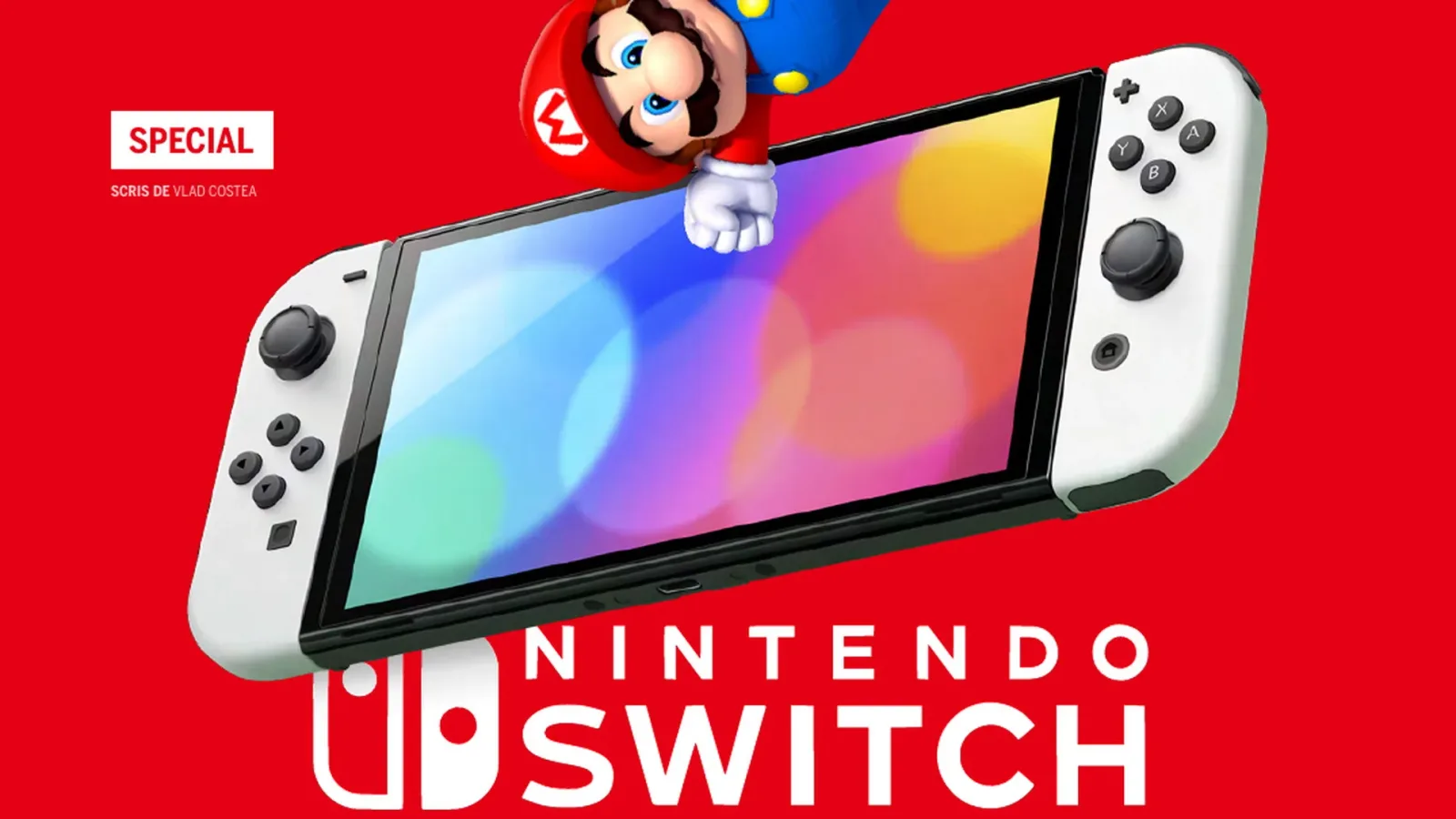
First published in GRIND IV, pages 146–153.
"NINTENDO has won the current-gen console war" In 2024, it's obvious that Nintendo won the current-gen console war. 146 million systems sold is almost as much as the combined sales of Sony's PlayStation 4 (117.2 million) and Xbox One (58 million). Or PS4 and PS5 added together (117.2 + 65 million… for now). Or about 40 million units short of what Xbox has shifted over 23 years, across 4 different console generations. If an alien trained an ultra-high-performance telescope on our civilisation, it would conclude that the Nintendo Switch is a sacred object through which humans idolise hand-held digital gods. And if we look at the most recent photographs of the Moon's surface, we'll identify 2-3 pairs of limited-edition Splatoon 2 Joy-Cons that were lobbed out by the astronauts on the International Space Station… and then catapulted towards Earth's natural satellite by the force of a cosmic garbage vortex.
Although the statistics look incredibly good, with a system that managed to outdo the success of the Wii phenomenon, Nintendo is still seen as a 'niche' player in the console market. They just make toys for kids, they can't be compared to the brute force radiating out of PlayStation and Xbox. After all, the rival companies offer higher resolutions, polygon-rendering tech that rivals the fidelity of films at the cinema, more frames per second than the average human eye can perceive, and titles so bloody and packed with explosions that the censors at PEGI and ESRB are often left baffled.
There's just one problem with the whole story: Mario Kart 8 Deluxe, a game Nintendo originally released in 2014 for the Wii U and later remastered for Switch, has sold roughly 64 million units. How much is 64 million? More than Spider-Man, GTA V and God of War put together on PlayStation 4. 2.5 times more than the PS5's top 5, which includes Spider-Man 2, Ratchet & Clank: Rift Apart, Elden Ring, Final Fantasy XVI, Demon’s Souls and EA Sports FC 24. The ranking of the 12 best-selling games on Xbox One, which includes PUBG: Battlegrounds, Halo 5:
Guardians, The Witcher 3: Wild Hunt, Dead Rising 3, Cuphead, Cyberpunk 2077, Forza Motorsport 5, Monster Hunter World, Ark:
Survival Evolved, Ryse: Son of Rome, Forza Motorsport 6 and Rise of the Tomb Raider, adds up to just 27.3 million. Not even half of what Mario Kart 8 Deluxe managed!
And our maths still hasn't taken in Animal Crossing: New Horizons (46.45 million), Super Smash Bros. Ultimate (35.14 million), The Legend of Zelda: Breath of the Wild (32.29 million) and Super Mario Odyssey (28.50 million). Every single one of those, on its own, outsells the combined tally of every title that has passed a million units on Xbox One and PS5. And Microsoft is so embarrassed by the disastrous figures that it has given up reporting numbers altogether and now focuses solely on pushing a monthly subscription.
It's true, The Last of Us, The Witcher, Halo, Cyberpunk and Gran Turismo all get far more aggressive marketing.
They are exactly the "hardcore" gamer category, obsessed with realism and serious stories. These are titles even your gran knows about, a week after you've installed Netflix and HBO Max on her TV. What, are we taking the conversation into cinema territory now? Well, as it stands, The Super Mario Bros. Movie is the sixteenth best-selling film in history.
With a budget of $100 million and box-office takings 13 times that, the moustachioed plumbers have outgrossed mega-productions from Marvel, DC, LucasArts and Disney. Exactly the same sum of money went into the first season of The Last of Us, but the details about what it took are rather less resounding.
Given the financial balance sheet of the Nintendo Switch era, we have to ask ourselves an important question: who's the niche now? Hardcore players will carry on counting frames per second and polygon density on screen, yet Ghost of Tsushima sold as many copies as Super Mario 3D All-Stars (a compilation of old Mario games, availa- ble on the market for only a few months).
Cyberpunk 2077 sold almost as much as Paper Mario: The Origami King.
Final Fantasy VII Remake, a title close to my heart and a titanic effort from the people at Square Enix, couldn't even beat the Switch port of Minecraft. And Gran Turismo Sport, a worthy attempt at reproducing the realism of motor racing, didn't sell in 7 years what Super Mario Bros. Wonder managed to sell in its first 5 months.
If a game launched on every platform, then most of the time the Switch version was the one that sold best. If it was re-released for Switch alone, it blew expectations out of the water. Somewhere around 2020, things reached the point where studios were falling over themselves to port games to the Nintendo console: from the BioShock collection all the way to The Witcher 3 and the Crysis trilogy, everything was adapted to run on hardware that looked obsolete from day one. Even Rockstar, a studio that hadn't published a Grand Theft Auto game on a Nintendo console since 2009, put the Switch on the list of chosen platforms for the Grand Theft Auto: The Trilogy - The Definitive Edition remaster. id Software weren't about to be outdone either, delivering a masterclass in optimisation with the DOOM 2016 and DOOM: Eternal ports.
And a little later, the scramble for that Japanese gold was completed by WB Games with Hogwarts Legacy and Batman: Arkham Trilogy – two technically less worthy efforts, but ones that sold like 1-Up mushrooms after a shower of spiky monsters lobbed down by the cloud in World 4-1.
At this point I have a finely honed sense of the criticism heading my way, and I can anticipate the counter-arguments with remarkable precision. True enough, quantity doesn't necessarily mean quality. Players the world over will certainly talk about Cyberpunk 2077 or God of War with deeper nostalgia than those who had anything to do with Mario Kart 8 Deluxe.
Maybe The Last of Us Part II will end up having a stronger cultural impact than the entire kingdom of Hyrule as depicted in The Legend of Zelda: Breath of the Wild. And Nathan Drake's adventures around the globe will be recalled with greater pathos than Mario's 2017 Odyssey.
But then again, the critics don't agree: on Metacritic, in the ranking of the games that received the highest marks from specialist journalists, the Nintendo Switch generation has two entries in the top 15, through The Legend of Zelda: Breath of the Wild (6th place, with a score of 97) and Super Mario Odyssey (13th place, also with a score of 97). Of the games in that top 15, five have been ported or remastered for Switch: The Legend of Zelda: Ocarina of Time (1st place, with a near-perfect score of 99), Super Mario Galaxy (4th place, with a score of 97), Perfect Dark (8th place, with a score of 97), Metroid Prime (11th place, with a score of 97) and Grand Theft Auto III (12th place, with a score of 97). On top of having 6 exclusives in that top 15, Nintendo makes two more masterpieces available, taking it to a formidable 8/15. The only contemporary title to the Switch that climbs to the level of the scores achieved by The Legend of Zelda: Breath of the Wild is Red Dead Redemption 2 – a genuinely worthy game, deserving of every bit of praise it gets.
In Metacritic's top 100, the Nintendo Switch also occupies positions 29 (The Legend of Zelda: Tears of the Kingdom) and 58 (Metroid Prime Remastered). Never mind that plenty of the games in this ranking, from Super Mario 3D World to Quake, Diablo, Grim Fandango, BioShock, Metal Gear Solid 2, Final Fantasy IX and Devil May Cry, are all there to be played on Switch. Whatever your tastes and your favourite genres, the Nintendo Switch lets you enjoy almost everything good the gaming industry has to offer. And you can play at home, at the train station, on the bus, in the canteen where you eat your lunch and in your hotel room – one of the reasons Nintendo's console has won over even PlayStation and Xbox fans.
Just as during the Wii generation, Nintendo set the standards and dictated the industry's trends. In 2010, PlayStation announced its Move controllers and Microsoft tried to revolutionise player-console interaction with Kinect. More than a decade later, in response to the Switch's success, PlayStation launched the Portal and Microsoft came forward with a full range of portable systems compatible with the Xbox Game Pass service (Logitech G Cloud, Razer Edge, ASUS ROG Ally, Lenovo Legion Go). Even Steam joined the pocket-console race with the Steam Deck – a product clearly trying to cash in on the craze Nintendo started.
This tendency to copy Nintendo's success showed up in the games too – the mechanics and scenery of The Legend of Zelda: Breath of the Wild were reproduced fairly blatantly in the Horizon series, in Ubisoft releases like Assassin’s Creed: Odyssey and Immortals: Fenyx Rising, and in the much-trumpeted Genshin Impact (which you can read about in Mădălina Coman's piece in GRIND magazine issue 2). Even Nintendo recycled a good chunk of it when they launched the follow-up, Tears of the Kingdom.
The wider reach of the Pokémon series, continued on Switch through Let’s Go Pikachu/ Eevee, Sword & Shield, Legends: Arceus and Scarlet & Violet, found its echoes in Coromon and Palworld. And the Super Smash Bros. Ultimate recipe – throwing fighters from universes Nintendo doesn't necessarily own into the same ring – inspired games like Brawlhalla, Shovel Knight Showdown, MultiVersus, Nickelodeon
All-Star Brawl and the Romanian-made Brawlout. But it's worth pausing on the context the Switch was launched into, and on the fact that success was never a given for the Kyoto company. The Wii U didn't sell at all well: right now there are only 13.5 million units scattered around the world. By comparison, the Wii had sailed past the 101 million mark, and the “failure” of its predecessor, the GameCube, had amounted to 21 million systems sold.
For three years running after the Wii U launched, Nintendo reported losses and found itself laying people off. And the peak of the shame came in September 2016, when Shigeru Miyamoto (creator of Mario, The Legend of Zelda and Donkey Kong) turned up at the iPhone 7 launch to present Super Mario Run: an iOS game that marked a desperate attempt by Nintendo to raise capital. It was the first time in 22 years that Mario had an official game outside Nintendo consoles, after the disaster that was Hotel Mario on the Philips CD-i in 1994.
The experiment was an interesting one: the first levels came free, and finishing the adventure cost you a one-off $10 fee. In the age of microtransactions and “freemium” monetisation models, Super Mario Run was a fair pro- position. But its success on iPhone fell short of expectations (the estimate is that the game made just $38 million between September and January), and a few months later the Android version turned up as well.
Fortunately, the Switch's launch in March 2017 turned out to be exactly the win the company needed to get back on an even keel. Before the Switch, there were rumours going round that Nintendo might quit making consoles altogether and focus purely on software (the way Sega did in 2001). And the very idea of a dedicated portable gaming system looked obsolete in the smartphone era. Fortunately, Mario's daddies came back to a position where they could dictate industry trends, and saved the concept of the handheld console.
Plenty of analysts describe the Switch as a “do or die” or “go big or go home” gamble. In a parallel universe, Nintendo would have made mobile games and ended up being bought by Microsoft somewhere around 2021. Many of the games released in our world would never have seen the light of day, because they wouldn't have passed the diversity test imposed by three gender studies graduates with purple hair who moved to Kyoto. Maybe even the simplicity of Mario and Zelda, which lets any player learn as they go, would have been replaced by elaborate tutorials that show you where every button sits on the controller and force you to sit through pointless dialogue while you mash A in fury. And The Super Mario Bros. Movie would have had a scene where Master Chief and Marcus Fenix riddle Bowser with bullets and flee the kingdom, mid-dynamiting, at the wheel of a couple of Forza 4 motors.
Jokes aside, the whole gaming landscape would have been poorer without Nintendo. The Sony–Microsoft rivalry hasn't produced an innovative title in a decade and a half.
Both giants are sitting comfortably, and they've reached the point where a new generation of consoles is just a fast platform for running old releases at a higher resolution and a more generous frame rate. Without Breath of the Wild and Tears of the Kingdom, open-world adventures would have stagnated at a fairly mediocre level, one where freedom of exploration is nothing but an illusion.
So what lessons can we learn from the NINTENDO SWITCH's success?
First, hardware doesn't matter as much as the games themselves. No use having a state-of-the-art system capable of pushing hundreds of millions of polygons a second and churning out umpteen teraflops if you haven't got the games to show it off.
Second, no use having impressive hardware if you can't produce enough units to meet the demand that's out there… and then a global pandemic blocks your production and distribution logistics for months on end. When people were stuck indoors looking for digital entertainment, they bought whatever was within reach. The Nintendo Switch was in plentiful supply, alongside exclusives that could keep you busy for a good few months. Who needs a PS5 when you have to pay exorbitant sums and wait weeks for delivery, only to discover there aren't really any next-gen games? The Switch is cheaper, easy to get hold of and loaded with excellent experiences.
Third, gameplay is king: impressive graphics rarely excuse a lack of action, or the feeling that you're shuffling down an illusory painted corridor put there to suggest freedom. In The Legend of Zelda: Breath of the Wild, you can explore everything you can see. There's no mountain you can't climb. There's no water you can't swim in. There's no island you can't land on. And, most importantly, there's no predefined order in which you have to play out your adventure.
Every player picks their own route and sets their own priorities. If you want to head straight for the castle where the final battle with Ganon takes place, you are more than free to do it.
By comparison, every attempt to reproduce these principles ends up feeling straitjacketed by constraints. The first Horizon lets you climb only the stretches of mountain the level designer marked out for you. The second Horizon allows more freedom of movement, but its story is linear, and you can only tackle it one way. What's more, the tutorials and cinematic sequences have the effect of chipping away at the sense of exploring the wilderness.
Fancy widening the discussion about gameplay? Super Mario Odyssey manages to refine the 3D Mario recipe, adding the ability to possess enemies' bodies by way of the hat. It's a simple mechanic, but one that opens up plenty of possibilities and makes the experience less repetitive and less predictable. Just when you think you've worked out how the game works, you'll be stacking Goombas and bouncing around as a fireball in a lava lake. On top of that, the Moons scattered through the levels force you to get creative with “how on earth do I get up there?” puzzles and encourage you to explore beyond the main missions.
It works precisely because the game is fun, because Mario moves in a fluid, athletic way, and because the difficulty level is set by each player who decides to approach the levels in a particular way.
Mario Odyssey makes you feel free without any of the pretence of a vast world you can explore: what it offers instead is more planes and perspectives from which to see the same scenery.
No point making spectacular games if the gameplay itself amounts to pushing the stick to move and pressing A (or X) to interact every so often. What's in front of you can no longer be called a game… it's an interactive movie that picks visual spectacle over freedom of movement.
Third, we need to talk about development time and budgets. True enough, a AAA today means several hundred million dollars spent over at least five years. But Nintendo grasped something very important: not every game has to be a AAA. There's room for slightly less serious releases too, as long as they're fun. Equally, when you've got a console that has outsold its predecessors, you have enough room to manoeuvre to bring excellent games back into the spotlight that maybe didn't get their due the first time round – which is how Switch players got remakes and remasters of The Legend of Zelda:
Link’s Awakening, Pikmin 1 + 2, Metroid Prime and Paper Mario: The Thousand-Year Door.
When you've got an impressive catalogue of excellent titles, you can shuffle things around a bit to cut the waiting time for blockbusters and AAAs.
By comparison, Sony and Microsoft have struggled to justify the investment their customers made when they swapped PS4/Xbox One for the next generation. It seems those genuinely important titles will only really arrive around 2025, some five years after the systems launched. But until they got there, Xbox looked like a platform kept alive on a drip feed of millions of dollars pumped in by daddy Microsoft, while Sony was putting out games on PS4 and PS5 at the same time.
Fourthly, I have to add a caveat to the 'graphics aren't everything' argument: the gap between the console generations now on the market is no longer as significant as it was when we moved from SNES to Nintendo 64, or from PlayStation 1 to PlayStation 2. I fooled myself into buying the PS5 version of Uncharted 4, only to discover that the difference from the original is well-nigh impossible to spot. You literally have to go looking for the improvements, magnifying glass over every texture in the environment to convince yourself you really did make the smart choice. The improvements are marginal, and Nintendo understood that very well. Your average player won't notice the difference between 1080p and 4K, or between 60 fps and 120 fps. Most of the time these specs are just a marketing mechanism for masking the game's own lack of originality or ingenuity.
The lads in Kyoto could easily have put out a Nintendo Switch Pro around 2021, promising players more spectacular graphics and shorter loading times. But the pragmatism of upgrading only the screen and the battery proved the wiser call. Which brings us to lesson number 5:
What, you didn't know? Nintendo makes money selling hardware, but it also makes money selling games. Unlike Sony and Microsoft, who subsidise the price of the console in the hope that players will pay for monthly subscriptions and buy games at $70. If Xbox and PlayStation tend to get cheaper over time, the Switch has held its retail price through seven years on the market. It has even crept up slightly to keep pace with inflation. As for games, we'll see the Sony and Microsoft AAAs end up going for half price after the first year. Not so on Nintendo Switch, where The Legend of Zelda:
Breath of the Wild (the console's launch title) has stayed stubbornly around the $60 mark, and has rarely had so much as a short-lived promotion. Long term, everything with a Nintendo logo on it holds its value better. And players who want to resell the games they've finished know this, and stay loyal to the platform that helps them lose less money.
And yes, there's still demand for physical media. Especially if it includes a definitive version of the game, needing updates or internet downloads only where there are online modes. This is about preserving the most memorable digital experiences, in the hope that future generations will discover them too. Just as NES, SNES and N64 games still work a treat and are being rediscovered by people born after 2000. Nintendo made the wise call when it went for cartridges: it guaranteed fast read times, ensured it kept a monopoly on production (piracy by copying the whole format being far harder than with laser-read-and-write discs), and let collectors take their hobby seriously again in a modern setting.
Maybe the PS5 and Xbox Series X are far more technically advanced. But which of them lets a fresh owner play the moment they take the console out of the box? This is about user experience – an aspect the industry giants neglect, demanding hundreds of gigabytes of updates, the joy of actually playing getting lost along the way. On top of that, Xbox and PlayStation are systems that depend on an internet connection. Yes, you can play without one… but you won't get the updates that keep a game running smoothly (think Cyberpunk 2077 with no patches at all, in the state it was pressed to disc).
The Nintendo Switch, on the other hand, can be switched on and used with no account, without faffing about with a Wi-Fi connection, and without suffering from the lack of any patch. These are completely different philosophies and approaches, springing from the difference in business models: Nintendo is already turning a profit the moment the customer buys the console.
Sony and Microsoft, by contrast, have to claw back the money they lost when they let you into their ecosystem for a sum that doesn't cover production costs.
Worth mentioning too that Nintendo put its foot in it a fair few times during the Switch generation. Super Mario Maker 2 was abandoned pretty quickly, left in the hands of the community. The Joy-Cons turned out to be less reliable than any other controller in the company's history, with repairs and replacements for tens of thousands of customers.
Splatoon 2 was replaced by a sequel barely different from it, bringing little that was new or distinctive. The Pokémon games oscillated between mediocrity and poor optimisation for the system's specs. The Labo project, which let robotics enthusiasts build all sorts of cardboard contraptions, was buried and ended up on the discount shelves before you could say “1-2-Switch”… and the company's dreams of putting motion sensors and gestures into every game evaporated quickly enough to make way for a hospitable platform, one that took in ports of thousands of games and became the favourite system of a few indie studios. The Nintendo Switch phenomenon is hard to describe. It took a bold, ingenious idea that broke with home console convention. A global pandemic helped speed the sales up. Sony's and Microsoft's failures only swelled the audience interested in Nintendo. But most importantly, the exclusives were genuinely excellent and made history. A Switch 2 (or Super Switch) launching in 2025 is unlikely to enjoy the same success. But if the new system offers backwards compatibility with Switch games and accessories, then the madness could carry on and beat the records set by the PlayStation 2. I'm glad Nintendo is back on form, with the budget to make any fantasy of its Kyoto employees real. If the next Zelda, Mario, Metroid and Donkey Kong games are as good and shape industry trends as forcefully, then we can expect a far more obvious turning of the tables – with Sony and Microsoft putting a number of exclusives on the Nintendo platform just to generate extra profit. We already have the Lego Horizon announcement for Switch, which puts Aloy on the screens of players who don't own a PlayStation 5. If all goes well, the revolution is only just beginning… and “Switch” will no longer mean just a change in how we play, but a toppling of the console industry's hierarchy!
VLAD COSTEA
THE CALENDAR
Donkey Kong Country™ Returns HD Release date 16 January 2025 Xenoblade Chronicles™ X:
Definitive Ed.
Release date 20 March 2024 Metroid Prime 4™:
Beyond Release date
TBC 2025
OF RELEASES
Tomb Raider IV-VI Remastered Release date 14 February 2025 Pokémon Legends™:
Z-A
Release date