
Octopath Traveler
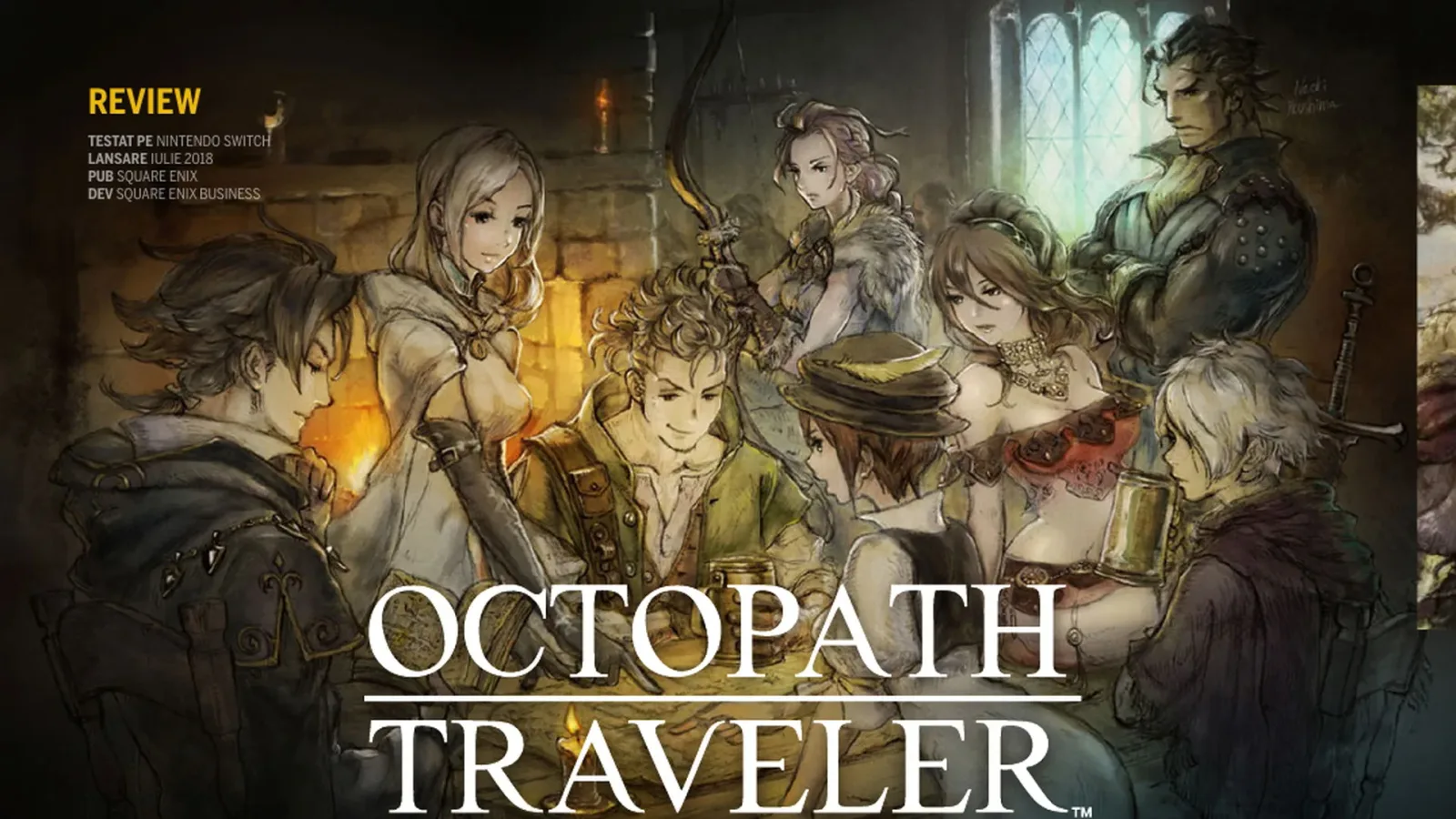
First published in GRIND II, pages 4–11.
No matter which path we follow, the final destination will be the same.
What really matters is enjoying the journey.
I went into Octopath Traveler knowing I was in for an 8/10 game, one that would hand me around 70 hours of story and a healthy (but honest) dose of grind. I already knew I'd be travelling alongside 8 different characters and hitching myself to a scattered adventure, one where narrative continuity depends more on my ability to remember events across several hours, tacked onto the end of other interleaved happenings. And I was aware that a pile of far better games was waiting for me, ones that satisfy my need to consume stories in a slightly more organised fashion.
Even so, I was drawn in by the gorgeous graphics (inspired by pixelated masterpieces from the 16-bit console era), and in recent years I've developed a fascination with the profound way the Japanese can feed our imagination with folk tales. Knowing this was a Square Enix production, and having had enough time to read the reviews talking about the Japanese studio's return to form, I was expecting a spiritual successor to Final Fantasy VI and Chrono Trigger.
Octopath Traveler, though, gave me an experience quite different from those initial expectations. In short, I realised that the side quests and the content unlocked at the end of the 8 main stories bring a charm and a candour that eclipse everything that came before. In practice, the first 50 hours are an exposition for the next 20-30, which turn out to be far more loaded with meaning. Which is a bit sad, because the real fun starts at the point where most players will have already given up on Octopath Traveler in favour of a title that handles their time and attention a little better.
The adventure Square Enix is proposing truly shines only when every NPC is satisfied, the common enemy takes the last spell/sword strike/arrow, and the main characters get a chance to interact in situations that bring their character traits to the fore. For me, that's a reward for the patience of grinding – for someone else it might be a perfectly good reason to go and play Chrono Trigger or Final Fantasy VI instead.
Even so, the inner warmth I felt when I helped a desperate father find his daughter, kidnapped by a creature of the forest, made me take a break to reflect on my own family problems and on how rarely we really say what we feel when our words could make a difference.
The chance to help an old writer rediscover his inspiration and his motivation to keep working also reminded me of the efforts I put in between 2017 and 2021 alongside the NEXTLVL project. The big difference is that, in games at least, the ending is a happy one and the effort bears fruit.
What's more, the chance to help the pharmacist Ogen (a veritable Max Payne 3 of proto-medicine, who decided to wander from town to town after his wife was murdered and then stained his hands with the killer's blood) rediscover his love for his own trade made me contemplate, a little, the role each of us plays in this world. Nobody is useless, and nobody is unworthy of a second chance.
Going by the Switch's own play-time counter, I spent approximately 130 hours in Octopath Traveler. I had to double-check before making that claim, but it's the equivalent of finishing Final Fantasy X and VII… to which I gave 65 hours each. That doesn't necessarily mean I was dealing with a better game… I simply felt more motivated to see a larger number of side quests through, and I wanted to train all 8 characters past level 65 (the maximum is 99).
The graphics and the music made me want to open the game again every day, and the stories told by the NPCs gripped me and got me thinking about problems in my own life I wouldn't normally have paid any attention to.
Because ultimately, art has to have that purifying dimension through which we discover ourselves from another angle and become better through the experiences it puts us in touch with.
What I find far more interesting about Octopath Traveler is that the true ending is triggered once certain side quests have been completed. To unlock the encounter with the beast that sits behind all the evil in the world, you have to satisfy NPCs that look random and unimportant. We're talking about a proper lottery, one that involves completing as many requests as possible from poor souls in a tight spot, or consulting detailed guides that explain the importance of the quests and the causal links between them. It may sound cryptic, but in the end it all ties together.
By the end of roughly 80 hours of play, you'll realise that the main character is another individual entirely, one who connects and correlates the stories of the 8 heroes. It's called
“Octopath Traveler” and not “Octopath Travelers” precisely because the true protagonist is someone who has already walked the 8 paths in the recent past.
Or maybe it's actually us, the players, as travellers through the lives of the octet of heroes. Because, thanks to our actions, 8 protagonists go on initiatory journeys through which they find each other, and themselves. Afterwards, they discover the element they have in common.
From what I've read, the concept is inspired by “Live A Live” – a title also released by Square on the Super Nintendo in 1994, which didn't show up outside Japan until its 2022 remaster.
The big difference is that Live A Live tells seven stories from different historical periods and different corners of the world, while Octopath Traveler bumps the number up to eight and keeps its protagonists on the same continent, in the same period of time. It's hard to compete with the Japanese.
If you only complete the main quests, you won't really understand what's going on in the game's universe, and you'll be tempted to agree with the editors who complained about the discontinuous nature of the narrative. A mistake a publication called GRIND can't afford.
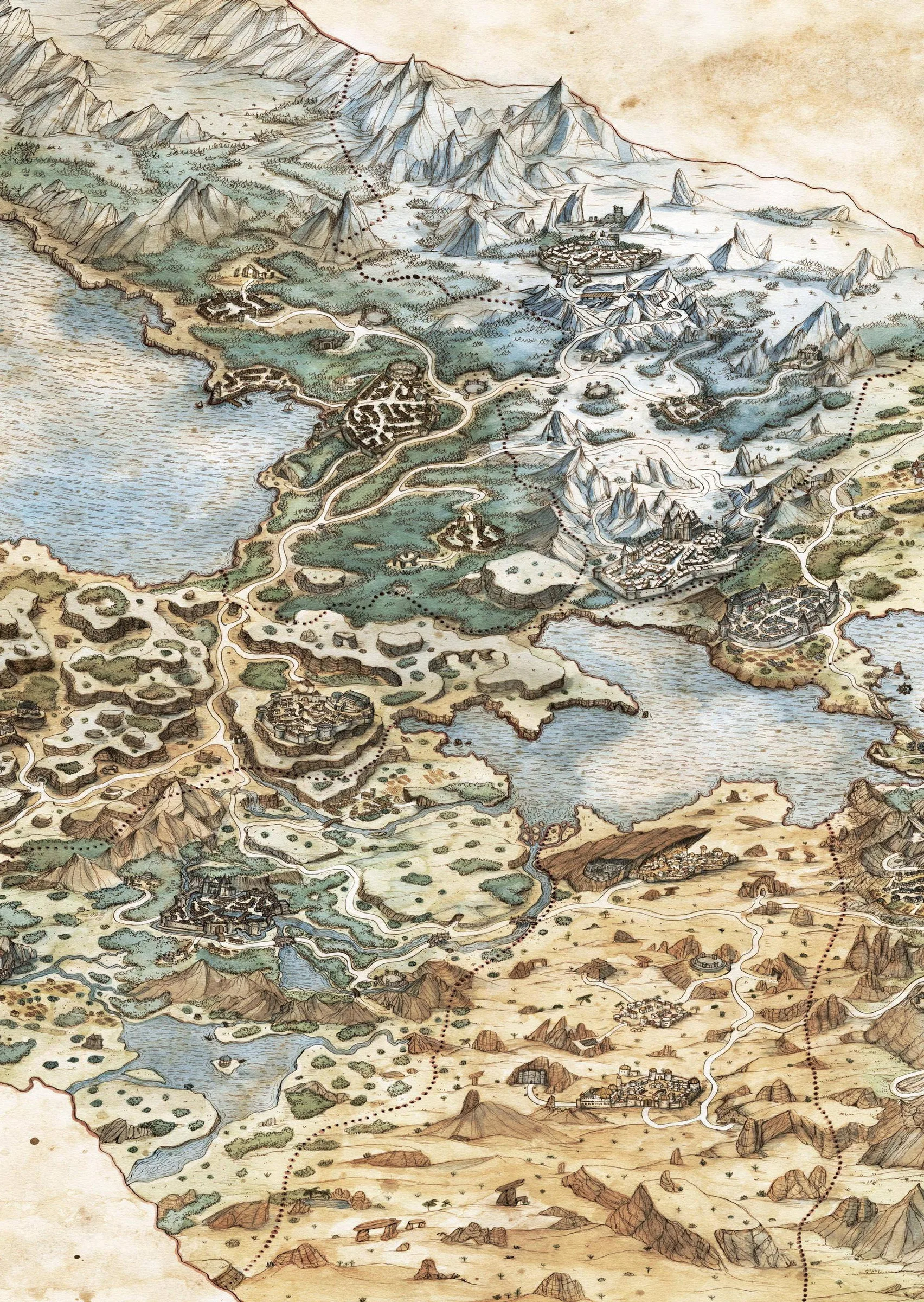
8-path travellers, crossing mountains and valleys. Mountains and valleys, windmills, fast rivers, mountain passes – these are just a few of the landforms, landscapes and natural wonders you'll explore in Octopath Traveler. Gil Dobrică's description, though, proves insufficient, because we're talking about a whole continent characterised by climatic diversity (snow-covered mountains, scorching deserts, rainy tundras and temperate plains), an alternation between overground lands and dark caves, plus architectural riches (medieval fortresses with an Anglo-Saxon look, lush ports that make trade easy, and homes adapted to the temperature and humidity of each region).
Now that we've talked about mountains and valleys, the time has come to meet the octet of adventurers, through whom we get to know the world of Orsterra. Since I still hope to convince you to give Octopath Traveler a go, I'll try to keep the story information to a minimum.
Ophilia Clement — Class: Cleric. She's a young preacher of the Church of Flamesgrace, the main religion in the game. After losing her parents in childhood, she was adopted by Archbishop Josef so she could become Lianna's sister and carry on the ancient teachings of the flame cult. Over the course of her journey, Ophilia will have to hold on to her innocence and show devotion to the religious movement she belongs to. In battle she's at her most useful when it comes to restoring her allies' health points. Her ability to fire off light-ray attacks, which are especially effective against enemies of the dark, shouldn't be neglected either. And if she runs out of mana, she can hit things with the sceptre she carries. Outside battle, Ophilia can convince NPCs to follow her – which proves handy in side quests built around meetings between various digital souls.
Cyrus Albright — Class: Scholar. He's a young academic who wants to know the secrets of the civilisations that have left their mark on the continent of Orsterra. When he isn't studying to feed his thirst for learning, he serves as teacher to the kingdom's princess.
But after a scandal he finds himself forced to step down from the lectern – a happy coincidence for Cyrus, who wanted to do more field research anyway. Over the course of his adventure he exposes the fraud and imposture of academic life. And thanks to the dark magic he practises, he proves useful in any kind of fight. He launches merciless attacks that scorch, freeze and electrocute the enemy. And when you want to know your opponents' weaknesses, Cyrus introduces the possibility of a useful, precise analysis that has a positive effect on the team's efficiency in battle. His journey is about knowledge and ethics, and the ability he offers outside battle lets us dig up extra information on every NPC.
Tressa Colzione Class: Merchant She's a teenager with trade in her blood. The daughter of shop owners, she has big ambitions: exploring the world and finding valuable items before anyone else. Over the course of her adventure she proves to be lucky – her random encounters include legendary ship captains, princesses and important people caught in thoroughly ordinary situations. Through her innocence, Tressa tends to treat everyone as an equal and sees no hierarchy in an interaction. That's what makes her easy to like when she meets the true celebrities of the land of Orsterra. But Tressa's most important quality is how easily she makes money: keep her in your party of four and she'll find money on the ground, fattening your coffers every time you set foot in a new region on the map. More than that, in battle she can collect money from enemies with low HP – which adds an extra layer of tactical depth when you have to choose between a certain sum of money and a quicker kill on some dangerous monsters. On the attack side, Tressa casts spells that unleash the power of wind. When the fight turns vicious, she can pay mercenaries who turn up to launch various kinds of attacks on the enemy. And when she interacts with NPCs in towns, she can buy items and often gets a discount.
Olberic Eisenberg Class: Warrior He's a burly warrior going through a midlife existential crisis. In the past he was one of a king's elite guards. But after that monarch was betrayed and the whole kingdom fell, Olberic took refuge in a small town at the foot of the mountains, where he tries to rediscover the meaning of life. Then a brief reunion with an old comrade-in-arms rekindles his desire to wield a sword, so he sets off on a journey to find the truth. Is it true that his best friend is the traitor who helped behead the king? Who is the tyrant behind the operation? And, most importantly, what causes are worth wielding a sword for? Those are the questions that trouble Olberic most – and over the course of his journey he'll discover satisfaction in helping the weak, the oppressed and those looking for a burly champion of justice.
Olberic's journey has honour as its central theme. He's not just a butcher but a warrior devoted to noble causes. That said, the swordsman isn't necessarily the sharpest of the characters. He's a simple man, all of a piece, honest about his own intentions. In battle, Olberic is the best handler of melee weapons (swords, daggers, spears) and the party member with the most HP and defence. He can be used as a shield for devastating attacks aimed at other teammates, or he can be turned into a true god of war himself.
In his interactions with NPCs, Olberic can start duels – confrontations that turn out to be useful for delivering justice in towns or for clearing aside characters who block access routes.
Primrose Azelhart Class: Dancer She's a dancer who sells her body every night, waiting for clients who might bring her information about her father's assassins. Her whole story revolves around the idea of revenge and involves exterminating the three men who killed her father figure. Elements specific to performance art get thrown in too – at one point a play is staged telling a meta-story about the characters involved in the action, with Primrose in the lead role.
Clearly, the story of the princess who fell to the level of a loose woman dancing in bars is far more mature than anything else you'll find in Octopath Traveler. When you read the dialogue and understand the implications, you'll realise the PEGI 12+ rating was handed out by people who most likely didn't play much of it. Some of Primrose's friends openly declare themselves prostitutes, and a few scenes allude to slavery and violence at the hands of pimps.
Often the dancer's story feels like it was lifted from another game, or shows signs that a different team of writers worked on the text. Between Primrose and Ophilia there's a complete contrast, and it's a little odd that two characters with opposing values and moral traits can be part of the same team.
But since I've brought up the team, it's worth spelling out Primrose's abilities too: in the first part of the game she's the only character who can launch dark magic attacks (later on, Cyrus will snaffle all the offensive spells). But throughout the game the dancer is the only one with incantations that buff her teammates' abilities: she can boost speed, physical attack power or the effectiveness of offensive spells. And when she interacts with NPCs, Primrose can seduce them into following her (an action effectively identical to Ophilia's power of persuasion, but with different dialogue lines).
Alfyn Greengrass Class: Apothecary He's an altruistic apothecary whom I can only describe as 'the salt of the earth'.
His journey isn't driven by any desire for revenge or selfish motive: he just wants to help sick people who can't afford other medical services, to return the favour he was shown in childhood, when another mysterious healer put him back on his feet. Even if Alfyn's story seems simple and innocent, the cases he runs into along the way push the limits of medical ethics: he discovers fraudsters who deliberately make people ill just so they can sell them the cure, and later he agrees to heal a serial killer who, once he's well again, abducts children for ransom.
Of all 8 main characters, Alfyn is the only one who ends up doubting his own philosophy of life and has moments of crisis. So his apparently simple story gains unexpectedly deep ramifications through a single moral dilemma: does every life deserve to be saved, or is the doctor the one who picks his patients according to his own judgement?
Along his journey, Alfyn befriends an older apothecary who, before lifting a finger, weighs up whether the sick deserve to be cured. And in the end, Alfyn learns more about his own past.
In battle, the young apothecary is the versatile character that advanced players can use to build unusual parties. His special ability is mixing ingredients. The resulting potions can have healing, defensive, poisonous and even magical effects. It's a combination of Ophilia and Primrose that can prove fatal in the hands of a skilled chemist. When interacting with NPCs, Alfyn can uncover extra information that otherwise only Cyrus could have found.
Therion Class: Thief He's a talented thief who never passes up a chance to steal valuable, well-guarded items. His motivation is more about the challenge than the money – and when he hears about the jewels in a noble house, he doesn't hesitate to slip into the palace and get his hands on the goods. But the pitcher goes to the well once too often: a more experienced thief foils his plan and clamps a bracelet on the young man that brands him a common thief. So Therion has to complete some quasi-Herculean tasks to win back his freedom and a shred of professional honour.
The main theme of Therion's journey is friendship: he is, par excellence, a loner. He meets people who offer to help him, and turns them down flat. Towards the end of the game, though, he starts to soften and builds relationships based on mutual respect. Sometimes there has to be honour among thieves… or, to paraphrase Bob Dylan, to live outside the law you must be honest.
In battle, Therion is the most skilled dagger wielder in the party and has the ability to steal the items his opponents are carrying. His success rate is inversely proportional to the HP left in the health bar of the unlucky sod who crosses his path. In interactions with NPCs, Therion can steal the items Tressa tries to buy. His success rate is directly proportional to the level he's reached. And if he fails 5 times in the same town, the whole party's reputation is compromised, the NPCs won't want to talk to you any more, and the only solution left is to bribe the local tavern keeper, who can spread positive rumours that restore your standing as a decent sort. Sometimes you get lucky and rob entire towns with no consequences; other times you end up paying tavern keepers more money than you'd have spent if you'd bought everything honestly.
H’aanit Class: Hunter She's a young huntress who handles a bow with mastery and lives in perfect harmony with the nature around her. She speaks an archaic English (Middle English) that would make even Shakespeare scratch his head a bit, has a leopard companion who proves extremely useful in the tough battles of the game's early stretch, and has the ability to capture wild beasts, which she can then summon to help wipe out enemies. A true Pokémon trainer who sets her moral compass by the laws of the forest: big animals eat the small ones, carnivores prey on herbivores, and those with a conscience become obliged to step in and restore the balance.
H’aanit’s story opens with a proper lesson in wilderness justice. But the journey itself sets off with the mysterious disappearance of Master Z’aanta, the man who was her mentor and trainer. Once she has left her home village, the young archer will come up against challenges she had heard about in Z’aanta’s stories but had always taken for fables or embellishments. She will defeat and capture legendary beasts, run into situations trickier than anything back in her native S’warkii, and make friends who marvel at her strange dialect. It’s a classic story in which the apprentice becomes the master.
In battle, H’aanit is one of the most useful characters. As well as wielding bow and axes, she brings tactical complexity by being able to capture weakened beasts or bring previously captured ones onto the battlefield. On top of that, the archer can use a spell called “leghold trap” that delays certain enemies’ attacks, giving her allies priority when it comes to going on the offensive. And before any of the other characters pick up abilities that hit multiple foes, H’aanit rains down arrows that can seriously decimate any horde of unlucky monsters.
With NPCs, the archer has a talent for provoking spontaneous fights with the beast at her side. Any villager will be tempted to test their strength against Linde the leopard or some other ferocious creature. The ability works much like the duelling challenge Olberic performs.
As you’ve probably worked out, the initials of the eight characters spell out the word OCTOPATH. Which means the real traveller is you, the one following each character’s fate.
So what’s the grind?
Saying that Octopath Traveler is addictive is a claim as trite as “water is wet”. For the first 30 minutes of the game you’re still in the settling-in phase, free to press the same attack button like a robot without giving a thought to enemy weaknesses.
But once you run into the first boss, you find yourself having to adapt to the new conditions.
To win battles in Octopath Traveler you have to abuse the “BREAK” mechanic: you exploit the enemy’s weakness to smash all of their shields, which buys you a full turn of attacks while the foe sits there stunned and your whole party goes to town (2x damage). The magic of the system lies in discovery: at first, if you’re up against a new monster type or a boss, you don’t know what kind of attack will break their shields. So you experiment with spells, arrows, sword slashes, dagger stabs and everything else in the arsenal.
And once you’ve found a weakness, you’ll discover that only one character can launch that particular type of attack… so the experimenting continues until you’ve unravelled the whole mystery and reached the point where every member of your party can contribute to breaking shields.
It’s a simple mechanic, but it works. What’s more, the turn order is shown at the top of the screen. You always know which of the combatants is going to attack next, so you have to plan every move as you would in a game of chess. If you break all the enemy’s shields, you know you’re in for a turn where only your characters attack. And if you use certain spells (like “leghold trap”), you can slow an opponent’s manoeuvres and buy your team more time. There are however also end-game bosses that punish you with exponentially higher difficulty the moment you break their shields – which means doing the exact opposite of what you’ve grown used to, and the game suddenly turns into a race of resource management and survival against imminent attacks.
What Octopath Traveler adds on top is a system of “boost” points that you earn after every turn in battle. Spend one point and your character will attack twice in a row or hit for double damage. Spend two and the offensive impact scales with the resource consumed. And if you build up three or more attack points, special abilities unlock that have a devastating effect on enemies.
Once again, this is a situation where resource management is essential. On one hand you want to break enemy shields as fast as possible. On the other, you want your offence in the turn when those shields are down to benefit from as many attack points as possible. You find the balance by weighing up the threat: do you throw out more attacks to block enemy initiative, or do you hit harder? Hit too hard too early and you can be left exposed to what comes next. Break the shields but fail to go to town during the free offensive turn and you drag the fight out. Fortunately there are potions for boost points and spells that let you transfer points from one character to another. It’s recommended that you save your resources for the end-of-game battles, but ultimately you’re the one who sets the strategy.
Octopath Traveler is turn-based without running a time-limited turn system. This adds tactical depth and helps you calculate every move as you would in a game of chess.
Against run-of-the-mill monsters you can just mash the normal attack button without worrying too much about taking losses. But when you’re in a region where the beasts are higher level, or up against a boss, you need to consider the full arsenal of attacks and every way of approaching the fight.
With these basic mechanics in hand, you’re invited to explore an entire continent.
Beyond the main stories and the towns you have to visit to trigger various quests, there are caves, monsters of the water and the forest, snow-capped mountain ridges and sunlit beaches waiting to be discovered. Pay attention to some obscure forks in the path and you’ll uncover one of the 12 temples that let you grant your party members abilities specific to another class. H’aanit, for instance, is an archer, but she can also become a warrior, thief, apothecary, merchant, cleric or scholar. Ophilia practises white magic, but she too can learn to blast and scorch enemies just like Cyrus.
There’s no limit to the combinations you can put together: each character can learn a second job to supplement any type of attack or healing magic. But if you want to beat the final monster that reveals all the story’s secrets, you also have to find the four caves where fierce mythical creatures are hiding – creatures that, once put down, grant you one of the advanced jobs:
Sorcerer (ideal for turning Cyrus into a perfect offensive weapon); Runelord (perfect for supplementing Tressa’s abilities); Warmaster (fits Olberic and H’aanit like a glove); Starseer (an excellent choice for Ophilia or Primrose).
You have eight travellers at your disposal, but your party can only be four strong. To swap them around you have to head to the tavern in the nearest town and decide who stays behind for a pint and who comes with you on the road ahead. So there’s some arithmetic to do before you set off. And if you want to beat the big boss, you’ll need to bring all eight of them past level 60.
Which means a lot of grind, given that each character’s “main” story can be finished at around level 45.
I should also make a point about how much the first hero you set off with matters. At the start you travel alone. And depending on your starting town and the choices you make during that initial exploration, you’ll meet the other characters in a different order. I, for instance, began my adventure with H’aanit, found Therion first, and then entered the land of ice where Ophilia preaches the religion of the flame. Had I set off with Tressa (as some speedrunners recommend), I would have met Olberic, Primrose and Alfyn first. And if I’d wanted to follow the sequence of initials that spells OCTOPATH, I would have started with Ophilia and gone looking for Cyrus, then worked my way around the map counter-clockwise.
How you organise your journey is entirely your choice. But unfortunately you can’t tackle the stories in one continuous run. First of all you have to find all eight. Then you have to pick the four-person team that suits you and try to complete their four missions in alternating fashion. Finish the first mission with Cyrus and you then need to level up some more before you can set off for the second chapter. So between acts you’re forced to get stuck into the others’ stories too (or grind pointlessly for a good few hours).
The trouble is that you end up losing certain details of each adventure, you risk mixing up fragments of information, and you can reach a point where you simply don’t care what’s happening because you’ll forget it anyway. The good news is that once you’ve finished one character’s story you’ll already have a team strong enough to cut down the time needed to complete the challenges that remain.
A single high-level member will make it easier for the others to progress and will make battles quicker.
Fortunately for Octopath Traveler, the stories are well executed, the dialogue is delicious, some of the battles in the characters' adventures are genuinely memorable, and the narrative fragments are a strong enough spur to push you into spending another ten hours exterminating mammoth and eagle heads out in the wild. What's more, if the map encourages you to explore every last corner of the continent of Orsterra, then the combat mechanics dare you to discover every vulnerability of every enemy type. And the inner warmth you feel when you help a villager rediscover their lost love, or join the resistance movement to dethrone the despotic leader of a citadel… well, it's hard to describe. The virtual thanks of a pixelated character will motivate you in mysterious ways to carry on with the journey.
The Story of Stories Anticipating Silviu Răban's article, which was supposed to run in the second NEXTLVL magazine and has been pending for nearly two years, I wanted to nod to Ion Creangă's work as well. You've surely read the story about the peasant who grows corn, is rude to the Saviour passing through the area, and ends up selling dicks at the market. But leaving aside the beginnings of erotic literature in the Romanian language and getting back to Octopath Traveler, what I actually want to highlight with the subtitle “the story of stories” is the complementary nature of the eight adventures. In the end, all the wickedness in Orsterra springs from the same antagonist and is caused by the negligence of a secret character who indirectly managed to shape everyone's fate. A sort of live-bat-eating Chinese from the Wuhan market, but with a far more plausible story.
To find out all of that, you have to grind a lot and be patient with the side quests. The more you play, the more you understand.
And the more you understand, the better your overall picture of the events on the continent of Orsterra.
It's like doing a 100-piece puzzle handed to you without a picture of the finished result: you have to be patient and study every piece to find where it goes, so that afterwards you can savour every moment when you exclaim “AHA!”
Only that the “AHA” moment comes after more than 30 hours of play.
Yet the most precious resources of our times are patience and time.
When everything is handed to us on a plate and becomes instantly available after a financial transaction, we're forced to rediscover something that makes sense and rests entirely on consistent effort.
I didn't think I'd end up sinking 130 hours into Octopath Traveler – only to then spend another 5-6 writing and correcting this article. But it's the game I shared the most moments with in 2022. And the magazine I write for is called GRIND, not “Gratification, Rapidity, Insufficient Narrative and Delassement”.
When my future children ask me what I was doing at the age of 30, I'll tell them I was working 10 hours a day… only to button-mash the Switch for 2-3 hours at night to satisfy various NPCs in Octopath Traveler.
And they'll probably suggest I don't hang around when their schoolmates come over to play Fortnite vs Splatoon 2030, Call of Duty: Bobby Kotick’s Political Warfare 3 and Minecraft Metaverse:
Zuckerberg Edition. But that's fine, because 2023 will bring us a sequel to Octopath Traveler – and I'll have plenty more unpopular stories to tell.
In closing, I want to highlight how good the game's music is. I listened to it the whole time I was writing the article, but somehow I forgot to give it the praise it deserves. The citadels ring with the sounds of medieval instruments, the mountain landscapes get a neoclassical treatment into which rhythmic influences typical of electronic music are let slip as well, and the important scenes are treated to an uplifting orchestral reading. Right from the menu you're greeted by a symphony majestically sung on wind instruments, with tribal percussion and a virtuoso orchestra. What's more, every character and every town has a theme of its own. For example,
Cyrus is characterised by a bouncy, officious waltz that is clearly inspired by the works of Russian Romantic composers.
Olberic's entrance is announced by a violin ensemble that initially conveys pessimism through minor chords, after which a crescendo introduces major thirds that induce a feeling of heroic hope – a similar modulation can be heard in the soundtrack Danny Elfman composed for the film Batman (1989). The dancer Primrose, on the other hand, gets a waltz played on Mediterranean instruments, with influences that fold in Greek music and flamenco percussion.
I could go on for another couple of pages, but I'll leave you the pleasure of discovering for yourselves what the game has to offer. If you don't pick up Octopath Traveler, then at least go on YouTube and look for the music. And if you do decide to play this modern classic released by Square Enix, then I must warn you that the grind can be addictive.
No matter which path we follow, the final destination will be the same. What truly matters is enjoying the journey.
Vlad Costea
0 votes
Scroll down here and stay on the page for at least 30 seconds to vote.
Pick a score from 0 to 10 (halves are allowed).