
Resident Evil 4
First published in GRIND II, pages 22–27.
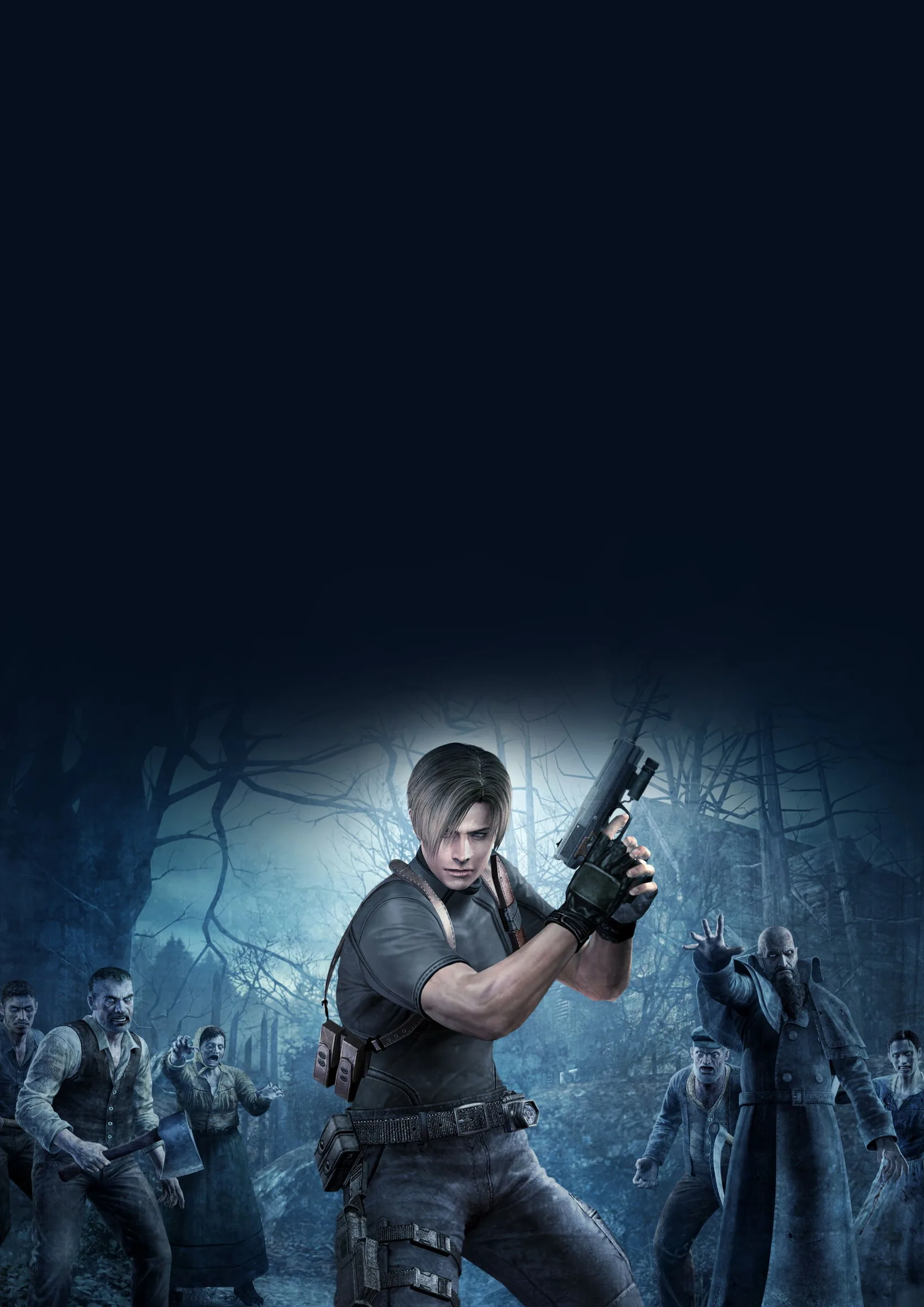
A trailblazer for third-person perspective, and an action game that brought extra dynamism through spontaneous button-mashing before the mechanics became a cliché.
I played Resident Evil 4 at the perfect moment: just two weeks after I finished the story, Capcom published a few minutes of gameplay from the upcoming remake. I effectively landed in the transition period between old and new, when I can offer a few extra thoughts on what could be improved and what will most likely be added in the updated version.
Still, I want to say from the outset that, across the 30 hours I spent with Leon S. Kennedy and the quasi-human genetic experiments he wipes out, I never once felt I was dealing with a product of a bygone age. To be playable today, Resident Evil 4 doesn't need any kind of adjustment. It's classic enough to reflect the limitations of the GameCube/PlayStation 2 generation, and modern enough that I can pick out mechanics later traced over wholesale in Uncharted, God of War, The Last of Us and Gears of War. A trailblazer for the 'over-the-shoulder' third-person perspective, and an action game that brought extra dynamism through spontaneous button-mashing (quick time events) before those mechanics became a cliché.
But above all, Resident Evil 4 has a gift for beautifully balanced proportions. Had it been a Greek tragedy, it would have stuck to Pythagorean proportions. Had it been a painting by Leonardo da Vinci, it would have observed the golden ratio Ø = (1+√5) / 2. And had it been a girl from my year at school, it would have been the one in the second row who radiated precisely because she had a little bit of everything.
My experience with Resident Evil 4 unfolded on Nintendo Switch.
It felt fitting that a former exclusive from the
GameCube should be played on a Nintendo console – even if the lads at Capcom have ported and adapted RE4 to PC, PlayStation 2/3/4/5, Android devices and Oculus Quest 2.
That technical detail matters, given that the 2005 graphics didn't strike me as so outdated that they needed an update. I will, however, add one important technical detail: the Switch screen is quite small, while the monitor on my desk is only 23 inches. Had I used a wall-sized TV, I would certainly have noticed the textures breaking down into polygons and pixels.
Mind you, Resident Evil 4 doesn't really give you time to get lost in the scenery. Unlike the first three games in the series, the slow, methodical approach typical of survival horror is replaced by action ripped straight out of the best films starring
Schwarzenegger and Bruce Willis. The fixed angles that induce claustrophobia are replaced by an adjustable camera. And the pragmatism of managing resources is shoved aside to make room for an abundance that's fatal for the pixelated, Spanish-speaking zombies.
Yes, the action takes place in a village in Spain. Yes, Leon S. Kennedy's mission (a protagonist we also met in Resident Evil 2, when he was a rookie cop in Raccoon City) is to rescue the US President's daughter. And yes, that's pretty much all you need to know about the story. In a world full of epic dramas and Greek tragedies, Capcom chose to follow John Carmack's advice and not exceed the narrative depth of an adult film. You know why the action is happening, you know what your objective is, and after that you just have to enjoy the adventure.
I loved wiping out entire armies of genetically modified villagers turned cultist zombies. I also enjoyed the handful of moments when the game made me feel unprepared and helpless in the face of an obstacle that breaks the conventions it had established earlier (El Gigante, Regenerator and Iron Maiden among them). But what I appreciated most were the end-of-chapter boss fights: a water monster seemingly torn from a Herman Melville novel, genetically modified giants, a muscular knife-wielding soldier and a tentacled creature the size of the Icon of Sin from DOOM 2. Those battles stand out for a general tendency to flip the dynamic of the whole level: if you're used to emptying your machine gun into enemies, then you'll have to handle a harpoon; if the shotgun was your best friend, then it's time to fire a rocket launcher too; and if you've become an expert shot, then the game will push you to hit button combinations at the right moment to play out a scene made up of cinematic sequences. Resident Evil 4 is the game that popularised the concept of quick time events. Whole battles rest on your reaction speed, and there are obstacles you can clear with elegance if you hit the combination shown on screen in time. One particular fight in the final act, which stages a knife duel, best captures the genesis of this trend. But popularising something doesn't necessarily mean pioneering it: the famous arcade game Dragon's Lair and the underrated masterpiece Shenmue did it before it was cool. Yet Resident Evil 4 is the one that became so popular it influenced the Uncharted, God of War and Mass Effect series, along with the entire Telltale catalogue.
If it irritates you that you have to hammer X or the spacebar to complete some mundane task alongside Kratos, then you know which modern title to blame.
So why does Resident Evil 4 deserve a place in a magazine called Grind?
I'm glad you asked: because the game runs on an economy of little gold coins called pesetas that are never enough to buy every upgrade and piece of equipment, but which carry over from one playthrough to the next. What's more, you have a limited-slot inventory, to which you can add new special weapons unlocked by finishing the story.
What I'm getting at is that you can make the most of these perks to start a second adventure alongside Leon S. Kennedy, one where you no longer need to fear the enemies and everything turns into a slaughter, just like in a DOOM session.
These little perks are supplied by the most important and charismatic character in the whole game: the dodgy merchant, who calls you “stranger” and always has special offers on weapons, potions and upgrades. Forget the story about the president's daughter, ignore the reckless antagonists who lay out their evil plans more meticulously than Team Rocket in Pokémon, let go of any idea of bonding with other NPCs. The merchant is all you need to enjoy the levels in Resident Evil 4.
He'll buy every treasure you find in the castles, and he'll be the one thanking you in that smarmy tone of his when you buy a rocket launcher for… scientific experiments.
And since we're on the subject of experiments, the Umbrella Corporation certainly didn't waste its funding. It left behind an entire religious cult infected with tentacled parasites and gave rise to monsters so hideous that even the protagonist of DOOM would clutch his head in despair. The game offers something for every bullet type – and, unlike earlier titles in the Resident Evil series, it equips you with enough weaponry and ammo that you don't have to scrimp too hard or reach for the knife.
The first two hours are the hardest, precisely because you have to get by largely with the pistol. But once you start finding more serious weapons and upgrading them, you'll end up having a blast wreaking havoc. Leon S. Kennedy also knows martial arts moves he can use in various combos: a Chuck Norris-style high kick and a suplex seemingly ripped from a wrestling show will help you diversify your offensive arsenal and save bullets for ranged confrontations.
As for the levels and the variety of settings, Resident Evil 4 serves up three distinct locations: a village inhabited by infected people, a castle full of monks and an island housing an entire military base. The level design is built so that you start in an open space where you have complete freedom of movement and exploration, continue into a set of somewhat narrower rooms, and then wreak havoc in open-field combat. Between these scenes there are also houses, laboratories, kitchens, caves and corridors waiting to be explored.
Most of the time I got the impression that the story was just an excuse to walk you through all that variety of places – but I've no reason to complain, the game never became monotonous or predictable.
Resident Evil 4 also serves up action scenes worthy of big-budget blockbusters. Alongside Leon S. Kennedy you get to explore the waterways in a motorboat, cut through mining areas in a cart on rails that possessed villagers leap into, flee a ferocious beast through a labyrinth hanging from cables (and about to collapse), shoot enemies from behind a truck and escape astride a high-speed jet ski. Moments like these give you some distance from the core mechanics and challenge you to adapt to new conditions. After all, the mission to rescue the US President's daughter shouldn't be something repetitive and dull.
And yes, we have to talk about Ashley – the daughter of the most powerful man in the world (so powerful he commands a military budget of billions of dollars, yet sends a single man to retrieve his loved one). In the opening scenes the blonde teenager is helpless, and she can turn into an ordeal for reckless adventurers. If you don't keep Ashley alive, your adventure is over. And if the girl gets hurt, you have to burn one of your health potions to avoid reloading from the last checkpoint. Fortunately, she knows how to hide in all sorts of places and obeys commands like “follow me” or “stay put”. I've read several comments online where fans of the series complained about having to babysit an NPC. But Ashley is only an NPC up to a point – the point where the game hands over an entire section in which the blonde becomes the new protagonist.
Honestly, I enjoyed sneaking about, using traps and solving slightly more complex puzzles through her. It offers a well-deserved breather from the shooting sections, and I appreciated that the guys at Capcom didn't suddenly turn her into Ripley from the Alien films. Over the course of the game Ashley evolves from a damsel in distress into someone who takes on increasingly important roles – without making Leon look any less competent. Watching her grow, I could see where Naughty Dog drew their inspiration when they created Ellie in The Last of Us. Once again, Resident Evil 4 proves its cultural relevance and its leading position, dictating trends that are still with us today.
From what I've seen in the remake trailer, the new-gen approach will bring in more horror scenes and tends to automate certain moments that happened spontaneously in the original (escaping the chainsaw-wielding villager, for instance). It's still too early to weigh in on the real differences, though, because the guys at Capcom still have time to make significant changes. The original Resident Evil 4 itself went through several drafts and iterations – and one of them turned into Devil May Cry. I do appreciate, though, that the graphics, sound and level design are being updated so a new generation can enjoy the action.
I do think, however, that the original RE 4 is still a relevant title, kept young by the very series that later used it as a source of inspiration. With the balanced proportions of action, puzzles and RPG mechanics it offers, I reckon it's still a game plenty of studios could learn from.
But the fact that the Japanese at Capcom themselves dropped the ball with the Resident Evil releases that followed shows us that the “recipe” is hard to reproduce or define. I hope the remake manages to recreate the same magic.
Vlad Costea
0 votes
Scroll down here and stay on the page for at least 30 seconds to vote.
Pick a score from 0 to 10 (halves are allowed).