
The Elder Scrolls IV: Oblivion Remastered – Review
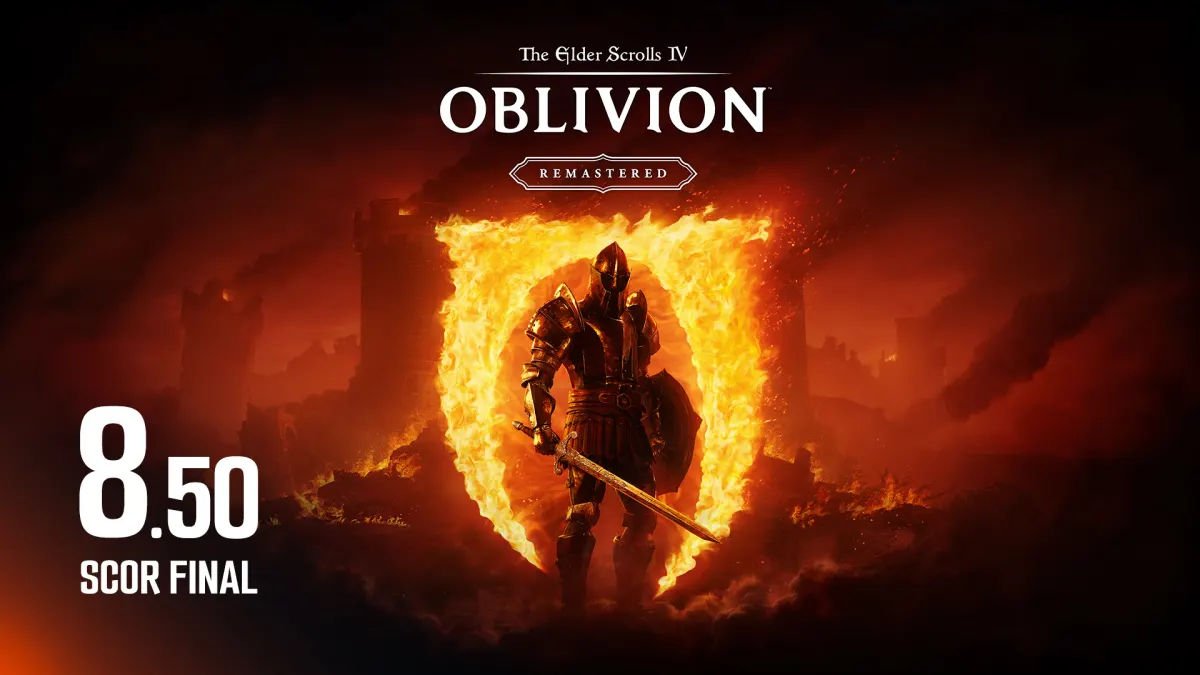
Oblivion is comfort food par excellence
I have quite a long history with The Elder Scrolls series. Daggerfall was the second game I played intensively on my new 486 DX4 (the one with 100 MHz in turbo mode). For a few months, it was also the only one, because I had borrowed it from a PC game rental centre and, as I didn't have the necessary funds to either buy it or rent it for a year, I copied it to my HDD and fiddled with it so it wouldn't look for the CD in the optical drive anymore. Anyway, "fiddled" is an overstatement, I just changed something in a text configuration file and it worked. The major problem was that the hard drive had 540 MB, so I had to delete pretty much everything from it. Including Windows 95. And, for approximately six months, my hard drive only contained Daggerfall and Borland Pascal, because I had to show my parents that they hadn't bought me a PC for nothing.

Since then, Daggerfall (which is the second in the series) has been a constant on my PC. The strange part is that I haven't even finished it to this day. Because another constant, this time of the series, is the not-so-interesting main quest. You always find something more engaging and enjoyable to do instead of sticking to the story. Daggerfall was also the game that put me on the LEVEL map. My first article published in the magazine was a nostalgic chunk of questionable quality text about Daggerfall.
I somehow skipped Morrowind. I didn't have a PC that could run it properly and, from what I saw at friends' houses, it seemed a bit odd. If Daggerfall had that semi-optimistic high-fantasy game vibe, the brownish, mushroom-filled Morrowind seemed slightly strange. Not to mention the guards in Balmora who looked like aliens. What was truly fascinating about Morrowind compared to Daggerfall, and the element that convinced me to install it as soon as I had a PC powerful enough to run it, was the game's universe, infinitely more advanced than what I had seen in The Elder Scrolls II. Because, in essence, Daggerfall was a more refined dungeon crawler. The world was huge, true, but emptier than a pub during the pandemic. Your time and activities were divided between one city or another and the dungeons, which were largely procedurally generated. Wandering through the wilderness was as boring as necessity itself, because apart from some pyramids that served as hills and tree sprites, you didn't have much to do or see. Morrowind, on the other hand, made sure you wouldn't get bored if you decided to walk to Balmora, for example, or to another more distant town. In terms of nostalgic impact, Morrowind still didn't manage to dethrone Daggerfall, though. It was my first…


When Oblivion, or Oblio as we affectionately called it in the editorial office, came out, I was already working at LEVEL. I had a powerful PC to run it, I had time, and someone was even paying me to play it. A civil servant would have said it was a confluence of factors whose resultant created a conducive framework for the optimal use of an interactive multimedia product intended for the general public. In other words, I played the hell out of it. I remember that at the time there was an open conflict between the Gothic 2 fandom and the Morrowind devotees. Consequently, when Oblivion was released, the specialist press that didn't want to be mainstream was battling it out with negative reviews. The rest just got on with it. I'm spilling the beans, but I can't help myself. An amusing anecdote from the shows made by Carmen Ivanov in collaboration with us and other representatives of the gaming press in Romania was when colleagues from Computergames, who were very proud of their negative review for Oblivion, got a little upset that they hadn't been invited to the show to badmouth Oblio. Between you and me, it wasn't hard to write a negative review for Oblivion if you knew where to look. As an RPG, it's somewhere below average. The main quest is, in my opinion, more boring than a Jehovah's Witness preaching the word of thermodynamics, the dialogues are mostly short and somewhat bland, and if I start talking about the cornerstone of a proper RPG, namely choices and their consequences, these are completely absent. And the level scaling, which was theoretically a good idea, served up super-wolves and humble bandits equipped with elven armour which, logically, if they had sold it, would have ensured them a luxurious and idle old age. The Shivering Isles add-on, plus the Thieves Guild and Dark Brotherhood questlines, which shine like solid 7s compared to the main quest, save it from absolute RPG mediocrity. Apropos, the man who handled the Dark Brotherhood, meaning the lore and questline, is Emil Pagliarulo. If you've eaten Thief for breakfast, the name might be familiar. Mr Pagliarulo worked on Thief II: The Metal Age, something that is evident in the quest design for the Dark Brotherhood. That he was later promoted to lead writer and designer for Fallout 3, where I think he shot himself in the foot, is another matter which we will probably discuss in a future article about the Fallout 3 remaster.

But despite its shortcomings, Oblivion attracted me from its launch and, over time, it transformed into that hypercaloric ice cream you eat and cry over. It's comfort food par excellence. The wonderful landscapes that contrast with the NPCs as ugly as mining work, the exploration music, the gentle dungeon crawling – which you do just for the sake of wandering underground, because the rewards are somewhat randomly generated and you end up spitting on the 50 gold coins found in a chest locked with seventeen padlocks – it all makes you forget you're playing a sub-mediocre RPG. It's a hiking simulator par excellence and I played it precisely for the walks in nature, sneaking into people's houses at night, following guards to see where the hell they go (and to level up sneak, but that's just me being a munchkin). As a bonus, the story and characters from Shivering Isles, as well as the guild questlines I mentioned above.

At the risk of repeating myself, it's not exactly a good RPG; the main story is the most boring thing since the original Neverwinter Nights campaign, and the ending with the three NPCs acclaiming you still makes me burst out laughing every time I remember it. But I swear on Sheogorath's staff that every time I exit the first dungeon, I feel like a fish in water. Speaking of fish, the first thing I saw in the remaster after poking my nose out into the light from the imperial sewers, after the familiar image of Vilverin, was a slaughterfish majestically hovering above the ruins… Only then did I feel that I was… home.

The remaster is, from what I've played so far, a better-looking Oblivion. It's dressed in Unreal Engine 5 clothes, some mechanics have been tweaked, and I can't say I dislike the new level-up system where you get twelve points to allocate as you wish among three attributes. It reduces the calculations you used to make when increasing your skills based on which attributes you wanted to develop faster. I also noticed that the movement speed is increased compared to the original, which is welcome. I've established that I don't play Oblivion with Baldur's Gate-level expectations, so all these mechanical tweaks are absolutely welcome in my case. Anyway, I have several playthroughs under my belt with an Oblivion so modded that even its mother, Todd Howard, wouldn't recognise it, so you can imagine I'm not against change, quite the opposite. Otherwise, the Remaster seems identical to the original. They even kept the bugs and that adorable jank that spawned many legendary memes; I've been playing it for two days and I swear it's exactly what it needs to be. To make sure, I also have a vanilla Oblivion install that I'm playing for comparison. Everything is there and everything is as it should be.

I didn't expect it, but the remaster, which came at just the right time, in a rather strange moment, gave me the same feeling of comfort mixed with nostalgia, mixed with the realisation that Oblivion has almost always restored my appetite for play and fun whenever I thought depression would turn me into a responsible adult who saves money for a rainy day and no longer laughs at fart jokes. It's a feeling that few games still give me, especially when I feel like nothing is in its place and the Universe is inexorably moving towards the edge of the abyss from which an anemic splash will be heard and that will have been it. Just then, as if in a dream, I hear the voice of old Picard asking me for the tenth time to close Oblivion's jaws, for crying out loud. Well, I'm not closing Oblivion's jaws, am I, Patrick? And this thing, often, pulls me out of my personal oblivion for a few hours. Enough to gain energy for adulting.


Played on: PS5
Release date: 22 April 2025
Developer: Virtuos, Bethesda Game Studios
Publisher: Bethesda Softworks
0 votes
Scroll down here and stay on the page for at least 30 seconds to vote.
Pick a score from 0 to 10 (halves are allowed).