
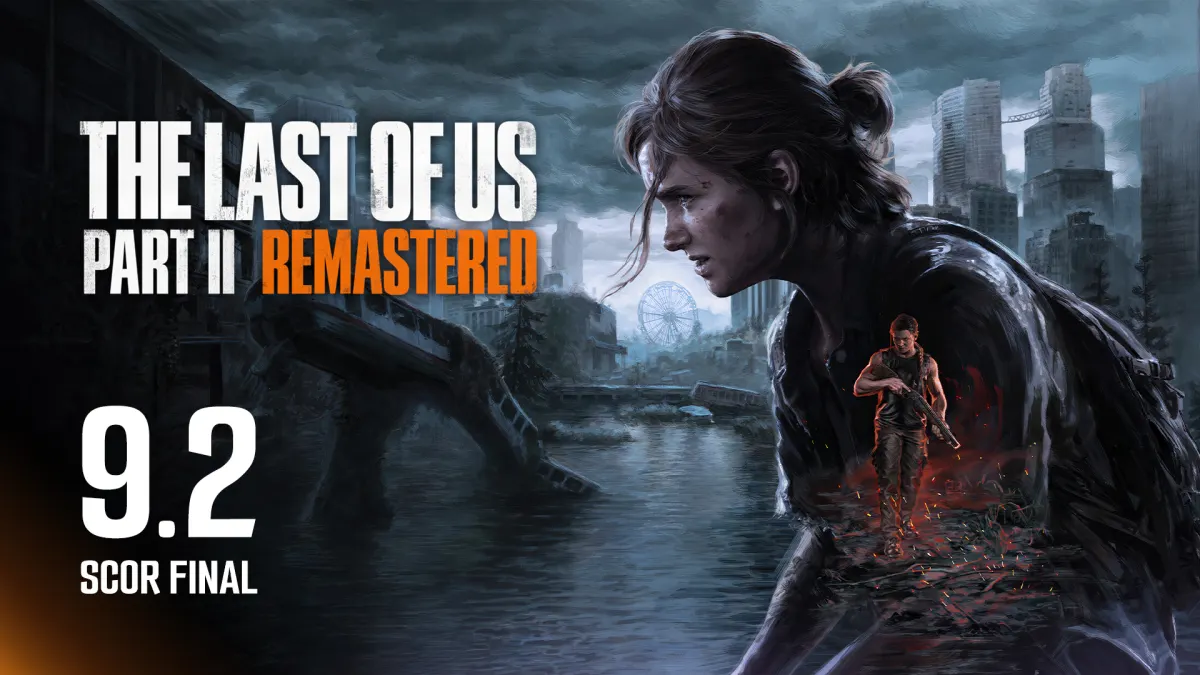
The Last of Us Part II Remastered – Review

“The revenge motif is among the most used literary elements in history.”

From the Atreidae of ancient Greece, through Elizabethan revenge plays, and up to transgressive and contemporary stories like The Last House on the Left or I Spit on Your Grave, we seem to gravitate like moths to the flame of some bloody vendetta.
It's easy to understand why it's such a popular sentiment. For the writer, it offers an easy yet impactful dramatic structure. For the consumer, it represents a mental space where they can explore their most violent impulses under the shield of perceived moral superiority.
And then, why shouldn't we root for the heroes? When we've spent enough time with them to understand their fears and desires as if they were our own, when we've seen their expressions and reactions from the driest dad jokes to the most desperate fights for survival, and when we've pressed R2 to order them to execute people in cold blood, the contrast between what they feel and what we feel has diminished.
That's pretty much the foundation on which I, like many others, became attached to the Joel/Ellie duo until the end of TLOU. In the context of post-apocalyptic ruins where you have to survive various groups of cannibals, paramilitaries, religious fanatics, and a fungal infection with zombifying effects, the fact that you, in turn, leave hundreds of corpses behind somehow pales. Murder becomes routine, a banal ritual as necessary and sufficient as brushing your teeth or hanging out the laundry.
Well, The Last of Us Part II teaches us that actions have consequences, and the tribalism that served our survival has ugly and hard-to-accept ramifications, but ones about which it's important to have a conversation.


A Brave New World
Four years have passed since Joel Miller massacred most of the revolutionary Fireflies, choosing to save the life of a 14-year-old girl at the expense of all humanity. Life seems to have settled down for the two after integrating into the welcoming community of Jackson, a peaceful and numerous group that sustains itself through agriculture and scavenging.
In parallel, we are introduced to another group of people overseeing the protagonists' community from the shelter of an abandoned cabin on a nearby ridge. As luck would have it, Abby, the leader of this group, is saved from a horde by Tommy and Joel himself, the latter being the very individual she is looking for.
To our shock and horror, Abby repays his kindness with a cartridge to the kneecap and a golf club facial, because the same chance that brought them together means she is one of the last remaining Firefly militants after her friends and father were massacred by the man she is hunting.

This is pretty much the catalytic event for the action in The Last of Us Part II. The decision to eliminate the protagonist of the previous game at the end of the prologue, not just unceremoniously, but extremely brutally and unfairly, will certainly upset a good part of us. In fact, for the theme and motives of the first title in the series to work, it was essential for us to become attached to the two of them during the twenty-odd hours we spent together.
The game's hope – and indeed an absolutely necessary condition to accept its premise and direction – is that we can detach ourselves enough from this emotional anchor to accept that good and evil are subjective concepts, and that reality involves a degree of indeterminism and causality to which we are blind from the beast's cage we inhabit.
Ellie thus sets off on Abby's trail, guided by clues found in the ruins of Seattle. This is where the game hit me hardest, in a semi-open section where you ride between several points in the abandoned city to track down the WLF, the paramilitary group you discover your target of revenge is part of.
Dina joins you and, later, Jesse, in the role of travel companions (and the occasional obligatory 'press triangle here' in Naughty Dog releases), and conversations with them provide a well-deserved relief from the general anguish of the world you're exploring. From time to time, flashbacks fill in narrative time segments or remind you who you're fighting for.

Like Uncharted, The Last of Us alternates exploration sections with stealth and combat segments, arranged to absorb the story from collectibles, scenery, and conversations in doses interspersed with frantic fights for survival. Here, however, the pace is a bit slower and stealth plays a much more important role, which gives you more time and mental space to absorb every detail of the urban ruins.
And yes, that includes the rain – because it's hard to conceive of a media representation of an American metropolis without precipitation. Naughty Dog has always had a penchant for flooded environments, sea-based set pieces, and swimming sections (a Marco Polo break is even a recurring joke in the Uncharted series), and TLOU Part II is no exception. The weather is going to be bad, and it looks bloody incredible.
Wet clothes and hair, realistic reflections, and water dynamics in general are some of the most impressive examples of a game-film, and I still feel that way more than a year after its Steam release. I could write you pages about the moments I paused the game and played in Photo Mode, about the tableau-like shots, about the expressive animations and the interplay of light and texture that outline the vivid and richly detailed image of a bygone world, but it would be superfluous, because it would be more effective to simply experience them for yourself. Just believe me when I tell you that if you appreciate the craftsmanship of form (art direction, production design, and everything that implies visual identity), there will never be a moment when you lack eye candy.

The first few hours of gameplay constantly remind you that several years have passed since the cities emptied and humanity lost control of the planet. Nature, naturally, has stretched its ivy and covered the streets, and the vestiges have begun to be eaten away by the unforgiving march of time. The attention to detail, the way Ellie's journey through the ashes of the American empire is presented in the first part of the game, is one of the most carefully crafted interactive worlds I've ever walked through.
The implications of the passage of time also have a pragmatic effect on these segments – the tall grass makes you practically invisible to anyone not two metres away, and the shops, hotels, TV stations or hospitals you pass through have been emptied of people but have left behind invaluable resources for the guerrilla warfare you must wage against not only your enemy, but also your enemy's enemy and basically any faction whose territory you trespass.
Mechanically, the game is a minor evolution of the gameplay loop from the first part, adding the ability to crawl and a few new weapons, such as a crossbow or automatic carbines, in line with the WLF's military origin. Largely, however, nothing essential has changed. We use bottles, duct tape and scissors to prepare for each encounter like Kevin McAllister prepares for Christmas Eve: from makeshift pistol silencers to explosive traps, we have a whole arsenal of tools that simplify the enemy segments.
In drawers, boxes and cupboards, we find components that we can use to upgrade our weapons, and we unlock new skill trees with the help of manuals that appear from time to time in the abandoned houses we rummage through.

To balance the scales, which were already tipping in our favour, soldiers are now joined by dogs, which can track and expose even those hidden in the tall grass I mentioned earlier. Even the virus seems to have evolved in the few years since the first game, through mutations that have produced a new specimen – Shamblers – with abilities that discourage close combat, and as life always seeks to evolve into a superorganism, something even more monstrous might await us by the end of the adventure…

The Fungus Among Us
Clicks heard through walls tell us what kind of infected are hiding in the next room. The heart-wrenching screams of an enemy I hit squarely, who gives up the ghost in a haunting way. Small, clear and distinct audio cues for various pieces of information the game tries to convey without being invasive. All of these are part of an exceptional sound design, which is also felt in the music.
Although minimalist (music only appears diegetically or in a few narratively important moments), I didn't feel any sound was out of place, and for those who pay attention, there are countless subtle auditory details that contribute to the game's soundscape. String instruments mark intense moments, and tension is built by deep percussion, but with a rarity that makes you forget the soundtrack exists most of the time.
The patter of rain differs depending on the material, and explosions resonate completely differently in enclosed spaces compared to open ones. Firearms still have a distinct crunchiness, and the mixing and sense of spatiality created by the way every rustle of leaves is treated simply takes your breath away.
A minor detail that stuck in my mind long after the credits rolled was the guitar mini-games, where you practise a few chords before Ellie or Joel put them together and start playing a cover. If you're like me, you'll shed a few tears hearing Ashley Johnson's acoustic version of A-ha's Take on Me. This is not only because it preserves all the character's vocal inflections and peculiarities, but especially because of the implications – Joel was the one who taught her to play guitar, and these small moments of quiet and exposed human spirit (like the giraffe scene in the first game) have the effect of taking us through the inner world of those we control – and later, those we hunt.

Tribes
Always, in stories about the world after the end of the world, there is a conflict within humanity between those who reject and those who embrace the new state of affairs.
There’s that authoritarian arm of the world of yesterday that desperately tries to maintain a semblance of control – FEDRA from the previous game, here in a non-governmental form, the WLF. In conflict with them is a cult, the Seraphites, who advocate a return to nature and a societal regression that rejects technology and promotes the teachings of an unnamed prophet. No one knows how they managed to survive outside the quarantine zones, but what is certain is that at some point they began an open conflict with the Front, resulting in massive losses on both sides.
They live on islands, isolated from the general infection, and encounters with them carry particular dangers: they communicate via whistles and wield bows. Arrows, unlike other projectiles, can stick into you and cause continuous damage until you pull them out. Their brutal and fundamentalist culture translates into self-inflicted scars, meant to remind them of humanity’s imperfections.

Then, like a corrupted reflection of communal living in Jackson, we have the Rattlers, a faction that, like our protagonists' sanctuary, understands the value of agriculture, but solves the labour problem by the method through which the Belgians spread Western civilisation through the Congo: slavery imposed through barbaric punishments.
From their fortress built in the complex of an abandoned luxury resort, the Rattlers kidnap survivors and literally force them to work on the plantation in subhuman conditions. Those who resist are beaten and tied to poles stuck on the beach and left to die of exposure. They are the best equipped of all the factions in the game, fitted with helmets and bulletproof armour. Not even in death can one escape them: the Rattlers chain up infected and use them as guard dogs to defend their territories.

Abby
I think the hardest thing for fans to accept isn't the killing of the previous game's hero itself, but the change in perspective that occurs about halfway through the narrative. Structurally speaking, the film pauses at the end of the second act and rewinds the tape to the beginning, forcing you to see the daily life of a woman who has shown nothing but villainy and bloodlust in the little she had revealed up to that point.
And then, even in her relationships with her friends (the same people who helped her find and execute Joel), she's no monument to virtue. Abby is, like most of us, a complicated person – equally capable of selfishness and manipulation as she is of improbable acts of self-sacrifice and heroism. The truth is, there's no specific moment when you accept her as a protagonist – I think some of us never will – but there's an imperceptible transition where you accept her as a human. Over time, her status as a person crystallises, because her role in the story is shaped by the decisions she makes, in a way much closer to how we define the people around us than a simplistic villain stereotype we want to off.
Her story begins at the WLF (Washington Liberation Front) base, a residential complex with a mess hall, gym, shooting range, and all the luxuries you could ask for from a disused stadium in a post-apocalyptic world. In short, she has everything she needs, and this also translates into a massive physique, the maintenance of which would require significant resources (because I don't know if you can look like Abby just by lifting weights).

This abundance also translates into gameplay: her weapons are much more powerful, the challenges she faces are more brutal and involve more combat and less sneaking, and personally, I liked the level design in this part of the game a bit more, even though it's much more linear than Ellie's Seattle.
Just as Jesse and Dina are Ellie's companions in her segment, Lev and Yara, two exiled Seraphites, represent Abby's emotional sphere. Through them, she regains her humanity. How much you accept her story depends on how attached you are to the initial tragedy, but I think anyone who had the sensitivity to understand Joel's choice at the end of the first game will understand what the sequel is trying to say.
By the end of the game, I found it hard to choose between wishing her salvation or death, which is a rare feeling to have for a pile of pixels in a video game.

He who fights monsters
If it isn't painfully clear by now, The Last of Us Part II is not a happy story. Nor is it necessarily new – as I said at the beginning, the history of literature (and implicitly of humanity) is built on cycles of revenge spiralling out of control. It is, however, a well-told story, treated with exceptional attention to detail and populated by complex, living characters.
The narrative risks it takes will certainly not be to everyone's taste, and the slow start that halts a plan before the climax to drag you through about 10 hours of build-up from scratch might also attract criticism. However, for me, the ending was worth it despite a few breaks in rhythm that led to it.
And the motion capture, the animations, the non-existent barrier between gameplay and cinematics (because this time everything is rendered in real-time) harmonise with the themes proposed by the narrative: the countless instances where you strangle someone while they struggle desperately to save their life, or where your enemies call out their comrades' names, are meant to remind you of objective reality. Interactivity is also part of this lesson, because The Last of Us bases its entire demonstration on the premise that you see yourself reflected in your actions, and that these characters, artificial as they are, have found a place in your soul.
We can debate who is right, who is good and who is evil endlessly and never reach a definitive conclusion, but what I believe The Last of Us Part II aims to do (and for me, succeeds in doing) is to offer us the degree of nuance necessary to have that conversation in the first place.

No Return
Complementing the story, we have a roguelite mode that recreates the stealth and combat encounters from the game in arenas inspired by the campaign levels.
We can unlock and choose to play with any of twelve protagonists, including characters from Part I, each with their own abilities and skill trees. Between encounters, we use components to upgrade weapons, pills to develop abilities, and coins to unlock new items and skills.
Each run ends with a boss fight and death, naturally, results in resetting the entire playthrough. For those with competitive inclinations, there's also a Daily Run (a fixed game mode configuration that changes every day and can only be attempted once) and the final score is posted on a leaderboard available to all.

The encounters themselves can have multiple objectives – from capturing a safe before it locks to a fight for survival where enemies know exactly where you are and come in seemingly endless waves. What's more, almost every map features modifiers that can turn an otherwise peaceful afternoon of dragging people into bushes into a hell of Molotov cocktails raining down from the sky.
Besides dead drops (secondary objectives consisting of crafting and delivering predefined items for various rewards), we also have gambits (special challenges that produce bullets and coins), and completing certain objectives unlocks new characters, skins, and game modes.
Overall, not an incredibly long-lasting mode – I completed almost all challenges in about 15-20 runs (on average, completing this mode takes about half an hour on higher difficulty levels once you understand the skill trees and how each mode should be played), but a nice addition that makes full use of the hide-and-seek "arenas" borrowed from the campaign and good training for when you play through the campaign on Grounded difficulty, which, like Crushing in Uncharted, is a difficulty mode that raises the stakes and makes you a bit more present in every fight for survival.


Played on: PC (Steam)
Release date: 3 April 2025
Developer: Naughty Dog, Nixxes Software, Iron Galaxy Studios
Publisher: Naughty Dog
0 votes
Scroll down here and stay on the page for at least 30 seconds to vote.
Pick a score from 0 to 10 (halves are allowed).