
The Lullaby of Life – Review
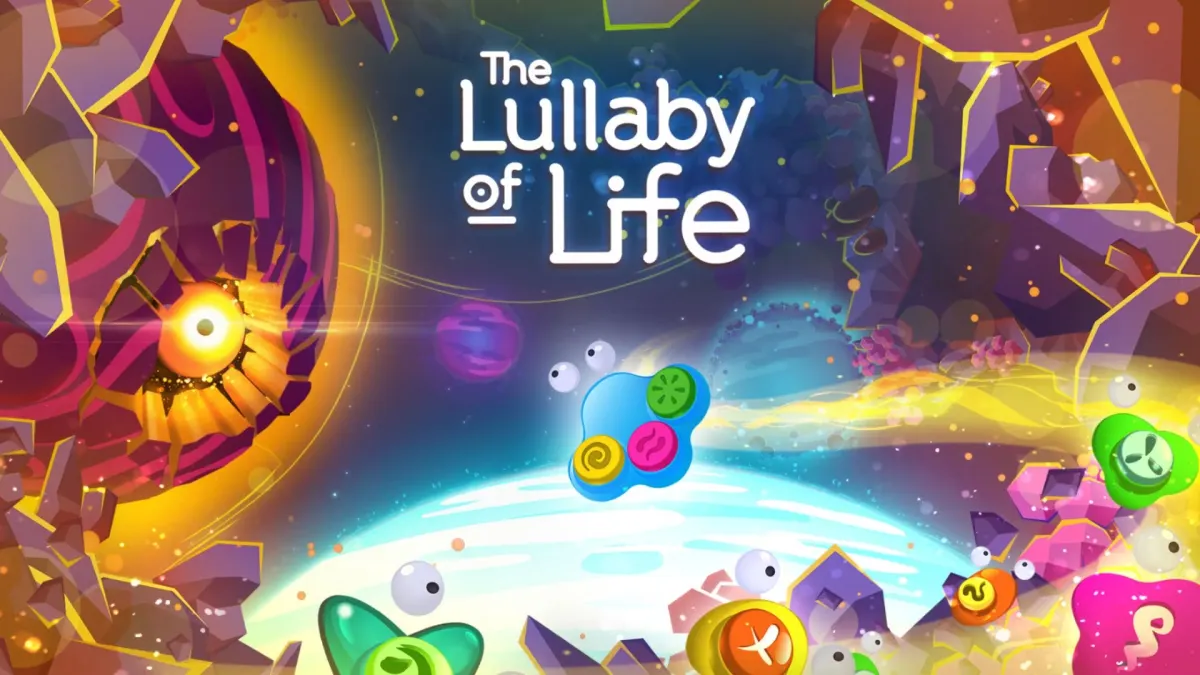
Alien Creatures and Colourful Puzzles
The Lullaby of Life is the first PC game from mobile game developer 1 Simple Game and the first title published by Midwest Games. I’ve known the folks at Midwest Games for a while and I’m really happy to be working on the review of their first published game. That aside, I like to tell you, as usual, “Brother, brother, but cheese costs money.” I’m going to scrutinise this game just like any other and tell you what’s good, what’s bad, and what could be a little better. With that said, let’s see what these colourful aliens are all about.

A Story Open to Interpretation
You start the game as a slime-like space creature that must make its way from one planet to another. What is our ultimate goal, or what destination are we heading towards? That remains to be seen. All we know is that we have to solve puzzles using musical notes. These notes can be emitted either by our character or by similar creatures we encounter, unlock, and who join us on our mission, whatever it may be. Each planet has an alien monster governing it that seems to be asleep – you must awaken this monster by unlocking and using different musical notes to progress to the next chapter of the story.
I can’t tell you much about the story, not out of malice, but because story elements are very sparsely present in the game and don’t contribute significantly to the overall picture. You meet slime buddies, travel from planet to planet, and… that’s about it – at least until the end of the game.
Out of curiosity, I glanced at Steam reviews from players and was surprised to see comments like “5/5 for story,” given that it doesn’t play such an important role in the game. Sure, you’ll eventually find out why you’re solving puzzle after puzzle, but that’s about it. The story is neither good nor bad. It just is.

Colourful Gameplay. But is it cozy?
Gameplay is the most prominent aspect of this game. As I mentioned earlier, our character can emit musical notes to solve puzzles and progress. Initially, you can only emit one musical note, represented by a button attached to your slime, and you gain access to two more as you play. But these three won’t be enough to advance – you’ll need to unlock or activate several smaller monsters that represent other notes to solve the rest of the puzzles. These don’t attach to your character but simply follow it when it moves. You can switch between controlling the main character and these little monsters to emit the correct sequence of notes for each puzzle. Your goal is to awaken the larger monsters that govern each planet to get free passage to the next.
My first and foremost concern was screen clutter when you unlock too many such companions. Fortunately, the developers came up with a solution to this problem. The larger monsters will assimilate the smaller ones that follow you to gently awaken from their slumber. This happens over several phases until our ugly sleepers are fully awake. The gameplay sequence sounds something like this: find the small monsters you need to emit all the necessary notes for the stage of waking the big, bad one -> emit the necessary note sequence -> companions are absorbed -> a new path is unlocked -> you return to collecting monsters for the next awakening stage.
Control and movement feel fluid, and traversing the environment is smooth. I like that they’ve also sprinkled in some high-speed corridors that propel you through levels – so you won’t waste too much time wandering around aimlessly. You also have the option to sprint and dash, to make traversing even faster. I’m also glad that the monsters following you can keep up and don’t move slower. You just have to be a little careful how you move, because they like to bump into walls and get stuck if you turn too sharply. Keep an eye on them before some idiot gets lost somewhere and you have to retrace your steps to pick them up and unlock the next stage. Believe me, these little ones like to get stuck in corners more than they should. Not to mention that your character can also get stuck in various corners accidentally, forcing you to restart the level to get unstuck – it’s a good time to warn those of you who think you can squeeze through tight spaces: it doesn’t quite work like that. Don’t believe me? Just look below how I got stuck between the two coloured stones. You’d think there’s room, but there isn’t.
The mechanics are creative and fun, with a few exceptions. I was already excited just finding some harp strings and walking back and forth just to listen to their soothing sound. Imagine how cool it was when I found out you could use them to transmit sounds to places you can’t reach. You’ll also find trampolines that not only catapult you through levels but can also be used to transmit sounds at inaccessible angles for different puzzles. You have candy-like stones that you can drag over certain switches to activate access doors, certain obstacles that don’t let sound pass through, as well as certain more dangerous areas that your companions cannot cross. I advise you to be careful in these areas – once one of the monsters following you touches them, it will disappear and you have to go back to where you initially unlocked them to reactivate them. The annoying part is that sometimes you can’t avoid this from happening. I had to unlock one such monster, then sprint along a wall of flames to the exit, for it to head straight for the exit when it wakes up, without touching the fire. All well and good, but the problem is that the little guy mostly hit the fire wall in many attempts due to the too-tight angle.
To be honest, sometimes the mechanics felt added for the sake of it, like puzzles where a series of musical stones are seemingly randomly aligned, but the solution is to activate only the first stone you encounter, and the puzzle will solve itself automatically from there.
Other times, it feels like the times to solve them are too short and you’re under pressure. This is also one of my concerns – the inconsistency in puzzle difficulty. Maybe I’m just particular, but when you label a game “Cozy,” generally the experience and atmosphere should be one of relaxation – you shouldn’t have to worry about difficulties. Here, it seems to me that The Lullaby of Life is having an existential crisis – it wants to be a cozy little game, but it leans more towards puzzles, thought exercises, or precise movements. At least from my point of view, it’s a puzzle game that does a great job of giving you a cozy and immersive vibe… until you hit that puzzle that challenges you, takes all the positive vibes, and kicks them out the window.
Cozy aspect? Definitely, yes.
Cozy gameplay? Ehh… not all the time.
Even if your character might die in certain circumstances, the save points are well placed and ensure you don’t have to wander aimlessly through the entire level to get back to where you were killed.
Last but not least, if you finish the game a bit faster, you might get something.

Speaking of appearance…
The visual aspect is one of the game’s strong points. To describe it in a few words, the environment and character design look fluid and organic, with a playful touch. Something that surprised and impressed me is that they managed to achieve a balance and colour contrast in such a pastel environment – I didn’t feel my eyes hurt during the game. However, this is just my perspective, as someone without visual colour disorders, an element for which the game loses points in terms of accessibility – there’s no way to adjust visual settings for those who suffer from different forms of colour blindness.
They didn’t just do a great job with colours, but also with character design. The little monsters not only have different colours and symbols, but also different shapes depending on the level they are in. For example, an orange one with a snake symbol will look different from level to level. As they say, variety is the spice of life.
The fluidity of the environment design sometimes works against you. There are certain areas where you can’t clearly distinguish what is an obstacle and what is part of the background or what is in the foreground. I encountered a situation where a stone bridge arched over the area I needed to go, and it blended so well with the environment that I thought it was a dead end – so my alien bumped its head against all the walls and checked all the places it had passed through until I guided it to that area because I literally had no other options. Chase scenes are also negatively impacted by these obstacles that might be part of the background, especially when they occur in low-light areas.

Relaxing and Playful Music
The background music and cinematic scores are a solid reason to pick up the game – they give me the same feelings as those soothing and relaxing melodies I’ve heard in meditation apps, meditation videos, or apps that help improve concentration and memory. I like the direction games are heading today by creating an audio identity for each separate area in the game – The Lullaby of Life is no exception.
What bothered me on the audio side were the sounds you use to solve puzzles, because they don’t sound very harmonious. Let’s say you activate a puzzle that completes automatically or you perform a longer sequence of notes to unlock one of the phases of the monsters that govern the planets – you’ll notice that it doesn’t sound very melodic and reminded me a little of how it sounded when I first started playing the piano. To give you some context, sounds played a pretty important role for me as a person who suffered from severe myopia and couldn’t see further than 7 cm in front of me until a few months ago – I am very sensitive to sounds, and if something sounds even slightly off-key, I’ll notice it and it will bother me.

Final Verdict
The Lullaby of Life is a colourful little game with a solid visual and audio identity most of the time, the gameplay is mostly fluid, and the puzzles are quite unique. It loses points when it comes to accessibility, as it lacks options for colour blindness – this can affect how enjoyable the experience will be for some of you. I’m also not a big fan of obstacles that blend in with the environment, the sounds used for puzzles that aren’t very harmonious, and the companion tracking system that sometimes glitches.
It gets a solid 7/10 from me – it would get an 8/10 if it were promoted more as a puzzle game and dropped the “Cozy” label; I know it makes people turn their heads, but it also sets certain expectations for the game. It particularly bothers me when you tie all achievements to speedrunning in such a game – does that really make sense in a cozy game?


Played on: PC
Release date: 24 July 2020
Developer: 1 Simple Plan
Publisher: Midwest Games

0 votes
Scroll down here and stay on the page for at least 30 seconds to vote.
Pick a score from 0 to 10 (halves are allowed).