
The Witcher: The Last Wish
First published in GRIND V, pages 218–221.
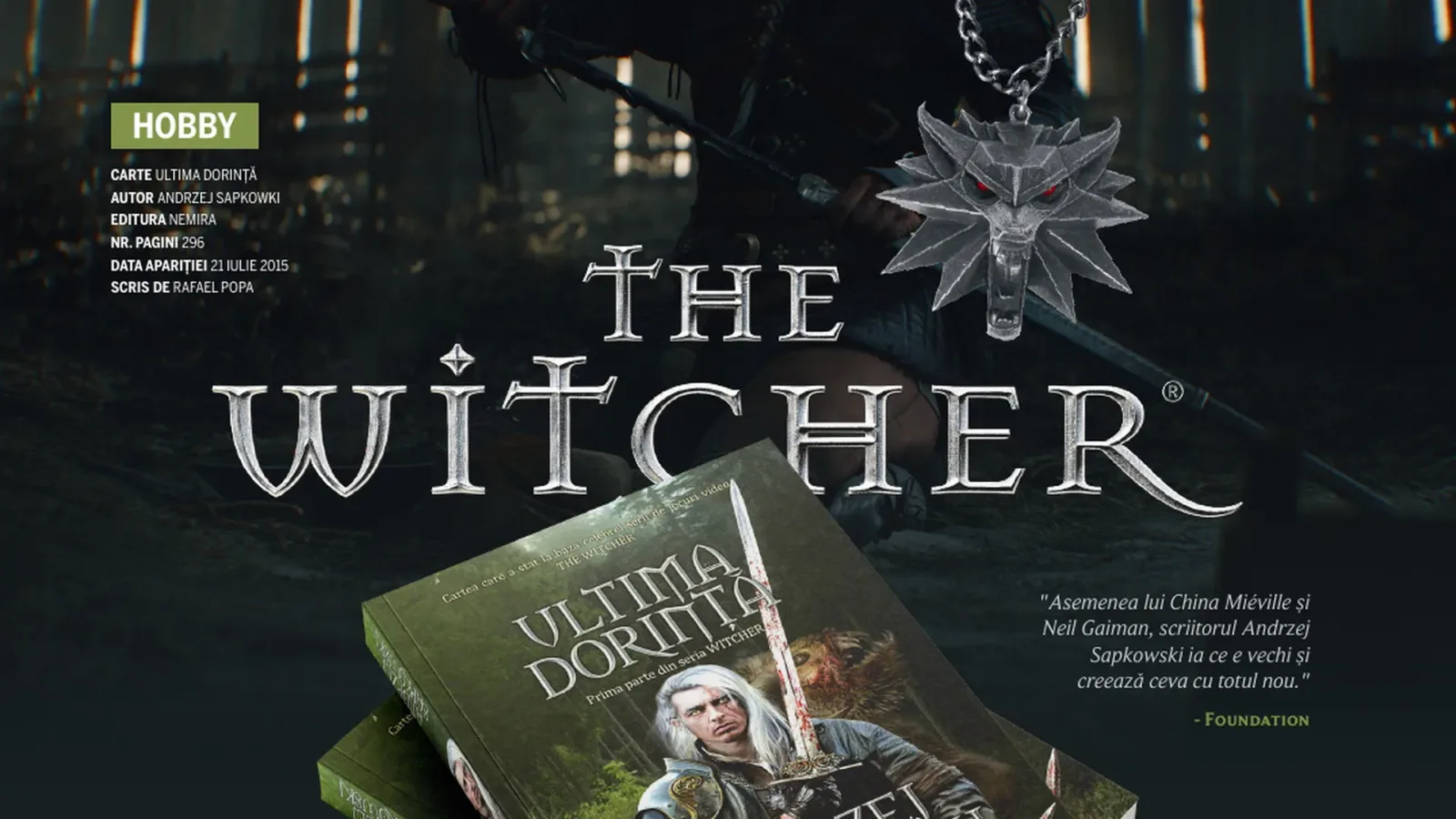
BOOK: THE LAST WISH
AUTHOR ANDRZEJ SAPKOWSKI
PAGES 296
"The Witcher series is a high point of the fantasy genre in recent decades. The Polish author's overflowing imagination wins over any reader." - The Guardian
"Like China Miéville and Neil Gaiman, writer Andrzej Sapkowski takes what is old and creates something entirely new." - Foundation "One of the best fantasy stories of all time" I don't know how well you, the readers of this piece, know me, but I count myself a die-hard fan of The Witcher universe — the kind of fan who has not only spent hundreds of hours in the game trilogy and watched every film and series connected to that universe, but has also read pretty much everything published by the man who wrote the books behind it, Andrzej Sapkowski.
This is also why I decided that the first book review I write this year should be about the Witcher books — specifically The Last Wish, the collection of short stories that gave birth to the franchise which took global pop culture by storm and became a landmark in the entertainment landscape of the last decade. But before I get into the review itself, I feel the need to tell you a little more about my own experience with The Witcher.
My story begins somewhere around the middle of 2015, when, watching one of my favourite YouTubers from abroad play The Witcher 3, I first learned of the game's existence and, by extension, of the universe created by Andrzej Sapkowski.
"I Believe In The Sword." Geralt of Rivia
I was already a kid who loved literature and fantasy video games, so I immediately grew curious about this grimdark world, which looked like one of the most interesting I'd seen up to that point. Unfortunately, my PC at the time couldn't run The Witcher 3, thanks to its integrated graphics card. But that didn't put me off — I tried to find other ways of getting my Witcher fix without the third game in the trilogy. So, in my quest to pirate the first game in the series, I also found out about the books and, to my great luck, I saw that the first book in the series had just been released over here by Nemira. As you can imagine, I asked my mum for the 30–40 lei the book cost back then, ordered it and waited impatiently for it to arrive, so I could lose myself in what I already knew would be some of the best fantasy stories of all time.
A few days later the book arrived, and I can still remember the morning I opened the parcel and first got my hands on The Last Wish. As expected, I was inseparable from it for nearly a month. Once I'd finished it the first time, I reread it at least twice more — it wasn't every day I got money for books, and I had to make the most of every page.
Looking back, I don't think The Last Wish is the best book an 11-year-old could read, but at the same time I understand that Sapkowski's work played a huge part in shaping the adult I've become — which is why I decided that, almost ten years after I first opened Sapkowski's books, the moment has come to talk to you about them.
So let me begin the review proper as it deserves to be begun — with the opening sequence of The Last Wish, which introduces Geralt, witcher and monster hunter, in a rather more intimate moment than we might have expected: making love to a priestess in the temple where "Kaer Morhen…
Can’t imagine a better place for my final resting place." Geralt of Rivia the book's interludes take place. Yes, I know, this opening sounds more like a Sandra Brown novel than a fantasy one, but bear with me, because I prefer to see it as the lull before the storm rather than the book's prevailing tone. Especially since the pages that follow shift the paradigm entirely and head back into the past, to Geralt's adventures before he reached the temple — more precisely, to his arrival in Vizima, capital of a typical fantasy kingdom called Temeria, which we'll keep running into in both the books and the games.
Here we also get the first example of the exceptional worldbuilding that defines Sapkowski and his work, because he manages to paint as realistic a picture as you could want of a city like Vizima, and even puts you in Geralt's boots, sinking you into the political intrigue at the court of King Foltest of Temeria.
What's more, I'd say that here, in the very first pages of the book, we can put our finger on the true essence of the universe: the way it fuses fantasy elements with Eastern European folklore — the same folklore that lives here too, in our own Miorița lands.
You see, Sapkowski was born in Łódź, Poland, some 700 kilometres from us, and it's precisely the stories that every Slavic-speaking childhood is made of — the very ones we heard ourselves when we were small — that shaped what we know today as The Witcher. In practice, Temeria isn't much different from a point of
Andrzej Sapkowski Andrzej Sapkowski was born on 21 June 1948 in Łódź, Poland. He studied economics and worked as a sales rep for a foreign company. He translated science fiction literature, and in 1986 he wrote his first short story for a laugh, but the text was published straight away in Fantastyka magazine. He then became a full-time writer, winning over both the general public and the literary critics. Fame came with the Wiedźmin series, known under the title The Witcher and popularised on a mass scale by the video games of the same name, which enjoy resounding success.
The saga that established him comprises three volumes of short stories, published in several editions and under several titles. The author has won numerous prestigious awards. He has two distinctions from the European Science Fiction Society and five Zajdel Awards to his name. In 2012 he was awarded the Gloria Artis Medal for Merit to Culture in Poland.
point of view, culturally speaking, from our own medieval states — and the monsters Geralt fights aren't so very different either from the ones our grandparents used to tell us about when we were children.
So, unlike authors such as George R. R. Martin, we don't get quite so many influences here from Anglo-Saxon folklore and mythology... those are replaced, instead, by influences from Slavic mythology and culture. Which is precisely why we meet not only strigoi, werewolves and other monsters native to our part of the world, but also, on the administrative side, voivodes and a nobility closer to medieval Wallachia than, say, to England of the same period, with all its lords and dukes.
Perhaps that doesn't sound like much, but when you consider that The Last Wish came out in the first half of the 90s — a period when fantasy writing was still overrun with copies of Tolkien and copies of Tolkien's copies — a book this original was completely atypical.
Basically, fantasy literature was ninety per cent monomyth, especially in the form described by Joseph Campbell in The Hero with a Thousand Faces. What does that mean? Well, that the main characters, even if each one had a different name and a backstory that wasn't entirely identical, followed the same developmental beats and everything repeated the same cycle, like a magic stew warmed up again.
If he wasn't called Frodo Baggins, he was called Rand al'Thor, and if he didn't have Aragorn for a guide, he had Lan Mandragoran. Different names, the same story every time.
Imagine, then, what Geralt's arrival on the scene meant. No more of the typical hero without sin, optimistic and upbeat: here was a cynical character, scarred by the horrors of the world and seemingly indifferent, yet with genuinely good intentions underneath.
His actions aren't always morally right, and they betray the duality playing out inside him. Alongside his typical heroics, Geralt is willing to walk over corpses when he reckons he stands to gain from it, and he won't hesitate to cause a little collateral damage when he decides there's no alternative.
Basically, Geralt is no Prince Charming in a white cloak, come to save princesses from wicked dragons, because to some extent he is aware of his own monstrosity. That, to my mind, is exactly what makes him such a good character — one who manages to go beyond the three-dimensionality of most protagonists in conventional fantasy.
And Geralt is only the tip of the iceberg — I say that because the other characters are just as complex and got the same attention from the author. Whether we're talking about his allies or his enemies, they all meet the same standard of quality.
All the characters here have motivations that feel real, traumas, joys and fears that are no different from those of the people we interact with in everyday life. A few examples that come to mind right now are
Yennefer, through the charisma she radiates in every gesture and every word, or Jaskier, the intellectual, womanising bard. Not to mention characters like Renfri, with her tragic past which, to some extent, is what drives her atrocities.
I don't want to ruin your experience of reading the book, so I won't go on about the characters any longer. What I can tell you is that they are without flaw, and I find it hard to think of another book series, fantasy or otherwise, that has managed to raise the bar this high on that front.
And as if all that weren't enough to make The Last Wish an absolute must-read, I should also mention that each of the six stories in this volume is a reinterpretation of the tales of our childhood, adapted and reinvented to fit Sapkowski's universe.
What happens when the princess is one and the same as the monster you have to save her from? What happens when the beast deserves its fate and the beauty is a cold-blooded psychopath? Or when Snow White is an unscrupulous killer?
Sapkowski answers these questions magnificently, and he even manages to set the reader thinking about human morality and their own actions.
In fact, that is also the book's theme. The essence of The Last Wish doesn't come from Geralt's epic battles, or from the way he conquers almost every woman he comes into contact with. No, it's something much deeper than that.
The essence of the book is the way it offers us a somewhat more realistic and more cynical perspective on human nature, and on the way we try to blame external factors and the unknown for the atrocities we commit with our own hands.
“People,” Geralt turned his head, “like to invent monsters and monstrosities. So they seem less monstrous themselves. When they drink, cheat, steal, beat their wives, starve their helpless grandmothers, bludgeon the fox caught in the hen house with an axe or riddle the last surviving unicorn on earth with arrows, they still like to believe that the Mora that creeps into their hovels at dawn is more monstrous than they are. That way they take a weight off their minds and feel relieved.
And it's easier for them to live.”
But just as nothing in life is perfect, neither is The Last Wish — in fact, it has a rather large flaw: the pacing. In some parts the book moves far too slowly, while in others the action seems to be on fast-forward, which doesn't necessarily let you process everything that's happening.
Perhaps I'm a little subjective, but even though I'm aware of this flaw in the book, I choose to overlook it, largely because it is brilliantly overshadowed by its good parts and by the pleasure that comes from experiencing Geralt's adventures.
In closing, I can say that The Last Wish is one of those (few) books that I believe every one of us, enthusiasts of this kind of geekness, must read at least once in our lives. Not only will it offer you new and interesting perspectives, but Sapkowski's prose is superb and manages to put you in the shoes of his characters in a way very few others can.
I await your thoughts, both about the review and about the book. I hope I've managed to convince you to give it a chance, and happy reading!