
31 Games That Changed My Life
First published in GRIND III, pages 106–124.
Games gave me valuable life lessons
Officially, I became a gamer in 1998. And over the last 25 years, games have played a significant part in expanding my imagination and in how I understand and relate to art. Through games, I learned to read and speak English. Games also gave me valuable life lessons: I learned the basics of driving a car before I had a driving licence, I identified with the stories of hundreds of characters and understood the possible consequences of certain actions, I made real-life friends who shared my interests, and I grew closer to family members with whom I shared memorable moments.
All heavy weapons: Because of games, I probably never reached my full potential as a pupil
My grades could have been much better, although I’m not sure how far academic performance would have given me a more comfortable life or a more fulfilling career.
For better or worse, at the age of 31 I decided to make a list of 31 games that changed my life. They’re not necessarily the best titles, just the ones that helped me discover something new or broadened my horizons about what video games can be. The order isn’t necessarily a definitive ranking – on any other day I’d probably shuffle every title except the one in first place. But in its current form, the list is satisfying and true to my experiences of the last 25 years.
Before I start talking about each game in turn, I want to thank my father, who always wanted to keep me up to date with the latest technology and saw computers as a way for me to prepare for the future. Thanks to him, I got my first PC in the summer of 2000 and received upgrades in 2003 and 2004. I also have to thank my paternal grandmother, who chipped in to get a more powerful system in 2004. What’s more, my mother made a huge financial effort to buy a computer for my younger brother Luca, and a few years later she paid half of what we needed for an Xbox 360. She also bought me a new laptop in 2010, which helped me try new releases like Skyrim and Duke Nukem Forever during university.
Since 1998, I’ve gone through 5 desktop computers, 2 laptops and about 8 consoles from different generations.
I’ve played with neighbours, classmates, male and female friends, and strangers on the internet. The only constant, however, has been my brother Luca: with him I unwrapped the Terminator console from under the Christmas tree and played Super Mario Bros and Duck Hunt; with him I saved up for an Xbox 360 in 2009; he’s the one who bought me a Nintendo Switch for my birthday in 2018; and he also chipped in for a PlayStation 5 in 2021. Luca is my favourite playmate, the only family member who is happy to see my collection grow, and probably the best FIFA player I know (he wreaked havoc at CERF 2004, when he was only 9). So I dedicate this article to him, and I hope that by Christmas we’ll finally finish It Takes Two and Super Mario 3D World.
VLAD COSTEA
SKIFREE (PC, 1998)
In the summer of 1998, I visited “Uncle Mihai”, a cousin of my mother’s who had a computer running Windows 95. SkiFree is the first PC game I ever tried, and it marks my first encounter with a mouse. It wasn’t necessarily a pleasant experience – I actually remember struggling a bit to control the skier. What’s more, the little monster that devours your character at the end showed up just as I was starting to master the slaloms. But it was a curiosity that left its mark on me, and one I’ll never forget.
SABOTEUR
Before Twitch and YouTube existed for watching other people play, I visited my older cousin Dragoș and watched him load an audio cassette into the “computer”, type in a series of commands and guide a ninja-looking character across the screen. At the time, I was too young to be allowed to try such technology without “breaking” it. But I watched the action on screen, fascinated, and promised myself that one day I’d grow up and be as sophisticated and modern as my cousin.
(Cip 03, 1996) SNAKE
Over the years, several mobile phone games showed me that wireless communication devices could be used for fun, without having to prank call people with funny names from the Yellow Pages. Space Impact on the Nokia 3310 and Stack Attack on the Siemens A57 swallowed dozens of hours and noticeably shortened the battery life of my relatives’ and friends’ phones. But nothing compares to the original Snake on the Nokia 5110 – a simple game, yet one that pushes you to sharpen your reflexes against the sudden threat of swallowing your own tail.
(Nokia 5110, 1999) BOMBERMAN (Terminator, 1996)
In the summer of 1999, just a few months before I started school, my dad became an expert at Bomberman, Dr. Mario and Tetris. Only the first of those has a memorable ending, though, in which the main character marches from the left of the screen to the right and changes clothes halfway. The text reads “Congratulations! Bomber Man becomes Runner. See you again in Lode Runner”… and at the time, Dad took the message as a pacifist metamorphosis: the former bomber had taken up running. Unfortunately, none of the yellow floppy disks I got my hands on in the following years contained Lode Runner. And even if I had found it, I don’t think either of us would have made the connection with the Bomberman ending straight away. Still, I’ll never forget how impressed I was by my dad’s skill at placing and timing bombs across the screen.
HERCULES (PC, 2002)
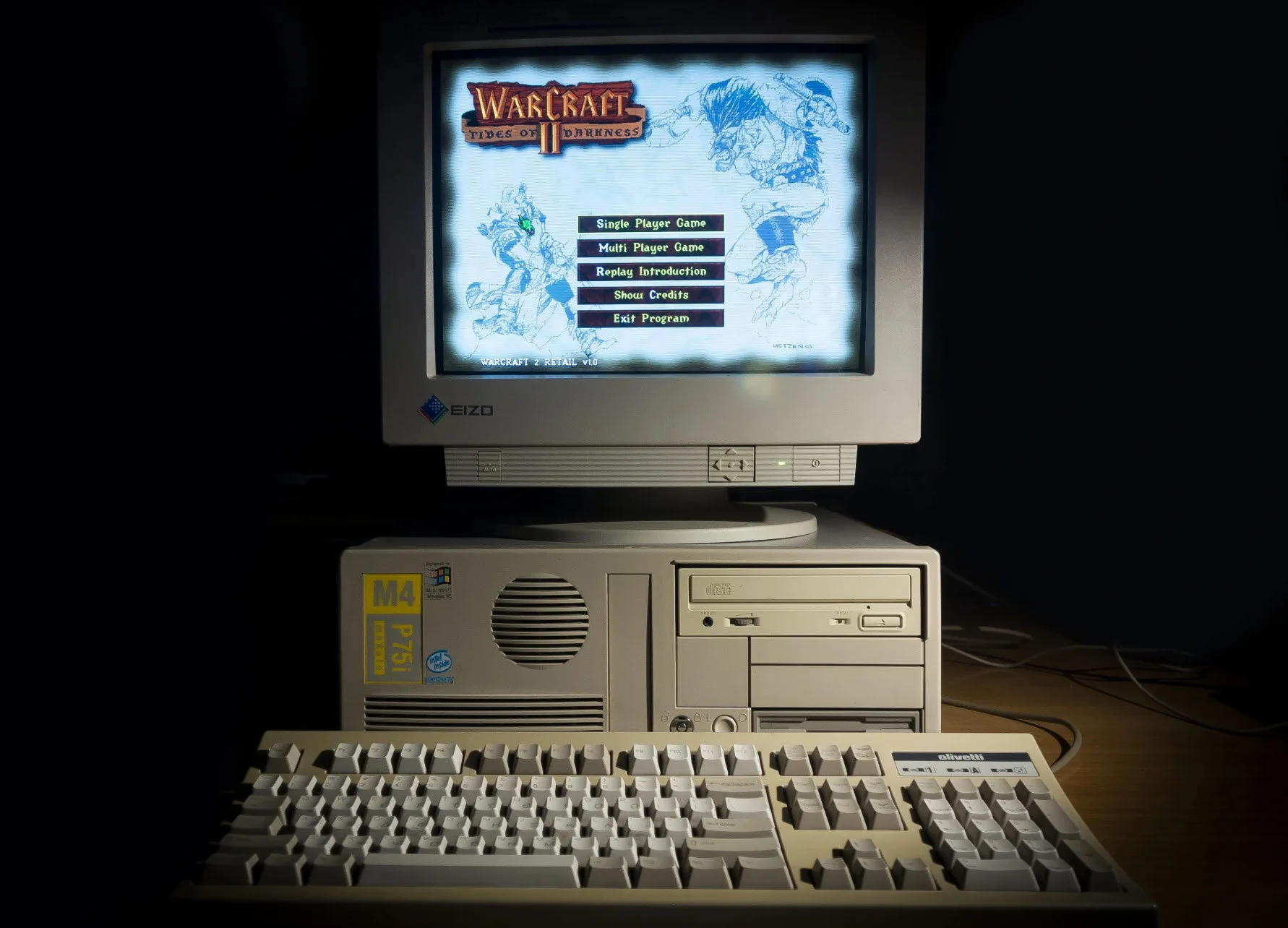
When I first got hold of the pirate compilation “Games Mania 5”, I was overjoyed to see Disney’s Hercules in the menu. But at the time, my Olivetti M4 PC had a monitor that couldn’t display more than 16 colours (even though the graphics card could manage 256). So I spent the next two years playing Hercules at other kids’ houses. It wasn’t until 2002 that I got a new monitor and a new system with an AMD K6-2 processor, 96 MB of RAM and a Riva TNT2 graphics card. I played and finished Hercules not because it was the best game, but because those earlier technical limits had made me want to run it on my home computer even more.
DOOM 3 (PC, 2004)
In February 2004, my parents made a gargantuan financial effort and bought me a current-generation computer. When I got that Pentium 4 with Hyper-Threading and a 2400 MHz clock speed, 256 MB of RAM and a GeForce FX 5200 graphics card, I thought there was no game I couldn’t run at maximum fidelity. The joy lasted just 6 months: in August 2004, id Software released DOOM 3 and brought my system to its knees – the RAM was barely enough, and the graphics card couldn’t cope even with medium settings. It was too soon to ask my parents for money for an upgrade, but past experience had already taught me to live with being behind the latest games. I tried to enjoy the privilege of stopping the demonic invasion of Mars with all the inevitable compromises, until I got hold of an ATI Radeon 9550 GT and another 256 MB DDR stick.
IMPOSSIBLE CREATURES (PC, 2004)
I first heard about Impossible Creatures around 2003, when my dad bought me an Italian games magazine from Metro. I found it fascinating that you could combine different animals and birds to create hybrid beasts and send them into battle. But the real reason Impossible Creatures is on this list has more to do with my beginnings as a collector: in the spring of 2004, my dad took me and my brother Luca to CERF. And in the middle of the biggest annual IT event, I saw an “original” game that I recognised, sold by an official distributor and at a price we could afford. The persuading was masterfully done by my brother, who eventually got Dad to part with “500,000” and make us the happy owners of an original game. For two kids who had grown up on pirated software, passed around on floppy disks or CDs labelled in permanent marker, the idea of owning something in an official case meant a great deal.
The game itself wasn't that good – in fact, I'd say Luca and I had more fun with strategies like Age of Empires or Heroes of Might and Magic 3. But the moment I placed an original on top of the pile of Traxdata, Imation and Verbatim cases was truly magical.
STAR WARS (PC, 2003) GALACTIC BATTLEGROUNDS
It's an Age of Empires 2 clone, but with units, civilisations and campaigns ripped straight from the Star Wars universe. It's neither the best real-time strategy game nor the worst. StarCraft and Age of Empires probably impressed me more at the time, thanks to their possibilities and game mechanics. Galactic Battlegrounds, though, let you play a campaign alongside Darth Vader and conquer the entire galaxy, planet by planet. The events of the film didn't matter: as a player, you were free to rewrite every battle and use your imagination to stage new scenarios. By far my favourite feature was the one where I could create my own maps to set up battles like “Darth Vader and Darth Maul versus Han Solo, Chewbacca and Jar Jar Binks”, “Emperor Palpatine at the bottom of the hill versus Master Yoda at the top”, or “Luke Skywalker versus 20 Stormtroopers scattered in different corners of the map”. I'd program the scenario, place the units on the map and then watch the events unfold. An 11-year-old kid who was still deepening his knowledge of the Star Wars universe, and who stayed up past midnight to watch the films when they aired on Pro TV, could hardly have imagined that a game could give him more than that. Galactic Battlegrounds was the perfect setting to fuel my imagination. If I'd had a bit more time and been a few years older, I'd probably have started writing entire books of fiction based on the events of a single confrontation staged by my own fascinations.
WORMS WORLD PARTY (PC, 2003)
I first discovered Worms: Armageddon in the spring of 2002, when I was visiting my friend Cornel. The mix of tactics, chaos and hilarious animations had me in stitches. Not even the best cartoons made violence this entertaining. A year later, I brought home a CD of Worms World Party: the same old thing, just with a few extra hats. I enjoyed the single-player mode, but what I loved most were the moments when Luca, Dad and I took turns hammering the keyboard, trying to sink (or blow up) the worms of the opposing teams. Kids today won't understand what it means to share a keyboard to move your units in turn, then form spontaneous alliances in the pauses with the weaker player to wipe out the dominant one… until a grenade blown off course by the wind turns any agreement into unpredictable anarchy, worthy of the grimmest analyses of nuclear war simulations. The Worms games are truly something special. Hallelujah!
HEROES (PC, 2001) OF MIGHT AND MAGIC 3
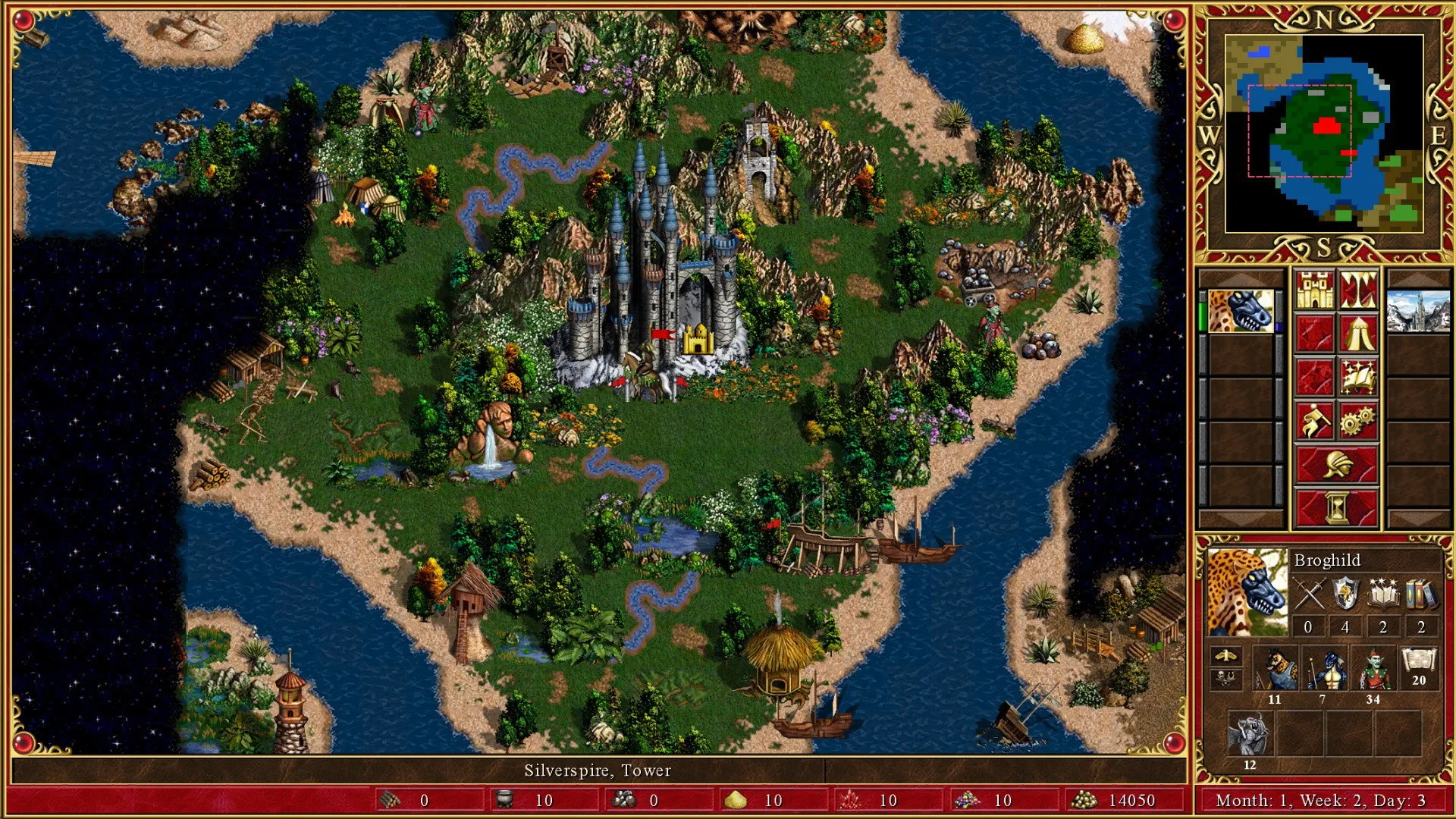
I first discovered “Heroes 3” at my godparents' house and was instantly drawn in by the mythology behind the story and the contrasts between the towns (the archangels of Castle Town versus the horned devils of Inferno Town, the titans of Tower Town versus the chaotic hydras of Fortress Town, the elves of Rampart Town versus the skeletons of Necropolis Town, the minotaurs of Dungeon Town versus the orcs and cyclopes of Stronghold Town). The battle between good and evil was fought on a huge scale, with hundreds of units, spells, traps and tactics that could change the outcome of a fight at any moment. Beyond the combat, there's an entire economy that covers both gathering resources and managing time and movement energy. For me, Heroes of Might and Magic 3 is the pinnacle of the TBS genre. But the real surprise comes when you have a friend or two to play with in “Hot Seat” mode – you share the same mouse and keyboard and move around the same map, but you fight over the same limited resources as you try to take the other players' castles. I'll never forget those magical evenings competing against my brother and Dad. Those moments were truly unique.
MAFIA
I first heard about Mafia in the autumn of 2002, in PC Games magazine. The cinematic presentation and the “period” style charmed me instantly… and even though I didn't yet have a system that could run such a gem of interactive virtual entertainment, I put Mafia on my priority list for some future miracle (which only happened, on my birthday, in 2004). What Mafia taught me is that games can reach a level where the graphics, dialogue, story and presentation offer an expe-
(PC, 2004)
rience like a film. At the time, I hadn't yet seen The Godfather trilogy, Goodfellas, the original Scarface or any film noir. So I had no other reference point to help me work out where the ideas were borrowed from. But that naive approach helped me enjoy the events even more and be far more surprised by the twists. I never managed to finish all the missions – “Visiting Rich People”, where you have to sneak through the garden of the prosecutor who holds compromising information about the Salieri family, got the better of me every time. My brother, though, has finished Mafia at least three times. For the same reason, our tomcat is called Salieri.
(XBOX 360, 2009) BATMAN: ARKHAM ASYLUM
In the summer of 1997, a year before I learned to read, my grandfather gave me the first issue of The Adventures of Batman comic as a present. Around the same time, I watched episodes of Batman: The Animated Series on Cartoon Network every evening. I grew up playing with Batman figures and saw Joel Schumacher's films at the cinema without ever doubting the quality of what was on screen. I also played the action game Sunsoft released on the NES/Famicom, so you can't say I came to Arkham Asylum in 2009 as a complete newcomer. What I do want to say, though, is that not even in my wildest dreams could I have imagined such a vast and intense adventure. Every character from the cartoons and comics turns up at some point, every ally or villain feeds into how events unfold, and the action never gets boring or repetitive. Between the combat sections there are puzzles, and once you put your mind to work, you have to manage the points you've earned to upgrade Batman's various abilities. And yes, I know Arkham City is considered the better game – but Arkham Asylum came first, offers a tighter adventure and left a much stronger impression on me. Afterwards, every comic-book superhero game (from Spider-Man to Wolverine) ended up being compared with Arkham Asylum. And I find it hard to think of a better staging of the Batman universe's characters, given the limitations of 2009. If you want a point of comparison, look up Batman Begins on PlayStation 2 and GameCube. The leap is immense.
BROKEN SWORD 2
I've played better point-and-click adventures than Broken Sword 2. But this one has the distinction of being the first full game I got from LEVEL magazine that I could run on my PC of the time without a care in the world (AMD K6-2 clocked at 333 MHz, 96 MB SDR, Riva TNT2). The first few minutes, in which our blond hero crushes a venomous tarantula with a bookshelf and puts out a fire in the room with an improvised siphon, hooked me and made me want to see the rest of the story. And the art style and fluid animation hardly betray the age of a game first released in 1997. Every time I think of LEVEL and the full games it gave away, Broken Sword 2 is the first title that comes to mind.
(PC, 2003) (Switch, 2022) OCTOPATH TRAVELER
Octopath Traveler hooked me with the free demo Square Enix put out in July 2018. After two hours, I wanted to see the rest of the story. But the €60 price seemed too high, so I decided to wait… and three and a half years later I ended up buying it second-hand on Olx for 200 lei, because the price never really dropped. I can say that Octopath Traveler is one of the best 2D RPGs I've ever played. The real magic, though, is in the characters' stories and the interactions with NPCs. Above all, this game transports you to a world where kindness and innocence are the norm – and evil is fairly easy to spot and has to be stamped out. In a world loaded with postmodern touches, shades of grey and relativism pushed to the extreme, discovering a universe where the line between good and evil is drawn by a few simple principles filled me with warmth and made me want to help every single character. Square Enix improved the recipe significantly in Octopath Traveler II – but I found it hard to recapture the same joy when I already knew what to expect.
AGE OF EMPIRES
I first came across Age of Empires on the computer in my dad's office. I'm not sure who the brilliant IT guy was who installed games and spread them around the institution's network – but for a while he managed to reduce employee productivity. Dad was so impressed by Age of Empires that he brought me into work before closing time just to show me how you could build cities, harvest the natural resources around you and, when you got bored, type in cheat codes that dropped marines and sports cars onto the battlefield. It was the first RTS I'd ever seen – before StarCraft, Warcraft, Empire Earth, Age of Mythology, Rise of Nations and Star Wars: Galactic Battlegrounds. But it still fired my imagination and widened my horizons in unexpected ways. Every game I'd tried up to then ran on instant reactions to imminent danger: chasm in front of you? Jump! Enemy attacking? Hit it with whatever weapon you're carrying, or jump on its head. Age of Empires showed me that games could also be built on strategic planning for situations that were bound to come up sooner or later. Pepperoni pizza!
(PC, 2001) (Switch, 2017) LEGEND OF BREATH OF THE WILD ZELDA:
Before “Breath of the Wild”, the idea of an open-world game meant nothing more than being free to pick the order of your missions and wander from one town to the next. Nintendo changed the rules, though, by introducing a simple concept to Zelda: anything you can see, you can explore. There's no river you can't swim in, no mountain you can't climb, no patch of ground you can't walk across. Apart from the sky and the celestial bodies, absolutely nothing is mere set dressing. And all of it takes up just 13.4 GB of the console's storage. I bought Breath of the Wild in the winter of 2018, a few months after my brother gave me a Nintendo Switch for my birthday. But it wasn't until the summer of 2019 that I finished the main story, having spent the rest of the time exploring every landform and hoovering up Korok seeds. In the first issue of NXT LVL I published an article a few pages long about the game… and I don't think I'll ever manage to put the joy of exploring and discovering into words. It's something Tears of the Kingdom perfected this year, and something every open-world game since 2018 has borrowed. But the original stays in my memory as an important landmark, one that revolutionised how I approach and understand games.
THE SIMS (PC, 2002)
The Sims series let an entire generation play God with a household, dictating every decision and interaction in the lives of virtual characters. But the genuinely revolutionary bit is the one where you build scenarios that are imaginary, or lifted straight out of real life. Want to recreate a picture of your own family, with ambitious parents and kids who play on the computer and don't always get the best grades at school? That's one of the possibilities I tried! Want to see what your life would look like with Ioana from the third desk by the window, once you've both grown up, can afford a house with no bank loans and can reproduce with a few romantic kisses? Nobody, apart from a nagging parent telling you to get off the computer and do your homework, can stop you. But The Sims games only get truly interesting once you put on the philosopher's hat and start asking yourself the questions that sages like Rabelais and Leibniz worked out centuries before you were born: what if we're characters in someone else's simulation too, and our free will is really being controlled by a superior intelligence we can't perceive? Only then do you start paying closer attention to the pool ladder, hoping it won't vanish while you're swimming in the deep end.
HARRY POTTER (PC, 2003) AND THE CHAMBER OF SECRETS
On Christmas morning 2002 I found an optical mouse with a scroll wheel and volume 2 of the Harry Potter books under the tree. Santa didn't have much of a grasp on the chronology of J.K. Rowling's universe. But over the following months I fell so hard for the magical world around Hogwarts School of Witchcraft and Wizardry that I read all the books, watched every film released up to that point and insisted on playing all the games. Of all the adaptations the EA Games studio turned out, the second one grabbed me hardest and fed my imagination about the challenges that come with life as a young wizard. Harry Potter and the Chamber of Secrets was the right game, and it arrived at exactly the right moment. And to a kid who was used to always being behind on the latest releases, that meant an enormous amount.
LEGEND
Plenty of players will tell you Legend of Kage is a mediocre game. A repetitive abomination that doesn't deserve a place of honour in the revolution Nintendo kicked off in the second half of the 1980s. A release worthy of an Angry Video Game Nerd episode. But in my memory, Legend of Kage is the first game I can remember finishing. Before I found out that there's a castle in Super Mario Bros that really does have a princess to rescue, I cut down ninja warriors across the 4 seasons (an excuse to reuse the same backdrops with a different colour scheme) and took Princess Kiri by the hand to begin a life of socio-economic uncertainty together. I was only about 7, but I knew how to parry shuriken stars, launch devastating attacks by swinging the arm that wields the katana, and deal with the kidnappers just like in Akira Kurosawa's films.
OF KAGE (Terminator, 1999) SAM & MAX: SEASONS 1 + 2 (PC, 2008)
I didn't play Sam & Max out of any nostalgia for their original 1993 adventure. I gave it a chance after reading a positive review in XtremPC magazine and realising I owned a computer that could no longer keep up with the latest releases. What I found instead was a challenge for mind and spirit that kept me amused throughout and pushed me to solve the mystery so I could move on to the next episode. Part of the charm comes precisely from the episodic format: each chapter has a smaller mystery, and by the end of the season everything ties together into a conspiracy of cosmic proportions. With Sam the detective dog and Max the hyperactive rabbit, I made Swiss cheese by riddling a lump of cheese with pistol bullets, learned about Sybil's many career reinventions, traded with the paranoid Bosco, underestimated just how evil the likeable Soda Poppers really are, and showed the whole world that the magician Hugh Bliss is a charlatan. The trips took in exotic spots like the White House, a virtual reality world, the North Pole, the Moon and Hell. When you get adventures of that calibre, you can forget Crysis, BioShock, Fallout 3 and every other game your PC can't run anyway.
GUITAR HERO 3 (PC, 2009)
Kids today will never understand what a phenomenon Guitar Hero was for a generation that grew up watching rock band videos on MTV. But in 2009 I decided to download Guitar Hero 3 off Filelist, map keys F1 to F5 to the 5 musical notes and pluck the imaginary strings with “Delete”. Then I turned the keyboard round to hold it like a guitar and sharpened my musical knowledge on tracks by bands like Smashing Pumpkins, Poison, Living Colour, Heart, Alice Cooper, DragonForce and KISS. At heart, Guitar Hero is a rhythm game that helps you lock in with the rest of the band. But after finishing the campaign on medium difficulty, I asked my parents for an electric guitar for Christmas. I thought it would be as easy as in the game; it took a few years before I could actually play the songs that inspired me to pick up a real instrument. I kept playing other titles from the Guitar Hero and Rock Band series too: I bought the full drum kit for Guitar Hero 6: Warriors of Rock, and in the breaks I even got to be Ringo Starr in The Beatles: Rock Band.
GTA: VICE CITY (PC, 2003)
Around October 2003 I went to visit my classmate Alex, who had an AMD Athlon 2000+ with 256 MB of RAM and a GeForce 4 graphics card. Sure, the pretext was that we'd write homework together. What we actually did was steal sports cars, run over pedestrians and type “PANZER” to outrun the police cars in a genuine tank. If that got boring, we'd grab a “rampage” mission and slaughter everything that moved – sometimes machine-gunning gangs of bandana-wearing Cubans, other times taking heads off with a samurai sword. A year later I discovered you could pick up prostitutes in your car to push your health up to 125%. And somehow neither Alex nor I turned violent, embraced the life of an outlaw in the middle of a mafia organisation, or ever ran over a prostitute to get our money back. Listening to the Flash FM and V-Rock stations, I discovered some of the most iconic hits of the 1980s. And once I worked out how to add my own MP3 files so I could listen to my music in the car, I ended up driving for hours on end, criss-crossing the virtual city. And yes, I went on to play every other GTA game. But none of them hit the same.
FINAL FANTASY X (Switch, 2021)
I discovered the Final Fantasy series relatively late. In 2021, while I was shut in at home along with the rest of the planet, I bought a compilation from Altex for 90 lei that included two of the best-looking games released on PlayStation 2: Final Fantasy X and X-2. My expectations weren’t very high, but X hooked me quite quickly with two surprisingly good elements: the combat system and the cinematic presentation of every scene. For the first 20 hours I didn’t care much about the story – I enjoyed the epic-scale battles and tried to cultivate the abilities of each character in the party. But in the second half, Final Fantasy X made me feel an attachment to its story and characters that I’ve rarely come across in games. I wanted to see Tidus return to his native Zanarkand. I hoped to see Yuna happy and unharmed at the end of a successful pilgrimage. Instead, I discovered a drama of cosmic proportions, with no happy ending. In the final hours it was hard to stay indifferent whenever the plot took a turn, and I regretted how little attention I’d paid to the story at the start of the game (going through it a second time, everything made more sense). Thanks to Final Fantasy X, I now want to collect and play every other title in the series. And sometimes, when I want to feel the intensity of those events again, I listen to the soundtrack once more and live through some of the turmoil that makes X a masterpiece. Art doesn’t always have to be perfect – its role is to humanise us and make us feel something that helps us become better.
FIFA 2000 (PlayStation, 2001)
Around October 2000, Dad decided to treat my brother and me to a trip to the games hall. Beyond the door was a dark room with some 15–20 CRT TVs and just as many PlayStation consoles. And when the bloke who charged “ten thousand an hour” asked Dad what game to give us, he answered, “something with football”. That’s how I discovered FIFA 2000 – the first football game I’d ever tried, apart from Soccer on the Terminator/NES. I can’t remember exactly which team I picked first, or whether the win was mine or my brother’s. I only know that for the next two years I saved up money to go to “PlayStation”. And no, I didn’t always play FIFA 2000 – I also tried Mortal Kombat 4, Marvel vs. Capcom, International Superstar Soccer and a racing game that was probably Crash Team Racing. The following year they brought a PlayStation 2 into the hall… but I never managed to get anywhere near it, because there were always older boys who had it booked for the rest of the day. Still, FIFA 2000 deserves credit for opening my eyes to PlayStation consoles, with graphics I didn’t get on the Terminator or on the computer at home. When I got a better PC, FIFA 2000 was among the first games I got hold of.
THE CYCLES (MS-DOS, 2000)
In the summer of 2000, my parents bought our first personal computer: an Olivetti M4 brought over from the Netherlands, which came with just two pre-installed games: Chessmaster 2000 and The Cycles. The second of them, which my brother and I called “the motorbike game”, was our first and most fun introduction to the world of pixelated interactive entertainment on PC. The bikes could be steered using only the arrow keys, and the difficulty was low enough for all of us to enjoy victories celebrated with champagne at the end of each race. It’s not the best racing game of its genre or era, but it was my way into MS-DOS and Windows 95 games. Later I would discover true masterpieces that got me to mash the Terminator’s controller less and to see the keyboard as a control interface for games (a view I didn’t get very often from my parents, who worked in Word and Excel).
(Terminator, 1999) MONSTER IN MY POCKET
Monster in My Pocket, also known as “Batman & Flash” in the even more heavily modified pirate versions, is one of the first games my brother Luca and I finished through a joint effort. Even though we had other titles that pushed us to work together (Contra, Rush’n Attack, Double Dragon II), Monster in My Pocket was the one we liked best. The two main characters, the vampire and Frankenstein (generically called “The Monster” to avoid a possible lawsuit), had to make their way through every room in the house, exterminate whole hordes of monsters and reach the TV in the living room for the final showdown with the demagogue Warlock, who shot lasers out of his eyes. A rather interesting metaphor about news channels and the mental liberation of an individual who has to step out of the house to see reality. The action starts in the bedroom, moves on to the kitchen, goes out into the street in front of the house and ends up in the sewers. You resurface on a building site, and getting back into the house takes you through an oriental garden. The last level is the most confusing, though, because the scenery turns mountainous and is ringed with Greek columns. The programmers clearly strayed from the concept just to build an arena for the final battles. In the typical style of late-1980s and early-1990s arcade games, the last level makes you fight all the other end-of-level bosses one after another, without a break. And if you get through that challenge with flying colours, you finally get the chance to take revenge on the mastermind who shows up on the living-room TV. I’m not sure Monster in My Pocket can be called a masterpiece of its genre… but it’s certainly an underrated game that offers a memorable experience if you have a second player next to you to team up with. Sliding down the banister in the hallway and climbing the kitchen chairs to get onto the table, where a sugar-cube-shaped enemy waits for you beside a coffee cup, is still a hard moment for me to forget.
MAX PAYNE 2 (PC, 2004)
Max Payne 2 is the game I associate with my parents’ divorce. It’s a pretty good third-person shooter and an exceptional psychological thriller, but its main quality was keeping me busy and distracted during the darkest moments of my childhood. When I realised my parents were about to split up, I found comfort in the fact that Max Payne goes through a true Greek tragedy in which everything he comes to love is doomed to perish. Aesthetically, what drew me to Max Payne was the story told through atmospheric comic-book panels, narrated by the characters’ voices. But however strange it sounds, in Max Payne and Mona Sax I saw exactly my parents’ fate: two characters who clearly care for each other and can work together in critical situations, but can’t stay together. Had it been otherwise, the introspective detective would have had no stories to tell, and the cold-blooded assassin would no longer be deadly.
WOLFENSTEIN 3D (PC, 2001)
Wolfenstein 3D is the first FPS I ever saw and played, as well as the first game I installed from two floppy disks. I was only 9, and our godson Dorin decided to surprise us with a brand-new experience: you step into the shoes of an American soldier infiltrating a Nazi castle to wreak havoc. The part that impressed me most was the perspective – at the time, I thought Wolfenstein 3D looked just like the Maze screensaver in Windows 95. A few years later I realised it was actually the other way round: Bill Gates was a big fan of the games made by id Software and was determined to release DOOM in a special version for Windows 95.
Somehow, I feel privileged to have started discovering first-person shooters (FPS) with Wolfenstein 3D. Without meaning to, and for reasons that had more to do with the technical limits of my computer at the time, my foray began with the father of the genre. And yes, I know there were FPS games before Wolfenstein, I get that it isn’t really “3D”, and I’m aware that DOOM is a much better game. But the Saturday evenings when my dad showed me how he was riddling none other than the Führer, Adolf Hitler, with bullets are forever stamped on my gamer’s memory. I never finished all the episodes, because the levels end up resembling real mazes (a problem of lighting and décor that DOOM solved). But my childhood was better thanks to Wolfenstein 3D.
COUNTER-STRIKE (PC, 2003) This Half-Life mod is a true phenomenon...
If any kid who lived through the first half of the 2000s tells me they grew up in a city and never tried Counter-Strike, I’ll assume I’m dealing with a time traveller or an interdimensional alien. At its peak, Counter-Strike (especially version 1.6) was the game newspapers and TV stations used to illustrate what a computer game was. Every internet café was packed with schoolkids trying to show their classmates and the older boys how to handle a mouse to fire an AK-47. There were Counter-Strike teams, clans and competitions before the term “esports” was invented, and long before professional players appeared who could make a living from it alone. In other words, this Half-Life mod is a true phenomenon that ate thousands of my hours and gave me a reflex for hitting the “full stop” and “comma” keys to buy ammo. When I was getting riddled with bullets, I’d press “X” and “3” to tell my teammates I needed backup. And in the breaks between matches, I’d open WinAmp 2.91 and watch the “eoLithic – The Movie” clip for inspiration from the tactics of the Norwegian clan eoLithic (it’s also where I discovered bands like Within Temptation and Evanescence). Throughout my Counter-Strike “career” I only ever used two names: eoL_Dark and MaxPayne. So if there’s any veteran of the Link Mania servers who remembers my attempts to defuse bombs on de_dust2, I just want to say I never got any better than that… and somehow I never really cared. Counter-Strike is one of the few games I invested time and energy in precisely because I wanted to feel in step with what was trendy and have something in common with the rest of my schoolmates. And yes, all this was before CS: Source and Global Offensive. In my day, I had to open Half-Life and pick “Change Game” from the main menu, just as backgammon players first had to move the chess pieces out of the way.
CONQUER ONLINE (PC, 2005) Conquer taught me how markets work...
In my relatively distant adolescence, I played Conquer Online almost every day for about five years. It's a free MMORPG inspired by Chinese history and mythology, which I discovered in internet cafés while playing Counter-Strike with my schoolmates. In everyone's eyes, Conquer Online was the way to make friends with the older boys – a game stylistically similar to the Diablo series (isometric perspective, hero classes with a variety of abilities, an excessive emphasis on grind expressed through the slaughter of hundreds of monsters). But since I couldn't afford the monthly subscription for World of Warcraft, I chose to enjoy a universe where I could socialise with players from all over the world, teaming up on various quests or starting spontaneous duels. Without realising it, Conquer Online helped me perfect my English during the summer holiday between 7th and 8th grade. Because I took part in multiplayer events every week (guild wars, Dis City), I was connected to the Ventrilo app pretty often and had to report in time who was attacking, where, and what else was going on. At school it was enough to be able to say my name, describe the school I went to and offer a few personal opinions, but the Americans in Conquer didn't have time to teach me… so I had to keep up. What's more, Conquer taught me how markets work (I knew who bought items with real money and could work out how the influx of capital influenced the value of my equipment), why reputation systems matter (once you'd tricked or cheated someone, you had to suffer the consequences), and how to put things when negotiating or collaborating. Through a rather mediocre MMORPG (one that was later ruined by a system allowing anyone to hit max level with legendary equipment in a single day, if they forked out a few thousand dollars), I still ended up making friends from the Netherlands, Australia and the United States of America. I'm still in touch with some of them, and we send each other messages at Christmas or Easter. And I'm sure plenty of Romanians had similar experiences in RuneScape, Club Penguin, Metin2, MU Online, Guild Wars 2 and, if they could afford it, World of Warcraft. But if you ever played Conquer Online on the Aries server (and got there after the Tiger server split), then Cotenetz the archer says hello (PACALA the warrior, my brother's character, probably does too).
SUPER MARIO BROS (Terminator, 1998) Mario is a cultural phenomenon...
If I hadn't been given a Terminator for Christmas in 1998, my life would be extremely different today. First of all, I wouldn't feel any nostalgia or emotional attachment to Nintendo – so these days I wouldn't be playing on a Nintendo Switch, nor would I own a collection of games for consoles like the NES, SNES and GameCube. What's more, I'd never have ended up swapping “yellow floppy disks” with neighbours from my block, family friends and kindergarten/school classmates. I'd certainly have got a computer at some point, and if my first gaming experiences had happened in front of a monitor while I mashed the keyboard, then today I'd probably be a PC puritan more concerned with graphical performance than with fun itself. Super Mario Bros is the game that made me a gamer. It taught me the basic rules of games, initiated me into the world of controllers and helped me decipher the obscure language of level design. Thanks to Mario, I now have certain reflexes that help me instantly understand what I need to do in a game. Like Harry Potter and Pokémon, Mario is a cultural phenomenon that can help me find friends with common interests in any country on the planet. And even though I have hundreds of other games far more visually impressive and deeper than the old Super Mario Bros, I'm still willing to start the princess-saving adventure over again any time.