
Dev.Play 2023
First published in GRIND III, pages 198–203.
When we started working on GRIND 3 magazine, my colleague Leo had a slightly different vision: he thought we should get in touch with prominent people on the local gaming scene and try to make a name for ourselves. In other words, to push our target audience beyond the crowd of nostalgics who grew up with LEVEL, PC Games and XtremPC, in the hope of taking the project to the next level. After all, we are the makers of the only games magazine in Romania, we give away all of our content free to anyone who wants to download it, and that power comes with the responsibility of promoting the efforts of everyone who contributes to the project.
Thus, after some negotiations with representatives of the Romanian Game Developers Association (hereafter RGDA), Leo secured two invitations to the Dev.Play 2023 event – a conference held in Bucharest on 9 and 10 October 2023.
In exchange for the tickets, we were given the job of writing an article about what went on inside the Novotel Hotel and the Odeon. Fortunately, nobody told us what to write or how we should approach the subject – so we have absolute freedom to say what we think of Dev.Play, and the only serious consequence might be not getting invited to future events.
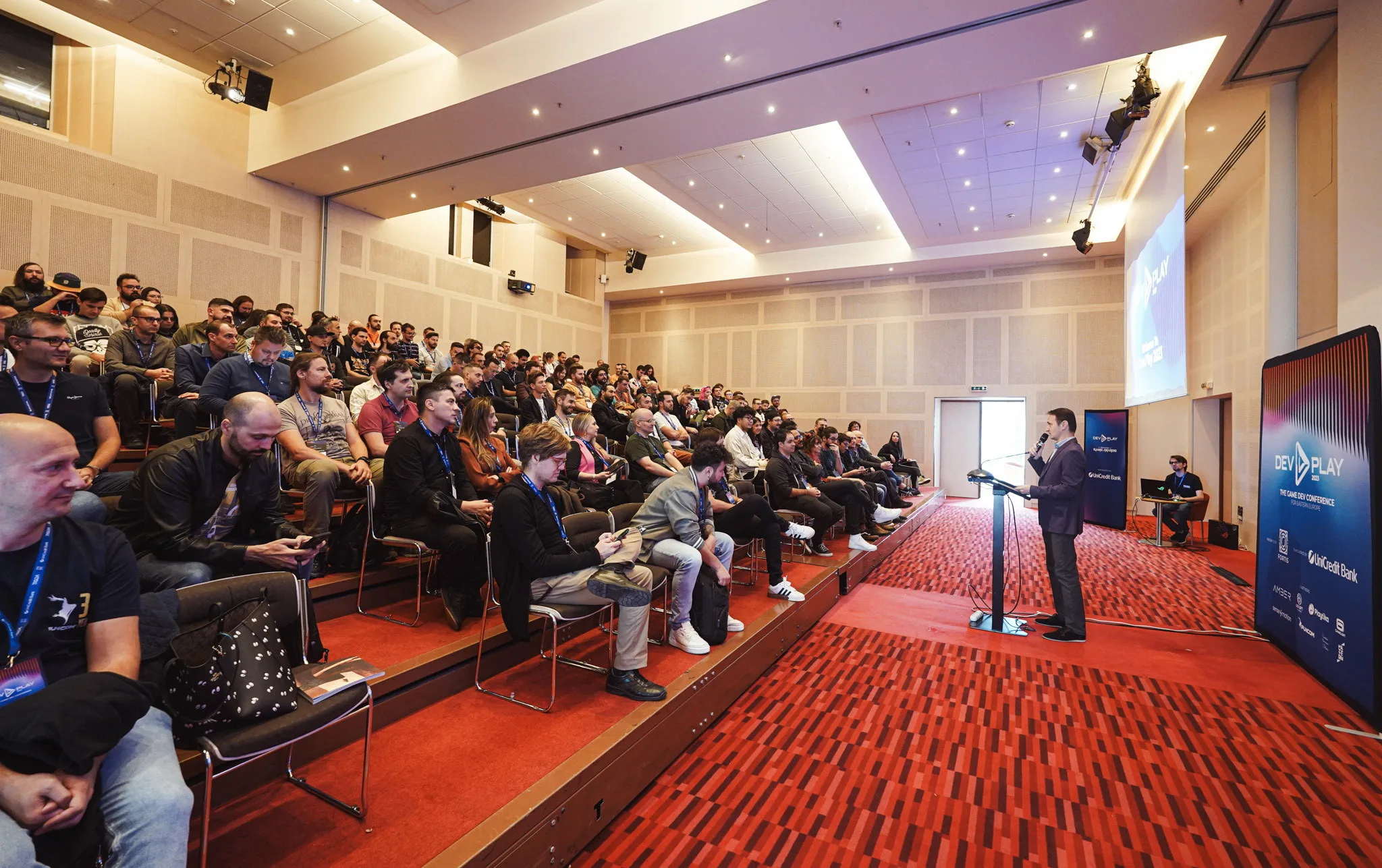
Leo would have come along too… but thanks to the Iași–Bucharest distance, he couldn't collect the laurels of his own negotiating triumph and sent me instead. Initially, Bogdan Menci was supposed to come with me; in the end it was Tudor-Codrin Enea who joined (author of the reviews for Sea of Stars and I Am Setsuna in the current issue). I reckon there were about 300 partici-
THE GAME DEV CONFERENCE
FOR EASTERN EUROPE
OCTOBER 9-10
pants, so the GRIND project was pretty well represented with a proud 0.6% – especially given that most of the people there didn't even know a Romanian games magazine is still being published these days.
On the whole, Dev.Play 2023 was a triumphant showing for Romanian gaming. An event that brought together reps from studios of every size, working across a wide spectrum of titles. From the contributions to FC 2024 and The Division 3 (still at an early stage of development) to Fap CEO, there are genuinely reasons to be proud and to praise the work done by 'our lot'. From Electronic Arts Romania through to Amber Studio and Playtika, Romanian programmers and designers are leaving their mark on games enjoyed the world over. What's more, gaming is starting to be taken seriously at academic level too: the Politehnica University of Bucharest and the National University of Theatre and Film Arts came to the conference to promote their study programmes aimed at the very same field which, over the last 30 years, has brought them millions of lei in resit fees paid by students who failed.
that we often overlook in how characters move – that's because we notice these details Day 01. Pessimism at the Novotel only when something isn't right.
The moment I stepped into the lobby of the Novotel on Calea Victoriei in Bucharest, I genuinely had no idea what to expect. The last time I went to an event with and about games, I was in my second year of secondary school, taking part in CERF 2007.
But since I'd been to some 15-20 Bitcoin conferences in the last 5 years, I felt more or less familiar with the atmosphere.
The big difference is that at Dev.Play I turned up as an outsider who knew nobody, with no close friendship with anyone at the stands to lean on so as to get in with everyone else.
So I sat there rather awkwardly through the 45 minutes of the “Welcome Coffee” and hunted for a spot in the conference hall to watch the presentations.
Ultimately, Dev.Play is organised first and foremost for people in the industry, most of whom already know each other. Next up, Cătălin Butnariu of the RGDA gave the opening speech that best captured the mood of the event's first day. There was talk of smaller budgets, fewer attendees than in previous years and a general downturn in the Romanian market. Later, Shawn Frost of Fortis was to take the stage to explain the situation the industry finds itself in: investor money is harder to come by, giants like Microsoft and Sony are buying up small studios and then folding them into their own machinery, the pandemic is over and people are spending less time at home looking for entertainment to keep their minds occupied, and creativity is suffering as a consequence of all those factors combined.
After a coffee break that the attendees spent socialising in the hallway, optimism seemed to be back. That's when I also ran into Sorin Mincă from Movie News, who wrote the System Shock article in this very magazine.
For a few moments I thought the GRIND editorial team might actually have 3 people out of 300 – so a 1% share.
But my bubble burst quickly when I realised I was in fact competing with Sorin to photograph the stands.
Back in the conference hall, I sat through a masterclass on physics and the way it has to accompany gameplay to leave an impression of naturalness and fluidity. George Comănescu of Ubisoft gave a technical but interesting presentation that highlighted elemen-
Next, Liliia Mandrino of EA spoke about innovation in design. The practical example she showed was the menu in FC 2024 and the way the options are made to be aesthetic and intuitive. Perhaps the details she described are interesting for design fans, but for me it was the longest and dullest part of the day. In my humble opinion, the information could have been delivered more concisely and on the back of more practical examples. But at least I can say I saw something of the new Fif… FC game.
From 4.30pm, Adam Kovac of 3Lateral took to the stage. By far his was the most spectacular presentation. I say that because he brought out the potential of the MetaHuman tool in Unreal Engine 5. The demo used a monologue delivered by a Serbian actor, filmed with motion capture technology.
Along the way, every step was shown by which an apparently run-of-the-mill video recording was turned into a genuinely cinematic visual experience. Everything, from brightness through to facial features, was tweaked to produce something worthy of a Hollywood blockbuster.
For anyone into Unreal Engine, I'm sure the presentation was an excellent tutorial. For me, though, it opened another window onto the future and helped me understand what I should expect from entertainment in the years to come.
After another 30-minute socialising break, which I used to explore the rest of the stands in the hallway, a panel of four industry people took place on stage, representing the studios Rocket Ride Games, Fortis, Mega Studio and Gameloft. The subject? Successful practices in times of crisis, for business development. In other words, an attempt to find solutions to the problems listed in the first part of the event…
but with the emphasis on the financial side and not necessarily on the creativity that underpins games.
What came next, however, managed to eclipse the whole of the previous discussion and replaced indie-studio pragmatism with exuberant optimism. Radu Ziemba, founder and CEO of Deadlime, told us about the success of Fap CEO: an “idle clicker” that challenges players to run their own videochat empire. You start with one employee, Day 02. Odeon I must admit, the move from the Novotel to the Odeon marked a significant shift in the event's atmosphere: the participating studios' stands gained an extra touch of style thanks to the backdrop, the echo of conversations in the hallway added a further aura of solemnity, the layout of the seats in the hall (with boxes and balconies) also shaped the attendees' attitude, and the central stage did its bit to raise the quality of the presentations too.
What's more, the pessimism of the first day vanished completely. In its place came a mix of enthusiasm and cordiality that lifted the event and made it far more memorable. My only regret is that I didn't dress for the Odeon – but looking around, I noticed most of the attendees were just as relaxed as I was.
The day began at 2pm, with a 30-minute reception that included water and coffee. My colleague Tudor-Codrin Enea and I turned up on site, after which we headed to the nearby KFC for lunch and to settle on the plan of attack for the rest of the day: we'll try to you buy them high-performance equipment and naughty outfits, and then you grow the business to the point where you can no longer even name all the models, but you know you want to recruit another exotic-looking girl.
Fap CEO shows it can be done: it's a successful game, popularised by a PewDiePie stream in 2018 and elevated to cult-hit status thanks to the many occasions on which Google banned advertising for the title and Steam removed the game from its online store outright. It's hard enough to get hold of, needing a bit of effort from internet users, but somehow popular enough to rack up astronomical earnings and to have been downloaded more than Game of Thrones (an apparently real statistic).
During Radu Ziemba's presentation, I felt simultaneously amused and intrigued by the fact that other studios, which invest far more in creativity and technology, will never rake in as much money as an Andrew Tate life simulator. But the moment everyone in the room was handed a bottle of wine labelled with the manga artwork from Fap CEO, all sins were forgiven.
As the saying goes: he profited from the desperation of 40-year-old virgins, but at least he gave us something too.
Next, the event moved to the Expirat club by Carol I Park.
Those of you who've been to gigs at Arenele Romane will surely have memories tied to this venue. And I, despite having two free drink tickets, didn't manage to make it to the party.
I saved my energy for the next day, when I was going to promote GRIND magazine a little more aggressively.
we'll ‘make ourselves noticed’ every chance we get, we'll tell everyone about GRIND and we'll target studio representatives in particular. Our mission to make ourselves known was about to begin.
But first of all, we watched the far more optimistic speech from RGDA president Cătălin Butnariu, followed by a 45-minute presentation from Sir Ian Livingstone. I found it fascinating to hear the story of a fantasy author who popularised the Dungeons & Dragons phenomenon in Britain in the second half of the 1970s, and then helped found Eidos (the company responsible for bringing beloved characters such as Lara Croft and Agent 47 to prominence). The love of games shown by a distinguished 73-year-old gentleman who began his career selling D&D sets out of the flat he rented with two friends is genuinely contagious. And when someone with five decades of experience in the games industry radiates optimism from every pore, it's hard to stay indifferent.
During the 30-minute break that followed, Tudor and I got chatting to two people from Ubisoft Romania.
Conveniently, they had sat down right in front of us, so it was very easy to step forward and introduce ourselves.
I'd mention their names and the projects they're working on, but I was warned that I can't make statements without permission from the studio's PR department. What I can tell you with great certainty, though, is that I later saw one of the programmers leafing through the demo we published for GRIND 3 magazine.
I hope we'll have him on the podcast as a guest in the near future, although I was told that any information about projects in development has to be approved before it can be revealed… and Tudor and I promised to keep it confidential.
Another 30-minute break followed, during which Tudor and I were even more motivated to make sure the GRIND project would be noted in future presentations.
We chatted to a nice lady at the Playtika stand, about whom I found out during the awards gala that she holds an important role in the company (she was the one who collected the award on the studio's behalf). She was curious to hear our opinions on the presentations in the hall, and Tudor and I were more than happy to give her a few answers, tell her about the magazine we're working on and take part in the company's raffle for a chance to win a Sup 400 in 1 handheld console.
Then we went outside and lay in wait for about five minutes to waylay Mihai Gheza, CEO and co-founder of the Machinations project. He was caught up in another conversation in English and I couldn't cut in. My luck was that, once I was back inside the theatre building, Mihai came towards me… and when I greeted him and went to introduce myself, he recognised me! Apparently he'd followed the NEXT LEVEL podcast around 2020 and already knew I existed. So it was relatively easy to fill him in on GRIND and promise to let him know when the magazine was ready.
The last presentation of the day was also the least interesting one for me. Maybe because I was too preoccupied thinking about ways to promote the magazine before the event closed. Or maybe for the simple reason that I'm no longer as interested in educational offers as I was ten years ago. Still, Anthony Christov, a friend from south of the Danube, made a commendable effort to promote ARC Academy and the learning opportunities it offers for working in the gaming industry (as well as other creative fields). Later, after consulting the school's alumni page, I came to appreciate the presentation a bit more – and I hope there were people in the audience who discovered something useful for their future careers.
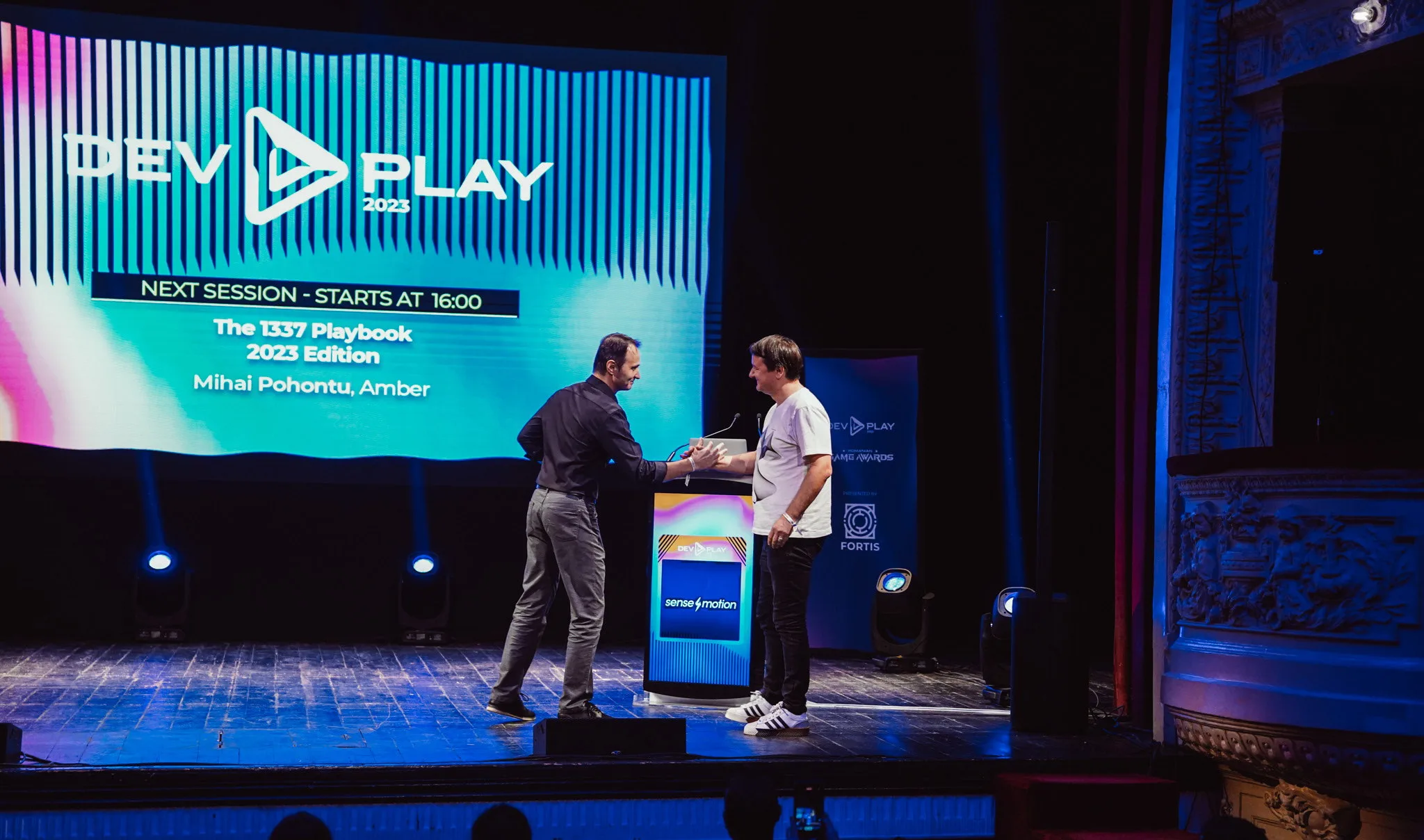
Mihai Pohonțu, general manager of the Amber studio, delivered a proper history lesson on the video games made in Romania. From the first “room-sized” computers designed in this country (CIFA-1 in 1957, MECIPT-1 in 1962 and DACCIC in 1963) and the first “microcomputers” (Felix C-256 in 1970 and Independent-100 in 1974) all the way to the first Romanian video game (“Felix-Șah”, released in 1976 for the Felix C-256 and first played in remote multiplayer seven years later), we have our modest reasons to be proud.
But Mihai Pohonțu's presentation didn't stop there: he also talked about the press (Game Over, LEVEL, NIVELUL2… and maybe next time he'll include GRIND), about the studios that have opened over the years (starting with Ubisoft Romania in 1991 and Gameloft in 1999, right through to JAMDAT/Electronic Arts in 2005 and Amber in 2013), and about Romania's leading position in the video games field (although we're 12th in the EU by GDP, we sit 6th by number of programmers in the gaming industry). I'm convinced that many of the attendees in the hall were familiar with the figures and saw the moment as a mere memory refresh – but for me it was something special, and it helped me understand better just how much interactive entertainment Romania contributes.
So I'll resort to a healthy dose of subjectivity to say that I was most impressed by Mihai Pohonțu's segment.
Between the last speech and the start of the Romanian Game Awards gala we had a two-hour break. So Tudor and I went off to dinner. Ionuț Biris from Habitmon Software, a developer of games meant to help children with ADHD symptoms, joined us as well.
The venue of choice was Bodega La Mahala in the Old Town, and the conversation, carried along by plates of mici and peasant potatoes, was mostly about the magazine. I also learned about Ionuț's attempts to make games in the VR/AR world, and we agreed the technology still hasn't gained the popularity it deserves. The equipment being too expensive for most consumers is probably to blame. The gala started at 9pm and greeted us with a pleasant surprise: a string quartet – three violins and a cello – performed music from games such as Super Mario Bros., The Legend of Zelda, Skyrim, Final Fantasy VII and Destiny 2. Afterwards, the awards ceremony unfolded in two sections that matter: the Dev.Play Awards and the Romanian Industry Awards. It should be said that this gala is something new for RGDA and the Romanian games industry, and the winners had the honour of taking part in writing history. If future editions are organised, they will inevitably be compared to the original – and the bar has been raised quite high. Last but not least, it should be noted that both categories had a jury that assessed each nomination:
Dev.Play Awards jury Vlad Zotta Commercial Director at Netzah Game Julia Kenny Game Design Consultant
NoThx Streamer (Bulgaria) Nestor Forjan Game Design Consultant
Bobospider Streamer (Romania) Dan Dimitrescu Co-founder and Game Designer at Killhouse Games Romanian Industry Awards jury Dan Teodorescu Game Director at Fortis Games Cristian Diaconescu Executive Creative Director at Sand Sailor Studio Matei Psatta Co-founder and CMO at Blindspot
George Lemnaru General Manager at Green House Studio Alexandru Palade Co-founder and General Manager at Rikodu Dragoș Stanca founder of UPGRADE 100, partner at ThinkDigital, president of BRAT
Alex Chica Technical Director at Electronic Arts Cătălin Butnariu President of RGDA
Dev.Play Awards Most Popular Game Best Design Best Graphics Survival: Fountain of Youth, Odinsoft My Little Universe, Estotty Daydream: Forgotten Sorrow, Frozen Line Biggest Innovation Best Game of the Event Greedventory, Black Tower Basement Greedventory, Black Tower Basement Romanian Industry Awards Best International Franchise Developed in Romania WSOP Team, Playtika Best Independent Studio of the Year Amber Best Marketing Campaign for a Romanian Game Bear with Breakfast, Gummy Cat Best Co-developed Project in Romania Dead Space Remake, Keywords Romania Best Game Development Education Programme in Romania UPB Graphics, Multimedia & Virtual Reality, Master Best Romanian Game of the Year Bear with Breakfast, Gummy Cat Honorary Awards for Supporters of the Romanian Gaming Industry Unicredit Bank, Bobospider (streamer), Andrei Istrate (RGDA founder) Overall, Dev.Play marked a triumph for the Romanian games industry. I'm glad I had the honour of attending the event and I want to thank the organisers at RGDA and Leo (who secured the invitations for GRIND). If reading this article has made you eager to support the efforts of our compatriots, then I invite you to try the award-winning games – and if you happen to like them, leave them positive comments on Steam (or any other digital store) and spread the word that we can do it too. VLAD COSTEA